Irish Paediatric Early Warning System (PEWS) Learning Outcomes By - - PowerPoint PPT Presentation
Irish Paediatric Early Warning System (PEWS) Learning Outcomes By the end of the session, you will be able to: Discuss the importance of clinical judgement and individualised assessment Discuss the use of PEWS in clinical practice
Learning Outcomes
By the end of the session, you will be able to:
- Discuss the importance of clinical judgement and
individualised assessment
- Discuss the use of PEWS in clinical practice
- Identify PEWS documentation
- Demonstrate effective use of PEWS charts
- Discuss the appropriate use of variance/modification
within PEWS
Aim of PEWS
Assist recognition and response to deterioration
Paediatric observation charts PEWS score
DCU Systematic Review
- Systematic review of
11 clinical guidelines & 70 research articles
- Grey literature
review & interviews
- Review of detection
& response systems, implementation & economic impact
DCU Systematic Review
“positive directional trends in improving clinical based
- utcomes”
“there is no consensus and limited evidence about which PEW system is most useful
- r ‘optimal’ for
paediatric contexts”
PEWS is...
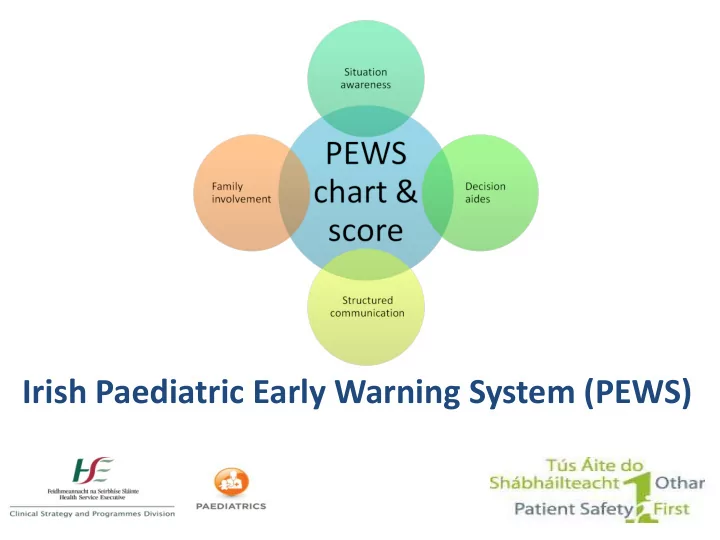
Team work & Communication Decision aides Situation Awareness/ Clinical Judgement Family Involvement PEWS chart & score
PEWS is not…
- PEWS does not replace:
– Emergency response – Clinical concern
Paediatric Observation Charts
Variance Total score Start date 6 Core parameters Decision aides Additional parameters
Aid to audit & handover Respiratory assessment tool
Triggers
Core parameters Score
1
Nurse or family concerns 0,1,
2
Respiratory Rate 0,1,2,3
3
Respiratory Effort 0,1,2,3
4
Oxygen therapy (L+ pressure) 0,1,2 + 0,1
5
Heart Rate 0,1,2,3
6
AVPU 0,1,3 Additional parameters Score
7
SpO2 0,1,2,3
8
Capillary refill time (central) 0,1
9
Blood Pressure (systolic) 0,1,2,3
10
Skin colour No score
11
Temperature No score
Using the PEWS chart
First time
- Addressograph x3
- Year
- Start date if present
- Planned frequency of observations
Using the PEWS chart
Every time
- Date, time of observations
- Nurse initials and NMBI PIN
As required
- Frequency of observations
- Event Record
Concern (clinical)
- What is concern?
- How should it be assessed?
- Dot if present, score 1
- Blank if not present, score 0
1
Airway + Breathing
- Respiratory Rate - RR
- Respiratory Effort – RE
- Oxygen Therapy – O2T
(mode, O2, pressures)
- Oxygen saturations – SpO2
Circulation
- Heart Rate – HR
- Central Capillary Refill Time – CRT
- Systolic Blood Pressure – BP
- Skin Colour (no score)
CCRT Mean BP = x
x x 4 1
Disability
- AVPU
0
Exposure
- Temperature (no score)
- Urine output (no score)
Urine output notifiable to medical team if : <1ml/kg/hr in <12 years or <0.5ml/kg/hr in >12 years of age
Recording the Observations
- Example column: ‘draw the dot, join the line’
- Baseline + trending essential in recognition
- Individual parameter score → total PEWS score
Consider
- Reassess within
Additional Information
- DNAR
- Blood/blood product transfusion
Escalation Guide
PEWS does not replace an emergency call
Score Minimum Observations Minimum Alert Minimum Response
1
4 hourly Nurse in charge Any trigger should prompt increase in observation frequency as clinically appropriate
2
2-4 hourly
3*
1 hourly Nurse in charge + 1st Doctor on call Nurse in charge review
4-5
30 minutes Urgent medical review
6
Continuous Nurse in charge + 1st Doctor on call + Senior Dr. +/- Consultant Urgent SENIOR medical review
≥7 URGENT PEWS CALL
Immediate local response team
*Pink score in any parameter merits review PEWS does not replace clinical concern
Urgent PEWS Call
- Response pathway to PEWS Score 7
Communication
Identify You Recipient of information Patient Situation “The situation is… “ Concerns, observations, PEWS score etc. Background “The background is…” (age, reason for admission, relevant medical/surgical history, relevant current treatment/interventions) Assessment “My assessment is…” Give relevant ABCDE assessment information What do you think the problem is? Recommendation “My recommendation is…” What do you need them to do? Recipient should provide any necessary clinical instruction.
Documentation
- Management plans following review:
– Impression – Plan for intervention – Plan for observations – Plan for review – Calling criteria
Variance
- Clinical judgement essential
- 3 levels
– Special situations – Parameter amendments (chronic conditions) – Medical escalation suspension (agreement) (acute illness)
Special Situations
Special situations
- Transient, simple cause for PEW increase
- Nurse-led decision not to escalate
- Must be documented
- Must have reassessment within a short timeframe
Special Situations
Example… Felix, age 6, admission post-tonsillectomy
- Observations 30mins following return to ward:
- Felix crying that he is in pain
- RR 34, HR 140, systolic BP 99
- Drug chart indicates paracetamol may be given
Total PEWS Score? Reasonable action?
Amended Parameters
- Senior medical decision
- Pre-existing conditions
- Not for acute presentation
- Amended range scores 0
- Outliers trigger pink 3
Amended parameter example
Parameter Amendment
for Chronic Conditions
Date/Time Clinical Parameters New Acceptable Range Next medical Review Doctor
Signature/Print name/MCRN
12.04.16 O2 saturations 75-90% 1/52 Dr ###
Medical Escalation Suspension/Agreement
- Conditional
- Senior medical decision
- Scoring due to current presentation/illness
- Wording: ‘escalation not required if’, ‘no escalation
provided’ ... state specific parameter ranges
- Score appropriately – continue trending and monitor
for changes
- Suspension of medical escalation only
- Caution in: cardiac conditions, newly admitted,
newly discharged from PICU/ICU, on-call, non- respiratory parameters…
Medical Escalation Suspension/Agreement
Medical Escalation Suspension (agreement)
Date / Time State impression and specific parameter ranges that are acceptable Next Medical Review
Doctor
Signature/Print name/MCRN
Start date: 22/8 Start time: 03.30
Imp: acute asthma – new admission Es Escala lation not not req required at at PEW EWS 5-6 6 pr provided: RR 25-45 RE Moderate (wheeze, I/C recession) SpO2 94% Aler lert for
- r cha
change in in con condit ition
2 hrs (05.30)
- r sooner if
any concerns Dr ### End date: 22/8 End time: 05.30 Start date: 22/8 Start time: 05.45
Imp: acute asthma – responding No
- es
escala lation req required at at PEW EWS 3-4 4 if if: RR 15-35 RE Mild No oxygen requirement SpO2 98%
8 hours (14.45)
- r sooner if
any concerns Dr ### End date: 22/8 End time: 14.45
PEWS single 3 or ≥4 → Urgent medical review PEWS Score 7 = Urgent PEWS pathway Escalate concern as appropriate
Chart Completion – scenario 1
10 week old, poor feeding RR 50 RE normal No supplemental oxygen HR170 Mottled skin Eye opening to mother’s voice, ‘flat’ Temp 39.5 ̊C
- What is the score so far?
- What needs to be done now?..............
Slide 1 of 2
Chart Completion – scenario 1
10 week old, poor feeding Additional information: SpO2 93% Central CRT 3 seconds BP 71/58 Slide 2 of 2
Chart Completion – scenario 2
8 year old with asthma RR 55 RE moderate Receiving O2 therapy of 2L/min (nasally) SpO2 96% HR 145 AVPU - agitated and uncooperative Escalation suspension in place 3 hours ago, valid 1 more hour: RR 25-40, RE mod, SpO2 >95
Chart Completion – scenario 3
13 year old with asthma RR 35 RE mild wheeze + recession no supplemental oxygen SpO2 98% HR 118 AVPU
Questions…
PEWS Key Points
- PEWS score is a tool, reliant on the
human user
- Escalate clinical concern
- Escalation Guide, not protocol
- Use clinical judgement
The next slide is for Train the Trainer only
PEWS Training Tips
- - Who are you training?
- - Create schedule
- - Venue/ environment
- - AV requirements
- - Pre-course organisation