IPG PHOTONICS CORPORATION (Exact name of registrant as specified in - - PDF document

ipg photonics corporation
SMART_READER_LITE
LIVE PREVIEW

IPG PHOTONICS CORPORATION (Exact name of registrant as specified in - - PDF document

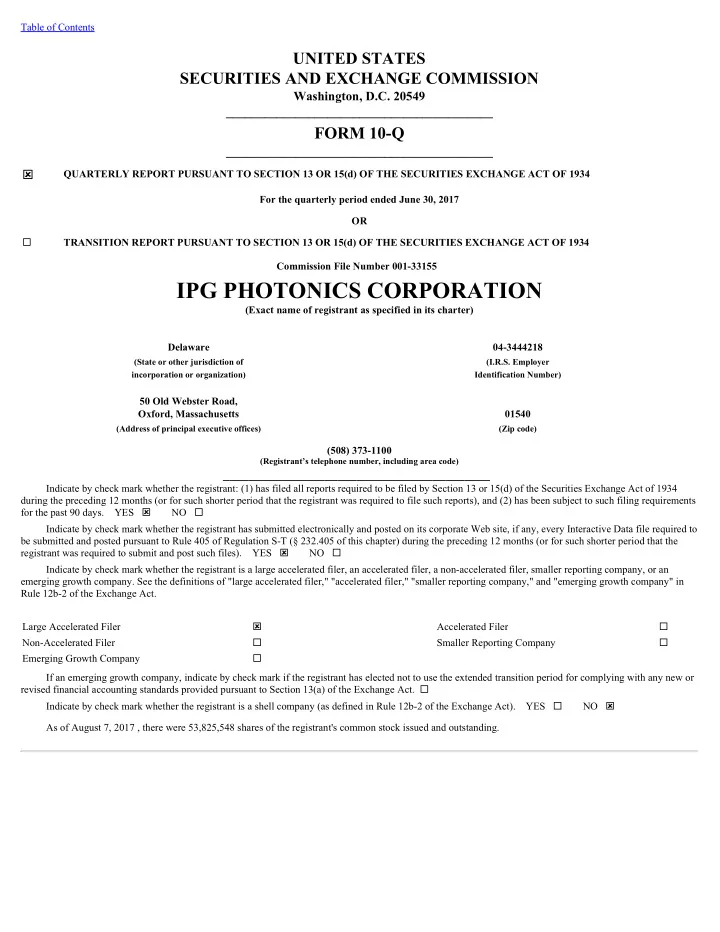
Table of Contents UNITED STATES SECURITIES AND EXCHANGE COMMISSION Washington, D.C. 20549 __________________________________________ FORM 10-Q __________________________________________ QUARTERLY REPORT PURSUANT TO SECTION 13 OR 15(d) OF


slide-1
SLIDE 1

Table of Contents

UNITED STATES SECURITIES AND EXCHANGE COMMISSION

Washington, D.C. 20549 __________________________________________

FORM 10-Q

__________________________________________ ý

QUARTERLY REPORT PURSUANT TO SECTION 13 OR 15(d) OF THE SECURITIES EXCHANGE ACT OF 1934 For the quarterly period ended June 30, 2017 OR ¨ TRANSITION REPORT PURSUANT TO SECTION 13 OR 15(d) OF THE SECURITIES EXCHANGE ACT OF 1934 Commission File Number 001-33155

IPG PHOTONICS CORPORATION

(Exact name of registrant as specified in its charter) Delaware 04-3444218

(State or other jurisdiction of (I.R.S. Employer incorporation or organization) Identification Number)

50 Old Webster Road, Oxford, Massachusetts 01540

(Address of principal executive offices) (Zip code)

(508) 373-1100

(Registrant’s telephone number, including area code)

__________________________________________

Indicate by check mark whether the registrant: (1) has filed all reports required to be filed by Section 13 or 15(d) of the Securities Exchange Act of 1934 during the preceding 12 months (or for such shorter period that the registrant was required to file such reports), and (2) has been subject to such filing requirements for the past 90 days. YES ý NO ¨ Indicate by check mark whether the registrant has submitted electronically and posted on its corporate Web site, if any, every Interactive Data file required to be submitted and posted pursuant to Rule 405 of Regulation S-T (§ 232.405 of this chapter) during the preceding 12 months (or for such shorter period that the registrant was required to submit and post such files). YES ý NO ¨ Indicate by check mark whether the registrant is a large accelerated filer, an accelerated filer, a non-accelerated filer, smaller reporting company, or an emerging growth company. See the definitions of "large accelerated filer," "accelerated filer," "smaller reporting company," and "emerging growth company" in Rule 12b-2 of the Exchange Act. Large Accelerated Filer ý Accelerated Filer ¨ Non-Accelerated Filer ¨ Smaller Reporting Company ¨ Emerging Growth Company ¨ If an emerging growth company, indicate by check mark if the registrant has elected not to use the extended transition period for complying with any new or revised financial accounting standards provided pursuant to Section 13(a) of the Exchange Act. ¨ Indicate by check mark whether the registrant is a shell company (as defined in Rule 12b-2 of the Exchange Act). YES ¨ NO ý As of August 7, 2017 , there were 53,825,548 shares of the registrant's common stock issued and outstanding.

slide-2
SLIDE 2

TABLE OF CONTENTS

Page

Part I. Financial Information 1 Item 1. Financial Statements 1 Consolidated Balance Sheets: June 30, 2017 and December 31, 2016 1 Consolidated Statements of Income: Three and Six Months Ended June 30, 2017 and 2016 2 Consolidated Statements of Comprehensive Income: Three and Six Months Ended June 30, 2017 and 2016 3 Consolidated Statements of Cash Flows: Six Months Ended June 30, 2017 and 2016 4 Consolidated Statements of Equity: Six Months Ended June 30, 2017 and 2016 5 Notes to Consolidated Financial Statements 6 Item 2. Management's Discussion and Analysis of Financial Condition and Results of Operations 14 Item 3. Quantitative and Qualitative Disclosures About Market Risk 24 Item 4. Controls and Procedures 26 Part II. Other Information 27 Item 1. Legal Proceedings 27 Item 1A. Risk Factors 27 Item 2. Unregistered Sales of Equity Securities and Use of Proceeds 27 Item 3. Defaults Upon Senior Securities 27 Item 4. Mine Safety Disclosures 27 Item 5. Other Information 27 Item 6. Exhibits 28 Signatures 29 EX-31.1 CERTIFICATION OF CEO PURSUANT TO RULE 13a-14(a) EX-31.2 CERTIFICATION OF CFO PURSUANT TO RULE 13a-14(a) EX-32 CERTIFICATION OF CEO AND CFO PURSUANT TO SECTION 1350 EX-101.INS XBRL INSTANCE DOCUMENT EX-101.SCH XBRL TAXONOMY EXTENSION SCHEMA EX-101.CAL XBRL TAXONOMY EXTENSION CALCULATION LINKBASE EX-101.LAB XBRL TAXONOMY EXTENSION LABEL LINKBASE EX-101.PRE XBRL TAXONOMY EXTENSION PRESENTATION LINKBASE EX-101.DEF XBRL TAXONOMY EXTENSION DEFINITION LINKBASE

slide-3
SLIDE 3

Table of Contents PART I-FINANCIAL INFORMATION ITEM 1. UNAUDITED INTERIM FINANCIAL STATEMENTS IPG PHOTONICS CORPORATION CONSOLIDATED BALANCE SHEETS

June 30, December 31, 2017 2016 (In thousands, except share and per share data)

ASSETS CURRENT ASSETS: Cash and cash equivalents $ 808,111 $ 623,855 Short-term investments 122,304 206,779 Accounts receivable, net 237,332 155,901 Inventories 260,661 239,010 Prepaid income taxes 37,912 34,128 Prepaid expenses and other current assets 44,454 41,289 Total current assets 1,510,774 1,300,962 DEFERRED INCOME TAXES, NET 47,843 42,442 GOODWILL 28,728 19,828 INTANGIBLE ASSETS, NET 32,294 28,789 PROPERTY, PLANT AND EQUIPMENT, NET 389,853 379,375 OTHER ASSETS 21,050 18,603 TOTAL $ 2,030,542 $ 1,789,999 LIABILITIES AND EQUITY CURRENT LIABILITIES: Current portion of long-term debt $ 1,188 $ 3,188 Accounts payable 28,996 28,048 Accrued expenses and other liabilities 116,499 102,485 Income taxes payable 10,102 24,554 Total current liabilities 156,785 158,275 DEFERRED INCOME TAXES AND OTHER LONG-TERM LIABILITIES 48,025 36,365 LONG-TERM DEBT, NET OF CURRENT PORTION 21,375 37,635 Total liabilities 226,185 232,275 COMMITMENTS AND CONTINGENCIES (NOTE 12) IPG PHOTONICS CORPORATION EQUITY: Common stock, $0.0001 par value, 175,000,000 shares authorized; 53,793,622 and 53,492,316 shares issued and

  • utstanding, respectively, at June 30, 2017; 53,354,579 and 53,251,805 shares issued and outstanding,

respectively, at December 31, 2016 5 5 Treasury stock, at cost (301,306 and 102,774 shares held) (33,058) (8,946) Additional paid-in capital 681,263 650,974 Retained earnings 1,275,314 1,094,108 Accumulated other comprehensive loss (119,167) (178,583) Total IPG Photonics Corporation equity 1,804,357 1,557,558 NONCONTROLLING INTERESTS — 166 Total equity 1,804,357 1,557,724 TOTAL $ 2,030,542 $ 1,789,999 See notes to consolidated financial statements. 1

slide-4
SLIDE 4

Table of Contents IPG PHOTONICS CORPORATION CONSOLIDATED STATEMENTS OF INCOME

Three Months Ended June 30, Six Months Ended June 30, 2017 2016 2017 2016 (in thousands, except per share data)

NET SALES $ 369,373

$

252,787

$

655,219 $ 460,035 COST OF SALES 163,077 115,084 291,656 207,921 GROSS PROFIT 206,296 137,703 363,563 252,114 OPERATING EXPENSES: Sales and marketing 12,136 9,689 22,963 17,723 Research and development 25,960 18,412 48,740 35,901 General and administrative 19,875 16,151 37,601 30,052 Loss (gain) on foreign exchange 7,183 (1,556) 11,636 3,411 Total operating expenses 65,154 42,696 120,940 87,087 OPERATING INCOME 141,142 95,007 242,623 165,027 OTHER INCOME (EXPENSE), Net: Interest income, net 468 270 776 462 Other income (expense), net 23 141 (506) 148 Total other income (expense) 491 411 270 610 INCOME BEFORE PROVISION FOR INCOME TAXES 141,633 95,418 242,893 165,637 PROVISION FOR INCOME TAXES (37,530) (28,387) (63,858) (49,277) NET INCOME 104,103 67,031 179,035 116,360 LESS: NET LOSS ATTRIBUTABLE TO NONCONTROLLING INTERESTS (13) (27) (26) (25) NET INCOME ATTRIBUTABLE TO IPG PHOTONICS CORPORATION $ 104,116

$

67,058

$

179,061 $ 116,385 NET INCOME ATTRIBUTABLE TO IPG PHOTONICS CORPORATION PER SHARE: Basic $ 1.95

$

1.26

$

3.35 $ 2.20 Diluted $ 1.91

$

1.25

$

3.29 $ 2.17 WEIGHTED AVERAGE SHARES OUTSTANDING: Basic 53,380 53,065 53,403 52,981 Diluted 54,471 53,788 54,450 53,705

See notes to consolidated financial statements. 2

slide-5
SLIDE 5

Table of Contents IPG PHOTONICS CORPORATION CONSOLIDATED STATEMENTS OF COMPREHENSIVE INCOME

Three Months Ended June 30, Six Months Ended June 30, 2017 2016 2017 2016 (In thousands)

Net income $ 104,103

$

67,031

$

179,035 $ 116,360 Other comprehensive income, net of tax: Translation adjustments 32,522 (3,615) 59,221 24,880 Unrealized (loss) gain on derivatives (30) 151 (46) 151 Loss on available-for-sale investments, net of tax reclassified to net income — — 298 — Total other comprehensive loss 32,492 (3,464) 59,473 25,031 Comprehensive income 136,595 63,567 238,508 141,391 Comprehensive loss attributable to noncontrolling interest (37) (19) (26) (13) Comprehensive income attributable to IPG Photonics Corporation $ 136,632

$

63,586

$

238,534 $ 141,404

See notes to consolidated financial statements. 3

slide-6
SLIDE 6

Table of Contents IPG PHOTONICS CORPORATION CONSOLIDATED STATEMENTS OF CASH FLOWS

Six Months Ended June 30, 2017 2016 (In thousands) CASH FLOWS FROM OPERATING ACTIVITIES: Net income $ 179,035

$

116,360 Adjustments to reconcile net income to net cash provided by operating activities: Depreciation and amortization 29,714 23,653 Deferred income taxes 4,533 (9,268) Stock-based compensation 11,059 10,436 Unrealized (gains) losses on foreign currency transactions 5,538 2,240 Other 688 294 Provisions for inventory, warranty & bad debt 22,754 20,459 Changes in assets and liabilities that (used) provided cash: Accounts receivable (73,634) 2,885 Inventories (25,820) (34,668) Prepaid expenses and other current assets (2,768) (652) Accounts payable 1,914 (8,441) Accrued expenses and other liabilities 2,102 (4,341) Income and other taxes payable (22,013) (10,653) Net cash provided by operating activities 133,102 108,304 CASH FLOWS FROM INVESTING ACTIVITIES: Purchases of and deposits on property, plant and equipment (43,632) (70,863) Proceeds from sales of property, plant and equipment 15,284 184 Purchases of short-term investments (71,244) (62,211) Proceeds from short-term investments 156,171 41,720 Acquisition of businesses, net of cash acquired (11,307) (46,527) Other (568) 72 Net cash provided by (used in) investing activities 44,704 (137,625) CASH FLOWS FROM FINANCING ACTIVITIES: Proceeds from line-of-credit facilities 6,761 4,002 Payments on line-of-credit facilities (6,761) (4,002) Purchase of noncontrolling interests (197) (950) Proceeds on long-term borrowings — 23,750 Principal payments on long-term borrowings (18,260) (1,000) Proceeds from issuance of common stock under employee stock option and purchase plans less payments for taxes related to net share settlement of equity awards 17,152 8,579 Purchase of treasury stock, at cost (24,112) — Net cash (used in) provided by financing activities (25,417) 30,379 EFFECT OF CHANGES IN EXCHANGE RATES ON CASH AND CASH EQUIVALENTS 31,867 3,696 NET INCREASE IN CASH AND CASH EQUIVALENTS 184,256 4,754 CASH AND CASH EQUIVALENTS — Beginning of period 623,855 582,532 CASH AND CASH EQUIVALENTS — End of period $ 808,111

$

587,286 SUPPLEMENTAL DISCLOSURES OF CASH FLOW INFORMATION: Cash paid for interest $ 975

$

349 Cash paid for income taxes $ 80,956

$

66,478 Non-cash transactions: Demonstration units transferred from inventory to other assets $ 1,845

$

1,746 Inventory transferred to machinery and equipment $ 1,531

$

1,129 (Reductions) additions to property, plant and equipment included in accounts payable $ (1,892) $ 806

See notes to consolidated financial statements. 4

slide-7
SLIDE 7

Table of Contents IPG PHOTONICS CORPORATION CONSOLIDATED STATEMENTS OF EQUITY

Six Months Ended June 30, 2017 2016 (In thousands, except share and per share data) Shares Amount Shares Amount

COMMON STOCK Balance, beginning of year 53,251,805

$

5 52,883,902 $ 5 Exercise of stock options 419,161 — 244,895 — Common stock issued under employee stock purchase plan 19,882 — 19,015 — Purchased common stock (198,532) — — — Balance, end of period 53,492,316 5 53,147,812 5 TREASURY STOCK Balance, beginning of year (102,774) (8,946) — — Purchased treasury stock (198,532) (24,112) — — Balance, end of period (301,306) (33,058) — — ADDITIONAL PAID-IN CAPITAL Balance, beginning of year 650,974 607,649 Stock-based compensation 11,059 10,436 Proceeds from issuance of common stock under employee stock option plan less payments for taxes related to net share settlement of equity awards 15,483 10,316 Proceeds from issuance of common stock issued under employee stock purchase plan 1,669 1,293 Effect of adopted accounting standards 2,078 — Balance, end of period 681,263 629,694 RETAINED EARNINGS Balance, beginning of year 1,094,108 833,356 Net income attributable to IPG Photonics Corporation 179,061 116,385 Effect of adopted accounting standards 2,145 — Balance, end of period 1,275,314 949,741 ACCUMULATED OTHER COMPREHENSIVE LOSS Balance, beginning of year (178,583) (181,482) Translation adjustments 59,164 24,880 Change in unrealized (loss) gain on derivatives, net of tax (46) 151 Unrealized loss on available-for-sale investments, net of tax (240) — Realized loss on available-for-sale investments, net of tax, reclassified to net income 538 — Balance, end of period (119,167) (156,451) TOTAL IPG PHOTONICS CORPORATION EQUITY

$

1,804,357

$

1,422,989 NONCONTROLLING INTERESTS ("NCI") Balance, beginning of year 166 1,137 Purchase of NCI (197) (950) Net loss attributable to NCI (26) (25) Other comprehensive income attributable to NCI 57 12 Balance, end of period — 174 TOTAL EQUITY

$

1,804,357

$

1,423,163

See notes to consolidated financial statements. 5

slide-8
SLIDE 8

Table of Contents IPG PHOTONICS CORPORATION NOTES TO CONSOLIDATED FINANCIAL STATEMENTS (In thousands, except share and per share data)

  • 1. BASIS OF PRESENTATION

The accompanying unaudited consolidated financial statements have been prepared by IPG Photonics Corporation, or "IPG", "its" or the "Company". Certain information and footnote disclosures normally included in financial statements prepared in accordance with accounting principles generally accepted in the United States of America have been condensed or omitted pursuant to the rules and regulations of the Securities and Exchange Commission ("SEC"). The consolidated financial statements include the Company's accounts and those of its subsidiaries. All intercompany balances have been eliminated in consolidation. These consolidated financial statements should be read in conjunction with the consolidated financial statements and notes thereto in the Company's Annual Report on Form 10-K for the year ended December 31, 2016 . In the opinion of the Company's management, the unaudited financial information for the interim periods presented reflects all adjustments necessary for a fair presentation of the Company's financial position, results of operations and cash flows. The results reported in these consolidated financial statements are not necessarily indicative of results that may be expected for the entire year. The Company has evaluated subsequent events through the time of filing this Quarterly Report on Form 10-Q with the SEC.

  • 2. RECENT ACCOUNTING PRONOUNCEMENTS

Adoption of New Accounting Pronouncement In January 2017, the FASB issued ASU No. 2017-01, "Business Combinations (Topic 805)" ("ASU 2017-01"). ASU 2017-01 revises the definition of a business with the objective of adding guidance to assist entities with evaluating whether transactions should be accounted for as acquisitions (or disposals) of assets

  • r businesses. ASU 2017-01 is effective for public companies for annual reporting periods beginning after December 15, 2017, and interim reporting periods

within such period. The amendments should be applied prospectively on or after the effective date. No disclosures are required at transition. Early application generally is allowed for transactions that have not been reported in financial statements which have been issued or made available for issuance. The Company has elected to early adopt this standard, and it did not have a material effect on its consolidated financial statements upon adoption. Recently Issued Accounting Pronouncements In May 2017, the FASB issued ASU No. 2017-09, "Scope of Modification Accounting" ("ASU 2017-09"). ASU 2017-09 amends ASC Topic 718 to better define what constitutes a modification of a share-based payment award by defining criteria that must be met for changes to a share-based payment award to not qualify as a modification. Changes to a share-based payment award must be accounted for as a modification under ASC Topic 718 unless all the newly defined criteria are met. ASU 2017-09 is effective for fiscal years beginning after December 15, 2017, which would be the Company's fiscal year ending December 31,

  • 2018. The Company is currently evaluating the potential impact that the standard will have on its consolidated financial statements upon adoption.

In February 2017, the FASB issued ASU No. 2017-05, "Other Income—Gains and Losses from the Derecognition of Nonfinancial Assets (Subtopic 610-20)" ("ASU 2017-05"). ASU 2017-05 was issued in conjunction with ASU No. 2014-09, "Revenue from Contracts with Customers" ("ASU 2014-09"), to clarify guidance for recognizing gains and losses from the transfer of nonfinancial assets in contracts with non-customers. The new guidance clarifies what constitutes an "in substance nonfinancial asset" and changes the accounting for partial sales of nonfinancial assets to be more consistent with the accounting for a sale of a

  • business. The amendments should be applied at the same time as those in ASU 2014-09 with interim and annual reporting periods beginning after December 15,

2017, which would be the Company's fiscal year ending December 31, 2018. The Company is currently evaluating the potential impact that the standard will have

  • n its consolidated financial statements upon adoption.

In January 2017, the FASB issued ASU No. 2017-04, "Intangibles—Goodwill and Other (Topic 350)" ("ASU 2017-04"). ASU 2017-04 simplifies the accounting for goodwill impairments by eliminating step 2 from the goodwill impairment test. ASU 2017-04 is effective for public companies for annual reporting periods beginning after December 15, 2020, and interim reporting periods within such period. The amendments should be applied prospectively on or after the effective date and require a disclosure as to the nature of and reason for the change in accounting principle upon transition. Early adoption is allowed for 6

slide-9
SLIDE 9

Table of Contents IPG PHOTONICS CORPORATION NOTES TO CONSOLIDATED FINANCIAL STATEMENTS - (Continued) (In thousands, except share and per share data) all entities as of January 1, 2017, for annual and any interim impairment tests occurring after January 1, 2017. The Company is currently evaluating the potential impact that the standard will have on its consolidated financial statements upon adoption. In October 2016, the FASB issued ASU No. 2016-16, "Income Taxes (Topic 740) - Intra-Entity Transfers of Assets other than Inventory" ("ASU 2016-16"). ASU 2016-16 eliminates the current exception that prohibits the recognition of current and deferred income tax consequences for intra-entity asset transfers (other than inventory) until the asset has been sold to an outside party. The amendments will be applied on a modified retrospective basis through a cumulative effect adjustment to retained earnings. Deferred tax assets should be assessed to determine if realizable. Disclosures will be required for the (i) reason for and notice of change, (ii) effect of change on income from continuing operations and (iii) cumulative effect of change on retained earnings. Public entities will apply these changes in annual reporting periods beginning after December 15, 2017, and interim reporting periods within such period. Early adoption is permitted. The Company is continuing to evaluate the standard but does not expect that it will have a material effect on its consolidated financial statements upon adoption. In February 2016, the FASB issued ASU No. 2016-02, "Leases (Topic 842)" ("ASU 2016-02"). ASU 2016-02 requires a lessee to recognize assets and liabilities on the balance sheet for leases with lease terms greater than twelve months. ASU 2016-02 is effective for fiscal years, and interim periods within those years, beginning after December 15, 2018, and early adoption is permitted. The Company is continuing to evaluate the standard but does not expect that it will have a material effect on its consolidated financial statements upon adoption. In January 2016, the FASB issued ASU No. 2016-01, "Financial Instruments - Overall (Subtopic 825-10): Recognition and Measurement of Financial Assets and Financial Liabilities" ("ASU 2016-01"). ASU 2016-01 addresses certain aspects of recognition, measurement, presentation, and disclosure of financial

  • instruments. ASU 2016-01 is effective for fiscal years, and interim periods within those years, beginning after December 15, 2017, and early adoption is not
  • permitted. The Company is currently evaluating the impact that the standard will have but does not expect it to have a material effect on its consolidated financial

statements upon adoption. In May 2014, the FASB issued ASU No. 2014-09, "Revenue from Contracts with Customers (Topic 606)" ("ASU 2014-09"). ASU 2014-09 supersedes the revenue recognition requirements in "Revenue Recognition (Topic 605)" and requires entities to recognize revenue when it transfers promised goods or services to customers in an amount that reflects the consideration to which the entity expects to be entitled to in exchange for those goods or services. In August 2015, the FASB issued ASU No. 2015-14 "Revenue from Contracts with Customers (Topic 606): Deferral of Effective Date," which defers the effective date of ASU 2014- 09 one year to interim and annual reporting periods beginning after December 15, 2017, which would be the Company's fiscal year ending December 31, 2018. In May 2016, the FASB also issued ASU 2016-12, "Revenue from Contracts with Customers (Topic 606): Narrow-Scope Improvements and Practical Expedients," to provide additional clarification of accounting for collections of sales taxes as well as recognition of revenue (i) associated with contract modifications, (ii) for noncash consideration, and (iii) based on the collectability of the consideration from the customer. The guidance also specifies when a contract should be considered "completed" for purposes of applying the transition guidance. The Company has completed an initial assessment of the new guidance and is in the process of completing documentation of this assessment. The Company does not expect the standard will have a material impact on the amount and timing of revenue recognized in the Company's consolidated financial statements. The Company has elected to use the modified retrospective application approach for transition to the new standard. 7

slide-10
SLIDE 10

Table of Contents IPG PHOTONICS CORPORATION NOTES TO CONSOLIDATED FINANCIAL STATEMENTS - (Continued) (In thousands, except share and per share data)

  • 3. INVENTORIES

Inventories consist of the following:

June 30, December 31, 2017 2016

Components and raw materials $ 116,399 $ 93,284 Work-in-process 26,755 44,723 Finished components and devices 117,507 101,003 Total $ 260,661 $ 239,010 The Company recorded inventory provisions totaling $5,435 and $5,772 for the three months ended June 30, 2017 and 2016 , respectively, and $9,406 and $9,725 for the six months ended June 30, 2017 and 2016 , respectively. These provisions relate to the recoverability of the value of inventories due to technological changes and excess quantities. These provisions are reported as a reduction to components and raw materials and finished components and devices.

  • 4. ACCRUED EXPENSES AND OTHER LIABILITIES

Accrued expenses and other liabilities consist of the following:

June 30, December 31, 2017 2016

Accrued compensation $ 43,352 $ 43,761 Customer deposits and deferred revenue 44,705 34,571 Current portion of accrued warranty 18,411 15,711 Other 10,031 8,442 Total $ 116,499 $ 102,485

  • 5. FINANCING ARRANGEMENTS

The Company's borrowings under existing financing arrangements consist of the following:

June 30, December 31, 2017 2016

Term debt: Long-term notes $ 22,563 $ 40,823 Less: current portion (1,188) (3,188) Total long-term debt $ 21,375 $ 37,635 At June 30, 2017 , the amount due on the Company's unsecured long-term note was $22,563 of which $1,188 is the current portion. The interest on this unsecured note is variable at 1.20% above the LIBOR rate and is fixed using an interest rate swap at 2.85% per annum. The unsecured note matures in May 2023, at which time the outstanding debt balance will be $15,438 . The long-term note secured by the Company's corporate aircraft was repaid in the second quarter of 2017 when the Company sold the aircraft. The Company also maintains U.S. and Euro lines-of-credit which are available to certain foreign subsidiaries and allow for borrowings in the local currencies of those subsidiaries. At June 30, 2017 and December 31, 2016 , there were no amounts drawn on the U.S. line-of-credit, and there were $109 and $2,828 , respectively, of guarantees issued against the facility which reduces the amount of the facility available to draw. At June 30, 2017 and December 31, 2016 , there were no amounts drawn on the Euro lines-of-credit, and there were $11,112 and $8,221 , respectively, of guarantees issued against those facilities which reduces the amount available to draw providing for total unused credit lines and overdraft facilities of $75,332 at June 30, 2017 . Subsequent to June 30, 2017, the Company entered into a new Euro credit facility, which replaced an expiring credit facility and increased the available line-

  • f-credit to Euro 50,000 from Euro 30,000 and closed on the purchase of a corporate aircraft for $28,000 that replaced the previous aircraft sold during the second

quarter of 2017. The Company financed the entire purchase with proceeds from borrowing on a new long-term note that is secured by the aircraft with a fixed interest rate of 2.75% that matures in July 2022, at which time the outstanding debt balance will be $15,375 .

  • 6. NET INCOME ATTRIBUTABLE TO IPG PHOTONICS CORPORATION PER SHARE

The following table sets forth the computation of diluted net income attributable to IPG Photonics Corporation per share:

Three Months Ended June 30, Six Months Ended June 30, 2017 2016 2017 2016

Net income attributable to IPG Photonics Corporation $ 104,116 $ 67,058 $ 179,061 $ 116,385 Weighted average shares 53,380 53,065 53,403 52,981

slide-11
SLIDE 11

Dilutive effect of common stock equivalents 1,091 723 1,047 724 Diluted weighted average common shares 54,471 53,788 54,450 53,705 Basic net income attributable to IPG Photonics Corporation per share $ 1.95 $ 1.26 $ 3.35 $ 2.20 Diluted net income attributable to IPG Photonics Corporation per share $ 1.91 $ 1.25 $ 3.29 $ 2.17 For the three months ended June 30, 2017 and 2016 , respectively, the computation of diluted weighted average common shares excludes of 45,900 and 59,000 common stock equivalents which include 6,400 and 11,000 restricted stock units ("RSUs") and 200 and 0 performance stock units ("PSUs"), respectively. For the six months ended June 30, 2017 and 2016 , it excludes 95,400 and 95,100 common stock equivalents which include 23,200 and 31,300 RSUs and 8,100 and 6,400 PSUs, respectively, because the effect of including them would be anti-dilutive. Under ASU 2016-09, "Compensation - Stock Compensation (Topic 718): Improvements to Employee Share-Based Payment Accounting" ("ASU 2016-09"), excess tax benefits and deficiencies as a result of stock option exercises and release of RSUs upon vesting are to be recognized as discrete items within income tax expense or benefit in the consolidated statements of comprehensive income in the reporting period in which they occur. The Company recognized excess tax benefits from stock award exercises and restricted stock unit vesting as a discrete tax benefit, which reduced the provision for income taxes for the three months ended June 30, 2017 by $3,394 and for the six months ended June 30, 2017 by $7,524 . The adoption of ASU 2016-09 also increased the calculation of fully diluted shares outstanding for the three months ended June 30, 2017 , by 238,917 shares and for six months ended June 30, 2017 , by 210,776 shares. On July 28, 2016, the Company announced that its Board of Directors authorized a share repurchase program (the “Program”) to mitigate the dilutive impact

  • f shares issued upon exercise or release under the Company's various employee and director equity compensation and employee stock purchase plans. Under the

Program, the Company's management is authorized to repurchase shares of common stock in an amount not to exceed the number of shares issued to employees and directors under its various employee and director equity compensation and employee stock purchase plans from January 1, 2016 through December 31, 2017. The Program limits aggregate share repurchases to no more than $100,000 over a period ending June 30, 2018. For the three months ended June 30, 2017 , the Company repurchased 90,832 shares of its common stock with an average price of $127.41 per share in the

  • pen market. Also, for the six months ended June 30, 2017 , the Company repurchased 198,532 shares of its common stock with an average price of $121.45 per

share in the open market. The impact on the reduction of weighted average shares for the three months ended June 30, 2017 was 59,256 shares and for the six months ended June 30, 2017 was 99,421 shares. As the Program was announced in July 2016, there were no repurchases made by the Company for the three months ended June 30, 2016 or six months ended June 30, 2016 .

  • 7. DERIVATIVE FINANCIAL INSTRUMENTS

Derivative instruments – The Company's primary market exposures are to interest rates and foreign exchange rates. The Company uses certain derivative financial instruments to help manage these exposures. The Company executes these instruments with financial institutions it judges to be credit-worthy. The Company does not hold or issue derivative financial instruments for trading or speculative purposes. The Company recognizes all derivative financial instruments as either assets or liabilities at fair value in the consolidated balance sheets. The Company has no derivatives that are not accounted for as a hedging instrument. 8

slide-12
SLIDE 12

Table of Contents IPG PHOTONICS CORPORATION NOTES TO CONSOLIDATED FINANCIAL STATEMENTS - (Continued) (In thousands, except share and per share data) Cash flow hedges – The Company entered into a cash flow hedge which is an interest rate swap associated with a long-term note issued during the second quarter of 2016 that will terminate with the long-term note in May 2023. The fair value amounts in the consolidated balance sheet related to the interest rate swap were:

Notional Amounts 1 Other Assets Other Long-Term Liabilities June 30, December 31, June 30, December 31, June 30, December 31, 2017 2016 2017 2016 2017 2016

$ 22,563 $ 23,156 $ 37 $ 77 $ — $ —

(1) Notional amounts represent the gross contract/notional amount of the derivatives outstanding.

The derivative gains and losses in the consolidated statements of income related to the Company's interest rate swap contracts were as follows:

Three Months Ended June 30, Six Months Ended June 30, 2017 2016 2017 2016

Effective portion recognized in other comprehensive income, pretax: Interest rate swap $ (13) $ 239 $ (40) $ 239 Effective portion reclassified from other comprehensive income to interest expense, pretax: Interest rate swap $ — $ — $ — $ — Ineffective portion recognized in income: Interest rate swap $ — $ — $ — $ —

  • 8. FAIR VALUE MEASUREMENTS

The Company's financial instruments consist of cash equivalents, short-term investments, accounts receivable, auction rate securities, accounts payable, drawings on revolving lines of credit, long-term debt, contingent purchase consideration and interest rate swaps. The valuation techniques used to measure fair value are based upon observable and unobservable inputs. Observable inputs reflect market data obtained from independent sources, while unobservable inputs reflect internal market assumptions. These two types of inputs create the following fair value hierarchy: Level 1, defined as observable inputs such as quoted prices for identical instruments in active markets; Level 2, defined as inputs other than quoted prices in active markets that are either directly or indirectly observable; and Level 3, defined as unobservable inputs for which little or no market data exists, therefore requiring an entity to develop its own assumptions. The carrying amounts of cash equivalents, short-term investments, accounts receivable, accounts payable and drawings on revolving lines of credit are considered reasonable estimates of their fair market value due to their short maturities. At June 30, 2017, the Company's long-term notes consisted entirely of a variable rate note, accordingly, the book value of the long-term note is considered a reasonable estimate of its fair market value. 9

slide-13
SLIDE 13

Table of Contents IPG PHOTONICS CORPORATION NOTES TO CONSOLIDATED FINANCIAL STATEMENTS - (Continued) (In thousands, except share and per share data) The following table presents information about the Company's assets and liabilities measured at fair value:

Fair Value Measurements at June 30, 2017 Total Level 1 Level 2 Level 3

Assets Cash equivalents $ 390,764 $ 390,764 $ — $ — Short-term investments 122,179 122,179 — — Interest rate swap 37 — 37 — Auction rate securities 1,148 — — 1,148 Total assets $ 514,128 $ 512,943 $ 37 $ 1,148 Liabilities Long-term notes $ 22,563 $ — $ 22,563 $ — Total liabilities $ 22,563 $ — $ 22,563 $ —

Fair Value Measurements at December 31, 2016 Total Level 1 Level 2 Level 3

Assets Cash equivalents $ 179,699 $ 179,699 $ — $ — Short-term investments 206,616 206,616 — — Interest rate swap 77 — 77 — Auction rate securities 1,144 — — 1,144 Total assets $ 387,536 $ 386,315 $ 77 $ 1,144 Liabilities Long-term notes $ 41,351 $ — $ 41,351 $ — Total liabilities $ 41,351 $ — $ 41,351 $ — Short-term investments consist of liquid investments including U.S. government and government agency notes, corporate notes, commercial paper and certificates of deposit with original maturities of greater than three months but less than one year and are recorded at amortized cost. The fair value of the short- term investments considered available-for-sale as of December 31, 2016 was $41,591 . This amount included an unrealized loss of $432 . There were no short-term investments considered available-for-sale as of June 30, 2017 . The fair value of the short-term investments considered held-to-maturity as of June 30, 2017 and December 31, 2016 was $122,179 and $165,025 , respectively, which represents an unrealized loss of $125 and $163 , respectively, as compared to the book value recorded on the Consolidated Balance Sheets for the same periods. The fair value of the auction rate securities considered prices observed in inactive secondary markets for the securities held by the Company. The fair value of accrued contingent purchase consideration incurred was determined using an income approach at the acquisition date and reporting date. That approach is based on significant inputs that are not observable in the market. Key assumptions include assessing the probability of meeting certain milestones required to earn the contingent purchase consideration. 10

slide-14
SLIDE 14

Table of Contents IPG PHOTONICS CORPORATION NOTES TO CONSOLIDATED FINANCIAL STATEMENTS - (Continued) (In thousands, except share and per share data) The following table presents information about the Company's movement in Level 3 assets and liabilities measured at fair value:

Three Months Ended June 30, Six Months Ended June 30, 2017 2016 2017 2016

Auction Rate Securities Balance, beginning of period $ 1,146 $ 1,138 $ 1,144 $ 1,136 Change in fair value and accretion 2 2 4 4 Balance, end of period $ 1,148 $ 1,140 $ 1,148 $ 1,140 Contingent Purchase Consideration Balance, beginning of period $ — $ 21 $ — $ 20 Period transactions — — — — Change in fair value and currency fluctuations — (1) — — Balance, end of period $ — $ 20 $ — $ 20

  • 9. GOODWILL AND INTANGIBLES

The following table sets forth the changes in the carrying amount of goodwill for the six months ended June 30, 2017 :

Amounts

Balance at January 1 $ 19,828 Total goodwill arising from acquisition 8,900 Balance at June 30 $ 28,728 Intangible assets, subject to amortization, consisted of the following:

June 30, 2017 December 31, 2016 Gross Carrying Amount Accumulated Amortization Net Carrying Amount Weighted- Average Lives Gross Carrying Amount Accumulated Amortization Net Carrying Amount Weighted- Average Lives

Patents $ 8,114 $ (5,103) $ 3,011 7 Years $ 8,114 $ (4,926) $ 3,188 7 Years Customer relationships 13,958 (4,360) 9,598 9 Years 12,727 (3,621) 9,106 9 Years Production know-how 6,743 (4,577) 2,166 8 Years 6,618 (4,093) 2,525 8 Years Technology, trademark and tradename 22,623 (5,104) 17,519 8 Years 17,910 (3,940) 13,970 8 Years $ 51,438 $ (19,144) $ 32,294 $ 45,369 $ (16,580) $ 28,789 During the second quarter of 2017, the Company acquired 100% of the shares of OptiGrate Corporation ("OptiGrate"). OptiGrate is located in Oviedo,

  • Florida. OptiGrate is a developer and manufacturer of volume Bragg gratings used in the production of lasers and laser diodes. The Company paid $16,870 to

acquire OptiGrate, which represents the fair value on that date. Of the purchase price, $1,849 was held back in escrow for potential post-closing adjustments related to working capital and indemnities provided by the sellers. As a result of the acquisition, the Company recorded intangible assets of $1,010 related to customer relationships and $4,650 of technology, trademark and tradename. Additionally, the Company recorded $8,900 of goodwill related to expected synergies from having in-house supply of these optical components. The goodwill arising from this acquisition will not be deductible for tax purposes. The purchase price allocations included in the Company's financial statements are estimates and are not complete. They are preliminary fair value estimates as of June 30, 2017 and may be subject to subsequent adjustment as the Company obtains additional information during the measurement period and finalizes its fair value estimates. Any subsequent adjustments to these fair value estimates occurring during the measurement period will result in an adjustment to goodwill or income, as applicable. Subsequent to June 30, 2017, the Company closed the previously announced acquisition of 100% of the shares of Innovative Laser Technologies, LLC ("ILT") for $40,181 in cash, subject to working capital adjustments. ILT is a Minneapolis, 11

slide-15
SLIDE 15

Table of Contents IPG PHOTONICS CORPORATION NOTES TO CONSOLIDATED FINANCIAL STATEMENTS - (Continued) (In thousands, except share and per share data) Minnesota based company which produces high precision laser-based systems for the medical device industry and other end user markets. Amortization expense for the three months ended June 30, 2017 and 2016 was $1,168 and $901 , respectively. Amortization expense for the six months ended June 30, 2017 and 2016 was $2,233 and $1,444 , respectively. The estimated future amortization expense for intangibles for the remainder of 2017 and subsequent years is as follows:

2017 2018 2019 2020 2021 Thereafter Total

$2,633 $5,201 $4,652 $4,141 $4,102 $11,565 $32,294

  • 10. PRODUCT WARRANTIES

The Company typically provides one to three -year parts and service warranties on lasers and amplifiers. Most of the Company's sales offices provide support to customers in their respective geographic areas. Warranty reserves have generally been sufficient to cover product warranty repair and replacement costs. The following table summarizes product warranty accrual activity recorded during the six months ended June 30, 2017 and 2016 .

2017 2016

Balance at January 1 $ 33,978 $ 28,210 Provision for warranty accrual 12,626 10,344 Warranty claims (7,476) (8,040) Foreign currency translation 1,687 442 Balance at June 30 $ 40,815 $ 30,956 Accrued warranty reported in the accompanying consolidated financial statements as of June 30, 2017 and December 31, 2016 consisted of $18,411 and $15,711 in accrued expenses and other liabilities and $22,404 and $18,267 in other long-term liabilities, respectively.

  • 11. INCOME TAXES

A reconciliation of the total amounts of unrecognized tax benefits is as follows:

2017 2016

Balance at January 1 $ 6,403 $ 7,579 Change in prior period positions (2,240) — Change for tax positions in current period — — Balance at June 30 $ 4,163 $ 7,579 Substantially all of the liability for uncertain tax benefits related to various federal, state and foreign income tax matters, would benefit the Company's effective tax rate, if recognized.

  • 12. COMMITMENTS AND CONTINGENCIES

From time to time, the Company may be involved in disputes and legal proceedings in the ordinary course of its business. These proceedings may include allegations of infringement of intellectual property, commercial disputes and employment

  • matters. As of June 30, 2017 and through the filing date of these Financial Statements, the Company has no legal proceedings ongoing that management estimates

could have a material effect on the Company's Consolidated Financial Statements.

  • 13. LONG-LIVED ASSETS

Long-lived assets, which consist primarily of property, plant and equipment, are reviewed by management for impairment whenever events or changes in circumstances indicate that the carrying amount may not be recoverable. In cases in which undiscounted expected future cash flows are less than the carrying value, an impairment loss is recorded equal to the amount by which the carrying value exceeds the fair value of assets. In the fourth quarter of 2016, the Company began assessing the possible sale of its corporate aircraft included within Property, Plant and Equipment, net in its Consolidated Balance Sheets. As a result of this assessment and certain market indications of the aircraft's value if sold, the Company prepared an updated 12

slide-16
SLIDE 16

Table of Contents IPG PHOTONICS CORPORATION NOTES TO CONSOLIDATED FINANCIAL STATEMENTS - (Continued) (In thousands, except share and per share data) impairment analysis of the carrying value of the aircraft as of March 31, 2017. The impairment analysis was probability weighted considering market data available, future cash flows and whether or not the Company would sell the aircraft. Based on that analysis the Company recorded a $162 impairment charge included in general and administrative expense in its Consolidated Statements of Income for the six months ended June 30, 2017 . There were no impairment losses recorded by the Company for the six months ended June 30, 2016 . The corporate aircraft was sold during the three months ended June 30, 2017 . 13

slide-17
SLIDE 17

Table of Contents ITEM 2. MANAGEMENT'S DISCUSSION AND ANALYSIS OF FINANCIAL CONDITION AND RESULTS OF OPERATIONS You should read the following discussion in conjunction with our consolidated financial statements and related notes included elsewhere in this Quarterly Report on Form 10-Q. This discussion contains forward looking statements that are based on management's current expectations, estimates and projections about

  • ur business and operations. Our actual results may differ materially from those currently anticipated and expressed in such forward-looking statements. See

"Cautionary Statement Regarding Forward-Looking Statements." Overview We develop and manufacture a broad line of high-performance fiber lasers, fiber amplifiers, diode lasers, laser systems and optical accessories that are used for diverse applications, primarily in materials processing. We sell our products globally to original equipment manufacturers ("OEMs"), system integrators and end users. We market our products internationally primarily through our direct sales force. We are vertically integrated such that we design and manufacture most of the key components used in our finished products, from semiconductor diodes to

  • ptical fiber preforms, finished fiber lasers and amplifiers. We also manufacture complementary products used with our lasers including optical delivery cables,

fiber couplers, beam switches, optical processing heads and chillers. In addition, we offer laser-based systems for certain markets and applications. Factors and Trends That Affect Our Operations and Financial Results In reading our financial statements, you should be aware of the following factors and trends that our management believes are important in understanding our financial performance. Net sales. We derive net sales primarily from the sale of fiber lasers and amplifiers. We also sell diode lasers, communications systems, laser systems and complementary products. We sell our products through our direct sales organization and our network of distributors and sales representatives, as well as system

  • integrators. We sell our products to OEMs that supply materials processing laser systems, communications systems, medical laser systems and other laser systems

for advanced applications to end users. We also sell our products to end users that build their own systems which incorporate our products or use our products as an energy or light source. Our scientists and engineers work closely with OEMs, systems integrators and end users to analyze their system requirements and match appropriate fiber laser or amplifier specifications. Our sales cycle varies substantially, ranging from a period of a few weeks to as long as one year or more, but is typically several months. Sales of our products generally are recognized upon shipment, provided that no obligations remain and collection of the receivable is reasonably assured. Our sales typically are made on a purchase order basis rather than through long-term purchase commitments. We develop our products to standard specifications and use a common set of components within our product architectures. Our major products are based upon a common technology platform. We continually enhance these and other products by improving their components and developing new components and new product designs. The average selling prices of our products generally decrease as the products mature. These decreases result from factors such as decreased manufacturing costs and increases in unit volumes, increased competition, the introduction of new products and market share considerations. In the past, we have lowered our selling prices in order to penetrate new markets and applications. Furthermore, we may negotiate discounted selling prices from time to time with certain customers that purchase multiple units. Gross margin . Our total gross margin in any period can be significantly affected by total net sales in any period, by product mix, that is, the percentage of

  • ur revenue in the period that is attributable to higher or lower-power products and the mix of sales between laser and amplifier sources and complete systems, by

sales mix between OEM customers who purchase devices from us in high unit volumes and other customers, by mix of sales in different geographies and by other factors, some of which are not under our control. Our product mix affects our margins because gross margin is generally higher in each product line for products with higher average output power. Certain specialty products also have higher gross margins. Also, the profit margins on systems can be lower than margins for our laser and amplifier sources, depending on the configuration, volume and availability of competitive products, among other factors. 14

slide-18
SLIDE 18

Table of Contents The mix of sales between OEM customers and other customers can affect gross margin because we provide sales price discounts on products based on the number of units ordered. As the number of OEM customers increase and the number of units ordered increases, the average sales price per unit will be reduced. We expect that the impact of reduced sales price per unit will be offset by the manufacturing efficiency provided by high unit volume orders, but the timing and extent

  • f achieving these efficiencies may not always match the mix of sales in any given time period or be realized at all.

We also regularly review our inventory for items that are slow-moving, have been rendered obsolete or determined to be excess. Any write-off of such slow- moving, obsolete or excess inventory affects our gross margins. For example, we recorded provisions for inventory totaling $5.4 million and $5.8 million for the three months ended June 30, 2017 and 2016 , respectively, and $22.8 million, $15.4 million and $11.3 million for the years ended December 31, 2016 , 2015 and 2014 , respectively. Sales and marketing expense. We expect to continue to expand our worldwide direct sales organization, build and expand applications centers, hire additional sales and marketing personnel at our existing and new geographic locations as well as to support sales of new product lines, increase the number of units for demonstration purposes and otherwise increase expenditures on sales and marketing activities in order to support the growth in our net sales. As such, we expect that our sales and marketing expenses will increase in the aggregate. Research and development expense. We plan to continue to invest in research and development to improve our existing components and products and develop new components, products, systems and applications technologies. The amount of research and development expense we incur may vary from period to

  • period. In general, if net sales continue to increase we expect research and development expense to increase in the aggregate.

General and administrative expense. We expect our general and administrative expenses to increase as we continue to invest in systems and resources in management, finance, legal, information technology, human resources and administration to support our worldwide operations. Legal expenses vary from quarter to quarter based primarily upon the level of litigation and transaction activities. Foreign Exchange. Because we are a U.S. based company doing business globally, we have both translational and transactional exposure to fluctuations in foreign currency exchange rates. Changes in the relative exchange rate between the U.S. dollar and the foreign currencies in which our subsidiaries operate directly affects our sales, costs and earnings. Differences in the relative exchange rates between where we sell our products and where we incur manufacturing and other

  • perating costs (primarily in the U.S., Germany and Russia) also affects our costs and earnings. Certain currencies experiencing significant exchange rate

fluctuations like the Euro, the Russian Ruble, the Japanese Yen and Chinese Yuan have had and could have an additional significant impact on our sales, costs and

  • earnings. Our ability to adjust the foreign currency selling prices of products in response to changes in exchange rates is limited and may not offset the impact of

the changes in exchange rates on the translated value of sales or costs. In addition, if we increase the selling price of our products in local currencies this could have a negative impact on the demand for our products. Major customers. While we have historically depended on a few customers for a large percentage of our annual net sales, the composition of this group can change from year to year. Net sales derived from our five largest customers as a percentage of our net sales was 27% for the six months ended June 30, 2017 and 22%, 25% and 23% for the full years 2016 , 2015 and 2014 , respectively. One of our customers accounted for 15% of our net sales for the six months ended June 30, 2017 . None of our customers accounted for more than 10% of our net sales for the six months ended June 30, 2016 . We seek to add new customers and to expand our relationships with existing customers. We anticipate that the composition of our significant customers will continue to change. If any of our significant customers substantially reduced their purchases from us, our results would be adversely affected. Results of Operations for the three months ended June 30, 2017 compared to the three months ended June 30, 2016 Net sales. Net sales increased by $116.6 million, or 46.1% , to $369.4 million for the three months ended June 30, 2017 from $252.8 million for the three months ended June 30, 2016 .

Three Months Ended June 30, 2017 2016 Change % of Total % of Total

Materials processing $ 353,065 95.6% $ 239,056 94.6% $ 114,009 47.7% Other applications 16,308 4.4% 13,731 5.4% 2,577 18.8% Total $ 369,373 100.0% $ 252,787 100.0% $ 116,586 46.1% 15

slide-19
SLIDE 19

Table of Contents Sales by Product

Three Months Ended June 30, 2017 2016 Change % of Total % of Total

High-Power Continuous Wave ("CW") Lasers $ 222,204 60.2% $ 141,406 55.9% $ 80,798 57.1% Medium-Power CW Lasers 29,988 8.1% 27,121 10.7% 2,867 10.6% Low-Power CW Lasers 3,285 0.9% 3,057 1.2% 228 7.5% Pulsed Lasers 41,106 11.1% 36,632 14.5% 4,474 12.2% Quasi-Continuous Wave ("QCW") Lasers 29,482 8.0% 16,225 6.5% 13,257 81.7% Other Revenue including Amplifiers, Laser Systems, Service, Parts, Accessories and Change in Deferred Revenue 43,308 11.7% 28,346 11.2% 14,962 52.8% Total $ 369,373 100.0% $ 252,787 100.0% $ 116,586 46.1% Materials processing Sales for materials processing applications increased due to higher sales of high-power lasers, medium-power lasers, pulsed lasers, QCW lasers and laser systems.

  • The increase in high-power laser sales related to growth in cutting and welding applications. High-power lasers continue to displace CO2 lasers. We

believe this transition has also benefited from an accelerated replacement cycle for older CO2 based cutting systems and from displacement of non- laser technologies which has resulted in higher demand for the fiber based cutting and welding systems sold by our OEM customers. Within the cutting applications, we continue to see a migration to lasers with higher output powers which improve processing speeds and enable processing of thicker

  • materials. The shift towards lasers with higher output powers has also benefited sales due to their higher average selling prices. The growth in high-

power welding sales relates primarily to automotive applications.

  • The increase in medium-power sales related to fine cutting, sintering and semiconductor wafer-inspection applications, partially offset by declines in

average selling prices due to increased competition.

  • Low-power laser sales increased slightly due to the increase in scientific and semiconductor applications, partially offset by a decrease in low-power laser

sales for medical applications.

  • Pulsed laser sales increased due to higher demand for marking and engraving applications. Within the pulsed laser category, increased sales of high-

power pulsed lasers and green pulsed lasers were partially offset by decreased sales of pulsed lasers with lower average power.

  • QCW laser sales increased due to the demand for welding and percussion hole drilling applications. The increase in demand for QCW in welding is

primarily related to consumer electronics.

  • Materials processing sales also increased as a result of higher laser systems and parts and service sales, which are included in Other Revenue in the

Sales by Product chart above. Other Applications Sales for other applications increased due to higher sales for telecom partially offset by lower sales for advanced applications. The increase in telecom sales was driven by sales from Menara Networks, Inc. ("Menara"), which we acquired in the second quarter of 2016, and an increase in amplifier sales used for last mile fiber access to the home applications. Sales of telecom products are included in Other Revenue in the Sales by Product chart above. Advanced application sales are typically uneven from quarter to quarter. Cost of sales and gross margin. Cost of sales increased by $48.0 million , or 41.7% , to $163.1 million for the three months ended June 30, 2017 from $115.1 million for the three months ended June 30, 2016 . Our gross margin increased to 55.9% for the three months ended June 30, 2017 from 54.5% for the three months ended June 30, 2016 . Gross margin increased due to a decrease in the cost of internally manufactured components, increased manufacturing efficiency and product mix which included increased sales of high-power, QCW and pulsed lasers with higher average powers. These increases in gross margin were partially offset by lower average selling prices. 16

slide-20
SLIDE 20

Table of Contents Sales and marketing expense. Sales and marketing expense increased by $2.5 million , or 25.3% , to $12.1 million for the three months ended June 30, 2017 from $9.7 million for the three months ended June 30, 2016 . This change was primarily a result of increases in personnel, commissions, travel and depreciation

  • expenses. As a percentage of sales, sales and marketing expense decreased to 3.3% for the three months ended June 30, 2017 from 3.8% for three months ended

June 30, 2016 . Research and development expense. Research and development expense increased by $7.5 million , or 41.0% , to $26.0 million for the three months ended June 30, 2017 , compared to $18.4 million for the three months ended June 30, 2016 . This change was primarily a result of increases in personnel, contractors and consultants expense as well as materials used for research and development projects and depreciation. Research and development continues to focus on developing new products, enhancing the performance of existing components, improving production processes and developing manufacturing of new components such as crystals and refining production processes to improve manufacturing yields and productivity. New products include lasers that operate at different wavelengths such as ultra-violet, visible and mid-infrared; lasers with ultra-fast pulses; laser-based systems for material processing, projection, display and medical; new telecom products including pluggable transceivers; and laser accessories such as welding and cutting heads. In addition to new products, research and development is focused on enhancing the performance of our existing products by improving their electrical efficiency and increasing their average power. As a percentage of sales, research and development expense decreased to 7.0% for the three months ended June 30, 2017 from 7.3% for the three months ended June 30, 2016 . General and administrative expense. General and administrative expense increased by $3.7 million , or 23.1% , to $19.9 million for the three months ended June 30, 2017 from $16.2 million for the three months ended June 30, 2016 . This change was primarily as a result of increases in personnel expense, stock-based compensation, travel, accounting, legal, information systems, recruitment, outside services, insurance and repairs and maintenance. As a percentage of sales, general and administrative expense decreased to 5.4% for the three months ended June 30, 2017 from 6.4% for the three months ended June 30, 2016 . Effect of exchange rates on net sales, gross profit and operating expenses. We estimate that, if exchange rates relative to the U.S. Dollar had been the same as one year ago, which were on average Euro 0.89 , Russian Ruble 66 , Japanese Yen 108 and Chinese Yuan 6.53 , respectively, we would have expected net sales to be $11.4 million higher, gross profit to be $7.9 million higher and total operating expenses would have been $0.5 million lower. Loss (gain) on foreign exchange. We incurred a foreign exchange loss of $7.2 million for the three months ended June 30, 2017 as compared to a $1.6 million gain for the three months ended June 30, 2016 . Foreign exchange losses for the three months ended June 30, 2017 were primarily attributable to the appreciation of the Euro as compared to the U.S. Dollar. Foreign exchange gains for the three months ended June 30, 2016 were primarily attributable to the appreciation of U.S. Dollar compared to the Euro and the appreciation of the Japanese Yen compared to the U.S. Dollar partially offset by the appreciation of the U.S. Dollar compared to the Russian Ruble and Chinese Yuan. Interest income, net. Interest income, net, increased to $0.5 million of income for the three months ended June 30, 2017 from $0.3 million for the three months ended June 30, 2016 as a result of higher interest yields. Other income (expense), net. Other income (expense), net, decreased slightly to $23 thousand of income for the three months ended June 30, 2017 from $0.1 million for the three months ended June 30, 2016 . Provision for income taxes. Provision for income taxes was $37.5 million for the three months ended June 30, 2017 compared to $28.4 million for the three months ended June 30, 2016 . The effective tax rates were 26.5% and 29.8% for the three months ended June 30, 2017 and 2016 , respectively. The decrease in the effective rate was primarily due to the release of reserves related to uncertain tax positions of $2.2 million following the completion of a tax audit and $3.4 million

  • f excess tax benefits related to exercise of stock options and release of restricted stock units which vested during the quarter. Effective as of the beginning of

2017, the accounting standard related to excess tax benefits and deficits changed, and these items are now recognized in the provision for income taxes whereas previously they were accounted for within additional paid-in capital.. Net income attributable to IPG Photonics Corporation. Net income attributable to IPG Photonics Corporation increased by $37.1 million to $104.1 million for the three months ended June 30, 2017 compared to $67.1 million for the three months ended June 30, 2016 . Net income attributable to IPG Photonics Corporation as a percentage of our net sales increased by 1.7 percentage points to 28.2% for the three months ended June 30, 2017 from 26.5% for the three months ended June 30, 2016 due to the factors described above. Results of Operations for the six months ended June 30, 2017 compared to the six months ended June 30, 2016 Net sales. Net sales increased by $195.2 million , or 42.4% , to $655.2 million for the six months ended June 30, 2017 from $460.0 million for the six months ended June 30, 2016 . 17

slide-21
SLIDE 21

Table of Contents

Six Months Ended June 30, 2017 2016 Change % of Total % of Total

Materials processing $ 617,196 94.2% $ 437,263 95.0% $ 179,933 41.1% Other applications 38,023 5.8% 22,772 5.0% 15,251 67.0% Total $ 655,219 100.0% $ 460,035 100.0% $ 195,184 42.4%

Six Months Ended June 30, 2017 2016 Change % of Total % of Total

High-Power CW Lasers $ 390,148 59.5% $ 259,626 56.4% $ 130,522 50.3% Medium-Power CW Lasers 49,729 7.6% 49,727 10.8% 2 —% Low-Power CW Lasers 6,680 1.0% 6,061 1.3% 619 10.2% Pulsed Lasers 73,561 11.2% 65,258 14.2% 8,303 12.7% QCW Lasers 50,850 7.8% 24,825 5.4% 26,025 104.8% Other Revenue including Amplifiers, Laser Systems, Service, Parts, Accessories and Change in Deferred Revenue 84,251 12.9% 54,538 11.9% 29,713 54.5% Total $ 655,219 100.0% $ 460,035 100.0% $ 195,184 42.4% Materials processing Sales for materials processing applications increased due to higher sales of high-power lasers, pulsed lasers, QCW lasers and laser systems.

  • The increase in high-power laser sales related to growth in cutting and welding applications partially offset by decreases in heat treating and annealing
  • applications. High-power lasers continue to displace CO2 lasers. We believe this transition has also benefited from an accelerated replacement cycle for
  • lder CO2 based cutting systems and from displacement of non-laser technologies which has resulted in higher demand for the fiber based cutting and

welding systems sold by our OEM customers. Within cutting applications, we continue to see a migration to lasers with higher output powers which improve processing speeds and enable processing of thicker materials. The shift towards lasers with higher output powers has also benefited sales due to their higher average selling prices. The growth in high power welding sales relates primarily to automotive applications.

  • Medium-power sales were essentially flat. Within the medium-power category, increases in sales for fine welding and semiconductor inspection

applications were offset by decreases in sales for fine cutting and laser sintering applications. Average selling prices for medium-power lasers also declined.

  • Low-power laser sales increased slightly due to the increase in scientific and semiconductor applications which was partially offset by a decrease in

low-power used in medical applications.

  • Pulsed laser sales increased due to higher increased sales for marking and engraving applications and cleaning and stripping applications. Within the

pulsed laser category, increased sales of high-power pulsed lasers and green pulsed lasers were partially offset by decreased sales of pulsed lasers with lower average power.

  • QCW laser sales increased due to the demand for welding and percussion hole drilling applications. Welding applications for QCW lasers are primarily

related to consumer electronics.

  • Materials processing sales also increased as a result of higher laser systems and parts and service sales, which are included in Other Revenue in the

Sales by Product chart above. Other Applications Sales for other applications increased due to higher sales for telecom and advanced applications. The increase in telecom sales was driven by sales from Menara and an increase in amplifier sales used for last mile fiber access to the home applications. Sales of telecom products are included in Other Revenue in the Sales by Product chart above. Advanced application sales are typically uneven from quarter to quarter. The increase in advanced applications sales was driven by 18

slide-22
SLIDE 22

Table of Contents increase in demand from defense, semiconductor and scientific applications. The increase in advanced application sales contributed to the increase in high-power laser sales and the increase in Other Revenue in the Sales by Product chart above. Cost of sales and gross margin. Cost of sales increased by $83.7 million , or 40.3% , to $291.7 million for the six months ended June 30, 2017 from $207.9 million for the six months ended June 30, 2016 . Our gross margin increased to 55.5% from 54.8% for the six months ended June 30, 2017 and 2016 , respectively. Gross margin increased due to decreases in the cost of internally manufactured components and increased manufacturing efficiency which were partially offset by decreases in average selling prices. Gross margin also benefited from product mix, including increased sales of high-power and pulsed lasers with higher output power. Sales and marketing expense. Sales and marketing expense increased by $5.2 million , or 29.6% , to $23.0 million for the six months ended June 30, 2017 from $17.7 million for the six months ended June 30, 2016 , primarily as a result of increased expenses for personnel, commissions, trade show and exhibitions, travel, premises and depreciation. As a percentage of sales, sales and marketing expense decreased to 3.5% for the six months ended June 30, 2017 from 3.9% for the six months ended June 30, 2016 . Research and development expense. Research and development expense increased by $12.8 million , or 35.8% , to $48.7 million for the six months ended June 30, 2017 , compared to $35.9 million for the six months ended June 30, 2016 , primarily as a result of an increase in expenses related to personnel, stock- based compensation, contractors, consultants, materials used for research and development projects and depreciation. Research and development continues to focus

  • n developing new products, enhancing performance of existing components, improving production processes and developing manufacturing of new components

such as crystals and refining production processes to improve manufacturing yields and productivity. New products include lasers that operate at different wavelengths such as ultra-violet, visible and mid-infrared; lasers with ultra-fast pulses; laser-based systems for material processing, projection, display and medical; new telecom products including pluggable transceivers; and laser accessories such as welding and cutting heads. In addition to new products research and development is focused on enhancing the performance of our existing products by improving their electrical efficiency and increasing their average power. As a percentage of sales, research and development expense decreased to 7.4% for the six months ended June 30, 2017 from 7.8% for the six months ended June 30, 2016 . General and administrative expense. General and administrative expense increased by $7.5 million , or 25.1% , to $37.6 million for the six months ended June 30, 2017 from $30.1 million for the six months ended June 30, 2016 , primarily as a result of increased expenses for personnel, stock-based compensation, fees and subscriptions, information technology, insurance, travel, accounting, legal, and increased bad debt provisions. As a percentage of sales, general and administrative expense decreased to 5.7% for the six months ended June 30, 2017 from 6.5% for the six months ended June 30, 2016 . Effect of exchange rates on net sales, gross profit and operating expenses. We estimate that, if exchange rates relative to the U.S. Dollar had been the same as one year ago, which were on average Euro 0.90 , Russian Ruble 70 , Japanese Yen 112 and Chinese Yuan 6.54 , respectively, we would have expected net sales for the six months ended June 30, 2017 to be $21.0 million higher, gross profit to be $15.0 million higher and total operating expenses would have been $1.4 million lower. Loss (gain) on foreign exchange. We incurred a foreign exchange loss of $11.6 million for the six months ended June 30, 2017 as compared to $3.4 million for the six months ended June 30, 2016 . The loss for the six months ended June 30, 2017 was primarily attributable to appreciation of the Euro as compared to the U.S. Dollar. The loss for the six months ended June 30, 2016 was primarily attributable to the appreciation of the Euro compared to the U.S. Dollar partially offset by the appreciation of the U.S. Dollar compared to the Russian Ruble and Chinese Yuan. Interest income, net. Interest income, net, increased to $0.8 million of income for the six months ended June 30, 2017 from $0.5 million for the six months ended June 30, 2016 as a result of higher interest yields on investments. Other income (expense), net. Other income (expense), net decreased to $0.5 million of expense for the six months ended June 30, 2017 compared to approximately $0.1 million of income for the six months ended June 30, 2016 as a result of the loss incurred upon sale of available-for-sale-securities being partially offset by net rental income from a building in the United States purchased in the second quarter of 2016 that is partially leased to third parties. Provision for income taxes. Provision for income taxes was $63.9 million for the six months ended June 30, 2017 compared to $49.3 million for the six months ended June 30, 2016 , representing an effective tax rate of 26.3% and 29.7% for the six months ended June 30, 2017 and 2016 , respectively. The decrease in the effective rate was primarily due to the release of reserves related to uncertain tax positions of $2.2 million following the completion of a tax audit and $7.5 million of excess tax benefits related to exercise of stock options and release of restricted stock units which vested during the period. Effective as of the beginning

  • f 2017, the accounting standard related to excess tax benefits and deficits changed, and these items are now recognized in the provision for income taxes whereas

previously they were accounted for within additional paid-in capital. The 19

slide-23
SLIDE 23

Table of Contents tax effects of the accounting for share-based compensation will increase or decrease our effective rate based upon the difference between our share-based compensation expense and the benefits taken on our tax return which depends on the share price at the time of employee award vesting. Additionally, we recognize excess tax benefits on a discrete basis and we anticipate that our effective rate will vary from quarter to quarter depending on our share price in each period. If our share price remains constant to the June 30, 2017 price, we anticipate that our effective rate will increase in the remaining quarters throughout the year and our full year rate will be higher than the rate in the first half of 2017. Net income attributable to IPG Photonics Corporation. Net income attributable to IPG Photonics Corporation increased by $62.7 million to $179.1 million ,

  • r 53.9% for the six months ended June 30, 2017 compared to $116.4 million for the six months ended June 30, 2016 . Net income attributable to IPG Photonics

Corporation as a percentage of our net sales increased by 2.0 percentage points to 27.3% for the six months ended June 30, 2017 from 25.3% for the six months ended June 30, 2016 due to the factors described above. Liquidity and Capital Resources Our principal sources of liquidity as of June 30, 2017 consisted of cash and cash equivalents of $808.1 million, short-term investments of $122.3 million , unused credit lines and overdraft facilities of $75.3 million and other working capital (excluding cash and cash equivalents and short-term investments) of $423.6

  • million. This compares to cash and cash equivalents of $623.9 million, short-term investments of $206.8 million , unused credit lines and overdraft facilities of

$71.5 million and other working capital (excluding cash and cash equivalents and short-term investments) of $312.1 million as of December 31, 2016 . The increase in cash and cash equivalents of $184.3 million relates primarily to cash provided by operating activities in the six months ended June 30, 2017 of $133.1 million and cash provided by investing activities of $44.7 million . The increase was partially offset by cash used in financing activities of $25.4 million . In addition, the effect of exchange rates increased cash and cash equivalents by $31.9 million . Short-term investments consist of liquid investments including U.S. government and government agency notes, corporate notes, commercial paper and certificates of deposit with original maturities of greater than three months but less than one year. Our long-term debt consists of one unsecured note with an outstanding balance at June 30, 2017 of $22.6 million of which $1.2 million is the current portion. The interest on this unsecured note is variable at 1.20% above LIBOR and is fixed using an interest rate swap at 2.85% per annum. The unsecured note matures in May 2023, at which time the outstanding debt balance will be $15.4 million. The long-term note secured by our corporate aircraft was paid off during the second quarter in connection with the sale of the aircraft. Subsequent to June 30, 2017, we closed on our purchase of a new corporate aircraft for $28.0 million. We financed the entire purchase with proceeds from a new long-term note that is secured by the aircraft with a fixed interest rate of 2.75% that matures in July 2022, at which time the outstanding debt balance will be $15.4 million. We believe that our existing cash and cash equivalents, short-term investments, our cash flows from operations and our existing lines of credit provide us with the financial flexibility to meet our liquidity and capital needs, as well as to complete certain acquisitions of businesses and technologies. We intend to continue to pursue acquisition opportunities based upon market conditions and the strategic importance and valuation of the target company. We may consider issuing debt to finance acquisitions depending on the timing and size of the acquisition. Our future long-term capital requirements will depend on many factors including our level of sales, the impact of the economic environment on our sales growth, the timing and extent of spending to support development efforts, the expansion of the global sales and marketing activities, government regulation including trade sanctions, the timing and introductions of new products, the need to ensure access to adequate manufacturing capacity and the continuing market acceptance of our products. 20

slide-24
SLIDE 24

Table of Contents The following table details our line-of-credit facilities as of June 30, 2017 :

Description Total Facility Interest Rate Maturity Security

U.S. Revolving Line of Credit (1) Up to $50.0 million LIBOR plus 0.80% to 1.20%, depending on our performance April 2020 Unsecured Euro Credit Facility (Germany) (2) Euro 30.0 million ($34.3 million) Euribor plus 1.00% or EONIA 1.25% July 2017 Unsecured, guaranteed by parent company and German subsidiary Euro Overdraft Facilities (3) Euro 2.0 million ($2.3 million) 1.0%-6.5% October 2017

Common pool of assets

  • f Italian subsidiary

(1) This facility is available to certain foreign subsidiaries in their respective local currencies. At June 30, 2017 , there were no drawings on this facility, however, there were $0.1 million of guarantees issued against the facility which reduces the amount of the facility available to draw. (2) This facility is also available to certain foreign subsidiaries in their respective local currencies. At June 30, 2017 , there were no drawings on this facility, however, there were $11.1 million of guarantees issued against the facility which reduces the amount of the facility available to draw. Subsequent to June 30, 2017, we entered into a new Euro credit facility, which replaced this facility and increased the available line-of-credit to Euro 50 million from Euro 30 million. (3) At June 30, 2017 , there were no drawings on these facilities. Our largest committed credit lines are with Bank of America N.A. and Deutsche Bank AG in the amounts of $50.0 million and $34.3 million (or 30 million Euro as described above), respectively, and neither of them is syndicated. We are required to meet certain financial covenants associated with our U.S. revolving line of credit and long-term debt facility. These covenants, tested quarterly, include a debt service coverage ratio and a funded debt to earnings before interest, taxes, depreciation and amortization ("EBITDA") ratio. The debt service coverage covenant requires that we maintain a trailing twelve month ratio of cash flow to debt service that is at least 1.5:1. Debt service is defined as required principal and interest payments during the period. Debt service in the calculation is decreased by our cash held in the U.S.A. in excess of $50 million up to a maximum of $250 million. Cash flow is defined as EBITDA less unfunded capital expenditures. The funded debt to EBITDA covenant requires that the sum of all indebtedness for borrowed money on a consolidated basis be less than three times our trailing twelve months EBITDA. We were in compliance with all such financial covenants as of and for the three months ended June 30, 2017 . Operating activities. Net cash provided by operating activities increased by $24.8 million to $133.1 million for the six months ended June 30, 2017 from $108.3 million for the six months ended June 30, 2016 . As the business and net income has grown, cash provided by net income after adding back non-cash charges has increased. For the six months ended June 30, 2017 , this increase was partially offset by continued growth in working capital to support the growth of the business. Our largest working capital items are inventory and accounts receivable. Items such as accounts payable to third parties, prepaid expenses and other current assets and accrued expenses and other liabilities are not as significant as our working capital investment in accounts receivable and inventory because of the amount of value added within IPG due to our vertically integrated structure. Accruals and payables for personnel costs including bonuses and income and other taxes payable are largely dependent on the timing of payments for those items. The increase in cash flow from operating activities for the six months ended June 30, 2017 primarily resulted from:

  • An increase of $89.1 million in cash provided by net income after adding back non-cash charges to $253.3 million for the six months ended June 30,

2017 as compared to $164.2 million for the same period in 2016 ;

  • A decrease in the cash used for inventory. Cash used for inventory was $25.8 million for the six months ended June 30, 2017 as compared to $34.7

million for the same period in 2016 ; partially offset by

  • An increase in cash used by accounts receivable of $73.6 million for the six months ended June 30, 2017 as compared to a decrease of $2.9 million for

the same period in 2016 due to an increase in sales and the timing of sales in the quarter; and 21

slide-25
SLIDE 25

Table of Contents

  • An increase in cash used for income taxes. Cash used for income and other taxes payable was $22.0 million for the six months ended June 30, 2017 as

compared to cash used for income and other taxes payable of $10.7 million for the same period in 2016 . Given our vertical integration, rigorous and time-consuming testing procedures for both internally manufactured and externally purchased components and the lead time required to manufacture components used in our finished products, the rate at which we turn inventory has historically been comparatively low when compared to our cost of sales. Also, our historic growth rates required investment in inventories to support future sales and enable us to quote short delivery times to our customers, providing what we believe is a competitive advantage. Furthermore, if there was a disruption to the manufacturing capacity of any of our key technologies, our inventories of components should enable us to continue to build finished products for a period of time. We believe that we will continue to maintain a relatively high level of inventory compared to our cost of sales. As a result, we expect to have a significant amount of working capital invested in

  • inventory. A reduction in our level of net sales or the rate of growth of our net sales from their current levels would mean that the rate at which we are able to

convert our inventory into cash would decrease. Investing activities. Net cash provided by investing activities was $44.7 million for the six months ended June 30, 2017 as compared to cash used in investing activities of $137.6 million in 2016 . The cash provided by investing activities in 2017 related to $84.9 million of net proceeds from sales of short-term investments and $15.3 million of proceeds from sales of property, plant and equipment, which primarily relates to our corporate aircraft, partially offset by $43.6 million of capital expenditures and $11.3 million , net of cash acquired for the acquisition of OptiGrate. The cash used in investing activities in 2016 related to $70.9 million of capital expenditures, $46.5 million for the acquisition of Menara and $20.5 million of net purchases of short-term investments. We expect to incur between $90 million and $100 million in net capital expenditures, excluding acquisitions. Capital expenditures include investments in facilities and equipment to add capacity worldwide to support anticipated revenue growth and the incremental cost to upgrade of our corporate aircraft. The timing and extent of any capital expenditures in and between periods can have a significant effect on our cash flow. If we obtain financing for certain projects, our cash expenditures would be reduced in the year of expenditure. Many of the capital expenditure projects that we undertake have long lead times and are difficult to cancel or defer to a later period. Financing activities. Net cash used in financing activities was $25.4 million for the six months ended June 30, 2017 as compared to net cash provided by financing activities of $30.4 million in 2016 . The cash used in financing activities in 2017 was primarily related to the purchase of treasury stock of $24.1 million and $18.3 million payments on our long-term borrowings, the majority of which related to repayment of the long-term note secured by our corporate aircraft. These uses of cash were partially offset by proceeds from the exercise of stock options and shares issued under our employee stock purchase plan net of amounts disbursed in relation to shares withheld to cover employee income taxes due upon the vesting and release of restricted stock units. The cash provided by financing activities in 2016 was primarily related to the cash provided by debt issued to finance the purchase of a building, the exercise of stock options, issuances under employee stock purchase plan and shares withheld to cover employee restricted stock taxes partially offset by the payments on our long-term borrowings and net payments of line-of-credit facilities. Cautionary Statement Regarding Forward-Looking Statements This Quarterly Report on Form 10-Q contains certain forward-looking statements within the meaning of Section 27A of the Securities Act of 1933 and Section 21E of the Securities Exchange Act of 1934, and we intend that such forward-looking statements be subject to the safe harbors created thereby. For this purpose, any statements contained in this Quarterly Report on Form 10-Q except for historical information are forward-looking statements. Without limiting the generality of the foregoing, words such as "may," "will," "expect," "believe," "anticipate," "intend," "could," "estimate," or "continue" or the negative or other variations thereof or comparable terminology are intended to identify forward-looking statements. In addition, any statements that refer to projections of our future financial performance, trends in our businesses, or other characterizations of future events or circumstances are forward-looking statements. The forward-looking statements included herein are based on current expectations of our management based on available information and involve a number

  • f risks and uncertainties, all of which are difficult or impossible to accurately predict and many of which are beyond our control. As such, our actual results may

differ significantly from those expressed in any forward-looking statements. Factors that may cause or contribute to such differences include, but are not limited to, those discussed in more detail in Item 1, "Business" and Item 1A, "Risk Factors" of Part I of our Annual Report on Form 10-K for the year ended December 31, 2016 . Readers should carefully review these risks, as well as the additional risks described in other documents we file from time to time with the Securities and Exchange Commission. In light of the significant risks and uncertainties inherent in the forward-looking information included herein, the inclusion of such information should not be regarded as a 22

slide-26
SLIDE 26

Table of Contents representation by us or any other person that such results will be achieved, and readers are cautioned not to rely on such forward-looking information. We undertake no obligation to revise the forward-looking statements contained herein to reflect events or circumstances after the date hereof or to reflect the

  • ccurrence of unanticipated events.

Recent Accounting Pronouncements Adoption of New Accounting Pronouncement In January 2017, the FASB issued ASU No. 2017-01, "Business Combinations (Topic 805)" ("ASU 2017-01"). ASU 2017-01 revises the definition of a business with the objective of adding guidance to assist entities with evaluating whether transactions should be accounted for as acquisitions (or disposals) of assets

  • r businesses. ASU 2017-01 is effective for public companies for annual reporting periods beginning after December 15, 2017, and interim reporting periods

within such period. The amendments should be applied prospectively on or after the effective date. No disclosures are required at transition. Early application generally is allowed for transactions that have not been reported in financial statements which have been issued or made available for issuance. We have elected to early adopt this standard, and it did not have an effect on our consolidated financial statements upon adoption. Recently Issued Accounting Pronouncements In May 2017, the FASB issued ASU No. 2017-09, "Scope of Modification Accounting" ("ASU 2017-09"). ASU 2017-09 amends ASC Topic 718 to better define what constitutes a modification of a share-based payment award by defining criteria that must be met for change to a share-based payment award to not qualify as a modification. Changes to a share-based payment award must be accounted for as a modification under ASC Topic 718 unless all the newly defined criteria are met. ASU 2017-09 is effective for fiscal years beginning after December 15, 2017, which would be our fiscal year ending December 31, 2018. We are currently evaluating the potential impact that the standard will have on our consolidated financial statements upon adoption. In February 2017, the FASB issued ASU No. 2017-05, "Other Income—Gains and Losses from the Derecognition of Nonfinancial Assets (Subtopic 610-20)" ("ASU 2017-05"). ASU 2017-05 was issued in conjunction with ASU No. 2014-09, "Revenue from Contracts with Customers" ("ASU 2014-09"), to clarify guidance for recognizing gains and losses from the transfer of nonfinancial assets in contracts with non-customers. The new guidance clarifies what constitutes an "in substance nonfinancial asset" and changes the accounting for partial sales of nonfinancial assets to be more consistent with the accounting for a sale of a

  • business. The amendments should be applied at the same time as those in ASU 2014-09 with interim and annual reporting periods beginning after December 15,

2017, which would be our fiscal year ending December 31, 2018. We are currently evaluating the potential impact that the standard will have on our consolidated financial statements upon adoption. In January 2017, the FASB issued ASU No. 2017-04, "Intangibles—Goodwill and Other (Topic 350)" ("ASU 2017-04"). ASU 2017-04 simplifies the accounting for goodwill impairments by eliminating step 2 from the goodwill impairment test. ASU 2017-04 is effective for public companies for annual reporting periods beginning after December 15, 2020, and interim reporting periods within such period. The amendments should be applied prospectively on or after the effective date and require a disclosure as to the nature of and reason for the change in accounting principle upon transition. Early adoption is allowed for all entities as of January 1, 2017, for annual and any interim impairment tests occurring after January 1, 2017. We are currently evaluating the potential impact that the standard will have on our consolidated financial statements upon adoption. In October 2016, the FASB issued ASU No. 2016-16, "Income Taxes (Topic 740) - Intra-Entity Transfers of Assets other than Inventory" ("ASU 2016-16"). ASU 2016-16 eliminates the current exception that prohibits the recognition of current and deferred income tax consequences for intra-entity asset transfers (other than inventory) until the asset has been sold to an outside party. The amendments will be applied on a modified retrospective basis through a cumulative effect adjustment to retained earnings. Deferred tax assets should be assessed to determine if realizable. Disclosures will be required for the (i) reason for and notice of change, (ii) effect of change on income from continuing operations and (iii) cumulative effect of change on retained earnings. Public entities will apply these changes in annual reporting periods beginning after December 15, 2017, and interim reporting periods within such period. Early adoption is permitted. We are continuing to evaluate the standard but do not expect that it will have a material effect on our consolidated financial statements upon adoption. In February 2016, the FASB issued ASU No. 2016-02, "Leases (Topic 842)" ("ASU 2016-02"). ASU 2016-02 requires a lessee to recognize assets and liabilities on the balance sheet for leases with lease terms greater than 12 months. ASU 2016-02 is effective for fiscal years, and interim periods within those years, beginning after December 15, 2018, and early adoption is permitted. We are continuing to evaluate the standard but do not expect that it will have a material effect

  • n our consolidated financial statements upon adoption.

23

slide-27
SLIDE 27

Table of Contents In January 2016, the FASB issued ASU No. 2016-01, "Financial Instruments - Overall (Subtopic 825-10): Recognition and Measurement of Financial Assets and Financial Liabilities" ("ASU 2016-01"). ASU 2016-01 addresses certain aspects of recognition, measurement, presentation, and disclosure of financial

  • instruments. ASU 2016-01 is effective for fiscal years, and interim periods within those years, beginning after December 15, 2017, and early adoption is not
  • permitted. We are currently evaluating the impact that the standard will have but do not expect it to have a material effect on our consolidated financial statements

upon adoption. In May 2014, the FASB issued ASU No. 2014-09, "Revenue from Contracts with Customers (Topic 606)" ("ASU 2014-09"). ASU 2014-09 supersedes the revenue recognition requirements in "Revenue Recognition (Topic 605)" and requires entities to recognize revenue when it transfers promised goods or services to customers in an amount that reflects the consideration to which the entity expects to be entitled to in exchange for those goods or services. In August 2015, the FASB issued ASU No. 2015-14 "Revenue from Contracts with Customers (Topic 606): Deferral of Effective Date," which defers the effective date of ASU 2014- 09 one year to interim and annual reporting periods beginning after December 15, 2017, which would be the Company's fiscal year ending December 31, 2018. In May 2016, the FASB also issued ASU 2016-12, "Revenue from Contracts with Customers (Topic 606): Narrow-Scope Improvements and Practical Expedients," to provide additional clarification of accounting for collections of sales taxes as well as recognition of revenue (i) associated with contract modifications, (ii) for noncash consideration, and (iii) based on the collectability of the consideration from the customer. The guidance also specifies when a contract should be considered "completed" for purposes of applying the transition guidance.We have completed an initial assessment of the new guidance and are in the process of completing documentation of this assessment. We do not expect the standard will have a material impact on the amount and timing of revenue recognized in our consolidated financial statements. We have elected to use the modified retrospective application approach for transition to the new standard. ITEM 3. QUANTITATIVE AND QUALITATIVE DISCLOSURES ABOUT MARKET RISK We are exposed to market risk in the ordinary course of business, which consists primarily of interest rate risk associated with our cash and cash equivalents and our debt and foreign exchange rate risk. Interest rate risk . Our investments have limited exposure to market risk. We maintain a portfolio of cash, cash equivalents and short-term investments, consisting primarily of bank deposits, money market funds, certificates of deposit, corporate notes and government and agency securities. None of these investments have a maturity date in excess of one year. The interest rates are variable and fluctuate with current market conditions. Because of the short-term nature of these instruments, a sudden change in market interest rates would not be expected to have a material impact on our financial condition or results of

  • perations.

We are also exposed to market risk as a result of increases or decreases in the amount of interest expense we must pay on our bank debt and borrowings on

  • ur bank credit facilities. Our interest obligations on our long-term debt are fixed either by the underlying agreement or by means of an interest rate swap
  • agreement. Although our U.S. revolving line of credit and our Euro credit facility have variable rates, we do not believe that a 10% change in market interest rates

would have a material impact on our financial position or results of operations. Exchange rates. Due to our international operations, a significant portion of our net sales, cost of sales and operating expenses are denominated in currencies

  • ther than the U.S. Dollar, principally the Euro, the Russian Ruble, the Chinese Yuan and the Japanese Yen. As a result, our international operations give rise to

transactional market risk associated with exchange rate movements of the U.S. Dollar, the Euro, the Russian Ruble, the Chinese Yuan and the Japanese Yen. The loss on foreign exchange transactions totaled $7.2 million for the three months ended June 30, 2017 and the gain totaled $1.6 million for the three months ended June 30, 2016 . Management attempts to minimize these exposures by partially or fully off-setting foreign currency denominated assets and liabilities at our subsidiaries that operate in different functional currencies. The effectiveness of this strategy can be limited by the volume of underlying transactions at various subsidiaries and by our ability to accelerate or delay inter-company cash settlements. As a result, we are unable to create a perfect offset of the foreign currency denominated assets and liabilities. At June 30, 2017 , our material foreign currency exposure is net U.S. Dollar denominated assets at subsidiaries where the Euro

  • r the Russian Ruble is the functional currency and U.S. Dollar denominated liabilities where the Chinese Yuan is the functional currency. The net U.S. Dollar

denominated assets are comprised of cash, third party receivables and inter-company receivables offset by third party and inter-company U.S. Dollar denominated

  • payables. The U.S. Dollar denominated liabilities are comprised of inter-company payables. A 5% change in the relative exchange rate of the U.S. Dollar to the

Euro as of June 30, 2017 applied to the net U.S. Dollar asset balances, would result in a foreign exchange gain of $5.1 million if the U.S. Dollar appreciated and a $5.1 million foreign exchange loss if the U.S. Dollar depreciated. In addition we are exposed to foreign currency translation risk for those subsidiaries whose functional currency is not the U.S. Dollar as changes in the value

  • f their functional currency relative to the U.S. Dollar can adversely affect the translated

24

slide-28
SLIDE 28

Table of Contents amounts of our revenue, expenses, net income, assets and liabilities. This can, in turn, affect the reported value and relative growth of sales and net income from

  • ne period to the next. In addition changes in the translated value of assets and liabilities due to changes in functional currency exchange rates relative to the U.S.

Dollar result in foreign currency translation adjustments that are a component of other comprehensive income or loss. Foreign currency derivative instruments can also be used to hedge exposures and reduce the risks of certain foreign currency transactions; however, these instruments provide only limited protection and can carry significant cost. We have no foreign currency derivative instrument hedges as of June 30, 2017 . We will continue to analyze our exposure to currency exchange rate fluctuations and may engage in financial hedging techniques in the future to attempt to minimize the effect of these potential fluctuations. Exchange rate fluctuations may adversely affect our financial results in the future. 25

slide-29
SLIDE 29

Table of Contents ITEM 4. CONTROLS AND PROCEDURES Evaluation of Disclosure Controls and Procedures Under the supervision of our chief executive officer and our chief financial officer, our management has evaluated the effectiveness of the design and

  • peration of our "disclosure controls and procedures" (as defined in Rules 13a-15(e) and 15d-15(e) promulgated under the Securities Exchange Act of 1934, as

amended (the "Exchange Act")), as of the end of the period covered by this Quarterly Report on Form 10-Q (the "Evaluation Date"). Based upon that evaluation,

  • ur chief executive officer and our chief financial officer have concluded that, as of the Evaluation Date, our disclosure controls and procedures are effective.

Changes in Internal Controls There was no change in our internal control over financial reporting (as defined in Rules 13a-15(f) and 15d-15(f) promulgated under the Exchange Act) that

  • ccurred during the last fiscal quarter that has materially affected, or is reasonably likely to materially affect, our internal control over financial reporting.

26

slide-30
SLIDE 30

Table of Contents PART II—OTHER INFORMATION ITEM 1. LEGAL PROCEEDINGS From time to time, we are party to various legal proceedings and other disputes incidental to our business. There have been no material developments to those proceedings reported in our Annual Report on Form 10-K for the year ended December 31, 2016 . ITEM 1A. RISK FACTORS In addition to the other information set forth in this report, you should carefully consider the factors discussed in Part I, "Item 1A. Risk Factors" in our Annual Report on Form 10-K for the year ended December 31, 2016 , which could materially affect our business, financial condition or future results. The risks described in our Annual Report on Form 10-K and Quarterly Reports on Form 10-Q are not the only risks facing our Company. Additional risks and uncertainties not currently known to us or that we currently deem to be immaterial also may materially adversely affect our business, financial condition and/or operating results. ITEM 2. UNREGISTERED SALES OF EQUITY SECURITIES AND USE OF PROCEEDS Issuer Purchases of Equity Securities

Date Total Number of Shares (or Units) Purchased Average Price Paid per Share (or Unit) Total Number of Shares (or Units) Purchased as Part

  • f Publicly

Announced Plans

  • r Programs

Maximum Number (or Approximate Dollar Value) of Shares (or Units) that May Yet Be Purchased Under the Plans or Programs

January 1, 2017 — January 31, 2017 15,300 (2) $ 99.69 — $ 89,529 February 1, 2017 — February 28, 2017 12,013 (1),(2) 119.60 — 88,094 March 1, 2017 — March 31, 2017 96,583 (1),(2) 119.40 — 78,516 April 1, 2017 — April 30, 2017 56,232 (1),(2) 120.29 — 71,752 May 1, 2017 — May 31, 2017 20,388 (1),(2) 135.67 — 69,092 June 1, 2017 — June 30, 2017 15,000 (1),(2) 143.28 — 66,942 Total 215,516 $ 121.45 — $ 66,942 (1) In 2012, our Board of Directors approved "withhold to cover" as a tax payment method for vesting of restricted stock awards for certain employees. Pursuant to the "withhold to cover" method, we withheld from such employees the shares noted in the table above to cover tax withholding related to the vesting of their awards. For the three months ended June 30, 2017 a total of 788 shares were withheld at an average price of $134.82 (2) In July 2016, the Board of Directors authorized a share repurchase program (the "Program"). Under the Program, the Company's management is authorized to repurchase shares of common stock in an amount not to exceed the number of shares issued to employees and directors under its various employee and director equity compensation and employee stock purchase plans from January 1, 2016 through December 31, 2017. The Program limits aggregate share repurchases to no more than $100 million over a period ending June 30, 2018. For the three months ended June 30, 2017 , the Company repurchased 90,832 shares of its common stock with an average price of $127.41 per share in the open market. ITEM 3. DEFAULTS UPON SENIOR SECURITIES None. ITEM 4. MINE SAFETY DISCLOSURES Not applicable. ITEM 5. OTHER INFORMATION None. 27

slide-31
SLIDE 31

Table of Contents ITEM 6. EXHIBITS (a) Exhibits

Exhibit No. Description

31.1 Certification of Chief Executive Officer pursuant to Rule 13a-14(a) 31.2 Certification of Chief Financial Officer pursuant to Rule 13a-14(a) 32 Certification of Chief Executive Officer and Chief Financial Officer pursuant to Section 1350 101.INS XBRL Instance Document 101.SCH XBRL Taxonomy Extension Schema 101.CAL XBRL Taxonomy Extension Calculation Linkbase 101.LAB XBRL Taxonomy Extension Label Linkbase 101.PRE XBRL Taxonomy Extension Presentation Linkbase 101.DEF XBRL Taxonomy Extension Definition Linkbase 28

slide-32
SLIDE 32

Table of Contents SIGNATURES Pursuant to the requirements of the Securities Exchange Act of 1934, the Registrant has duly caused this Report to be signed on its behalf by the undersigned thereunto duly authorized. IPG PHOTONICS CORPORATION Date: August 8, 2017 By: /s/ Valentin P. Gapontsev Valentin P. Gapontsev Chairman and Chief Executive Officer (Principal Executive Officer) Date: August 8, 2017 By: /s/ Timothy P.V. Mammen Timothy P.V. Mammen Senior Vice President and Chief Financial Officer (Principal Financial Officer) 29

slide-33
SLIDE 33

Exhibit 31.1 Certification of Chief Executive Officer Pursuant to Rule 13a – 14(a) or Rule 15d – 14(a) of the Securities Exchange Act of 1934 I, Valentin P. Gapontsev, certify that: 1. I have reviewed this quarterly report on Form 10-Q of IPG Photonics Corporation; 2. Based on my knowledge, this report does not contain any untrue statement of a material fact or omit to state a material fact necessary to make the statements made, in light of the circumstances under which such statements were made, not misleading with respect to the period covered by this report; 3. Based on my knowledge, the financial statements, and other financial information included in this report, fairly present in all material respects the financial condition, results of operations and cash flows of the registrant as of, and for, the periods presented in this report; 4. The registrant's other certifying officer and I are responsible for establishing and maintaining disclosure controls and procedures (as defined in Exchange Act Rules 13a-15(e) and 15d-15(e)) and internal control over financial reporting (as defined in Exchange Act Rules 13a-15(f) and 15d-15(f)) for the registrant and have: (a) Designed such disclosure controls and procedures, or caused such disclosure controls and procedures to be designed under our supervision, to ensure that material information relating to the registrant, including its consolidated subsidiaries, is made known to us by others within those entities, particularly during the period in which this report is being prepared; (b) Designed such internal control over financial reporting, or caused such internal control over financial reporting to be designed under our supervision, to provide reasonable assurance regarding the reliability of financial reporting and the preparation of financial statements for external purposes in accordance with generally accepted accounting principles; (c) Evaluated the effectiveness of the registrant's disclosure controls and procedures and presented in this report our conclusions about the effectiveness of the disclosure controls and procedures, as of the end of the period covered by this report based on such evaluation; and (d) Disclosed in this report any change in the registrant's internal control over financial reporting that occurred during the registrant’s most recent fiscal quarter (the registrant's fourth fiscal quarter in the case of an annual report) that has materially affected, or is reasonably likely to materially affect, the registrant's internal control over financial reporting; and 5. The registrant's other certifying officer and I have disclosed, based on our most recent evaluation of internal control over financial reporting, to the registrant's auditors and the audit committee of the registrant's board of directors (or persons performing the equivalent functions): (a) All significant deficiencies and material weaknesses in the design or operation of internal control over financial reporting which are reasonably likely to adversely affect the registrant's ability to record, process, summarize and report financial information; and (b) Any fraud, whether or not material, that involves management or other employees who have a significant role in the registrant's internal control over financial reporting. Date: August 8, 2017 By: /s/ Valentin P. Gapontsev Valentin P. Gapontsev Chairman and Chief Executive Officer (Principal Executive Officer)

slide-34
SLIDE 34

Exhibit 31.2 Certification of Chief Financial Officer Pursuant to Rule 13a – 14(a) or Rule 15d – 14(a) of the Securities Exchange Act of 1934 I, Timothy P.V. Mammen, certify that: 1. I have reviewed this quarterly report on Form 10-Q of IPG Photonics Corporation; 2. Based on my knowledge, this report does not contain any untrue statement of a material fact or omit to state a material fact necessary to make the statements made, in light of the circumstances under which such statements were made, not misleading with respect to the period covered by this report; 3. Based on my knowledge, the financial statements, and other financial information included in this report, fairly present in all material respects the financial condition, results of operations and cash flows of the registrant as of, and for, the periods presented in this report; 4. The registrant's other certifying officer and I are responsible for establishing and maintaining disclosure controls and procedures (as defined in Exchange Act Rules 13a-15(e) and 15d-15(e)) and internal control over financial reporting (as defined in Exchange Act Rules 13a-15(f) and 15d-15(f)) for the registrant and have: (a) Designed such disclosure controls and procedures, or caused such disclosure controls and procedures to be designed under our supervision, to ensure that material information relating to the registrant, including its consolidated subsidiaries, is made known to us by others within those entities, particularly during the period in which this report is being prepared; (b) Designed such internal control over financial reporting, or caused such internal control over financial reporting to be designed under our supervision, to provide reasonable assurance regarding the reliability of financial reporting and the preparation of financial statements for external purposes in accordance with generally accepted accounting principles; (c) Evaluated the effectiveness of the registrant's disclosure controls and procedures and presented in this report our conclusions about the effectiveness of the disclosure controls and procedures, as of the end of the period covered by this report based on such evaluation; and (d) Disclosed in this report any change in the registrant's internal control over financial reporting that occurred during the registrant’s most recent fiscal quarter (the registrant's fourth fiscal quarter in the case of an annual report) that has materially affected, or is reasonably likely to materially affect, the registrant's internal control over financial reporting; and 5. The registrant's other certifying officer and I have disclosed, based on our most recent evaluation of internal control over financial reporting, to the registrant's auditors and the audit committee of the registrant's board of directors (or persons performing the equivalent functions): (a) All significant deficiencies and material weaknesses in the design or operation of internal control over financial reporting which are reasonably likely to adversely affect the registrant's ability to record, process, summarize and report financial information; and (b) Any fraud, whether or not material, that involves management or other employees who have a significant role in the registrant's internal control over financial reporting. Date: August 8, 2017 By: /s/ Timothy P.V. Mammen Timothy P.V. Mammen Vice President and Chief Financial Officer (Principal Financial Officer)

slide-35
SLIDE 35

Exhibit 32 CERTIFICATION PURSUANT TO 18 U.S.C. SECTION 1350, AS ADOPTED PURSUANT TO SECTION 906 OF THE SARBANES-OXLEY ACT OF 2002 In connection with the filing of the Quarterly Report on Form 10-Q for the fiscal quarter ended June 30, 2017 (the "Report") by IPG Photonics Corporation (the "Company"), Valentin P. Gapontsev, as the Chief Executive Officer of the Company, and Timothy P.V. Mammen, as the Chief Financial Officer of the Company, each hereby certifies pursuant to 18 U.S.C. Section 1350, as adopted pursuant to Section 906 of the Sarbanes-Oxley Act of 2002, that, to the best of his knowledge: 1 the Report fully complies with the requirements of Section 13(a) or Section 15(d) of the Securities Exchange Act of 1934; and 2 the information contained in the Report fairly presents, in all material respects, the financial condition and results of

  • perations of the Company.

Date: August 8, 2017 /s/ Valentin P. Gapontsev Valentin P. Gapontsev Chairman and Chief Executive Officer /s/ Timothy P.V. Mammen Timothy P.V. Mammen Vice President and Chief Financial Officer A signed original of this written statement required by 18 U.S.C. Section 1350 has been provided to IPG Photonics Corporation and will be retained by IPG Photonics Corporation and furnished to the Securities and Exchange Commission or its staff upon request.