Ioan Durnescu Vienna, 2019 Many meanings and levels of - - PowerPoint PPT Presentation

ioan durnescu
SMART_READER_LITE
LIVE PREVIEW

Ioan Durnescu Vienna, 2019 Many meanings and levels of - - PowerPoint PPT Presentation

The futures of probation. If technology is the answer, what is the question? Ioan Durnescu Vienna, 2019 Many meanings and levels of definition: the application of scientific knowledge for practical purposes The


slide-1
SLIDE 1

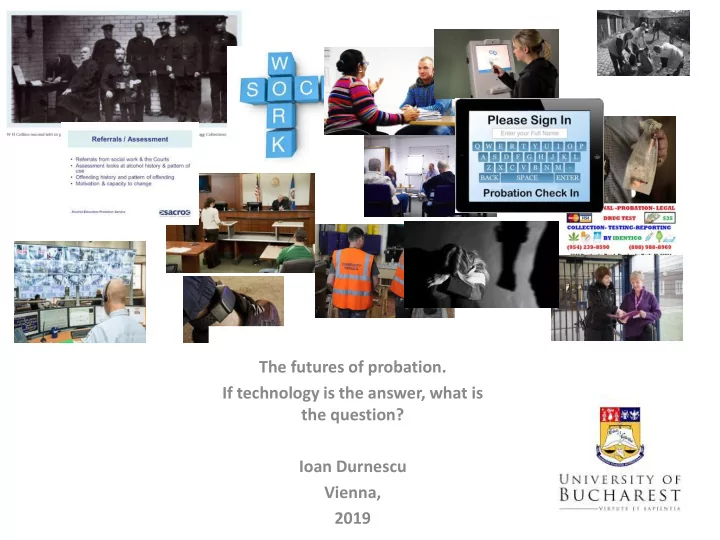
The futures of probation. If technology is the answer, what is the question? Ioan Durnescu Vienna, 2019
slide-2
SLIDE 2

What is technology?

  • Many meanings and levels of

definition: – ‘the application of scientific knowledge for practical purposes’ – ‘The machinery and equipment based on the scientific knowledge’ – ‘the branch of knowledge dealing with engineering or applied sciences’ – From Greek - ‘systematic treatment’ *dictionary.com

slide-3
SLIDE 3

Short history

  • f

rehabilitation

  • ‘Save the souls’ – end of XIXth Century –

‘man of God’

  • ‘Sentenced to social work’ – after the WW2
  • Years of pessimism – 70s-80s – ‘Nothing

works’ – help in the client’s terms

  • What works – 90s
  • Strengths based approaches – after 2000

Some of these developments were very aptly described and explained by McWilliams (1983, 1985) – how the religious fundament was replaced with the ‘scientific’ social work diagnostic by taking a more deterministic approach to alcohol consumption.

slide-4
SLIDE 4

Technology in rehabilitation 6 distinctive waves

  • Ever since science started to

play a more prevalent role – beginning of the 20th Century – diagnostic, treatment etc. based on social casework or psychodynamic theories

  • Community service, attendance

centres, drug addiction centres etc.

  • Electronic monitoring
  • Victim / Offender Mediation /

RJ

  • What Works – risk assessment,

programs etc.

  • Desistance – relationship work,

social capital

slide-5
SLIDE 5

Technology as programs – soft- technologies

  • Manualized programs – e.g. ’offending

behaviour’

  • Digitally assisted programs – TimeWise –

E&W – 14 steps, reducing violence, animates

  • Apps – Europe: Northern Ireland, Sweden

and Netherlands

  • Smart databases – for registration but

also for sentence planning, scheduling, supervision, correspondence etc. (Neustart – DOKU; Client system-KVR in Sweden)

  • Games
  • Computer software to monitor the

computer activities of the probationers

  • Use of Skype for communication with

remote areas.

  • Artificial Intelligence and big data
  • Facebook and Tweeter
slide-6
SLIDE 6

Probation Apps

  • supervision by smarphone
  • Pasive:

– providing information – e.g. Changing Lives (NI) – monitoring compliance – Telenav (Indiana)-observing compliance with home detention and drug treatment

  • Interactive
  • Neighborhood Opportunity Networks (NoONs)- NY –

encourage positive behavior – points system for community goals, customizable.

  • Allows direct communication with POs and other

service providers.

  • Integrated

– PO Smartphone App (North Carolina) – case management integrated with the monitoring of offenders – supervising POs?

slide-7
SLIDE 7

AI

  • Artificial intelligence (machine

learning): – Machine that learn, reason and self-correct – ‘Self-aware’ – to be developed

  • Risk - based on past events –

amplify discrimination based

  • n race, ethnicity or socio-

economic status

  • Self-aware – ‘game changer’ -

more preventive actions – anticipating and blocking the act

slide-8
SLIDE 8

Technology as equipment / machine

  • hard-

technology -

  • Electronic monitoring – 1983 (Jack

Love) – For small number on house arrest – Passive, active and GPS technology – ‘dirty technology’ - Electronic monitoring with Conducted Energy Devices (CED) (Nellis, 2018)

  • Alcohol monitoring:

– Ignition interlock device – measures blood alcohol content (BAC) – Continuous transdermal alcohol monitoring – reading from the probationer’s perspiration – alcoholmeter (NL) – Breathalyzer

slide-9
SLIDE 9

Conclusions

  • advantages
  • Numerous advantages: e.g. less

traveling, higher flexibility, more accuracy, more consistency across the service, improve digital skills, prolong the constructive influence of PO beyond the office, more fun, cheaper, faster etc. (after Kip et al, 2018)

slide-10
SLIDE 10

Conclusions

  • limits -
  • Limits of the existing technologies –

see risk assessment accuracy levels

  • Faulty technologies – no connections
  • Tighter control – more breach?
  • Hard technologies in time – passive –

interactive – pro-active (preventing undesirable behaviours)

  • Ethical issues around the use of the

pro-active tech and AI

slide-11
SLIDE 11

Questions:

  • Technology and information shape the

practice in many subtle ways – see the actor-network theory (Brown, 2006; Philips, 2017)

  • What are the ramifications of the use
  • f technology ?
  • How can we use technology to enable

and support compliance and not to promote breach?

  • What are the ethical implications for

each technology and how to deal with them?

  • How can we keep the humans in the

‘centre of the universe’?

slide-12
SLIDE 12

Technology is not good, or bad, or … neutral. It only exist!! Thank you !! Ioan Durnescu idurnescu@gmail.com