
SLIDE 1
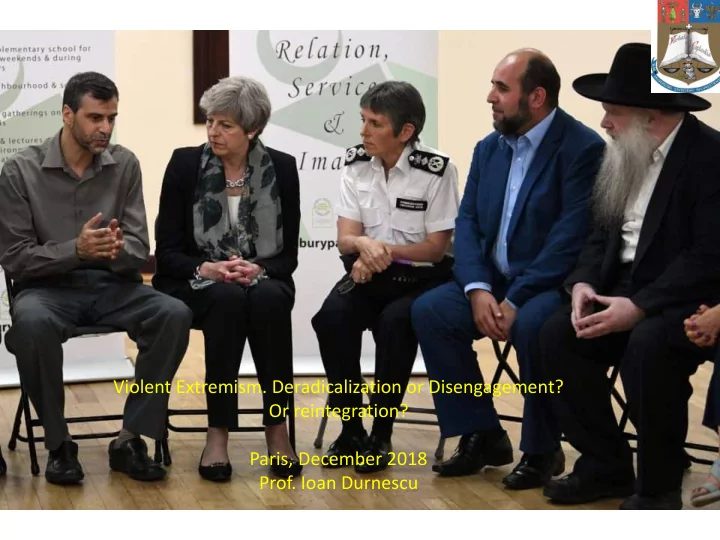
Violent Extremism. Deradicalization or Disengagement? Or reintegration? Paris, December 2018
- Prof. Ioan Durnescu
Violent Extremism. Deradicalization or Disengagement? Or - - PowerPoint PPT Presentation
Violent Extremism. Deradicalization or Disengagement? Or reintegration? Paris, December 2018 Prof. Ioan Durnescu Aim and structure Aim at presenting in a critical way the state of art on: Why and how people engage & disengage from
Violent Extremism. Deradicalization or Disengagement? Or reintegration? Paris, December 2018
(CoE)
are aimed at defending an ideology advocating racial, national, ethnic or religious supremacy or opposing core democratic principles and values. (CoE) – Involves engagement in some action
thinking that motivate/justify extremist offending or militancy.
networks’ associated to terrorism (Horgan, 2009). – Interventions that seek to change offender’s relationship or identification with the extremist group. – Less contact or restrain from action – Or changed their position or responsibilities in the group
connecting him to practical services (e.g. employment, accommodation, education etc.) and to networks of pro- social opportunities and networks
‘They all were looking for something …’
– Loss of significance – discrimination, humiliation, injustice, dishonor, shame etc. – Terrorism as an opportunity to significance gain – Significance loss leads to a need for cognitive closure
– To justify violence – Not only justifiable but necessary and laudable – Delegitimization of the target: dehumanization (stripping them of the human features – rats, serpents, cockroaches etc.), outcasting groups (infidels), defining them as enemies etc.
– Important for consensual validation of narratives – peer validation – Small groups endorse extreme values – Second family – ‘fused’ identities – strong in-group bonds – their identity as the one with the group identity – ‘fused’ individuals ready to sacrifice themselves for the group
sausages
attacking the ‘non-whites’ – context Combat 18 – collective experience, knifes, one man killed while defending him.
for khilafah.
great speaker and good role model – use of friends and family networks
friends, films with injustice, purpose in life – recruit as many people for the HT cause.
prejudice and build up another one. Stories to support Islamism – half truth
See also Nawaz video (10:20) !!
Theoretical model - Pro-Integration Model – Barrell, 2014
belonging
– Social relations – Coping – Identity – Ideology – Action orientation
1. Social relations
1. Important push factor – disillusionment 2. Having out-group relations – sign of pluralism and de-radicalization
2. Coping
1. Many suffered traumas, depression, paranoia, burnout etc. 2. Especially where they used violence and coercion in-group 3. Need for robust personalities and string social support
3. Identity
1. Readjusting personal and social identities as a member of the society 2. Sometimes an incident triggered the transformation 3. Contact with out-group
4. Ideology
1. An important step – to accept pluralism – acceptance of difference 2. Moderate views
5. Action Orientation
1. No longer using radical methods/ prosocial engagement in the society
permanent desistance from violent extremism than disengagement’: 540) – longitudinal – successful on both !!!
recreational, cultural/family and community
– Educational – formal schooling or vocational education in different languages (incl Tamil) – Vocational – training in regionally appropriate vocations (agriculture, beauty culture, wiring etc.). Business community involved on-site and off-site. – Psychosocial rehabilitation – clinical psychologists and mental health workers, involved prestigious people – as mentors, creative writing, drama etc. – Spiritual rehabilitation – various religious organizations (Hindu, Christian etc.) involved in delivering religious ceremonies, yoga, mindfulness etc. – Sport & Recreational rehabilitation – sport activities on a daily basis: ‘cricket for change’, regional athletic meets etc., home gardening, art and craft - able to sell – Social, cultural and family rehabilitation – call and visit their families, prison leaves, educational tours
– Community rehabilitation – one month out prior to release and back to provide feedback, meetings with religious and community leaders to discuss reintegration and support, media campaign to accept them.
The Entré programme Theory manual 2016
extremist group, cause or ideology.
relationships, groups and values.
identity development and mindfulness.
– For those strongly identifying and engaged - simply question their continuation – For those who begun to have doubts – to separate – For those already disengaged – consolidate their new commitments
– Explore needs, beliefs, values – Identify what is important in their lives
– Understand how they become what they are today – Explore why they become interested and involved in the cause/ideology/group
– Teach participants how to manage thoughts and feelings that impair their daily lives
– Re-examine their commitments they have made in life and how these commitments could be followed without offending.
– Explore costs and benefits of their involvement with offending – Explore what changes they can make to avoid offending
– Explore how they can preserve the desired self / identity without offending
– Explore ways to pursue their legitimate goals without offending
– Making plans on how they can move on with their lives without committing crimes, including developing new skills, taking other opportunities, create other relationships and so on.
environment – possibility of recall if any sign of reactivating (e.g. reconnecting with ex, Webber at al, 2018)
support, counseling, work, education, housing , family support etc.
ex-militants – misled
prevent them to turn to terrorism groups for support (Abuza, 2009),
(Yemen)
coach’ (Netherlands), religious counselor (Singapore)
– Macro-level – policies and counter-narratives developed at the national/regional level – Meso-level - community component – see Prevent as an example (UK, 2011 reviewed) – ‘taking care of each
– Involve NGOs, businesses, community leaders – ‘tipping point connectors’ – Improve quality of life and collect early signs – Make everybody responsible for community safety and wellbeing – Inform and make people aware of the consequences of discrimination – Reduce grievances and therefore reduce triggers
fighters (Colaert, 2017):
– Information sharing and coordination – Manualization of interventions – Sharing good practices – Employment, youth and integration initiatives – Early detection and engagement – Training for ‘radicalization officers’ – Helpline for parents – Network of Islam experts to support schools (to be evaluated !!!)
Principles of effective practice with violent extremists (CoE Guidelines, 2016)
– any supervision should be proportionate, – information exchange should be based on clear procedures, – appropriate autonomy and independence of rehabilitation.
– Respect diversity, tolerance and human dignity – Avoid violence, racism or islamophobia, discrimination – Consult with prisoners – Staff with intercultural and multi-faith awareness – Develop education and rehabilitation activities – Adequate resources
– Multi-disciplinary teams – Accurate tools used regularly
– Within justice, security but also inclusion agencies
– Mentoring, former violent extremists – Involvement of religious representatives, volunteers, pers, family members
– Links with community organizations – Case-by-case – family and networks – EM together with other professional interventions