
SLIDE 1
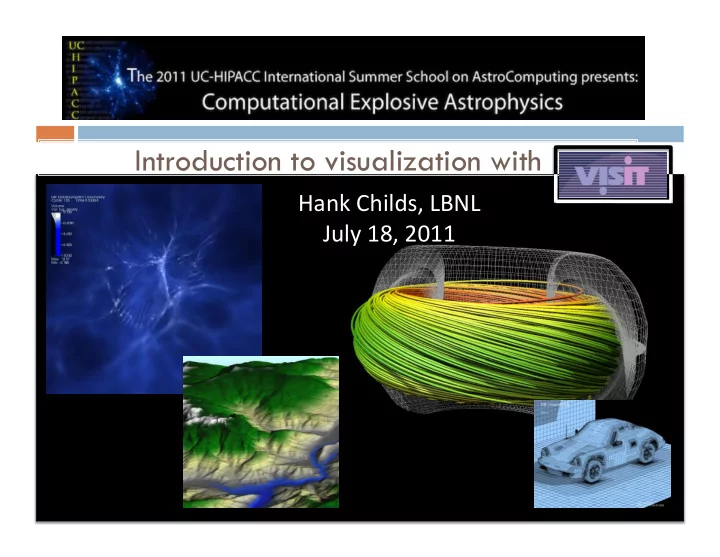
Introduction to visualization with Hank Childs, LBNL July 18, - - PowerPoint PPT Presentation
Introduction to visualization with Hank Childs, LBNL July 18, 2011 VisIt is an open source, richly featured, turn-key application for large data. 1 billion grid points / time slice Used by: Visualization experts
Used by:
Visualization experts Simulation code developers Simulation code consumers
Popular
R&D 100 award in 2005 Used on many of the Top500 >>>100K downloads 217 pin reactor cooling simulation Run on ¼ of Argonne BG/P Image credit: Paul Fischer, ANL 1 billion grid points / time slice
Data Exploration Presentations Visual Debugging Analysis
General analysis techniques (e.g. integration, volumes,
Specialized analysis (e.g. hohlraum flux at AGEX)
Meshes: rectilinear, curvilinear, unstructured, point, AMR Data: scalar, vector, tensor, material, species Dimension: 1D, 2D, 3D, time varying Rendering (~15): pseudocolor, volume rendering, hedgehogs,
Data manipulation (~40): slicing, contouring, clipping,
File formats (~110) Derived quantities: >100 interoperable building blocks
+,-,*,/, gradient, mesh quality, if-then-else, and, or, not
Many general features: position lights, make movie, etc Queries (~50): ways to pull out quantitative information,
Client-server
Good for remote
Leverages available
Scales well No need to move
Additional design considerations: Plugins Multiple UIs: GUI (Qt), CLI
remote machine Parallel vis resources User data localhost – Linux, Windows, Mac Graphics Hardware
8
#cores Problem Size Model Machine 8K 0.5T IBM P5 Purple 16K 1T Sun Ranger 16K 1T X86_64 Juno 32K 2T Cray XT5 JaguarPF 64K 4T BG/P Dawn 16K, 32K 1T, 2T Cray XT4 Franklin
Two trillion cell data set, rendered in VisIt by David Pugmire on ORNL Jaguar machine
Slides from the VisIt class
Over 75 person-years of effort Over 1.5 million lines of code Partnership between: Department of Energy’s Office of Science,
2004-6 User community grows, including AWE & ASC Alliance schools Fall ‘06 VACET is funded Spring ‘08 AWE enters repo 2003 LLNL user community transitioned to VisIt 2005 2005 R&D100 2007 SciDAC Outreach Center enables Public SW repo 2007 Saudi Aramco funds LLNL to support VisIt Spring ‘07 GNEP funds LLNL to support GNEP codes at Argonne Summer‘07 Developers from LLNL, LBL, & ORNL Start dev in repo ‘07-’08 UC Davis & UUtah research done in VisIt repo 2000 Project started ‘07-’08 Partnership with CEA is developed 2008 Institutional support leverages effort from many labs More developers Entering repo all the time
Everything works at scale Robust, usable tool Features that span the “power of visualization”:
Data exploration Confirmation Communication
Features for different kinds of users:
Vis experts Code developers Code consumers
Healthy future: vibrant developer and user communities
How to get VisIt running on your machine
Downloading and installing VisIt Building VisIt from scratch
How to get VisIt to read your data
Support for shapefiles, NetCDF, HDF5, and 100+ more
How to get help when you run into trouble
See http://www.visitusers.org/index.php?
VisIt is a richly featured visualization tool that is capable
Truth in advertising: a general interface & it sometimes takes a lot
VisIt has excellent built in support for large data sets. User resources: Main website: http://www.llnl.gov/visit Wiki: http://www.visitusers.org Tutorial: http://www.visitusers.org/index.php?title=Short_Tutorial Contacts: Hank Childs, hchilds@lbl.gov General VisIt user email list: visitusers@ornl.gov
How to get VisIt running on your machine
Downloading and installing VisIt Building VisIt from scratch
How to get VisIt to read your data How to get help when you run into trouble I like the power of VisIt, but I hate the interface How to run client-server
How to get VisIt running on your machine
Downloading and installing VisIt Building VisIt from scratch
How to get VisIt to read your data How to get help when you run into trouble I like the power of VisIt, but I hate the interface How to run client-server
Pre-built binaries work on most modern machines. … but pre-built binaries are serial only.
Why the VisIt team can’t offer parallel binaries:
… and it is difficult to use your own custom plugins with
Recommendation: try to use the pre-builts first and build
Also: all VisIt clients run serial-only. If you want to
A: Go to http://www.llnl.gov/visit
Important
Unix:
Download binary Download install script Run install script --or— Download binary Untar
Mac:
Download and open disk image. Follow instructions in the README file: run included install script
Windows:
Download installer program & run
Full install notes:
https://wci.llnl.gov/codes/visit/2.2.1/INSTALL_NOTES
Good for host profiles, maintaining multiple versions, multiple OSs Quick & easy
Many supercomputing sites have set up “host profiles”.
These files contain all the information about how to connect
You select which profiles to install when you install VisIt. Profiles that come with VisIt:
NERSC, LLNL Open, LLNL Closed, ORNL, Argonne, TACC,
Other sites maintain profiles outside of VisIt repository.
If you know folks running VisIt in parallel at a site not listed
How to get VisIt running on your machine
Downloading and installing VisIt Building VisIt from scratch
How to get VisIt to read your data How to get help when you run into trouble I like the power of VisIt, but I hate the interface How to run client-server
Building VisIt from scratch on your own is very
… but the “build_visit” script is fairly reliable.
Downloads third party libraries Patches them to accommodate OS quirks Builds the third party libraries. Creates “config-site” file, which communicates
Downloads VisIt source code Builds VisIt
How to get VisIt running on your machine
Downloading and installing VisIt Building VisIt from scratch
How to get VisIt to read your data How to get help when you run into trouble I like the power of VisIt, but I hate the interface How to run client-server
Six options:
FAQ
http://visit.llnl.gov/FAQ.html
Documentation
https://wci.llnl.gov/codes/visit/doc.html http://www.visitusers.org
VisIt-users mailing list VisIt-users archives VisIt users forum VisIt-help-XYZ mailing list
Getting started manual Users manual (old, but still useful) Python interface (to be updated in two weeks) Getting Data Into VisIt VisIt Class Slides VisIt Class Exercises This Tutorial
Users section has lots of
“I solved this problem
“Here’s my script to do
In practical terms, this is
You may only post to mailing list if you are also a subscriber Approximately 400 recipients, approx. 300 posts per
Developers monitor mailing list, strive for 100% response
Response time is typically excellent (O(1 hour)) International community really participates … not unusual for a
List: visit-users@ornl.gov More information:
Archive: https://email.ornl.gov/pipermail/visit-users/
Increasingly popular option; you can post without
But it is viewed by less people and less well supported.
http://www.visitusers.org/forum Google searches these pages.
Some customer groups pay for VisIt funding and get
These customers can post directly to visit-help-xyz
The messages are received by all VisIt developers and
Lists:
Visit-help-asc, visit-help-scidac, visit-help-gnep, visit-