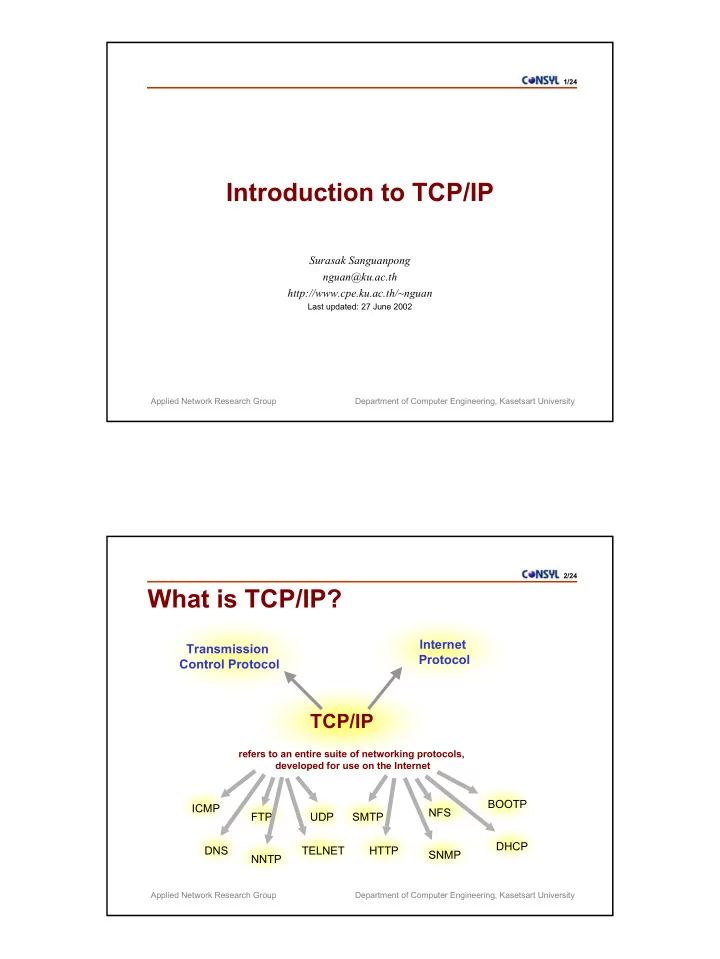
Introduction to TCP/IP Surasak Sanguanpong nguan@ku.ac.th - - PDF document

introduction to tcp ip
SMART_READER_LITE
LIVE PREVIEW

Introduction to TCP/IP Surasak Sanguanpong nguan@ku.ac.th - - PDF document

1/24 Introduction to TCP/IP Surasak Sanguanpong nguan@ku.ac.th http://www.cpe.ku.ac.th/~nguan Last updated: 27 June 2002 Applied Network Research Group Department of Computer Engineering, Kasetsart University


slide-1
SLIDE 1

1/24

Applied Network Research Group Department of Computer Engineering, Kasetsart University

Introduction to TCP/IP

Surasak Sanguanpong nguan@ku.ac.th http://www.cpe.ku.ac.th/~nguan

Last updated: 27 June 2002

2/24

Applied Network Research Group Department of Computer Engineering, Kasetsart University

What is TCP/IP?

TCP/IP

Transmission Control Protocol Internet Protocol

refers to an entire suite of networking protocols, developed for use on the Internet

ICMP UDP SMTP SNMP HTTP NFS TELNET DNS FTP DHCP BOOTP NNTP

slide-2
SLIDE 2

3/24

Applied Network Research Group Department of Computer Engineering, Kasetsart University

TCP/IP Characteristics

TCP/IP

provides the services to interconnect computers and to interconnect networks, creating the Internet Independence from underlying network topology, hardware, and operating system Unique IP Address Standardize high-level protocols Enable network devices a full functional end point for communicating with other device directly

4/24

Applied Network Research Group Department of Computer Engineering, Kasetsart University

TCP/IP Internetworking

Token Ring FDDI

slide-3
SLIDE 3

5/24

Applied Network Research Group Department of Computer Engineering, Kasetsart University

TCP/IP as Networking Softwares

TCP/IP protocol suites define a set of universal

communication services

Services can be implemented in a standardized

manner in the networking software, normally bundled with OS

TCP/IP Communication Software

Network

TCP/IP Communication Software

6/24

Applied Network Research Group Department of Computer Engineering, Kasetsart University

TCP/IP Architectural Layers

Application Application Transport Transport Internet Internet Network Physical

Network Application End-to-end Services Routing Transmission Network Interface services services services

slide-4
SLIDE 4

7/24

Applied Network Research Group Department of Computer Engineering, Kasetsart University

Physical

TCP/IP and OSI

Application Presentation Session Transport Network Data Link Physical Application Transport Internet Network

TCP/IP OSI

8/24

Applied Network Research Group Department of Computer Engineering, Kasetsart University

Data Transfer over Network

Application Presentation Session Transport Network Data Link Physical Application Presentation Session Transport Network Data Link Physical Network Data Link Physical Network Data Link Physical

source gateway gateway destination

slide-5
SLIDE 5

9/24

Applied Network Research Group Department of Computer Engineering, Kasetsart University

TCP/IP Majors Protocols

Physical Applications Transport Internet Network

FTP TELNET SMTP HTTP X-window DNS

TCP UDP

SNMP NFS TFTP BOOTP

IP Network Drivers

ICMP IGMP ARP RARP

NNTP Others

10/24

Applied Network Research Group Department of Computer Engineering, Kasetsart University

Address Relationship in TCP/IP

FTP TELNET SMTP HTTP X-window DNS

TCP UDP

SNMP NFS TFTP BOOTP

IP Datalink

NNTP Others

Port address IP address Hardware address port interface

slide-6
SLIDE 6

11/24

Applied Network Research Group Department of Computer Engineering, Kasetsart University

IP and Datalink Services

IP Packet for 192.168.100.64 Ethernet Packet for 00:E0:98:05:EE:11 IP address 192.168.100.2 Hardware address 00:E0:98:05:50:70 IP address 192.168.100.64 Hardware address 00:E0:98:05:EE:11

12/24

Applied Network Research Group Department of Computer Engineering, Kasetsart University

Address Mapping

IP address 192.168.100.2 Hardware address 00:E0:98:05:50:70 IP address 192.168.100.6 Hardware address 00:E0:98:05:EE:11 IP address 192.168.100.4 Hardware address 10:E1:11:15:40:44 00:E0:98:05:EE:11 has 192.168.100.4

Who has 192.168.100.4

1 2

slide-7
SLIDE 7

13/24

Applied Network Research Group Department of Computer Engineering, Kasetsart University

TCP in action

Request for opening a connection O.K., ready O.K., ready Request data Data sent Request for closing the connection O.K.

TCP is a connection-oriented protocol A connection is generated

before the data is exchanged (like a telephone conversation)

Provide error correction and flow

control

More functionality

source port destination port sequence number acknowledgment number data offs resv flag win size checksum urgent pointer

  • ptions and padding

data

TCP segment

14/24

Applied Network Research Group Department of Computer Engineering, Kasetsart University

UDP in action

Request for Data Reply Request for data Reply Request for data Reply

UDP is a connectionless protocol no need to establish connection (like

sending a postcard)

Try its best to delivery data, (no

guaranteed delivery)

Lighter, faster, less overhead

source port destination UDP length checksum data…...

UDP Datagram

slide-8
SLIDE 8

15/24

Applied Network Research Group Department of Computer Engineering, Kasetsart University

FTP Server

Client-Server Relationships

  • One application component,

called Server, provides a well- defined services for application components running, called client

  • A host can have server

processes for one or more application protocols

  • A host can have client

processes using one or more servers

TELNET Server TELNET Client FTP Client FTP Client FTP Client TELNET Server TELNET Client FTP Server FTP Server

FTP Protocol FTP Protocol FTP Protocol TELNET Protocol TELNET Protocol 16/24

Applied Network Research Group Department of Computer Engineering, Kasetsart University

How TCP/IP handles protocols

Ethernet ARP RARP IP ICMP IGMP UDP Application Application Application Application TCP incoming frame demux based on frame type in Ethernet header demux based on protocol type in IP header demux based on destination port number in TCP or UDP header

slide-9
SLIDE 9

17/24

Applied Network Research Group Department of Computer Engineering, Kasetsart University

What’s Internet ?

The Internet is a collection of networks that

communicate through gateways

18/24

Applied Network Research Group Department of Computer Engineering, Kasetsart University

Internet Milestones

ARPANET

1969 1971

15 nodes 23 hosts

1973

Development begins

1977

Internet Internet

with TCP/IP

1978 Unix TCP/IP 1986

110 M hosts 1,000 M URLs

2000

4 nodes

TCP/IP TCP/IP

WWW

1995

NSFNET established Unix Distribution

slide-10
SLIDE 10

19/24

Applied Network Research Group Department of Computer Engineering, Kasetsart University

Internet Growth

20/24

Applied Network Research Group Department of Computer Engineering, Kasetsart University

Internet Technical Bodies Structure

IESG

WG WG

IETF

IAB ISOC

International, nonprofit organization Promote research and other

activities relating to the Internet

Technical Advisor to the ISOC Oversee the development of

TCP/IP protocol Internet Society Internet Architecture Board

Internet Engineering Task Force Internet Research Task Force IRSG

WG WG

IRTF

A forum of working

groups managed by Internet Engineering Steering Group

Develop of protocols

and specifications for standardization

A forum of working

groups managed by Internet Research Steering Group

Conduct long-term

research

slide-11
SLIDE 11

21/24

Applied Network Research Group Department of Computer Engineering, Kasetsart University

Internet Standard Process

RFC Internet Draft Proposed Standard Draft Standard Internet Standard

  • fficial publication for Internet standard

and other publications entry-level, protocol specifications should be stable technically at least 2 independence and interoperable implementation that test all specification functions have had significant field use and clear community interest in production use. draft version for informal review and comment

Standard track

22/24

Applied Network Research Group Department of Computer Engineering, Kasetsart University

Non-standards track

specification may not be intended to be an

Internet Standard

labeled with one of three “off-track” maturity level:

Historic Informational Experimental

known as “protocol state”

Informational Experimental Proposed standard Draft standard Standard Historic

slide-12
SLIDE 12

23/24

Applied Network Research Group Department of Computer Engineering, Kasetsart University

Internet Documents

Number with RFCxxxx Updated RFCs are published with new RFC numbers RFC’s subseries designed to be a way to

standardization practice

Official Internet Standard RFC series that provide useful information

RFC : Request For Comment BCP (Best Current Practice) STD (Standard) FYI (For Your Information)

24/24

Applied Network Research Group Department of Computer Engineering, Kasetsart University

Important RFCs

Internet Official Protocol Standards (STD0001) Assigned Numbers (STD0002) Requirements for Internet Hosts-

communication layers (STD0003)

Requirements for Internet Hosts- Application

and Support (STD0003) RFC 2500

RFC 1700 RFC 1122 RFC 1123 (Updated by RFC 2181)