
SLIDE 1
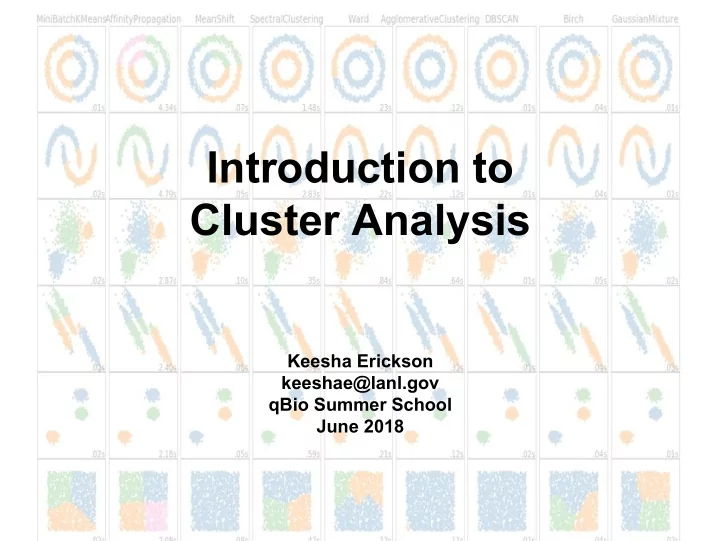
Introduction to Cluster Analysis
Keesha Erickson keeshae@lanl.gov qBio Summer School June 2018
Introduction to Cluster Analysis Keesha Erickson keeshae@lanl.gov - - PowerPoint PPT Presentation
Introduction to Cluster Analysis Keesha Erickson keeshae@lanl.gov qBio Summer School June 2018 Outline Background Intro Workflow Similarity metrics Clustering algorithms Hierarchical K-means
Keesha Erickson keeshae@lanl.gov qBio Summer School June 2018
∙ Data mining tool(s) for dividing a multivariate dataset
∙ Good clustering: ∙ Data points in one cluster are highly similar ∙ Data points in different clusters are dissimilar
Inter-cluster distances are maximized Intra-cluster distances are minimized
Tan, Steinbach, Karpatne, Kumar. Introduction to Data Mining, 2nd Edition.
− Groups of genes/proteins with
− Groups of cells with similar
− Reduce the size of a large
Clustering precipitation in Australia
Tan, Steinbach, Karpatne, Kumar. Introduction to Data Mining, 2nd Edition. Eisen, Brown, Botstein (1998) PNAS.
i.e., Dividing students into different registration groups alphabetically, by last name Although, some work in graph partitioning and more complex segmentation is related to clustering
Groupings are a result of an external specification
Supervised classification has class label information Clustering can be called unsupervised classification: labels derived from data
Finding connections between items in datasets
Tan, Steinbach, Karpatne, Kumar. Introduction to Data Mining, 2nd Edition.
Tan, Steinbach, Karpatne, Kumar. Introduction to Data Mining, 2nd Edition.
− Hierarchical: data are in nested clusters, organized in a
− Partition: data in non-overlapping subsets. One data
Tan, Steinbach, Karpatne, Kumar. Introduction to Data Mining, 2nd Edition. D’haeseleer (2005) Nature Biotech.
Partition Hierarchical
Tan, Steinbach, Karpatne, Kumar. Introduction to Data Mining, 2nd Edition.
Leskovec, Rajaraman, Ullman: Mining of Massive Datasets, http://www.mmds.org
Handl, Knowles, Kell (2005) Bioinformatics.
D’haeseleer (2005) Nature Biotech.
Tan, Steinbach, Karpatne, Kumar. Introduction to Data Mining, 2nd Edition. Leskovec, Rajaraman, Ullman: Mining of Massive Datasets, http://www.mmds.org
Tan, Steinbach, Karpatne, Kumar. Introduction to Data Mining, 2nd Edition. Image from Encyclopedia Britannica Online. Phylogeny entry. Web. 05 Jun 2018.
− Different approaches to defining this distance
Tan, Steinbach, Karpatne, Kumar. Introduction to Data Mining, 2nd Edition.
− Start with one point − In successive steps, look for closest pair of points
− Add q to the tree (add edge between p and q)
Tan, Steinbach, Karpatne, Kumar. Introduction to Data Mining, 2nd Edition.
− Single linkage − Complete linkage − Average linkage − Centroids − Ward’s method
Tan, Steinbach, Karpatne, Kumar. Introduction to Data Mining, 2nd Edition.
Tan, Steinbach, Karpatne, Kumar. Introduction to Data Mining, 2nd Edition.
Tan, Steinbach, Karpatne, Kumar. Introduction to Data Mining, 2nd Edition.
Tan, Steinbach, Karpatne, Kumar. Introduction to Data Mining, 2nd Edition. Lecture notes from C Shalizi, 36-350 Data Mining, Carnegie Mellon University.
∙ Single
1 2 3 4 5 6 1 2 3 4 5 1 2 3 4 5 6
Tan, Steinbach, Karpatne, Kumar. Introduction to Data Mining, 2nd Edition.
∙ Complete
1 2 3 4 5 6 1 2 3 4 5 6 1 2 5 3 4
Tan, Steinbach, Karpatne, Kumar. Introduction to Data Mining, 2nd Edition.
∙ Average
1 2 3 4 5 6 1 2 3 4 5 6 1 2 5 3 4
Tan, Steinbach, Karpatne, Kumar. Introduction to Data Mining, 2nd Edition.
Average Ward’s Method 1 2 3 4 5 6 1 2 5 3 4 Single Complete 1 2 3 4 5 6 1 2 5 3 4 1 2 3 4 5 6 1 2 5 3 4 1 2 3 4 5 6 1 2 3 4 5
Tan, Steinbach, Karpatne, Kumar. Introduction to Data Mining, 2nd Edition.
Tan, Steinbach, Karpatne, Kumar. Introduction to Data Mining, 2nd Edition.
Tan, Steinbach, Karpatne, Kumar. Introduction to Data Mining, 2nd Edition.
− Clusters will vary from one run to the next
Tan, Steinbach, Karpatne, Kumar. Introduction to Data Mining, 2nd Edition.
Tan, Steinbach, Karpatne, Kumar. Introduction to Data Mining, 2nd Edition.
m = centroid in cluster Ci x = a data point in cluster Ci
Leskovec, Rajaraman, Ullman: Mining of Massive Datasets, http://www.mmds.org
Choose K where SSE drops abruptly
K-means (3 Clusters) Original Points
Tan, Steinbach, Karpatne, Kumar. Introduction to Data Mining, 2nd Edition.
K-means (3 Clusters) Original Points
Tan, Steinbach, Karpatne, Kumar. Introduction to Data Mining, 2nd Edition.
Original Points K-means (2 Clusters)
Tan, Steinbach, Karpatne, Kumar. Introduction to Data Mining, 2nd Edition.
One solution is to use many clusters. Find parts of desired clusters, but need to put together.
Tan, Steinbach, Karpatne, Kumar. Introduction to Data Mining, 2nd Edition.
n = size of clusters (assuming relatively similar)
Tan, Steinbach, Karpatne, Kumar. Introduction to Data Mining, 2nd Edition.
“Real” clusters: Clusters obtained with K=10, some “real” clusters without initial centroids:
Tan, Steinbach, Karpatne, Kumar. Introduction to Data Mining, 2nd Edition.
Tan, Steinbach, Karpatne, Kumar. Introduction to Data Mining, 2nd Edition.
− Normalize the data − Eliminate outliers
− Eliminate small clusters (may represent outliers) − Split ‘loose’ clusters (i.e., clusters w/ high SSE) − Merge clusters that are close (w/ low SSE)
Tan, Steinbach, Karpatne, Kumar. Introduction to Data Mining, 2nd Edition.
Tan, Steinbach, Karpatne, Kumar. Introduction to Data Mining, 2nd Edition. Figure from Mo Velayati, hhtps://mvelayati.com
n = 7 r r r
Tan, Steinbach, Karpatne, Kumar. Introduction to Data Mining, 2nd Edition.
Tan, Steinbach, Karpatne, Kumar. Introduction to Data Mining, 2nd Edition.
Original data Clustered
Tan, Steinbach, Karpatne, Kumar. Introduction to Data Mining, 2nd Edition.
Limitations:
incomplete at points in low density regions are ignored
1) Determining the clustering tendency of a set of data, i.e., distinguishing whether non-random structure actually exists in the data. 2) Comparing the results of a cluster analysis to externally known results, e.g., to externally given class labels. 3) Comparing the results of two different sets of cluster analyses to determine which is better. 4) Determining the ‘correct’ number of clusters. For 2 and 3, we can further distinguish whether we want to evaluate the entire clustering or just individual clusters.
Tan, Steinbach, Karpatne, Kumar. Introduction to Data Mining, 2nd Edition.
Tan, Steinbach, Karpatne, Kumar. Introduction to Data Mining, 2nd Edition. Handle, Knowles, Kell (2005) Bioinformatics.
Tan, Steinbach, Karpatne, Kumar. Introduction to Data Mining, 2nd Edition. Handle, Knowles, Kell (2005) Bioinformatics.
http://scikit-learn.org/stable/modules/clustering.html