SLIDE 1 Introduction to Artificial Intelligence
Marc Toussaint March 29, 2016
The majority of slides of the earlier parts are adapted from Stuart Russell. This is a direct concatenation and reformatting of all lecture slides and exercises from the Artificial Intelligence course (winter term 2014/15, U Stuttgart), including indexing to help prepare for exams.
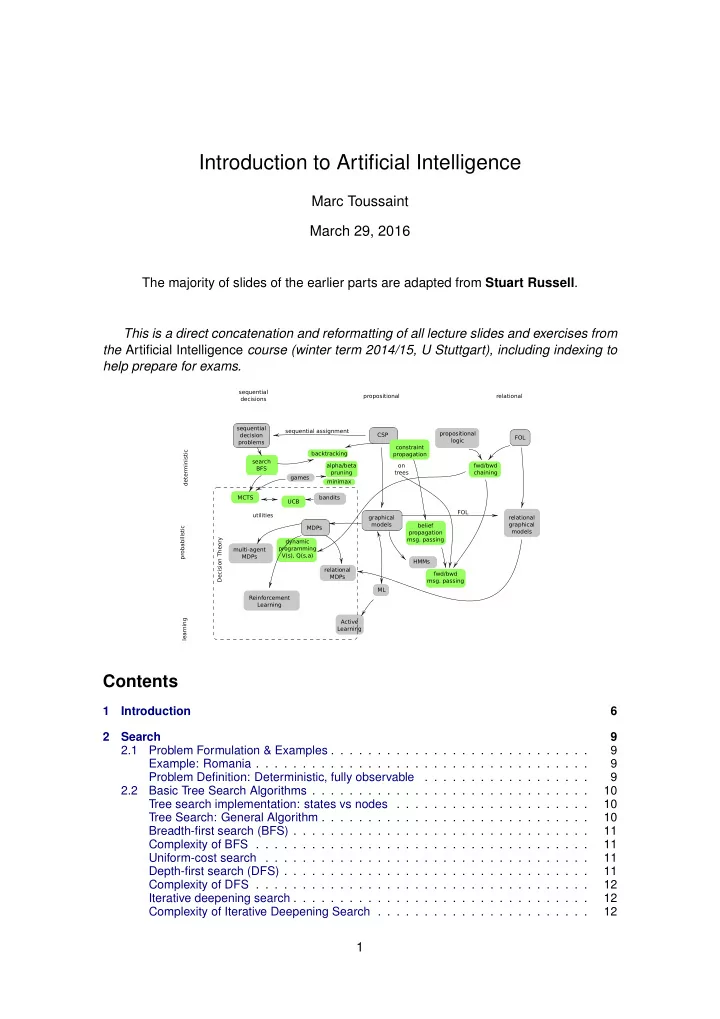
trees CSP graphical models MDPs sequential decision problems search BFS propositional logic FOL relational graphical models relational MDPs Reinforcement Learning HMMs ML multi-agent MDPs MCTS utilities deterministic learning probabilistic propositional relational sequential decisions games bandits UCB constraint propagation belief propagation
Active Learning Decision Theory dynamic programming V(s), Q(s,a) fwd/bwd chaining backtracking fwd/bwd
FOL sequential assignment alpha/beta pruning minimax
Contents
1 Introduction 6 2 Search 9 2.1 Problem Formulation & Examples . . . . . . . . . . . . . . . . . . . . . . . . . . . . 9 Example: Romania . . . . . . . . . . . . . . . . . . . . . . . . . . . . . . . . . . . . 9 Problem Definition: Deterministic, fully observable . . . . . . . . . . . . . . . . . . 9 2.2 Basic Tree Search Algorithms . . . . . . . . . . . . . . . . . . . . . . . . . . . . . . 10 Tree search implementation: states vs nodes . . . . . . . . . . . . . . . . . . . . . 10 Tree Search: General Algorithm . . . . . . . . . . . . . . . . . . . . . . . . . . . . . 10 Breadth-first search (BFS) . . . . . . . . . . . . . . . . . . . . . . . . . . . . . . . . 11 Complexity of BFS . . . . . . . . . . . . . . . . . . . . . . . . . . . . . . . . . . . . 11 Uniform-cost search . . . . . . . . . . . . . . . . . . . . . . . . . . . . . . . . . . . 11 Depth-first search (DFS) . . . . . . . . . . . . . . . . . . . . . . . . . . . . . . . . . 11 Complexity of DFS . . . . . . . . . . . . . . . . . . . . . . . . . . . . . . . . . . . . 12 Iterative deepening search . . . . . . . . . . . . . . . . . . . . . . . . . . . . . . . . 12 Complexity of Iterative Deepening Search . . . . . . . . . . . . . . . . . . . . . . . 12
1
SLIDE 2
2 Introduction to Artificial Intelligence, Marc Toussaint—March 29, 2016
Graph search and repeated states . . . . . . . . . . . . . . . . . . . . . . . . . . . 13 2.3 Greedy and A∗Search . . . . . . . . . . . . . . . . . . . . . . . . . . . . . . . . . . 13 Best-first Search . . . . . . . . . . . . . . . . . . . . . . . . . . . . . . . . . . . . . 13 Greedy Search . . . . . . . . . . . . . . . . . . . . . . . . . . . . . . . . . . . . . . 13 Complexity of Greedy Search . . . . . . . . . . . . . . . . . . . . . . . . . . . . . . 14 A∗ search . . . . . . . . . . . . . . . . . . . . . . . . . . . . . . . . . . . . . . . . . 14 A∗: Proof 1 of Optimality . . . . . . . . . . . . . . . . . . . . . . . . . . . . . . . . . 14 Complexity of A∗ . . . . . . . . . . . . . . . . . . . . . . . . . . . . . . . . . . . . . 14 A∗: Proof 2 of Optimality . . . . . . . . . . . . . . . . . . . . . . . . . . . . . . . . . 14 Admissible heuristics . . . . . . . . . . . . . . . . . . . . . . . . . . . . . . . . . . . 15 Memory-bounded A∗ . . . . . . . . . . . . . . . . . . . . . . . . . . . . . . . . . . . 15 3 Probabilities 17 3.1 Intro . . . . . . . . . . . . . . . . . . . . . . . . . . . . . . . . . . . . . . . . . . . . 17 Probabilities as (subjective) information calculus . . . . . . . . . . . . . . . . . . . 17 Inference: general meaning . . . . . . . . . . . . . . . . . . . . . . . . . . . . . . . 17 Frequentist vs Bayesian . . . . . . . . . . . . . . . . . . . . . . . . . . . . . . . . . 17 3.2 Basic definitions . . . . . . . . . . . . . . . . . . . . . . . . . . . . . . . . . . . . . 18 Definitions based on sets . . . . . . . . . . . . . . . . . . . . . . . . . . . . . . . . 18 Random variables . . . . . . . . . . . . . . . . . . . . . . . . . . . . . . . . . . . . 18 Probability distribution . . . . . . . . . . . . . . . . . . . . . . . . . . . . . . . . . . 18 Joint distribution . . . . . . . . . . . . . . . . . . . . . . . . . . . . . . . . . . . . . 18 Marginal . . . . . . . . . . . . . . . . . . . . . . . . . . . . . . . . . . . . . . . . . . 18 Conditional distribution . . . . . . . . . . . . . . . . . . . . . . . . . . . . . . . . . . 18 Bayes’ Theorem . . . . . . . . . . . . . . . . . . . . . . . . . . . . . . . . . . . . . 18 Multiple RVs, conditional independence . . . . . . . . . . . . . . . . . . . . . . . . 18 3.3 Probability distributions . . . . . . . . . . . . . . . . . . . . . . . . . . . . . . . . . 19 Bernoulli and Binomial distributions . . . . . . . . . . . . . . . . . . . . . . . . . . . 19 Beta . . . . . . . . . . . . . . . . . . . . . . . . . . . . . . . . . . . . . . . . . . . . 19 Multinomial . . . . . . . . . . . . . . . . . . . . . . . . . . . . . . . . . . . . . . . . 19 Dirichlet . . . . . . . . . . . . . . . . . . . . . . . . . . . . . . . . . . . . . . . . . . 20 Conjugate priors . . . . . . . . . . . . . . . . . . . . . . . . . . . . . . . . . . . . . 20 3.4 Distributions over continuous domain . . . . . . . . . . . . . . . . . . . . . . . . . . 21 Dirac distribution . . . . . . . . . . . . . . . . . . . . . . . . . . . . . . . . . . . . . 21 Gaussian . . . . . . . . . . . . . . . . . . . . . . . . . . . . . . . . . . . . . . . . . 21 Particle approximation of a distribution . . . . . . . . . . . . . . . . . . . . . . . . . 21 Utilities and Decision Theory . . . . . . . . . . . . . . . . . . . . . . . . . . . . . . 22 Entropy . . . . . . . . . . . . . . . . . . . . . . . . . . . . . . . . . . . . . . . . . . 22 Kullback-Leibler divergence . . . . . . . . . . . . . . . . . . . . . . . . . . . . . . . 22 3.5 Monte Carlo methods . . . . . . . . . . . . . . . . . . . . . . . . . . . . . . . . . . 23 Monte Carlo methods . . . . . . . . . . . . . . . . . . . . . . . . . . . . . . . . . . 23 Rejection sampling . . . . . . . . . . . . . . . . . . . . . . . . . . . . . . . . . . . . 23 Importance sampling . . . . . . . . . . . . . . . . . . . . . . . . . . . . . . . . . . . 23 Student’s t, Exponential, Laplace, Chi-squared, Gamma distributions . . . . . . . . 23 4 Bandits, MCTS, & Games 24 4.1 Bandits . . . . . . . . . . . . . . . . . . . . . . . . . . . . . . . . . . . . . . . . . . 24 Multi-armed Bandits . . . . . . . . . . . . . . . . . . . . . . . . . . . . . . . . . . . 24 4.2 Upper Confidence Bounds (UCB) . . . . . . . . . . . . . . . . . . . . . . . . . . . . 24 Exploration, Exploitation . . . . . . . . . . . . . . . . . . . . . . . . . . . . . . . . . 24 Upper Confidence Bound (UCB1) . . . . . . . . . . . . . . . . . . . . . . . . . . . . 25 4.3 Monte Carlo Tree Search . . . . . . . . . . . . . . . . . . . . . . . . . . . . . . . . 25 Monte Carlo Tree Search (MCTS) . . . . . . . . . . . . . . . . . . . . . . . . . . . 25 Upper Confidence Tree (UCT) . . . . . . . . . . . . . . . . . . . . . . . . . . . . . . 26 4.4 Game Playing . . . . . . . . . . . . . . . . . . . . . . . . . . . . . . . . . . . . . . . 26 Minimax . . . . . . . . . . . . . . . . . . . . . . . . . . . . . . . . . . . . . . . . . . 27 Alpha-Beta Pruning . . . . . . . . . . . . . . . . . . . . . . . . . . . . . . . . . . . 27 Evaluation functions . . . . . . . . . . . . . . . . . . . . . . . . . . . . . . . . . . . 28 UCT for games . . . . . . . . . . . . . . . . . . . . . . . . . . . . . . . . . . . . . . 28
SLIDE 3
Introduction to Artificial Intelligence, Marc Toussaint—March 29, 2016 3
5 Reinforcement Learning 30 5.1 Markov Decision Processes & Dynamic Programming . . . . . . . . . . . . . . . . 30 Markov Decision Process (MDP) . . . . . . . . . . . . . . . . . . . . . . . . . . . . 31 Value Function . . . . . . . . . . . . . . . . . . . . . . . . . . . . . . . . . . . . . . 31 Bellman optimality equation . . . . . . . . . . . . . . . . . . . . . . . . . . . . . . . 31 Value Iteration . . . . . . . . . . . . . . . . . . . . . . . . . . . . . . . . . . . . . . 32 Q-Function . . . . . . . . . . . . . . . . . . . . . . . . . . . . . . . . . . . . . . . . 32 Q-Iteration . . . . . . . . . . . . . . . . . . . . . . . . . . . . . . . . . . . . . . . . . 32 Proof of convergence of Q-Iteration . . . . . . . . . . . . . . . . . . . . . . . . . . . 32 5.2 Learning in MDPs . . . . . . . . . . . . . . . . . . . . . . . . . . . . . . . . . . . . 33 Temporal difference (TD) . . . . . . . . . . . . . . . . . . . . . . . . . . . . . . . . 33 Q-learning . . . . . . . . . . . . . . . . . . . . . . . . . . . . . . . . . . . . . . . . . 34 Proof of convergence of Q-learning . . . . . . . . . . . . . . . . . . . . . . . . . . . 34 Eligibility traces . . . . . . . . . . . . . . . . . . . . . . . . . . . . . . . . . . . . . . 34 Model-based RL . . . . . . . . . . . . . . . . . . . . . . . . . . . . . . . . . . . . . 36 5.3 Exploration . . . . . . . . . . . . . . . . . . . . . . . . . . . . . . . . . . . . . . . . 37 Epsilon-greedy exploration in Q-learning . . . . . . . . . . . . . . . . . . . . . . . . 37 R-Max . . . . . . . . . . . . . . . . . . . . . . . . . . . . . . . . . . . . . . . . . . . 37 Bayesian RL . . . . . . . . . . . . . . . . . . . . . . . . . . . . . . . . . . . . . . . 37 Optimistic heuristics . . . . . . . . . . . . . . . . . . . . . . . . . . . . . . . . . . . 38 5.4 Policy Search, Imitation, & Inverse RL* . . . . . . . . . . . . . . . . . . . . . . . . . 38 Policy gradients . . . . . . . . . . . . . . . . . . . . . . . . . . . . . . . . . . . . . . 38 Imitation Learning . . . . . . . . . . . . . . . . . . . . . . . . . . . . . . . . . . . . 39 Inverse RL . . . . . . . . . . . . . . . . . . . . . . . . . . . . . . . . . . . . . . . . 39 6 Constraint Satisfaction Problems 41 6.1 Problem Formulation & Examples . . . . . . . . . . . . . . . . . . . . . . . . . . . . 41 Inference . . . . . . . . . . . . . . . . . . . . . . . . . . . . . . . . . . . . . . . . . 41 Constraint satisfaction problems (CSPs): Definition . . . . . . . . . . . . . . . . . . 41 Map-Coloring Problem . . . . . . . . . . . . . . . . . . . . . . . . . . . . . . . . . . 41 6.2 Methods for solving CSPs . . . . . . . . . . . . . . . . . . . . . . . . . . . . . . . . 42 Backtracking . . . . . . . . . . . . . . . . . . . . . . . . . . . . . . . . . . . . . . . 42 Variable order: Minimum remaining values . . . . . . . . . . . . . . . . . . . . . . . 43 Variable order: Degree heuristic . . . . . . . . . . . . . . . . . . . . . . . . . . . . 43 Value order: Least constraining value . . . . . . . . . . . . . . . . . . . . . . . . . 43 Constraint propagation . . . . . . . . . . . . . . . . . . . . . . . . . . . . . . . . . . 43 Tree-structured CSPs . . . . . . . . . . . . . . . . . . . . . . . . . . . . . . . . . . 44 7 Graphical Models 46 7.1 Bayes Nets and Conditional Independence . . . . . . . . . . . . . . . . . . . . . . 46 Bayesian Network . . . . . . . . . . . . . . . . . . . . . . . . . . . . . . . . . . . . 46 Conditional independence in a Bayes Net . . . . . . . . . . . . . . . . . . . . . . . 47 Inference: general meaning . . . . . . . . . . . . . . . . . . . . . . . . . . . . . . . 47 7.2 Inference Methods in Graphical Models . . . . . . . . . . . . . . . . . . . . . . . . 48 Inference in graphical models: overview . . . . . . . . . . . . . . . . . . . . . . . . 48 Monte Carlo . . . . . . . . . . . . . . . . . . . . . . . . . . . . . . . . . . . . . . . . 48 Importance sampling . . . . . . . . . . . . . . . . . . . . . . . . . . . . . . . . . . . 49 Gibbs sampling . . . . . . . . . . . . . . . . . . . . . . . . . . . . . . . . . . . . . . 49 Variable elimination . . . . . . . . . . . . . . . . . . . . . . . . . . . . . . . . . . . 50 Factor graph . . . . . . . . . . . . . . . . . . . . . . . . . . . . . . . . . . . . . . . 50 Belief propagation . . . . . . . . . . . . . . . . . . . . . . . . . . . . . . . . . . . . 51 Message passing . . . . . . . . . . . . . . . . . . . . . . . . . . . . . . . . . . . . . 51 Loopy belief propagation . . . . . . . . . . . . . . . . . . . . . . . . . . . . . . . . . 52 Junction tree algorithm . . . . . . . . . . . . . . . . . . . . . . . . . . . . . . . . . . 52 Maximum a-posteriori (MAP) inference . . . . . . . . . . . . . . . . . . . . . . . . . 53 Conditional random field . . . . . . . . . . . . . . . . . . . . . . . . . . . . . . . . . 53
SLIDE 4
4 Introduction to Artificial Intelligence, Marc Toussaint—March 29, 2016
8 Dynamic Models 54 Markov Process . . . . . . . . . . . . . . . . . . . . . . . . . . . . . . . . . . . . . 54 Hidden Markov Model . . . . . . . . . . . . . . . . . . . . . . . . . . . . . . . . . . 54 Filtering, Smoothing, Prediction . . . . . . . . . . . . . . . . . . . . . . . . . . . . . 54 HMM: Inference . . . . . . . . . . . . . . . . . . . . . . . . . . . . . . . . . . . . . . 54 HMM inference . . . . . . . . . . . . . . . . . . . . . . . . . . . . . . . . . . . . . . 54 Kalman filter . . . . . . . . . . . . . . . . . . . . . . . . . . . . . . . . . . . . . . . 55 9 Propositional Logic 57 9.1 Syntax & Semantics . . . . . . . . . . . . . . . . . . . . . . . . . . . . . . . . . . . 57 Knowledge base: Definition . . . . . . . . . . . . . . . . . . . . . . . . . . . . . . . 57 Wumpus World example . . . . . . . . . . . . . . . . . . . . . . . . . . . . . . . . . 57 Logics: Definition, Syntax, Semantics . . . . . . . . . . . . . . . . . . . . . . . . . 58 Entailment . . . . . . . . . . . . . . . . . . . . . . . . . . . . . . . . . . . . . . . . . 58 Model . . . . . . . . . . . . . . . . . . . . . . . . . . . . . . . . . . . . . . . . . . . 58 Inference . . . . . . . . . . . . . . . . . . . . . . . . . . . . . . . . . . . . . . . . . 59 Propositional logic: Syntax . . . . . . . . . . . . . . . . . . . . . . . . . . . . . . . 59 Propositional logic: Semantics . . . . . . . . . . . . . . . . . . . . . . . . . . . . . 60 Logical equivalence . . . . . . . . . . . . . . . . . . . . . . . . . . . . . . . . . . . 60 Validity . . . . . . . . . . . . . . . . . . . . . . . . . . . . . . . . . . . . . . . . . . . 61 Satisfiability . . . . . . . . . . . . . . . . . . . . . . . . . . . . . . . . . . . . . . . . 61 9.2 Inference Methods . . . . . . . . . . . . . . . . . . . . . . . . . . . . . . . . . . . . 61 Horn Form . . . . . . . . . . . . . . . . . . . . . . . . . . . . . . . . . . . . . . . . 61 Modus Ponens . . . . . . . . . . . . . . . . . . . . . . . . . . . . . . . . . . . . . . 61 Forward chaining . . . . . . . . . . . . . . . . . . . . . . . . . . . . . . . . . . . . . 61 Completeness of Forward Chaining . . . . . . . . . . . . . . . . . . . . . . . . . . . 62 Backward Chaining . . . . . . . . . . . . . . . . . . . . . . . . . . . . . . . . . . . . 62 Conjunctive Normal Form . . . . . . . . . . . . . . . . . . . . . . . . . . . . . . . . 64 Resolution . . . . . . . . . . . . . . . . . . . . . . . . . . . . . . . . . . . . . . . . . 64 Conversion to CNF . . . . . . . . . . . . . . . . . . . . . . . . . . . . . . . . . . . . 64 10 First-Order Logic 66 10.1 The FOL language . . . . . . . . . . . . . . . . . . . . . . . . . . . . . . . . . . . . 66 FOL: Syntax . . . . . . . . . . . . . . . . . . . . . . . . . . . . . . . . . . . . . . . 66 Universal quantification . . . . . . . . . . . . . . . . . . . . . . . . . . . . . . . . . 66 Existential quantification . . . . . . . . . . . . . . . . . . . . . . . . . . . . . . . . . 66 10.2 FOL Inference . . . . . . . . . . . . . . . . . . . . . . . . . . . . . . . . . . . . . . 67 Reduction to propositional inference . . . . . . . . . . . . . . . . . . . . . . . . . . 68 Unification . . . . . . . . . . . . . . . . . . . . . . . . . . . . . . . . . . . . . . . . . 68 Generalized Modus Ponens . . . . . . . . . . . . . . . . . . . . . . . . . . . . . . . 69 Forward Chaining . . . . . . . . . . . . . . . . . . . . . . . . . . . . . . . . . . . . . 69 Backward Chaining . . . . . . . . . . . . . . . . . . . . . . . . . . . . . . . . . . . . 70 Conversion to CNF . . . . . . . . . . . . . . . . . . . . . . . . . . . . . . . . . . . . 71 Resolution . . . . . . . . . . . . . . . . . . . . . . . . . . . . . . . . . . . . . . . . . 71 11 Relational Probabilistic Modelling and Learning 73 11.1 STRIPS-like rules to model MDP transitions . . . . . . . . . . . . . . . . . . . . . . 73 Markov Decision Process (MDP) . . . . . . . . . . . . . . . . . . . . . . . . . . . . 73 STRIPS rules . . . . . . . . . . . . . . . . . . . . . . . . . . . . . . . . . . . . . . . 73 Planning Domain Definition Language (PDDL) . . . . . . . . . . . . . . . . . . . . 73 Learning probabilistic rules . . . . . . . . . . . . . . . . . . . . . . . . . . . . . . . 74 Planning with probabilistic rules . . . . . . . . . . . . . . . . . . . . . . . . . . . . . 74 11.2 Relational Graphical Models . . . . . . . . . . . . . . . . . . . . . . . . . . . . . . . 74 Probabilistic Relational Models (PRMs) . . . . . . . . . . . . . . . . . . . . . . . . 75 Markov Logic Networks (MLNs) . . . . . . . . . . . . . . . . . . . . . . . . . . . . . 76 The role of uncertainty in AI . . . . . . . . . . . . . . . . . . . . . . . . . . . . . . . 77
SLIDE 5
Introduction to Artificial Intelligence, Marc Toussaint—March 29, 2016 5
12 Exercises 78 12.1 Exercise 1 . . . . . . . . . . . . . . . . . . . . . . . . . . . . . . . . . . . . . . . . . 78 12.1.1 First Steps . . . . . . . . . . . . . . . . . . . . . . . . . . . . . . . . . . . . 78 12.1.2 Programmieraufgabe: Tree Search (50%) . . . . . . . . . . . . . . . . . . . 78 12.1.3 Votieraufgabe: Spezialf¨ alle der Suchstrategien (25%) . . . . . . . . . . . . 79 12.1.4 Votieraufgabe: A∗-Suche (25%) . . . . . . . . . . . . . . . . . . . . . . . . 79 12.1.5 Pr¨ asenzaufgabe: Beispiel f¨ ur Baumsuche . . . . . . . . . . . . . . . . . . 79 12.2 Exercise 2 . . . . . . . . . . . . . . . . . . . . . . . . . . . . . . . . . . . . . . . . . 79 12.2.1 Programmieraufgabe: Schach (75%) . . . . . . . . . . . . . . . . . . . . . . 79 12.2.2 Votieraufgabe: Bedingte Wahrscheinlichkeit (25%) . . . . . . . . . . . . . 80 12.2.3 Pr¨ asenzaufgabe: Bandits . . . . . . . . . . . . . . . . . . . . . . . . . . . 80 12.3 Exercise 3 . . . . . . . . . . . . . . . . . . . . . . . . . . . . . . . . . . . . . . . . . 80 12.3.1 Votieraufgabe: Value Iteration (50%) . . . . . . . . . . . . . . . . . . . . . 80 12.3.2 Programmieraufgabe: Value Iteration (50%) . . . . . . . . . . . . . . . . . 81 12.3.3 Pr¨ asenzaufgabe: Eligibilities in TD-learning . . . . . . . . . . . . . . . . . 81 12.4 Exercise 4 . . . . . . . . . . . . . . . . . . . . . . . . . . . . . . . . . . . . . . . . . 81 12.4.1 Programmieraufgabe: Constrained Satisfaction Problems (75%) . . . . . . 81 12.4.2 Votieraufgabe: CSP (25%) . . . . . . . . . . . . . . . . . . . . . . . . . . . 82 12.4.3 Pr¨ asenzaufgabe: Generalized Arc Consistency . . . . . . . . . . . . . . . 82 12.5 Exercise 5 . . . . . . . . . . . . . . . . . . . . . . . . . . . . . . . . . . . . . . . . . 82 12.5.1 Programmieraufgabe: Spamfilter mit Naive Bayes (50%) . . . . . . . . . . 82 12.5.2 Votieraufgabe: Hidden Markov Modelle (50%) . . . . . . . . . . . . . . . . 83 12.6 Exercise 6 . . . . . . . . . . . . . . . . . . . . . . . . . . . . . . . . . . . . . . . . . 84 12.6.1 Erf¨ ullbarkeit und allgemeine G¨ ultigkeit (Aussagenlogik) (30%) . . . . . . . . 84 12.6.2 Modelle enumerieren (Aussagenlogik) (30%) . . . . . . . . . . . . . . . . . 84 12.6.3 Unifikation (Pr¨ adikatenlogik) (40%) . . . . . . . . . . . . . . . . . . . . . . . 84 12.6.4 Pr¨ asenzaufgabe: Matching as Constraint Satisfaction Problem . . . . . . . 84 12.6.5 Pr¨ asenzaufgabe . . . . . . . . . . . . . . . . . . . . . . . . . . . . . . . . . 84 Index 86
SLIDE 6 6 Introduction to Artificial Intelligence, Marc Toussaint—March 29, 2016
1 Introduction
– The singularity – Ethics – The value problem – The outrageous inability of humans to define what is “good” – Paper clips
1:1
– Neuroscience? (EU Big Brain project) – Deep Learning? (Pure Machine Learning?, DeepMind (Lon- don)) – Social/Emotional/conciousnes/Feelings stuff? – Hardcore classical AI? Modern probabilistic/learning AI? – Robotics?
- Why is there no university department for Intelligence Re-
search?!
1:2
Potted history of AI
1943 McCulloch & Pitts: Boolean circuit model of brain 1950 Turing’s “Computing Machinery and Intelligence” 1952–69 Look, Ma, no hands! 1950s Early AI programs, including Samuel’s checkers program, Newell & Simon’s Logic Theorist, Gelernter’s Geometry Engine 1956 Dartmouth meeting: “Artificial Intelligence” adopted 1965 Robinson’s complete algorithm for logical reasoning 1966–74 AI discovers computational complexity Neural network research almost disappears 1969–79 Early development of knowledge-based systems 1980–88 Expert systems industry booms 1988–93 Expert systems industry busts: “AI Winter” 1985–95 Neural networks return to popularity 1988– Resurgence of probability; general increase in technical depth “Nouvelle AI”: ALife, GAs, soft computing 1995– Agents, agents, everywhere . . . 2003– Human-level AI back on the agenda 1:3
What is intelligence?
- Maybe it is easier to first ask what systems we actually
talk about:
– Decision making – Problem solving – Interacting with an environment
1:4
Interactive domains
- We assume the agent is in interaction with a domain.
– The world is in a state st ∈ S (see below on what that means) – The agent senses observations yt ∈ O – The agent decides on an action at ∈ A – The world transitions to a new state st+1
- The observation yt describes all information received by
the agent (sensors, also rewards, feedback, etc) if not explicitly stated otherwise
(The technical term for this is a POMDP)
1:5
State
- The notion of state is often used imprecisely
- At any time t, we assume the world is in a state st ∈ S
- st is a state description of a domain iff future observations
yt+, t+ > t are conditionally independent of all history
- bservations yt−, t− < t given st and future actions at:t+:
agent
s0 s1 a0 s2 a1 s3 a2 a3 y0 y1 y2 y3
– Intuitively, st describes everything about the world that is “relevant” – Worlds do not have additional latent (hidden) variables to the state st
1:6
Examples
- What is a sufficient definition of state of a computer that
you interact with?
- What is a sufficient definition of state for a thermostat
scenario? (First, assume the ’room’ is an isolated chamber.)
- What is a sufficient definition of state in an autonomous
car case?
SLIDE 7 Introduction to Artificial Intelligence, Marc Toussaint—March 29, 2016 7
→ in real worlds, the exact state is practically not repre- sentable → all models of domains will have to make approximating assumptions (e.g., about independencies)
1:7
How can agents be formally described?
...or, what formal classes of agents do exist?
- Basic alternative agent models:
– The agent maps yt → at (stimulus-response mapping.. non-optimal) – The agent stores all previous observations and maps f : y0:t, a0:t-1 → at f is called agent function. This is the most general model, including the others as special cases. – The agent stores only the recent history and maps yt−k:t, at−k:t-1 → at (crude, but may be a good heuristic) – The agent is some machine with its own internal state nt, e.g., a computer, a finite state machine, a brain... The agent maps (nt-1, yt) → nt (internal state update) and nt → at – The agent maintains a full probability distribution (belief) bt(st) over the state, maps (bt-1, yt) → bt (Bayesian belief update), and bt → at
1:8
POMDP coupled to a state machine agent
agent
s0 s1 s2 r1 r0 r2 a2 y2 a1 y1 a0 y0 n0 n1 n2
- Is this a very limiting agent model?
1:9
Multi-agent domain models
(The technical term for this is a Decentralized POMDPs)
(from Kumar et al., IJCAI 2011)
- This is a special type (simplification) of a general DEC-
POMDP
- Generally, this level of description is very general, but
NEXP-hard Approximate methods can yield very good results, though
1:10
- We gave above very general and powerful models (for-
malizations) of what it means that an agent takes deci- sions in an interactive environment. There are many flavors of this:
– Fully observable vs. partially observable – Single agent vs. multiagent – Deterministic vs. stochastic – Structure of the state space: Discrete, continuous, hybrid; factored; relational – Discrete vs. continuous time
- Next we need to decide on Objectives
1:11
Objectives, optimal agents, & rationality
- Utilities, rewards, etc
- An optimal (=rational) agent is one that takes decisions
to maximize the (expected) objective
1:12
trees CSP graphical models MDPs sequential decision problems search BFS propositional logic FOL relational graphical models relational MDPs Reinforcement Learning HMMs ML multi-agent MDPs MCTS utilities deterministic learning probabilistic propositional relational sequential decisions games bandits UCB constraint propagation belief propagation
Active Learning Decision Theory dynamic programming V(s), Q(s,a) fwd/bwd chaining backtracking fwd/bwd
FOL sequential assignment alpha/beta pruning minimax
1:13
Organisation
1:14
Vorlesungen der Abteilung MLR
– Grundlagen der K¨ unstlichen Intelligenz (3+1 SWS)
SLIDE 8 8 Introduction to Artificial Intelligence, Marc Toussaint—March 29, 2016
– Vertiefungslinie Intelligente Systeme (gemeinsam mit An- dres Bruhn) – WS: Maths for Intelligent Systems – WS: Introduction to Robotics – SS: Machine Learning – SS: Optimization – manchmal: Reinforcement Learning (Vien Ngo), Advanced Robotics – Hauptseminare: Machine Learning (WS), Robotics (SS)
1:15
Andres Bruhn’s Vorlesungen in der Vertiefungslinie
– WS: Computer Vision – SS: Correspondence Problems in Computer Vision – Hauptseminar: Recent Advances in Computer Vision
1:16
Vorraussetzungen f¨ ur die KI Vorlesung
ur Informatiker und Softwaretechniker
– Algorithmen und Datenstrukturen – Theoretische Informatik
1:17
Vorlesungsmaterial
https://ipvs.informatik.uni-stuttgart.de/mlr/ marc/teaching/ die Folien und ¨ Ubungsaufgaben werden dort online gestellt
- Alle Materialien des letzten Jahres sind online – bitte
machen Sie sich einen Eindruck
Stuart Russell & Peter Norvig: Artificial Intelligence – A Modern Approach
– Many slides are adopted from Stuart
1:18
Pr¨ ufung
ufung, 60 Minuten
- Termin zentral organisiert
- keine Hilfsmittel erlaubt
- Anmeldung: Im LSF / beim Pr¨
ufungsamt
ufungszulassung: 50% der Punkte der ¨ Ubungsaufgaben
1:19
¨ Ubungen
Ubungsgruppen (4 Tutoren)
- 2 Arten von Aufgaben: Coding- und Votier- ¨
Ubungen
- Coding-Aufgaben: Teams von bis zu 3 Studenten geben
die Coding-Aufgaben zusammen ab
– Zu Beginn der ¨ Ubung eintragen, welche Aufgaben bear- beiten wurden/pr¨ asentiert werden k¨
– Zuf¨ allige Auswahl
- Schein-Kriterium: 50% aller Aufgaben gel¨
- st (Coding und
Voting).
http://uebungsgruppen.informatik.uni-stuttgart.de/
– username: KI, passwd: 10110 – ALS VORNAMEN ANGEBEN: ”Vorname TEAMNAME”, zB ”Peter frogs”
1:20
SLIDE 9 Introduction to Artificial Intelligence, Marc Toussaint—March 29, 2016 9
2 Search
Motivation & Outline
Search algorithms are core tool for decision making, especially when the domain is too complex to use alternatives like Dynamic Program- ming. In recent years, with the increase in computational power search methods became the method of choice for complex domains, like the game of Go, or certain POMDPs. Learning about search tree algorithms is an important background for several reasons:
- The concept of decision trees, which represent the space of
possible future decisions and state transitions, is generally im- portant for thinking about decision problems.
- In probabilistic domains, tree search algorithms are a special
case of Monte-Carlo methods to estimate some expectation, typically the so-called Q-function. The respective Monte-Carlo Tree Search algorithms are the state-of-the-art in many do- mains.
- Tree search is also the background for backtracking in CSPs
as well as forward and backward search in logic domains. We will cover the basic tree search methods (breadth, depth, iterative deepening) and eventually A∗
Outline
- Problem formulation & examples
- Basic search algorithms
2:1
2.1 Problem Formulation & Examples Example: Romania
On holiday in Romania; currently in Arad. Flight leaves tomorrow from Bucharest Formulate goal: be in Bucharest, Sgoal = {Bucharest} Formulate problem: states: various cities, S = {Arad, Timisoara, . . . } actions: drive between cities, A = {edges between states} Find solution: sequence of cities, e.g., Arad, Sibiu, Fagaras, Bucharest minimize costs with cost function, (s, a) → c
2:3
Example: Romania
2:4
Problem types
Deterministic, fully observable (“single-state problem”) Agent knows exactly which state it will be in; solution is a sequence First state and world known → the agent does not rely on obser- vations Non-observable (“conformant problem”) Agent may have no idea where it is; solution (if any) is a sequence Nondeterministic and/or partially observable (“contingency problem”) percepts provide new information about current state solution is a reactive plan or a policy
- ften interleave search, execution
Unknown state space (“exploration problem”)
2:5
Deterministic, fully observable problem def.
A deterministic, fully observable problem is defined by four items: initial state s0 ∈ S e.g., s0 = Arad successor function succ : S × A → S e.g., succ(Arad,Arad-Zerind) = Zerind goal states Sgoal ⊆ S e.g., s = Bucharest step cost function cost(s, a, s′), assumed to be ≥ 0 e.g., traveled distance, number of actions executed, etc. the path cost is the sum of step costs A solution is a sequence of actions leading from s0 to a goal An optimal solution is a solution with minimal path costs
2:6
Example: vacuum world state space graph
SLIDE 10 10 Introduction to Artificial Intelligence, Marc Toussaint—March 29, 2016
states??: integer dirt and robot locations (ignore dirt amounts etc.) actions??: Left, Right, Suck, NoOp goal test??: no dirt path cost??: 1 per action (0 for NoOp)
2:7
Example: The 8-puzzle
states??: integer locations of tiles (ignore intermediate positions) actions??: move blank left, right, up, down (ignore un- jamming etc.) goal test??: = goal state (given) path cost??: 1 per move [Note: optimal solution of n-Puzzle family is NP-hard]
2:8
2.2 Basic Tree Search Algorithms Tree search algorithms
Basic idea:
- ffline, simulated exploration of state space
by generating successors of already-explored states (a.k.a. expanding states)
2:10
Tree search example
2:11
Tree search example
2:12
Tree search example
2:13
Implementation: states vs. nodes
A state is a (representation of) a physical configuration A node is a data structure constituting part of a search tree includes parent, children, depth, path cost g(x) States do not have parents, children, depth, or path cost! The EXPAND function creates new nodes, filling in the various fields and using the SUCCESSORFN of the prob- lem to create the corresponding states.
2:14
Implementation: general tree search
function TREE-SEARCH( problem, fringe) returns a solution, or failure fringe ← INSERT(MAKE-NODE(INITIAL-STATE[problem]), fringe) loop do if fringe is empty then return failure node ← REMOVE-FRONT(fringe) if GOAL-TEST(problem, STATE(node)) then return node fringe ← INSERTALL(EXPAND(node,problem),fringe) function EXPAND( node, problem) returns a set of nodes successors ← the empty set for each action,result in SUCCESSOR-FN(problem, STATE[node]) do s ← a new NODE PARENT-NODE[s] ← node; ACTION[s] ← action; STATE[s] ← result PATH-COST[s] ← PATH-COST[node] + STEP-COST(STATE[node], action,result) DEPTH[s] ← DEPTH[node] + 1 add s to successors return successors
2:15
Search strategies
A strategy is defined by picking the order of node expan- sion Strategies are evaluated along the following dimensions: completeness—does it always find a solution if one exists? time complexity—number of nodes generated/expanded space complexity—maximum number of nodes in mem-
- ry
- ptimality—does it always find a least-cost solution?
Time and space complexity are measured in terms of b—maximum branching factor of the search tree
SLIDE 11 Introduction to Artificial Intelligence, Marc Toussaint—March 29, 2016 11
d—depth of the least-cost solution m—maximum depth of the state space (may be ∞)
2:16
Uninformed search strategies
Uninformed strategies use only the information available in the problem definition
– Breadth-first search – Uniform-cost search – Depth-first search – Depth-limited search – Iterative deepening search
2:17
Breadth-first search
Expand shallowest unexpanded node Implementation: fringe is a FIFO queue, i.e., new successors go at end
2:18
Properties of breadth-first search
Complete?? Yes (if b is finite) Time?? 1 + b + b2 + b3 + . . . + bd + b(bd − 1) = O(bd+1), i.e., exp. in d Space?? O(bd+1) (keeps every node in memory) Optimal?? Yes, if cost-per-step=1; not optimal otherwise Space is the big problem; can easily generate nodes at 100MB/sec so 24hrs = 8640GB.
2:19
Uniform-cost search
Expand least-cost unexpanded node Implementation: fringe = queue ordered by path cost, lowest first Equivalent to breadth-first if step costs all equal Complete?? Yes, if step cost ≥ ǫ Time?? # of nodes with g ≤ cost-of-optimal-solution, O(b⌈C∗/ǫ⌉) where C∗ is the cost of the optimal solution Space?? # of nodes with g ≤ cost-of-optimal-solution, O(b⌈C∗/ǫ⌉) Optimal?? Yes: nodes expanded in increasing order of g(n)
2:20
Depth-first search
Expand deepest unexpanded node Implementation: fringe = LIFO queue, i.e., put successors at front
SLIDE 12 12 Introduction to Artificial Intelligence, Marc Toussaint—March 29, 2016
2:21
Properties of depth-first search
Complete?? No: fails in infinite-depth spaces, spaces with loops Modify to avoid repeated states along path ⇒ com- plete in finite spaces Time?? O(bm): terrible if m is much larger than d but if solutions are dense, may be much faster than breadth-first Space?? O(bm), i.e., linear space! Optimal?? No
2:22
Depth-limited search
= depth-first search with depth limit l, i.e., nodes at depth l have no successors Recursive implementation using the stack as LIFO:
function DEPTH-LIMITED-SEARCH( problem, limit) returns soln/fail/cutoff RECURSIVE-DLS(MAKE-NODE(INITIAL-STATE[problem]),problem, limit) function RECURSIVE-DLS(node,problem,limit) returns soln/fail/cutoff cutoff-occurred? ← false if GOAL-TEST(problem, STATE[node]) then return node else if DEPTH[node] = limit then return cutoff else for each successor in EXPAND(node, problem) do result ← RECURSIVE-DLS(successor,problem,limit) if result = cutoff then cutoff-occurred? ← true else if result = failure then return result if cutoff-occurred? then return cutoff else return failure
2:23
Iterative deepening search
function ITERATIVE-DEEPENING-SEARCH( problem) returns a solution inputs: problem, a problem for depth ← 0 to ∞ do result ← DEPTH-LIMITED-SEARCH( problem, depth) if result = cutoff then return result end
2:24
Iterative deepening search
2:25
Properties of iterative deepening search
Complete?? Yes Time?? (d + 1)b0 + db1 + (d − 1)b2 + . . . + bd = O(bd) Space?? O(bd) Optimal?? Yes, if step cost = 1 Can be modified to explore uniform-cost tree Numerical comparison for b = 10 and d = 5, solution at far left leaf: N(IDS) = 50 + 400 + 3, 000 + 20, 000 + 100, 000 = 123, 450 N(BFS) = 10 + 100 + 1, 000 + 10, 000 + 100, 000 + 999, 990 IDS does better because other nodes at depth d are not expanded BFS can be modified to apply goal test when a node is generated
2:26
Summary of algorithms
Criterion Breadth- Uniform- Depth- Depth- Iterative First Cost First Limited Deepening Complete? Yes∗ Yes∗ No Yes, if l ≥ d Yes Time bd+1 b⌈C∗/ǫ⌉ bm bl bd Space bd+1 b⌈C∗/ǫ⌉ bm bl bd Optimal? Yes∗ Yes No No Yes∗
SLIDE 13 Introduction to Artificial Intelligence, Marc Toussaint—March 29, 2016 13
2:27
Loops: Repeated states
Failure to detect repeated states can turn a linear prob- lem into an exponential one!
2:28
Graph search
function GRAPH-SEARCH( problem, fringe) returns a solution, or failure closed ← an empty set fringe ← INSERT(MAKE-NODE(INITIAL-STATE[problem]), fringe) loop do if fringe is empty then return failure node ← REMOVE-FRONT(fringe) if GOAL-TEST(problem, STATE[node]) then return node if STATE[node] is not in closed then add STATE[node] to closed fringe ← INSERTALL(EXPAND(node,problem),fringe) end
But: storing all visited nodes leads again to exponential space complexity (as for BFS)
2:29
Summary
In BFS (or uniform-cost search), the fringe propagates layer-wise, containing nodes of similar distance-from-start (cost-so-far), leading to optimal paths but exponential space complexity O(Bd+1) In DFS, the fringe is like a deep light beam sweeping over the tree, with space complexity O(bm). Iteratively deep- ening it also leads to optimal paths. Graph search can be exponentially more efficient than tree search, but storing the visited nodes may lead to exponential space complexity as BFS.
2:30
2.3 Greedy and A∗Search Best-first search
Idea: use an arbitrary priority function f(n) for each node – actually f(n) is neg-priority: nodes with lower f(n) have higher priority f(n) should reflect which nodes could be on an optimal path – could is optimistic – the lower f(n) the more opti- mistic you are that n is on an optimal path ⇒ Expand the unexpanded node with highes priority Implementation: fringe is a queue sorted in decreasing order of priority Special cases: greedy search A∗ search
2:32
Uniform-Cost Search as special case
- Define g(n) = cost-so-far to reach n
- Then Uniform-Cost Search is Prioritized Search with f =
g
2:33
Romania with step costs in km
2:34
Greedy search
We set the priority function equal to a heuristic f(n) = h(n) h(n) = estimate of cost from n to the closest goal E.g., hSLD(n) = straight-line distance from n to Bucharest Greedy search expands the node that appears to be clos- est to goal
2:35
Greedy search example
SLIDE 14 14 Introduction to Artificial Intelligence, Marc Toussaint—March 29, 2016
2:36
Properties of greedy search
Complete?? No–can get stuck in loops, e.g., Iasi → Neamt → Iasi → Neamt → Complete in finite space with repeated-state checking Time?? O(bm), but a good heuristic can give dramatic improvement Space?? O(bm)—keeps all nodes in memory Optimal?? No Greedy search does not care about the ’past’ (the cost- so-far).
2:37
A∗ search
Idea: combine information from the past and the future neg-priority = cost-so-far + estimated cost-to-go Evaluation function f(n) = g(n) + h(n) g(n) = cost-so-far to reach n h(n) = estimated cost-to-go from n f(n) = estimated total cost of path through n to goal A∗ search uses an admissible (=optimistic) heuristic i.e., h(n) ≤ h∗(n) where h∗(n) is the true cost-to-go from n. (Also require h(n) ≥ 0, so h(G) = 0 for any goal G.) E.g., hSLD(n) never overestimates the actual road dis- tance Theorem: A∗ search is optimal (=finds the optimal path)
2:38
A∗ search example
2:39
Proof of optimality of A∗
Suppose some suboptimal goal G2 has been generated and is in the fringe (but has not yet been selected to be tested for goal condition!). We want to proof: Any node on a shortest path to an optimal goal G will be expanded before G2. Let n be an unexpanded node on a shortest path to G. f(G2) = g(G2) since h(G2) = 0 > g(G) since G2 is suboptimal ≥ f(n) since h is admissible Since f(n) < f(G2), A∗ will expand n before G2. This is true for any n on the shortest path. In particular, at some time G is added to the fringe, and since f(G) = g(G) < f(G2) = g(G2) it will select G before G2 for goal testing.
2:40
Properties of A∗
Complete?? Yes, unless there are infinitely many nodes with f ≤ f(G) Time?? Exponential in [relative error in h × length of soln.] Space?? Exponential. Keeps all nodes in memory Optimal?? Yes A∗ expands all nodes with f(n) < C∗ A∗ expands some nodes with f(n) = C∗ A∗ expands no nodes with f(n) > C∗
2:41
SLIDE 15 Introduction to Artificial Intelligence, Marc Toussaint—March 29, 2016 15
Optimality of A∗ (more useful)
Lemma: A∗ expands nodes in order of increasing f value∗ Gradually adds “f-contours” of nodes (cf. breadth-first adds layers) Contour i has all nodes with f = fi, where fi < fi+1
2:42
Proof of lemma: Consistency
A heuristic is consistent if h(n) ≤ c(n, a, n′) + h(n′) If h is consistent, we have f(n′) = g(n′) + h(n′) = g(n) + c(n, a, n′) + h(n′) ≥ g(n) + h(n) = f(n) I.e., f(n) is nondecreasing along any path.
2:43
Admissible heuristics
E.g., for the 8-puzzle: h1(n) = number of misplaced tiles h2(n) = total Manhattan distance (i.e., no. of squares from desired location of each tile) h1(S) =?? 6 h2(S) =?? 4+0+3+3+1+0+2+1 = 14
2:44
Dominance
If h2(n) ≥ h1(n) for all n (both admissible) then h2 dominates h1 and is better for search Typical search costs: d = 14 IDS = 3,473,941 nodes A∗(h1) = 539 nodes A∗(h2) = 113 nodes d = 24 IDS ≈ 54,000,000,000 nodes A∗(h1) = 39,135 nodes A∗(h2) = 1,641 nodes Given any admissible heuristics ha, hb, h(n) = max(ha(n), hb(n)) is also admissible and dominates ha, hb
2:45
Relaxed problems
Admissible heuristics can be derived from the exact solution cost of a relaxed version of the problem If the rules of the 8-puzzle are relaxed so that a tile can move anywhere, then h1(n) gives the shortest solution If the rules are relaxed so that a tile can move to any adjacent square, then h2(n) gives the shortest solution Key point: the optimal solution cost of a relaxed problem is no greater than the optimal solution cost of the real problem
2:46
Memory-bounded A∗
As with BFS, A∗ has exponential space complexity Iterative-deepening A∗, works for integer path costs, but problematic for real-valued (Simplified) Memory-bounded A∗ (SMA∗): – Expand as usual until a memory bound is reach – Then, whenever adding a node, remove the worst node n′ from the tree – worst means: the n′ with highest f(n′) – To not loose information, backup the measured step-cost cost(˜ n, a, n′) to improve the heuristic h(˜ n) of its parent SMA∗ is complete and optimal if the depth of the optimal path is within the memory bound
2:47
Summary
Combine information from the past and the future A heuristic function h(n) represents information about the future – it estimates cost-to-go optimistically Good heuristics can dramatically reduce search cost Greedy best-first search expands lowest h – incomplete and not always optimal A∗ search expands lowest f = g + h – neg-priority = cost-so-far + estimated cost-to-go – complete and optimal – also optimally efficient (up to tie-breaks, for forward search) Admissible heuristics can be derived from exact solution
Memory-bounded startegies exist
SLIDE 16 16 Introduction to Artificial Intelligence, Marc Toussaint—March 29, 2016
2:48
Outlook
Tree search with partial observations – rather discuss this in a fully probabilistic setting later Tree search for games – minimax extension to tree search – discuss state-of-the-art probabilistic Monte-Carlo tree search methods later
2:49
SLIDE 17 Introduction to Artificial Intelligence, Marc Toussaint—March 29, 2016 17
3 Probabilities
Motivation & Outline
AI systems need to reason about what they knows, or not know. Un- certainty may have so many sources: The environment might be stochatic, making it impossible to predict the future deterministically. The environment can only partially be observed, leading to uncer- tainty about the rest. This holds especially when the environment includes other agents or humans, the intensions of which are not directly observable. A system can only collect limited data, neces- sarily leading to uncertain models. We need a calculus for all this. And probabilities are the right calculus. Actually, the trivial Bayes’ rule in principle tells us how we have to process information: whenever we had prior uncertainty about some- thing, then get new information, Bayes’ rules tells us how to update
- ur knowledge. This concept is so general that it includes large parts
- f Machine Learning, (Bayesian) Reinforcement Learning, Bayesian
filtering (Kalman & particle filters), etc. The caveat of course is to compute or approximate such Bayesian information processing in practise. In this lecture we introduce some basics of probabilities, many
- f which you’ve learned before in other courses. So the aim is also
to recap and introduce the notation. What we introduce is essential for the later lectures on bandits, reinforcement learning, graphical models, and relational probabilistic models.
3.1 Intro Objective Probability
The double slit experiment:
x
P
θ
3:2
Probability Theory
- Why do we need probabilities?
– Obvious: to express inherent (objective) stochasticity
- f the world
- But beyond this:
(also in a “deterministic world”):
– lack of knowledge! – hidden (latent) variables – expressing uncertainty – expressing information (and lack of information) – Subjective Probability
- Probability Theory: an information calculus
3:3
Outline
– Random variables – joint, conditional, marginal distribution – Bayes’ theorem
- Probability distributions:
– Binomial & Beta – Multinomial & Dirichlet – Conjugate priors – Gauss & Wichart – Student-t; Dirak; etc – Dirak & Particles
- Utilities, decision theory, entropy, KLD*
- Monte Carlo*
These are generic slides I use throughout my
- lectures. Only parts are relevant for this course.
3:4
Inference
- “Inference” = Given some pieces of information (prior, ob-
served variabes) what is the implication (the implied infor- mation, the posterior) on a non-observed variable
- Decision-Making and Learning as Inference:
– given pieces of information: about the world/game, col- lected data, assumed model class, prior over model pa- rameters – make decisions about actions, classifier, model parame- ters, etc
3:5
Probability: Frequentist and Bayesian*
- Frequentist probabilities are defined in the limit of an infi-
nite number of trials
Example: “The probability of a particular coin landing heads up is 0.43”
- Bayesian (subjective) probabilities quantify degrees of be-
lief
SLIDE 18 18 Introduction to Artificial Intelligence, Marc Toussaint—March 29, 2016
Example: “The probability of it raining tomorrow is 0.3” – Not possible to repeat “tomorrow”
3:6
3.2 Basic definitions Probabilities & Sets
e.g. Ω = {1, 2, 3, 4, 5, 6}
P : A ⊂ Ω → [0, 1] e.g., P({1}) = 1
6,
P({4}) = 1
6,
P({2, 5}) = 1
3,
– Nonnegativity P(A) ≥ 0 – Additivity P(A ∪ B) = P(A) + P(B) if A ∩ B = { } – Normalization P(Ω) = 1
0 ≤ P(A) ≤ 1 P({ }) = 0 A ⊆ B ⇒ P(A) ≤ P(B) P(A ∪ B) = P(A) + P(B) − P(A ∩ B) P(Ω \ A) = 1 − P(A)
3:8
Probabilities & Random Variables
- For a random variable X with discrete domain dom(X) =
Ω we write: ∀x∈Ω : 0 ≤ P(X =x) ≤ 1
Example: A dice can take values Ω = {1, .., 6}. X is the random variable of a dice throw. P(X =1) ∈ [0, 1] is the probability that X takes value 1.
- A bit more formally: a random variable is a map from a measureable
space to a domain (sample space) and thereby introduces a probability measure on the domain (“assigns a probability to each possible value”)
3:9
Probabilty Distributions
- P(X =1) ∈ R denotes a specific probability
P(X) denotes the probability distribution (function over Ω)
Example: A dice can take values Ω = {1, 2, 3, 4, 5, 6}. By P(X) we discribe the full distribution over possible values {1, .., 6}. These are 6 numbers that sum to one, usually stored in a table, e.g.: [ 1
6 , 1 6, 1 6 , 1 6 , 1 6 , 1 6 ]
- In implementations we typically represent distributions over
discrete random variables as tables (arrays) of numbers
- Notation for summing over a RV:
In equation we often need to sum over RVs. We then write
as shorthand for the explicit notation
x∈dom(X) P(X =x) · · ·
3:10
Joint distributions
Assume we have two random variables X and Y
Joint: P(X, Y ) Marginal: P(X) =
Y P(X, Y )
Conditional: P(X|Y ) = P (X,Y )
P (Y )
The conditional is normalized: ∀Y :
X P(X|Y ) = 1
- X is independent of Y iff: P(X|Y ) = P(X)
(table thinking: all columns of P(X|Y ) are equal)
3:11
Joint distributions
joint: P(X, Y ) marginal: P(X) =
Y P(X, Y )
conditional: P(X|Y ) = P (X,Y )
P (Y )
- Implications of these definitions:
Product rule: P(X, Y ) = P(X|Y ) P(Y ) = P(Y |X) P(X) Bayes’ Theorem: P(X|Y ) = P (Y |X) P (X)
P (Y ) 3:12
Bayes’ Theorem
P(X|Y ) = P(Y |X) P(X) P(Y ) posterior =
likelihood · prior normalization
3:13
Multiple RVs:
- Analogously for n random variables X1:n (stored as a
rank n tensor)
SLIDE 19 Introduction to Artificial Intelligence, Marc Toussaint—March 29, 2016 19
Joint: P(X1:n) Marginal: P(X1) =
X2:n P(X1:n),
Conditional: P(X1|X2:n) = P (X1:n)
P (X2:n)
- X is conditionally independent of Y given Z iff:
P(X|Y, Z) = P(X|Z)
- Product rule and Bayes’ Theorem:
P(X1:n) = n
i=1 P(Xi|Xi+1:n)
P(X1|X2:n) =
P (X2|X1,X3:n) P (X1|X3:n) P (X2|X3:n)
P(X, Z, Y ) = P(X|Y, Z) P(Y |Z) P(Z) P(X|Y, Z) = P (Y |X,Z) P (X|Z)
P (Y |Z)
P(X, Y |Z) = P (X,Z|Y ) P (Y )
P (Z)
3:14
3.3 Probability distributions
Bishop, C. M.: Pattern Recogni- tion and Machine Learning. Springer, 2006 http://research. microsoft.com/en-us/um/ people/cmbishop/prml/
Bernoulli & Binomial
- We have a binary random variable x ∈ {0, 1} (i.e. dom(x) =
{0, 1}) The Bernoulli distribution is parameterized by a single scalar µ, P(x=1 | µ) = µ , P(x=0 | µ) = 1 − µ Bern(x | µ) = µx(1 − µ)1−x
- We have a data set of random variables D = {x1, .., xn},
each xi ∈ {0, 1}. If each xi ∼ Bern(xi | µ) we have P(D | µ) = n
i=1 Bern(xi | µ) = n i=1 µxi(1 − µ)1−xi
argmax
µ
log P(D | µ) = argmax
µ n
xi log µ + (1 − xi) log(1 − µ) = 1 n
n
xi
- The Binomial distribution is the distribution over the count
m = n
i=1 xi
Bin(m | n, µ) =
n
m
µm(1 − µ)n−m , n
m
=
n! (n − m)! m!
3:16
Beta*
How to express uncertainty over a Bernoulli parameter µ
- The Beta distribution is over the interval [0, 1], typically
the parameter µ of a Bernoulli: Beta(µ | a, b) = 1 B(a, b) µa−1(1 − µ)b−1 with mean µ =
a a+b and mode µ∗ = a−1 a+b−2 for a, b > 1
– Assume we are in a world with a “Bernoulli source” (e.g., binary bandit), but don’t know its parameter µ – Assume we have a prior distribution P(µ) = Beta(µ | a, b) – Assume we collected some data D = {x1, .., xn}, xi ∈ {0, 1}, with counts aD =
i xi of [xi =1] and bD = i(1−
xi) of [xi =0] – The posterior is P(µ | D) = P(D | µ) P(D) P(µ) ∝ Bin(D | µ) Beta(µ | a, b) ∝ µaD(1 − µ)bD µa−1(1 − µ)b−1 = µa−1+aD(1 − µ)b− = Beta(µ | a + aD, b + bD)
3:17
Beta*
The prior is Beta(µ | a, b), the posterior is Beta(µ | a + aD, b + bD)
– The semantics of a and b are counts of [xi =1] and [xi =0], respectively – The Beta distribution is conjugate to the Bernoulli (ex- plained later) – With the Beta distribution we can represent beliefs (state
- f knowledge) about uncertain µ ∈ [0, 1] and know how to
update this belief given data
3:18
Beta*
from Bishop 3:19
Multinomial
SLIDE 20 20 Introduction to Artificial Intelligence, Marc Toussaint—March 29, 2016
- We have an integer random variable x ∈ {1, .., K}
The probability of a single x can be parameterized by µ = (µ1, .., µK): P(x=k | µ) = µk with the constraint K
k=1 µk = 1 (probabilities need to be
normalized)
- We have a data set of random variables D = {x1, .., xn},
each xi ∈ {1, .., K}. If each xi ∼ P(xi | µ) we have P(D | µ) = n
i=1 µxi = n i=1
K
k=1 µ[xi=k] k
= K
k=1 µmk k
where mk = n
i=1[xi =k] is the count of [xi =k]. The ML
estimator is argmax
µ
log P(D | µ) = 1 n(m1, .., mK)
- The Multinomial distribution is this distribution over the
counts mk Mult(m1, .., mK | n, µ) ∝ K
k=1 µmk k 3:20
Dirichlet*
How to express uncertainty over a Multinomial parameter µ
- The Dirichlet distribution is over the K-simplex, that is,
- ver µ1, .., µK ∈ [0, 1] subject to the constraint K
k=1 µk =
1: Dir(µ | α) ∝ K
k=1 µαk−1 k
It is parameterized by α = (α1, .., αK), has mean µi =
αi
i = αi−1
- jαj−K for ai > 1.
- The crucial point is:
– Assume we are in a world with a “Multinomial source” (e.g., an integer bandit), but don’t know its parameter µ – Assume we have a prior distribution P(µ) = Dir(µ | α) – Assume we collected some data D = {x1, .., xn}, xi ∈ {1, .., K}, with counts mk =
i[xi =k]
– The posterior is P(µ | D) = P(D | µ) P(D) P(µ) ∝ Mult(D | µ) Dir(µ | a, b) ∝ K
k=1 µmk k
K
k=1 µαk−1 k
= K
k=1 µαk−1+mk k
= Dir(µ | α + m)
3:21
Dirichlet*
The prior is Dir(µ | α), the posterior is Dir(µ | α + m)
– The semantics of α is the counts of [xi =k] – The Dirichlet distribution is conjugate to the Multinomial – With the Dirichlet distribution we can represent beliefs (state
- f knowledge) about uncertain µ of an integer random vari-
able and know how to update this belief given data
3:22
Dirichlet*
Illustrations for α = (0.1, 0.1, 0.1), α = (1, 1, 1) and α = (10, 10, 10):
from Bishop 3:23
Motivation for Beta & Dirichlet distributions*
– If we have binary [integer] bandits, the Beta [Dirichlet] dis- tribution is a way to represent and update beliefs – The belief space becomes discrete: The parameter α of the prior is continuous, but the posterior updates live on a discrete “grid” (adding counts to α) – We can in principle do belief planning using this
– Assume we know that the world is a finite-state MDP , but do not know its transition probability P(s′ | s, a). For each (s, a), P(s′ | s, a) is a distribution over the integer s′ – Having a separate Dirichlet distribution for each (s, a) is a way to represent our belief about the world, that is, our belief about P(s′ | s, a) – We can in principle do belief planning using this → Bayesian Reinforcement Learning
- Dirichlet distributions are also used to model texts (word
distributions in text), images, or mixture distributions in general
3:24
Conjugate priors*
- Assume you have data D = {x1, .., xn} with likelihood
P(D | θ) that depends on an uncertain parameter θ Assume you have a prior P(θ)
- The prior P(θ) is conjugate to the likelihood P(D | θ) iff
the posterior P(θ | D) ∝ P(D | θ) P(θ) is in the same distribution class as the prior P(θ)
- Having a conjugate prior is very convenient, because then
you know how to update the belief given data
3:25
SLIDE 21 Introduction to Artificial Intelligence, Marc Toussaint—March 29, 2016 21
Conjugate priors*
likelihood conjugate Binomial Bin(D | µ) Beta Beta(µ | a, b) Multinomial Mult(D | µ) Dirichlet Dir(µ | α) Gauss N(x | µ, Σ) Gauss N(µ | µ0, A) 1D Gauss N(x | µ, λ-1) Gamma Gam(λ | a, b) nD Gauss N(x | µ, Λ-1) Wishart Wish(Λ | W, ν) nD Gauss N(x | µ, Λ-1) Gauss-Wishart N(µ | µ0, (βΛ)-1) Wish(Λ | W, ν)
3:26
3.4 Distributions over continuous domain Distributions over continuous domain
- Let x be a continuous RV. The probability density func-
tion (pdf) p(x) ∈ [0, ∞) defines the probability P(a ≤ x ≤ b) = b
a
p(x) dx ∈ [0, 1] The (cumulative) probability distribution F(y) = P(x ≤ y) = y
−∞ dx p(x) ∈ [0, 1] is the cumulative integral with
limy→∞ F(y) = 1
(In discrete domain: probability distribution and probability mass func- tion P(x) ∈ [0, 1] are used synonymously.)
Gaussian: N(x | µ, Σ) =
1 | 2πΣ | 1/2 e− 1
2 (x−µ) ⊤ Σ-1 (x−µ)
Dirac or δ (“point particle”) δ(x) = 0 except at x = 0,
δ(x) =
∂ ∂xH(x) where H(x) = [x ≥ 0] = Heavyside step
function
3:28
Gaussian distribution
1 | 2πσ2 | 1/2 e− 1
2 (x−µ)2/σ2
N(x|µ, σ2) x 2σ µ
- n-dim Gaussian in normal form:
N(x | µ, Σ) = 1 | 2πΣ | 1/2 exp{−1 2(x − µ)
⊤ Σ-1 (x − µ)}
with mean µ and covariance matrix Σ. In canonical form: N[x | a, A] = exp{− 1
2a ⊤A-1a}
| 2πA-1 | 1/2 exp{−1 2x
⊤ A x + x ⊤a} (1)
with precision matrix A = Σ-1 and coefficient a = Σ-1µ (and mean µ = A-1a).
- Gaussian identities: see http://ipvs.informatik.uni-stuttgart.
de/mlr/marc/notes/gaussians.pdf 3:29
Gaussian identities*
Symmetry: N(x | a, A) = N(a | x, A) = N(x − a | 0, A) Product: N(x | a, A) N(x | b, B) = N[x | A-1a + B-1b, A-1 + B-1] N(a | b, A + B) N[x | a, A] N[x | b, B] = N[x | a + b, A + B] N(A-1a | B-1b, A-1 + B-1) “Propagation”:
- y N(x | a + Fy, A) N(y | b, B) dy = N(x | a + Fb, A + FBF⊤)
Transformation: N(Fx + f | a, A) =
1 | F | N(x | F -1(a − f), F -1AF - ⊤)
Marginal & conditional: N x y
b , A C C⊤ B
- = N(x | a, A) · N(y | b + C⊤A-1(x - a), B −
C⊤A-1C) More Gaussian identities: see http://ipvs.informatik.uni-stuttgart.
de/mlr/marc/notes/gaussians.pdf 3:30
Gaussian prior and posterior*
- Assume we have data D = {x1, .., xn}, each xi ∈ Rn,
with likelihood P(D | µ, Σ) =
i N(xi | µ, Σ)
argmax
µ
P(D | µ, Σ) = 1 n
n
xi argmax
Σ
P(D | µ, Σ) = 1 n
n
(xi − µ)(xi − µ)
⊤
- Assume we are initially uncertain about µ (but know Σ).
We can express this uncertainty using again a Gaussian N[µ | a, A]. Given data we have P(µ | D) ∝ P(D | µ, Σ) P(µ) =
i N(xi | µ, Σ) N[µ | a, A]
=
i N[µ | Σ-1xi, Σ-1] N[µ | a, A] ∝ N[µ | Σ-1 i xi, nΣ
Note: in the limit A → 0 (uninformative prior) this be- comes P(µ | D) = N(µ | 1 n
xi, 1 nΣ) which is consistent with the Maximum Likelihood estima- tor
3:31
Motivation for Gaussian distributions
- Gaussian Bandits
- Control theory, Stochastic Optimal Control
- State estimation, sensor processing, Gaussian filtering
(Kalman filtering)
3:32
SLIDE 22 22 Introduction to Artificial Intelligence, Marc Toussaint—March 29, 2016
Particle Approximation of a Distribution
- We approximate a distribution p(x) over a continuous do-
main Rn
- A particle distribution q(x) is a weighed set S = {(xi, wi)}N
i=1
– each particle has a “location” xi ∈ Rn and a weight wi ∈ R – weights are normalized,
i wi = 1
q(x) :=
N
wi δ(x − xi) where δ(x − xi) is the δ-distribution.
- Given weighted particles, we can estimate for any (smooth)
f: f(x)p =
f(x)p(x)dx ≈ N
i=1 wif(xi)
See An Introduction to MCMC for Machine Learning www. cs.ubc.ca/˜nando/papers/mlintro.pdf
3:33
Particle Approximation of a Distribution
Histogram of a particle representation:
3:34
Motivation for particle distributions
- Numeric representation of “difficult” distributions
– Very general and versatile – But often needs many samples
- Distributions over games (action sequences), sample based
planning, MCTS
- State estimation, particle filters
- etc
3:35
Utilities & Decision Theory*
- Given a space of events Ω (e.g., outcomes of a trial, a
game, etc) the utility is a function U : Ω → R
- The utility represents preferences as a single scalar –
which is not always obvious (cf. multi-objective optimiza- tion)
- Decision Theory making decisions (that determine p(x))
that maximize expected utility E{U}p =
U(x) p(x)
- Concave utility functions imply risk aversion (and convex,
risk-taking)
3:36
Entropy*
- The neg-log (− log p(x)) of a distribution reflects some-
thing like “error”:
– neg-log of a Guassian ↔ squared error – neg-log likelihood ↔ prediction error
- The (− log p(x)) is the “optimal” coding length you should
assign to a symbol x. This will minimize the expected length of an encoding H(p) =
p(x)[− log p(x)]
- The entropy H(p) = Ep(x){− log p(x)} of a distribution
p is a measure of uncertainty, or lack-of-information, we have about x
3:37
Kullback-Leibler divergence*
- Assume you use a “wrong” distribution q(x) to decide on
the coding length of symbols drawn from p(x). The ex- pected length of a encoding is
p(x)[− log q(x)] ≥ H(p)
D
p(x) log p(x) q(x) ≥ 0 is called Kullback-Leibler divergence
Proof of inequality, using the Jenson inequality: −
p(x) log q(x) p(x) ≥ − log
p(x) q(x) p(x) = 0 3:38
SLIDE 23 Introduction to Artificial Intelligence, Marc Toussaint—March 29, 2016 23
3.5 Monte Carlo methods Monte Carlo methods
- Generally, a Monte Carlo method is a method to generate
a set of (potentially weighted) samples that approximate a distribution p(x). In the unweighted case, the samples should be i.i.d. xi ∼ p(x) In the general (also weighted) case, we want particles that allow to estimate expectations of anything that de- pends on x, e.g. f(x): lim
N→∞f(x)q = lim N→∞ N
wif(xi) =
f(x) p(x) dx = f(x)p In this view, Monte Carlo methods approximate an inte- gral.
- Motivation: p(x) itself is too complicated to express ana-
lytically or compute f(x)p directly
- Example: What is the probability that a solitair would come out suc-
cessful? (Original story by Stan Ulam.) Instead of trying to analytically compute this, generate many random solitairs and count.
- Naming: The method developed in the 40ies, where computers became
- faster. Fermi, Ulam and von Neumann initiated the idea. von Neumann
called it “Monte Carlo” as a code name.
3:40
Rejection Sampling*
- How can we generate i.i.d. samples xi ∼ p(x)?
- Assumptions:
– We can sample x ∼ q(x) from a simpler distribution q(x) (e.g., uniform), called proposal distribution – We can numerically evaluate p(x) for a specific x (even if we don’t have an analytic expression of p(x)) – There exists M such that ∀x : p(x) ≤ Mq(x) (which im- plies q has larger or equal support as p)
– Sample a candiate x ∼ q(x) – With probability
p(x) Mq(x) accept x and add to S; otherwise
reject – Repeat until |S| = n
- This generates an unweighted sample set S to approxi-
mate p(x)
3:41
Importance sampling*
– We can sample x ∼ q(x) from a simpler distribution q(x) (e.g., uniform) – We can numerically evaluate p(x) for a specific x (even if we don’t have an analytic expression of p(x))
– Sample a candiate x ∼ q(x) – Add the weighted sample (x, p(x)
q(x)) to S
– Repeat n times
- This generates an weighted sample set S to approximate
p(x) The weights wi = p(xi)
q(xi) are called importance weights
- Crucial for efficiency: a good choice of the proposal q(x)
3:42
Applications*
- MCTS estimates the Q-function at branchings in decision
trees or games
- Inference in graphical models (models involving many de-
pending random variables)
3:43
Some more continuous distributions*
Gaussian N(x | a, A)
1 | 2πA | 1/2 e− 1
2 (x−a) ⊤ A-1 (x−a)
Dirac or δ δ(x) =
∂ ∂xH(x)
Student’s t
(=Gaussian for ν → ∞, otherwise heavy tails)
p(x; ν) ∝ [1 + x2
ν ]− ν+1
2
Exponential
(distribution over single event time)
p(x; λ) = [x ≥ 0] λe−λx Laplace
(“double exponential”)
p(x; µ, b) =
1 2be− | x−µ | /b
Chi-squared p(x; k) ∝ [x ≥ 0] xk/2−1e−x/2 Gamma p(x; k, θ) ∝ [x ≥ 0] xk−1e−x/θ
3:44
SLIDE 24 24 Introduction to Artificial Intelligence, Marc Toussaint—March 29, 2016
4 Bandits, MCTS, & Games
Motivation & Outline
The first lecture was about tree search (a form of sequential decision making), the second about probabilities. If we combine this we get Monte-Carlo Tree Search (MCTS), which is the focus of this lecture. But before discussing MCTS we introduce an important con- ceptual problem: Multi-armed bandits. This problem setting is THE prototype for so-called exploration-exploitation problems. More pre- cisely, for problems where sequential decisions influence both, the state of knowledge of the agent as well as the states/rewards the agent gets. Therefore there is some tradeoff between choosing de- cisions for the sake of learning (influencing the state of knowledge in a positive way) versus for the sake of rewards—while clearly, learn- ing might also enable you to better collect rewards later. Bandits are a kind of minimalistic problem setting of this kind, and the methods and algorithms developed for Bandits translate to other exploration- exploitation kind problems within Reinforcement Learning, Machine Learning, and optimization. Interestingly, our first application of Bandit ideas and methods is tree search: Performing tree search is also a sequential decision problem, and initially the ’agent’ (=tree search algorithm) has a lack
- f knowledge of there the optimum in the tree is. This sequential de-
cision problem under uncertain knowledge is also and exploitation- exploration problem. Applying the Bandit methods we get state-of- the-art MCTS methods, which nowadays can solve problems like computer Go. We first introduce bandits, the MCTS and how to apply it in 2- player games.
4.1 Bandits Multi-armed Bandits
- There are n machines
- Each machine i returns a reward y ∼ P(y; θi)
The machine’s parameter θi is unknown
- Your goal is to maximize the reward, say, collected over
the first T trials
4:2
Bandits – applications
- Online advertisement
- Clinical trials, robotic scientist
- Efficient optimization
4:3
Bandits
- The bandit problem is an archetype for
– Sequential decision making – Decisions that influence knowledge as well as rewards/states – Exploration/exploitation
- The same aspects are inherent also in global optimiza-
tion, active learning & RL
- The Bandit problem formulation is the basis of UCB –
which is the core of serveral planning and decision mak- ing methods
- Bandit problems are commercially very relevant
4:4
4.2 Upper Confidence Bounds (UCB) Bandits: Formal Problem Definition
- Let at ∈ {1, .., n} be the choice of machine at time t
Let yt ∈ R be the outcome
- A policy or strategy maps all the history to a new choice:
π : [(a1, y1), (a2, y2), ..., (at-1, yt-1)] → at
Find a policy π that maxT
t=1 yt
maxyT
- r other objectives like discounted infinite horizon max∞
t=1 γtyt
4:6
Exploration, Exploitation
- “Two effects” of choosing a machine:
– You collect more data about the machine → knowledge – You collect reward
– Exploration: Choose the next action at to minH(bt) – Exploitation: Choose the next action at to maxyt
4:7
SLIDE 25 Introduction to Artificial Intelligence, Marc Toussaint—March 29, 2016 25
Digression: Active Learning
“Experimental Design” “Exploration in Reinforcement Learning” All of these are strongly related to trying to minimize (also) H(bt) Gaussian Processes:
(from Rasmussen & Williams) 4:8
Upper Confidence Bound (UCB1)
1: Initialization: Play each machine once 2: repeat 3:
Play the machine i that maximizes ˆ yi + β
ni 4: until
ˆ yi is the average reward of machine i so far ni is how often machine i has been played so far n =
i ni is the number of rounds so far
β is often chosen as β = 1 The bound is derived from the Hoeffding inequality
See Finite-time analysis of the multiarmed bandit problem, Auer, Cesa-Bianchi & Fischer, Machine learning, 2002. 4:9
UCB algorithms
- UCB algorithms determine a confidence interval such
that ˆ yi − σi < yi < ˆ yi + σi with high probability. UCB chooses the upper bound of this confidence interval
- Optimism in the face of uncertainty
- Strong bounds on the regret (sub-optimality) of UCB1
(e.g. Auer et al.)
4:10
UCB for Bernoulli
- If we have a single Bernoulli bandits, we can count
a = 1 + #wins , b = 1 + #losses
- Our posterior over the Bernoulli parameter µ is Beta(µ | a, b)
- The mean is µ =
a a+b
The mode (most likely) is µ∗ =
a−1 a+b−2 for a, b > 1
The variance is Var{µ} =
ab (a+b+1)(a+b)2
One can numerically compute the inverse cumulative Beta distribution → get exact quantiles
argmax
i
90%-quantile(µi) argmax
i
µi + β
4:11
UCB for Gauss
- If we have a single Gaussian bandits, we can compute
the mean estimator ˆ µ = 1
n
the empirical variance ˆ σ2 =
1 n−1
µ)2 and the estimated variance of the mean estimator Var{ˆ µ} = ˆ σ2/n
µ and Var{ˆ µ} describe our posterior Gaussian belief over the true underlying µ Using the err-function we can get exact quantiles
90%-quantile(µi) ˆ µi + β
µi + βˆ σ/√n
4:12
UCB - Discussion
- UCB over-estimates the reward-to-go (under-estimates
cost-to-go), just like A∗ – but does so in the probabilis- tic setting of bandits
- The fact that regret bounds exist is great!
- UCB became a core method for algorithms (including
planners) to decide what to explore: In tree search, the decision of which branches/actions to explore is itself a decision problem. An “intelligent agent” (like UBC) can be used within the planner to make deci- sions about how to grow the tree.
4:13
4.3 Monte Carlo Tree Search
SLIDE 26 26 Introduction to Artificial Intelligence, Marc Toussaint—March 29, 2016
Monte Carlo Tree Search (MCTS)
- MCTS is very successful on Computer Go and other games
- MCTS is rather simple to implement
- MCTS is very general: applicable on any discrete domain
- Key paper:
Kocsis & Szepesv´ ari: Bandit based Monte-Carlo Plan- ning, ECML 2006.
Browne et al.: A Survey of Monte Carlo Tree Search Methods, 2012.
- Tutorial presentation: http://web.engr.oregonstate.edu/˜afern/
icaps10-MCP-tutorial.ppt 4:15
Monte Carlo methods
- General, the term Monte Carlo simulation refers to meth-
- ds that generate many i.i.d. random samples xi ∼ P(x)
from a distribution P(x). Using the samples one can es- timate expectations of anything that depends on x, e.g. f(x): f =
P(x) f(x) dx ≈ 1 N
N
f(xi) (In this view, Monte Carlo approximates an integral.)
- Example: What is the probability that a solitair would
come out successful? (Original story by Stan Ulam.) Instead of trying to analytically compute this, generate many random solitairs and count.
- The method developed in the 40ies, where computers
became faster. Fermi, Ulam and von Neumann initiated the idea. von Neumann called it “Monte Carlo” as a code name.
4:16
Flat Monte Carlo
- The goal of MCTS is to estimate the utility (e.g., expected
payoff ∆) depending on the action a chosen—the Q-function: Q(s0, a) = E{∆|s0, a} where expectation is taken with w.r.t. the whole future randomized actions (including a potential opponent)
- Flat Monte Carlo does so by rolling out many random
simulations (using a ROLLOUTPOLICY) without growing a tree The key difference/advantage of MCTS over flat MC is that the tree growth focusses computational effort on promis- ing actions
4:17
Generic MCTS scheme
from Browne et al.
1: start tree V = {v0} 2: while within computational budget do 3:
vl ← TREEPOLICY(V ) chooses a leaf of V
4:
append vl to V
5:
∆ ← ROLLOUTPOLICY(V ) rolls out a full simulation, with return ∆
6:
BACKUP(vl, ∆) updates the values of all parents of vl
7: end while 8: return best child of v0
4:18
Generic MCTS scheme
- Like FlatMC, MCTS typically computes full roll outs to a
terminal state. A heuristic (evaluation function) to esti- mate the utility of a state is not needed, but can be incor- porated.
- The tree grows unbalanced
- The TREEPOLICY decides where the tree is expanded –
and needs to trade off exploration vs. exploitation
- The ROLLOUTPOLICY is necessary to simulate a roll out.
It typically is a random policy; at least a randomized pol- icy.
4:19
Upper Confidence Tree (UCT)
- UCT uses UCB to realize the TREEPOLICY, i.e. to decide
where to expand the tree
- BACKUP updates all parents of vl as
n(v) ← n(v) + 1 (count how often has it been played) Q(v) ← Q(v) + ∆ (sum of rewards received)
- TREEPOLICY chooses child nodes based on UCB:
argmax
v′∈∂(v)
Q(v′) n(v′) + β
n(v′)
4:20
4.4 Game Playing
SLIDE 27 Introduction to Artificial Intelligence, Marc Toussaint—March 29, 2016 27
Outline
- Minimax
- α–β pruning
- UCT for games
4:22
Game tree (2-player, deterministic, turns)
4:23
Minimax
Perfect play for deterministic, perfect-information games Idea: choose move to position with highest minimax value = best achievable payoff against best play
4:24
Minimax algorithm
function MINIMAX-DECISION(state) returns an action inputs: state, current state in game return the a in ACTIONS(state) maximizing MIN-VALUE(RESULT(a, state)) function MAX-VALUE(state) returns a utility value if TERMINAL-TEST(state) then return UTILITY(state) v ← −∞ for a, s in SUCCESSORS(state) do v ← MAX(v, MIN-VALUE(s)) return v function MIN-VALUE(state) returns a utility value if TERMINAL-TEST(state) then return UTILITY(state) v ← ∞ for a, s in SUCCESSORS(state) do v ← MIN(v, MAX-VALUE(s)) return v
4:25
Properties of minimax
Complete?? Yes, if tree is finite (chess has specific rules for this) Optimal?? Yes, against an optimal opponent. Other- wise?? Time complexity?? O(bm) Space complexity?? O(bm) (depth-first exploration) For chess, b ≈ 35, m ≈ 100 for “reasonable” games ⇒ exact solution completely infeasible But do we need to explore every path?
4:26
α–β pruning example
SLIDE 28 28 Introduction to Artificial Intelligence, Marc Toussaint—March 29, 2016
4:27
Why is it called α–β?
α is the best value (to MAX) found so far off the current path If V is worse than α, MAX will avoid it ⇒ prune that branch Define β similarly for MIN
4:28
The α–β algorithm
function ALPHA-BETA-DECISION(state) returns an action return the a in ACTIONS(state) maximizing MIN-VALUE(RESULT(a, state)) function MAX-VALUE(state,α,β) returns a utility value inputs: state, current state in game α, the value of the best alternative for
MAX along the path to
state β, the value of the best alternative for
MIN along the path to
state if TERMINAL-TEST(state) then return UTILITY(state) v ← −∞ for a, s in SUCCESSORS(state) do v ← MAX(v, MIN-VALUE(s,α,β)) if v ≥ β then return v α ← MAX(α, v) return v function MIN-VALUE(state,α,β) returns a utility value same as MAX-VALUE but with roles of α, β reversed
4:29
Properties of α–β
Pruning does not affect final result Good move ordering improves effectiveness of pruning A simple example of the value of reasoning about which computations are relevant (a form of metareasoning)
4:30
Resource limits
Standard approach:
- Use CUTOFF-TEST instead of TERMINAL-TEST
e.g., depth limit
- Use EVAL instead of UTILITY
i.e., evaluation function that estimates desir- ability of position Suppose we have 100 seconds, explore 104 nodes/second ⇒ 106 nodes per move ≈ 358/2 ⇒ α–β reaches depth 8 ⇒ pretty good chess pro- gram
4:31
Evaluation functions
For chess, typically linear weighted sum of features EVAL(s) = w1f1(s) + w2f2(s) + . . . + wnfn(s) e.g., w1 = 9 with f1(s) = (number of white queens) – (number of black queens), etc.
4:32
Upper Confidence Tree (UCT) for games
Standard backup updates all parents of vl as n(v) ← n(v) + 1 (count how often has it been played) Q(v) ← Q(v) + ∆ (sum of rewards received) In games use a “negamax” backup: While iterating up- ward, flip sign ∆ ← −∆ in each iteration Survey of MCTS applications: Browne et al.: A Survey of Monte Carlo Tree Search Methods, 2012.
4:33
IEEE TRANSACTIONS ON COMPUTATIONAL INTELLIGENCE AND AI IN GAMES, VOL. 4, NO. 1, MARCH 2012 48 Go Phantom Go Blind Go NoGo Multi-player Go Hex Y, Star, Renkula! Havannah Lines of Action P-Game Clobber Othello Amazons Arimaa Khet Shogi Mancala Blokus Duo Focus Chinese Checkers Yavalath Connect Four Tic Tac Toe Sum of Switches Chess LeftRight Games Morpion Solitaire Crossword SameGame Sudoku, Kakuro Wumpus World Mazes.Tigers,Grids CADIAPLAYER ARY Flat MC/UCB + + + BAST TDMC(λ) + BB Active Learner UCT + + + + + + + + + + + + + + + + + + + + + + ? + + SP-MCTS + FUSE MP-MCTS + + Coalition Reduction Multi-agent MCTS + Ensemble MCTS + HOP Sparse UCT Info Set UCT Multiple MCTS + UCT+ MCαβ + ? MCCFR Reflexive MC + Nested MC + + + + + NRPA + + HGSTS + + FSSS, BFS3 + TAG UNLEO UCTSAT ρUCT + + MRW MHSP UCB1-Tuned Bayesian UCT EXP3 HOOT First Play Urgency + (Anti)Decisive Moves + + + + Move Groups + + Move Ordering + + + Transpositions + + + + + Progressive Bias + Opening Books + + MCPG Search Seeding + Parameter Tuning + History Heuristic + + + + + + AMAF + + + + RAVE + + + + + + + + + + Killer RAVE + RAVE-max + PoolRAVE + + MCTS-Solver + MC-PNS + Score Bounded MCTS + + Progressive Widening + + Pruning + + + + Contextual MC + + Fill the Board + + + MAST, PAST, FAST + Simulation Balancing + Last Good Reply + + Patterns + + + + Score Bonus + Decaying Reward + Leaf Parallelisation + + + + Root Parallelisation + + Tree Parallelisation + + UCT-Treesplit + +
TABLE 3 Summary of MCTS variations and enhancements applied to combinatorial games.
IEEE TRANSACTIONS ON COMPUTATIONAL INTELLIGENCE AND AI IN GAMES, VOL. 4, NO. 1, MARCH 2012 49 Tron
Pocman, Battleship Dead-End Wargus ORTS Skat Bridge Poker Dou Di Zhu Klondike Solitaire Magic: The Gathering Phantom Chess Urban Rivals Backgammon Settlers of Catan Scotland Yard Roshambo Thurn and Taxis OnTop Security Mixed Integer Prog. TSP, CTP Sailing Domain Physics Simulations Function Approx. Constraint Satisfaction
Printer Scheduling Rock-Sample Problem PMPs Bus Regulation Large State Spaces Feature Selection PCG Flat MC/UCB + + + + + + + + + BAST + TDMC(λ) BB Active Learner UCT + + + + + + + + + + + + + + + + + + + + + + + SP-MCTS + FUSE + MP-MCTS + + Coalition Reduction + Multi-agent MCTS Ensemble MCTS HOP + Sparse UCT + Info Set UCT + + Multiple MCTS UCT+ + MCαβ MCCFR + Reflexive MC Nested MC + + + NRPA HGSTS FSSS, BFS3 + TAG + UNLEO UCTSAT + ρUCT + + + MRW + MHSP + UCB1-Tuned + Bayesian UCT EXP3 + HOOT + First Play Urgency (Anti)Decisive Moves Move Groups Move Ordering Transpositions Progressive Bias + Opening Books MCPG + Search Seeding Parameter Tuning History Heuristic AMAF + RAVE + Killer RAVE RAVE-max PoolRAVE MCTS-Solver + MC-PNS Score Bounded MCTS Progressive Widening + Pruning + Contextual MC Fill the Board MAST, PAST, FAST Simulation Balancing Last Good Reply Patterns Score Bonus Decaying Reward + Leaf Parallelisation Root Parallelisation Tree Parallelisation UCT-Treesplit
TABLE 4 Summary of MCTS variations and enhancements applied to other domains.
4:34
SLIDE 29 Introduction to Artificial Intelligence, Marc Toussaint—March 29, 2016 29
Brief notes on game theory
- (Small) zero-sum games can be represented by a payoff
matrix
- Uji denotes the utility of player 1 if she chooses the pure
(=deterministic) strategy i and player 2 chooses the pure strategy j. Zero-sum games: Uji = −Uij , U T = −U
- Fining a minimax optimal mixed strategy p is a Linear
Program max
w
w s.t. Up ≥ w ,
pi = 1 , p ≥ 0 Note that Up ≥ w implies minj(Up)j ≥ w.
- Gainable payoff of player 1: maxp minq qT Up
Minimax-Theorem: maxp minq qT Up = minq maxp qT Up Minimax-Theorem ↔ optimal p with w ≥ 0 exists
4:35
SLIDE 30 30 Introduction to Artificial Intelligence, Marc Toussaint—March 29, 2016
5 Reinforcement Learning
Motivation & Outline
Reinforcement Learning means to learn to perform well in an previ-
- usly unknown environment. So it naturally combines the problems
- f learning about the environment and decision making to receive
- rewards. In that sense, I think that the RL framework is a core of AI.
(But one should also not overstate this: standard RL solvers typically address limited classes of MDPs—and therefore do not solve many
The notion of state is central in the framework that underlies Reinforcement Learning. One assumes that there is a ‘world state’ and decisions of the agent change the state. This process is for- malized as Markov Decision Process (MDP), stating that a new state may only depend the previous state and decision. This formaliza- tion leads to a rich family of algorithms underlying both, planning in known environments as well as learning to act in unknown ones. This lecture first introduces MDPs and standard Reinforcement Learning methods. We then briefly focus on the exploration problem— very much related to the exploration-exploitation problem represented by bandits. We end with a brief illustration of policy search, imitation and inverse RL without going into the full details of these. Especially inverse RL is really worth knowing about: the problem is to learn the underlying reward function from example demonstrations. That is, the agent tries to “understand” (human) demonstrations by trying to find a reward function consistent with them. 1
5.1 Markov Decision Processes & Dynamic Pro- gramming
(around 2000, by Schaal, Atkeson, Vijayakumar) (2007, Andrew Ng et al.) 5:2
Wolfgang K¨
Intelligenzpr¨ ufungen am Menschenaffen The Mentality of Apes Goal-directed Decision Making What are computational principles for such behavior?
5:3
Learning & Behavior
- Much of ML is about learning from static data
– exception: active learning
- Behavioral learning is different:
– an agent interacts with an environment – collected data depends on behavior – agent could decide to behave with the goal to learn as much as possible, or with the goal of getting as much reward as possible (exploration, exploitation tradeoff)
5:4
Long history of RL in AI
Idea of programming a computer to learn by trial and error (Tur- ing, 1954) SNARCs (Stochastic Neural-Analog Reinforcement Calculators) (Minsky, 54) Checkers playing program (Samuel, 59) Lots of RL in the 60s (e.g., Waltz & Fu 65; Mendel 66; Fu 70) MENACE (Matchbox Educable Naughts and Crosses Engine (Mitchie, 63) RL based Tic Tac Toe learner (GLEE) (Mitchie 68) Classifier Systems (Holland, 75) Adaptive Critics (Barto & Sutton, 81) Temporal Differences (Sutton, 88)
from Satinder Singh’s Introduction to RL, videolectures.com
- Long history in Psychology
5:5
Outline
- Markov Decision Processes as formal model
– Definition – Value/Q-function – Planning as computing V /Q given a model
SLIDE 31 Introduction to Artificial Intelligence, Marc Toussaint—March 29, 2016 31
– Temporal Difference & Q-learning – Limitations of the model-free view – Model-based RL
– Imitation Learning & Inverse RL – Continuous states and actions (LSPI, Policy Gradients)
5:6
Markov Decision Process
a0 s0 r0 a1 s1 r1 a2 s2 r2
P(s0:T +1, a0:T , r0:T ; π) = P(s0) T
t=0 P(at|st; π) P(rt|st, at) P(st+1|st, at)
– world’s initial state distribution P(s0) – world’s transition probabilities P(st+1 | st, at) – world’s reward probabilities P(rt | st, at) – agent’s policy π(at | st) = P(a0|s0; π) (or deterministic at = π(st))
– We assume P(s′ | s, a) and P(r|s, a) independent of time – We also define R(s, a) := E{r|s, a} =
5:7
State value function
- The value (expected discounted return) of policy π when
started in state s: V π(s) = Eπ{r0 + γr1 + γ2r2 + · · · | s0 =s} discounting factor γ ∈ [0, 1]
- Definition of optimality:
behavior π∗ is optimal iff ∀s : V π∗(s) = V ∗(s) where V ∗(s) = max
π
V π(s) (simultaneously maximising the value in all states)
(In MDPs there always exists (at least one) optimal deterministic policy.)
5:8
An example for a value function...
demo: test/mdp runVI
Values provide a gradient towards desirable states
5:9
Value function
- The value function V is a central concept in all of RL!
Many algorithms can directly be derived from properties of the value function.
- In other domains (stochastic optimal control) it is also
called cost-to-go function (cost = −reward)
5:10
Recursive property of the value function
V π(s) = E{r0 + γr1 + γ2r2 + · · · | s0 =s; π} = E{r0 | s0 =s; π} + γE{r1 + γr2 + · · · | s0 =s; π} = R(s, π(s)) + γ
s′ P(s′ | s, π(s)) E{r1 + γr2 + · · · | s1 =s′; π
= R(s, π(s)) + γ
s′ P(s′ | s, π(s)) V π(s′)
- We can write this in vector notation
V π = Rπ+γP πV π with vectors V π
s = V π(s), Rπ s = R(s, π(s)) and matrix
P π
ss′ = P(s′ | s, π(s))
V π(s) =
a π(a|s)R(s, a) + γ s′,a π(a|s)P(s′ | s, a) V π(s′) 5:11
Bellman optimality equation
- Recall the recursive property of the value function
V π(s) = R(s, π(s)) + γ
s′ P(s′ | s, π(s)) V π(s′)
- Bellman optimality equation
V ∗(s) = maxa
s′ P(s′ | s, a) V ∗(s′)
- with π∗(s) = argmaxa
- R(s, a) + γ
s′ P(s′ | s, a) V ∗(s′)
SLIDE 32 32 Introduction to Artificial Intelligence, Marc Toussaint—March 29, 2016
(Sketch of proof: If π would select another action than argmaxa[·], then π′ which = π everywhere except π′(s) = argmaxa[·] would be better.)
- This is the principle of optimality in the stochastic case
5:12
Richard E. Bellman (1920—1984)
Bellman’s principle of optimality
A B
A opt ⇒ B opt
V ∗(s) = max
a
s′ P(s′ | s, a) V ∗(s′)
a
s′ P(s′ | s, a) V ∗(s′)
Value Iteration
- How can we use this to compute V ∗?
- Recall the Bellman optimality equation:
V ∗(s) = maxa
s′ P(s′ | s, a) V ∗(s′)
(initialize Vk
= 0(s) = 0)
∀s : Vk+1(s) = max
a
P(s′|s, a) Vk(s′)
maxs |Vk+1(s) − Vk(s)| ≤ ǫ
- Note that V ∗ is a fixed point of value iteration!
- Value Iteration converges to the optimal value function
V ∗ (proof below)
demo: test/mdp runVI 5:14
State-action value function (Q-function)
- We repeat the last couple of slides for the Q-function...
- The state-action value function (or Q-function) is the ex-
pected discounted return when starting in state s and tak- ing first action a: Qπ(s, a) = Eπ{r0 + γr1 + γ2r2 + · · · | s0 =s, a0 =a} = R(s, a) + γ
P(s′ | s, a) Qπ(s′, π(s′)) (Note: V π(s) = Qπ(s, π(s)).)
- Bellman optimality equation for the Q-function
Q∗(s, a) = R(s, a) + γ
s′ P(s′ | s, a) maxa′ Q∗(s′, a′)
with π∗(s) = argmaxa Q∗(s, a)
5:15
Q-Iteration
- Recall the Bellman equation:
Q∗(s, a) = R(s, a) + γ
s′ P(s′ | s, a) maxa′ Q∗(s′, a′)
(initialize Qk
= 0(s, a) = 0)
∀s,a : Qk+1(s, a) = R(s, a)+γ
P(s′|s, a) max
a′ Qk(s′, a′)
stopping criterion: maxs,a |Qk+1(s, a) − Qk(s, a)| ≤ ǫ
- Note that Q∗ is a fixed point of Q-Iteration!
- Q-Iteration converges to the optimal state-action value
function Q∗
5:16
Proof of convergence*
- Let ∆k = ||Q∗ − Qk||∞ = maxs,a |Q∗(s, a) − Qk(s, a)|
Qk+1(s, a) = R(s, a) + γ
P(s′|s, a) max
a′ Qk(s′, a′)
≤ R(s, a) + γ
P(s′|s, a) max
a′
- Q∗(s′, a′) + ∆k
- =
- R(s, a) + γ
- s′
P(s′|s, a) max
a′ Q∗(s′, a′)
= Q∗(s, a) + γ∆k similarly: Qk ≥ Q∗ − ∆k ⇒ Qk+1 ≥ Q∗ − γ∆k
- The proof translates directly also to value iteration
5:17
For completeness*
- Policy Evaluation computes V π instead of V ∗: Iterate:
∀s : V π
k+1(s) = R(s, π(s)) + γ s′ P(s′|s, π(s)) V π k (s′)
Or use matrix inversion V π = (I − γP π)−1Rπ, which is O(|S|3).
- Policy Iteration uses V π to incrementally improve the
policy:
- 1. Initialise π0 somehow (e.g. randomly)
- 2. Iterate:
SLIDE 33 Introduction to Artificial Intelligence, Marc Toussaint—March 29, 2016 33
– Policy Evaluation: compute V πk or Qπk – Policy Update: πk+1(s) ← argmaxa Qπk(s, a)
demo: test/mdp runPI 5:18
Towards Learning
- From Sutton & Barto’s Reinforcement Learning book:
The term dynamic programming (DP) refers to a collection of algorithms that can be used to compute optimal policies given a perfect model of the environment as a Markov decision process (MDP). Classical DP algorithms are of limited utility in reinforcement learning both because of their assumption of a perfect model and because of their great computational expense, but they are still important
- theoretically. DP provides an essential foundation for the understanding of the
methods presented in the rest of this book. In fact, all of these methods can be viewed as attempts to achieve much the same effect as DP , only with less computation and without assuming a perfect model of the environment.
- So far, we introduced basic notions of an MDP and value
functions and methods to compute optimal policies as- suming that we know the world (know P(s′|s, a) and R(s, a)) Value Iteration and Q-Iteration are instances of Dynamic Programming
5:19
5.2 Learning in MDPs Outline
- Markov Decision Processes as formal model
– Definition – Value/Q-function – Planning as computing V /Q given a model
– Temporal Difference & Q-learning – Limitations of the model-free view – Model-based RL
– Imitation Learning & Inverse RL – Continuous states and actions (LSPI, Policy Gradients)
5:21
model−based model−free
Q
e a r n i n g T D
e a r n i n g m
e l l e a r n i n g a c t i
s e l e c t i
p l a n n i n g
dynamic prog. policy search
{(s, a, r, s′)} V (s), Q(s, a) P (s′ | a, s) R(s, a) experience model value π(a | s) policy
5:22
Learning in MDPs
- While interacting with the world, the agent collects data
- f the form
D = {(st, at, rt, st+1)}T
t=1
(state, action, immediate reward, next state) What could we learn from that?
learn to predict next state: estimate P(s′|s, a) learn to predict immediate reward: estimate P(r|s, a)
learn to predict value: estimate V (s) or Q(s, a)
e.g., estimate the “policy gradient”, or directly use black box (e.g. evolutionary) search
5:23
Let’s introduce basic model-free methods first.
experience knowledge behaviour value
l e a r n i n g a c t i
s e l e c t i
model-free
5:24
Sarsa: Temporal difference (TD) learning of Qπ
- Recall the recursive property of Q(s, a):
Qπ(s, a) = R(s, a) + γ
s′ P(s′|s, a) Q∗(s′, π(s′))
SLIDE 34 34 Introduction to Artificial Intelligence, Marc Toussaint—March 29, 2016
- TD learning: Given a new experience (s, a, r, s′, a′ =
π(s′)) Qnew(s, a) = (1 − α) Qold(s, a) + α [r + γQold(s′, a′)] = Qold(s, a) + α [r + γQold(s′, a′) − Qold(s, a)]
– more reward than expected (r > Qold(s, a)−γQold(s′, a′)) → increase Q(s, a) – less reward than expected (r < Qold(s, a)−γQold(s′, a′)) → decrease Q(s, a)
5:25
Q-learning: TD learning of Q∗
- Recall the Bellman optimality equation for the Q-function:
Q∗(s, a) = R(s, a) + γ
s′ P(s′|s, a) maxa′ Q∗(s′, a′)
- Q-learning (Watkins, 1988) Given a new experience (s, a, r, s′)
Qnew(s, a) = (1 − α) Qold(s, a) + α [r + γmax
a′ Qold(s′, a′)]
= Qold(s, a) + α [r − Qold(s, a) + γ max
a′ Qold(s′, a′)]
– more reward than expected (r > Qold(s, a)−γ maxa′ Qold(s′, a′)) → increase Q(s, a) – less reward than expected (r < Qold(s, a)−γ maxa′ Qold(s′, a′)) → decrease Q(s, a)
5:26
Sarsa pseudo code
- Sarsa is called on-policy: We estimate Qπ while execut-
ing π
1: Initialize Q(s, a) = 0 2: repeat
// for each episode
3:
Initialize start state s
4:
Choose action a ≈ǫ argmaxa Q(s, a)
5:
repeat // for each step of episode
6:
Take action a, observe r, s′
7:
Choose action a′ ≈ǫ argmaxa′ Q(s′, a′)
8:
Q(s, a) ← Q(s, a) + α [r + γQ(s′, a′) − Q(s, a)]
9:
s ← s′, a ← a′
10:
until end of episode
11: until happy
- ǫ-greedy action selection:
a ≈ǫ argmax
a
Q(s, a) ⇐ ⇒ a = random with prob. ǫ argmaxa Q(s, a) else 5:27
Q-learning pseudo code
- Q-learning is called off-policy: We estimate Q∗ while
executing π
1: Initialize Q(s, a) = 0 2: repeat
// for each episode
3:
Initialize start state s
4:
repeat // for each step of episode
5:
Choose action a ≈ǫ argmaxa Q(s, a)
6:
Take action a, observe r, s′
7:
Q(s, a) ← Q(s, a) + α [r + γ maxa′ Q(s′, a′) − Q(s, a)]
8:
s ← s′
9:
until end of episode
10: until happy
5:28
Q-learning convergence with prob 1*
- Q-learning is a stochastic approximation of Q-Iteration:
Q-learning: Qnew(s, a) = (1−α)Qold(s, a)+α[r+γ maxa′ Qold(s′, a′)] Q-Iteration: ∀s,a : Qk+1(s, a) = R(s, a) + γ
s′ P(s′|s, a) maxa′ Qk(s′, a′)
We’ve shown convergence of Q-Iteration to Q∗
- Convergence of Q-learning:
Q-Iteration is a deterministic update: Qk+1 = T(Qk) Q-learning is a stochastic version: Qk+1 = (1 − α)Qk + α[T(Qk) + ηk] ηk is zero mean!
5:29
Q-learning impact
- Q-Learning was the first provably convergent direct adap-
tive optimal control algorithm
- Great impact on the field of Reinforcement Learning in
80/90ies
– “Smaller representation than models” – “Automatically focuses attention to where it is needed,” i.e., no sweeps through state space – Can be made more efficient with eligibility traces
5:30
Eligibility traces
based on single experience (s0, r0, s1) Vnew(s0) = Vold(s0) + α[r0 + γVold(s1) − Vold(s0)]
- Longer experience sequence, e.g.: (s0, r0, r1, r2, s3)
SLIDE 35 Introduction to Artificial Intelligence, Marc Toussaint—March 29, 2016 35
Temporal credit assignment, think further backwards: receiving r0:2 and ending up in s3 also tells us something about V (s0) Vnew(s0) = Vold(s0) + α[r0 + γr1 + γ2r2 + γ3Vold(s3) − Vold(s0)]
- TD(λ): remember where you’ve been recently (“eligibility
trace”) and update those values as well: e(st) ← e(st) + 1 ∀s : Vnew(s) = Vold(s) + α e(s) [rt + γVold(st+1) − Vold(st)] ∀s : e(s) ← γλe(s)
- Core topic of Sutton & Barto book
→ great improvement of basic RL algorithms
5:31
TD(λ), Sarsa(λ), Q(λ)
∀s : V (s) ← V (s) + α e(s) [rt + γVold(st+1) − Vold(st)]
∀s,a : Q(s, a) ← Q(s, a) + α e(s, a) [r + γQold(s′, a′) − Qold(s, a)]
∀s,a : Q(s, a) ← Q(s, a)+α e(s, a) [r+γ maxa′ Qold(s′, a′)− Qold(s, a)]
5:32
TD-Gammon, by Gerald Tesauro*
(See section 11.1 in Sutton & Barto’s book.)
- MLP to represent the value function V (s)
- Only reward given at end of game for win.
- Self-play: use the current policy to sample moves on
both sides!
- random policies → games take up to thousands of steps.
Skilled players ∼ 50 − 60 steps.
- TD(λ) learning (gradient-based update of NN weights)
5:33
TD-Gammon notes*
- Choose features as raw position inputs (number of pieces
at each place) → as good as previous computer programs
- Using previous computer program’s expert features
→ world-class player
- Kit Woolsey was world-class player back then:
– TD-Gammon particularly good on vague positions – not so good on calculable/special positions – just the opposite to (old) chess programs
- See anotated matches: http://www.bkgm.com/matches/
woba.html
– value function approximation – game theory, self-play
5:34
Detour: Dopamine*
Montague, Dayan & Sejnowski: A Framework for Mesen- cephalic Dopamine Systems based on Predictive Heb- bian Learning. Journal of Neuroscience, 16:1936-1947, 1996.
5:35
So what does that mean?
– We derived an algorithm from a general framework – This algorithm involves a specific variable (reward residual) – We find a neural correlate of exactly this variable
Great! Devil’s advocate:
– Does not proof that TD learning is going on Only that an expected reward is compared with a experi- enced reward – Does not discriminate between model-based and model- free (Both can induce an expected reward)
SLIDE 36 36 Introduction to Artificial Intelligence, Marc Toussaint—March 29, 2016
5:36
Limitations of the model-free view
- Given learnt values, behavior is a fixed SR (or state-
action) mapping
- If the “goal” changes: need to re-learn values for every
state in the world! all previous values are obsolete
- No general “knowledge”, only values
- No anticipation of general outcomes (s′), only of value
- No “planning”
5:37
model-free RL? NO WAY!
5:38
Detour: Psychology*
Edward Tolman (1886 - 1959) Wolfgang K¨
(1887– 1967)
learn facts about the world that they could subsequently use in a flexible manner, rather than simply learning automatic responses
Clark Hull (1884 - 1952) Principles of Behavior (1943)
learn stimulus-response mappings based on reinforcement 5:39
Goal-directed vs. habitual: Devaluation*
[skinner]
Niv, Joel & Dayan: A normative perspective on motiva-
- tion. TICS, 10:375-381, 2006.
5:40
Goal-directed vs. habitual: Devaluation*
Niv, Joel & Dayan: A normative perspective on motiva-
- tion. TICS, 10:375-381, 2006.
5:41
By definition, goal-directed behavior is performed to obtain a desired
- goal. Although all instrumental behavior is instrumental in achieving its
contingent goals, it is not necessarily purposively goal-directed. Dick- inson and Balleine [1,11] proposed that behavior is goal-directed if: (i) it is sensitive to the contingency between action and outcome, and (ii) the outcome is desired. Based on the second condition, motivational manipulations have been used to distinguish between two systems of action control: if an instrumental outcome is no longer a valued goal (for instance, food for a sated animal) and the behavior persists, it must not be goaldirected. Indeed, after moderate amounts of training, outcome revaluation brings about an appropriate change in instrumental actions (e.g. leverpressing) [43,44], but this is no longer the case for exten- sively trained responses ([30,31], but see [45]). That extensive training can render an instrumental action independent of the value of its con- sequent outcome has been regarded as the experimental parallel of the folk psychology maxim that wellperformed actions become habitual [9] (see Figure I).
Niv, Joel & Dayan: A normative perspective on motiva-
- tion. TICS, 10:375-381, 2006.
5:42
Model-based RL
experience knowledge behaviour value
l e a r n i n g p l a n n i n g
model-based
SLIDE 37 Introduction to Artificial Intelligence, Marc Toussaint—March 29, 2016 37
- Model learning: Given data D = {(st, at, rt, st+1)}T
t=1
estimate P(s′|s, a) and R(s, a). For instance:
– discrete state-action: ˆ P(s′|s, a) = #(s′,s,a)
#(s,a)
– continuous state-action: ˆ P(s′|s, a) = N(s′ | φ(s, a)
⊤β, Σ)
estimate parameters β (and perhaps Σ) as for regression (including non-linear features, regularization, cross-validation!)
– discrete state-action: Value Iteration with the estimated model – continuous state-action: Least Squares Value Iteration Stochastic Optimal Control (Riccati, Differential Dynamic Prog.)
5:43 (around 2000, by Schaal, Atkeson, Vijayakumar)
- Use a simple regression method (locally weighted Linear
Regression) to estimate P( ˙ x|u, x)
local
= N( ˙ x | Ax + Bu, σ)
5:44
5.3 Exploration Outline
- Markov Decision Processes as formal model
– Definition – Value/Q-function – Planning as computing V /Q given a model
– Temporal Difference & Q-learning – Limitations of the model-free view – Model-based RL
– Imitation Learning & Inverse RL – Continuous states and actions (LSPI, Policy Gradients)
5:46
ǫ-greedy exploration in Q-learning
1: Initialize Q(s, a) = 0 2: repeat
// for each episode
3:
Initialize start state s
4:
repeat // for each step of episode
5:
Choose action a =
with prob. ǫ argmaxa Q(s, a) else
6:
Take action a, observe r, s′
7:
Qnew(s, a) ← Qold(s, a) + α [r + γ maxa′ Qold(s′, a′) − Qold(s, a)]
8:
s ← s′, a ← a′
9:
until end of episode
10: until happy
5:47
R-MAX
Brafman and Tennenholtz (2002)
- Simply use an optimistic reward function: 1
RR-MAX(s, a) =
c(s, a)≥m (s, a known) Rmax c(s, a)<m (s, a unknown)
- Is PAC-MDP efficient
- Optimism in the face of uncertainty
5:48
KWIK-R-max*
(Li, Littman, Walsh, Strehl, 2011)
- Extension of R-MAX to more general representations
- Let’s say the transition model P(s′ | s, a) is defined by n
parameters Typically, n ≪ number of states!
- Efficient KWIK-learner L requires a number of samples
which is polynomial in n to estimate approximately cor- rect ˆ P(s′ | s, a) (KWIK = Knows-what-it-knows framework)
- KWIK-R-MAX using L is PAC-MDP efficient in n
→ polynomial in number of parameters of transition model! → more efficient than plain R-MAX by several orders of magnitude!
5:49
Bayesian RL*
- There exists an optimal solution to the exploration-exploitation
trade-off: belief planning (see my tutorial “Bandits, Global
SLIDE 38 38 Introduction to Artificial Intelligence, Marc Toussaint—March 29, 2016
Optimization, Active Learning, and Bayesian RL – under- standing the common ground”) V π(b, s) = R(s, π(b, s))+
- b′,s′ P(b′, s′ | b, s, π(b, s)) V π(b′, s′)
– Agent maintains a distribution (belief) b(m) over MDP mod- els m – typically, MDP structure is fixed; belief over the parameters – belief updated after each observation (s, a, r, s′): b → b′ – only tractable for very simple problems
- Bayes-optimal policy π∗ = argmaxπ V π(b, s)
– no other policy leads to more rewards in expectation w.r.t. prior distribution over MDPs – solves the exploration-exploitation tradeoff
5:50
Optimistic heuristics
- As with UCB, choose estimators for R∗, P ∗ that are optimistic/over-
confident Vt(s) = max
a
s′ P ∗(s′|s, a) Vt+1(s′)
– R∗(s, a) =
if #s,a < n ˆ θrsa
, P ∗(s′|s, a) =
if #s,a < n ˆ θs′sa
– Guarantees over-estimation of values, polynomial PAC re- sults! – Read about “KWIK-Rmax”! (Li, Littman, Walsh, Strehl, 2011)
- Bayesian Exploration Bonus (BEB), Kolter & Ng (ICML
2009)
– Choose P ∗(s′|s, a) = P(s′|s, a, b) integrating over the cur- rent belief b(θ) (non-over-confident) – But choose R∗(s, a) = ˆ θrsa +
β 1+α0(s,a) with a hyperparam-
eter α0(s, a), over-estimating return
- Confidence intervals for V -/Q-function (Kealbling ’93, Dear-
den et al. ’99)
5:51
More ideas about exploration
- Intrinsic rewards for learning progress
– “fun”, “curiousity” – in addition to the external “standard” reward of the MDP – “Curious agents are interested in learnable but yet unknown regularities, and get bored by both predictable and inher- ently unpredictable things.” (J. Schmidhuber) – Use of a meta-learning system which learns to predict the error that the learning machine makes in its predictions; meta-predictions measure the potential interestingness of situations (Oudeyer et al.)
- Dimensionality reduction for model-based exploration in
continuous spaces: low-dimensional representation of the transition function; focus exploration on relevant dimen- sions (A. Nouri, M. Littman)
5:52
5.4 Policy Search, Imitation, & Inverse RL* Outline
- Markov Decision Processes as formal model
– Definition – Value/Q-function – Planning as computing V /Q given a model
– Temporal Difference & Q-learning – Limitations of the model-free view – Model-based RL
– Policy Search – Imitation Learning & Inverse RL
5:54
model−based model−free
Q
e a r n i n g T D
e a r n i n g m
e l l e a r n i n g a c t i
s e l e c t i
p l a n n i n g
dynamic prog. policy search
{(s, a, r, s′)} V (s), Q(s, a) P (s′ | a, s) R(s, a) experience model value π(a | s) policy – Policy gradients are one form of policy search. – There are other, direct policy search methods (e.g., plain stochastic search, “Covariance Matrix Adapta- tion”)
5:55
Policy Gradients*
- In continuous state/action case, represent the policy as
linear in arbitrary state features: π(s) =
k
φj(s)βj = φ(s)
⊤β
(deterministic) π(a | s) = N(a | φ(s)
⊤β, Σ)
(stochastic) with k features φj.
SLIDE 39 Introduction to Artificial Intelligence, Marc Toussaint—March 29, 2016 39
- Basically, given an episode ξ = (st, at, rt)H
t=0, we want to
estimate ∂V (β) ∂β
5:56
Policy Gradients*
- One approach is called REINFORCE:
∂V (β) ∂β = ∂ ∂β
- P(ξ|β) R(ξ) dξ =
- P(ξ|β) ∂
∂β log P(ξ|β)R(ξ)dξ = Eξ|β{ ∂ ∂β log P(ξ|β)R(ξ)} = Eξ|β{
H
γt ∂ log π(at|st) ∂β
H
γt′−trt′
}
- Another is PoWER, which requires ∂V (β)
∂β
= 0 β ← β + Eξ|β{H
t=0 ǫtQπ(st, at, t)}
Eξ|β{H
t=0 Qπ(st, at, t)} See: Peters & Schaal (2008): Reinforcement learning of motor skills with policy gradients, Neural Networks. Kober & Peters: Policy Search for Motor Primitives in Robotics, NIPS 2008. Vlassis, Toussaint (2009): Learning Model-free Robot Control by a Monte Carlo EM Algorithm. Autonomous Robots 27, 123-130. 5:57 Kober & Peters: Policy Search for Motor Primitives in Robotics, NIPS 2008. 5:58
Five approaches to learning behavior*
Policy Search Inverse RL Imitation Learning Model−free Model−based
learn value fct. V (s) policy π(s)
learn latent costs R(s, a) dynamic prog. π(s) policy learn policy π(s) policy learn model π(s) P(s′|s, a) R(s, a) dynamic prog. V (s) V (s) π(s) demonstration data experience data D = {(s0:T , a0:T )d}n
d=1
D = {(st, at, rt)}T
t=0
5:59
Imitation Learning*
D = {(s0:T , a0:T )d}n
d=1 learn/copy
→ π(s)
- Use ML to imitate demonstrated state trajectories x0:T
Literature:
Atkeson & Schaal: Robot learning from demonstration (ICML 1997) Schaal, Ijspeert & Billard: Computational approaches to motor learning by imitation (Philosophical Transactions of the Royal Society of London. Series B: Biological Sciences 2003) Grimes, Chalodhorn & Rao: Dynamic Imitation in a Humanoid Robot through Nonparametric Probabilistic Inference. (RSS 2006) R¨ udiger Dillmann: Teaching and learning of robot tasks via observation
- f human performance (Robotics and Autonomous Systems, 2004)
5:60
Imitation Learning*
- There a many ways to imitate/copy the oberved policy:
Learn a density model P(at | st)P(st) (e.g., with mixture
- f Gaussians) from the observed data and use it as policy
(Billard et al.) Or trace observed trajectories by minimizing perturbation costs (Atkeson & Schaal 1997)
5:61
Imitation Learning*
Atkeson & Schaal 5:62
Inverse RL*
D = {(s0:T , a0:T )d}n
d=1 learn
→ R(s, a)
DP
→ V (s) → π(s)
SLIDE 40 40 Introduction to Artificial Intelligence, Marc Toussaint—March 29, 2016
- Use ML to “uncover” the latent reward function in ob-
served behavior Literature:
Pieter Abbeel & Andrew Ng: Apprenticeship learning via inverse rein- forcement learning (ICML 2004) Andrew Ng & Stuart Russell: Algorithms for Inverse Reinforcement Learning (ICML 2000) Nikolay Jetchev & Marc Toussaint: Task Space Retrieval Using Inverse Feedback Control (ICML 2011).
5:63
Inverse RL (Apprenticeship Learning)*
- Given: demonstrations D = {xd
0:T }n d=1
- Try to find a reward function that discriminates demon-
strations from other policies – Assume the reward function is linear in some features R(x) = w
⊤φ(x)
– Iterate:
- 1. Given a set of candidate policies {π0, π1, ..}
- 2. Find weights w that maximize the value margin be-
tween teacher and all other candidates max
w,ξ
ξ s.t. ∀πi : w
⊤φD value of demonstrations
≥ w
⊤φπi value of πi
+ξ | |w| |2 ≤ 1
- 3. Compute a new candidate policy πi that optimizes
R(x) = w
⊤φ(x) and add to candidate list. (Abbeel & Ng, ICML 2004) 5:64 5:65
Policy Search Inverse RL Imitation Learning Model−free Model−based
learn value fct. V (s) policy π(s)
learn latent costs R(s, a) dynamic prog. π(s) policy learn policy π(s) policy learn model π(s) P(s′|s, a) R(s, a) dynamic prog. V (s) V (s) π(s) demonstration data experience data D = {(s0:T , a0:T )d}n
d=1
D = {(st, at, rt)}T
t=0
5:66
Conclusions
- Markov Decision Processes and RL provide a solid frame-
work for describing behavioural learning & planning
Policy Search Inverse RL Imitation Learning Model−free Model−based
learn value fct. V (s) policy π(s)
learn latent costs R(s, a) dynamic prog. π(s) policy learn policy π(s) policy learn model π(s) P(s′|s, a) R(s, a) dynamic prog. V (s) V (s) π(s) demonstration data experience data D = {(s0:T , a0:T )d}n
d=1
D = {(st, at, rt)}T
t=0
5:67
Basic topics not covered
- Partial Observability (POMDPs)
What if the agent does not observe the state st? → The policy π(at | bt) needs to build on an internal representation, called belief βt.
- Continuous state & action spaces, function approxima-
tion in RL
- Predictive State Representations, etc etc...
5:68
SLIDE 41 Introduction to Artificial Intelligence, Marc Toussaint—March 29, 2016 41
6 Constraint Satisfaction Problems
Motivation & Outline
Here is a little cut in the lecture series. Instead of focussing on se- quential decision problems we turn to problems where there exist many coupled variables. The problem is to find values (or, later, probability distributions) for these variables that are consistent with their coupling. This is such a generic problem setting that it ap- plies to many problems, not only map colouring and sudoku. In fact, many computational problems can be reduced to Constraint Satis- faction Problems or their probabilistic analogue, Probabilistic Graph- ical Models. This also includes sequential decision problems, as I mentioned in some extra lecture. Further, the methods used to solve CSPs are very closely related to descrete optimization. From my perspective, the main motivation to introduce CSPs is as a precursor to introduce their probabilistic version, graphical mod-
- els. These are a central language to formulate probabilitic models
in Machine Learning, Robotics, AI, etc. Markov Decision Processes, Hidden Markov Models, and many other problem settings we can’t discuss in this lecture are special cases of graphical models. In both settings, CSPs and graphical models, the core it to understand what it means to do inference. Tree search, constraint propagation and belief propagation are the most important methods in this context. In this lecture we first define the CSP problem, then introduce basic methods: sequential assignment with some heuristics, back- tracking, and constraint propagation.
6.1 Problem Formulation & Examples Inference
- The core topic of the following lectures is
Inference: Given some pieces of information
- n some things (observed variabes, prior, knowl-
edge base) what is the implication (the implied information, the posterior) on other things (non-
- bserved variables, sentence)
- Decision-Making and Learning can be viewed as Infer-
ence:
– given pieces of information: about the world/game, col- lected data, assumed model class, prior over model pa- rameters – make decisions about actions, classifier, model parame- ters, etc
– “Deterministic” inference in CSPs – Probabilistic inference in graphical models variabels) – Logic inference in propositional & FO logic
6:2
trees CSP graphical models MDPs sequential decision problems search BFS propositional logic FOL relational graphical models relational MDPs Reinforcement Learning HMMs ML multi-agent MDPs MCTS utilities deterministic learning probabilistic propositional relational sequential decisions games bandits UCB constraint propagation belief propagation
Active Learning Decision Theory dynamic programming V(s), Q(s,a) fwd/bwd chaining backtracking fwd/bwd
FOL sequential assignment alpha/beta pruning minimax
6:3
Constraint satisfaction problems (CSPs)
- In previous lectures we considered sequential decision
problems CSPs are not sequential decision problems. However, the basic methods address them by testing sequentially ’decisions’
– We have n variables xi, each with domain Di, xi ∈ Di – We have K constraints Ck, each of which determines the feasible configurations of a subset of variables – The goal is to find a configuration X = (X1, .., Xn) of all variables that satisfies all constraints
- Formally Ck = (Ik, ck) where Ik ⊆ {1, .., n} determines
the subset of variables, and ck : DIk → {0, 1} determines whether a configuration xIk ∈ DIk of this subset of vari- ables is feasible
6:4
Example: Map-Coloring
Variables W, N, Q, E, V , S, T (E = New South Wales) Domains Di = {red, green, blue} for all variables Constraints: adjacent regions must have different colors e.g., W = N, or (W, N) ∈ {(red, green), (red, blue), (green, red), (green, blue), . . .}
6:5
SLIDE 42 42 Introduction to Artificial Intelligence, Marc Toussaint—March 29, 2016
Example: Map-Coloring contd.
Solutions are assignments satisfying all constraints, e.g., {W = red, N = green, Q = red, E = green, V = red, S = blue, T = green}
6:6
Constraint graph
- Pair-wise CSP: each constraint relates at most two vari-
ables
- Constraint graph: a bi-partite graph: nodes are variables,
boxes are constraints
- In general, constraints may constrain several (or one)
variables (|Ik| = 2)
c1 c2 c3 c6 c8 c4 c5 c7
T V E Q N S W
c9
6:7
Varieties of CSPs
- Discrete variables: finite domains; each Di of size |Di| =
d ⇒ O(dn) complete assignments
– e.g., Boolean CSPs, incl. Boolean satisfiability infinite do- mains (integers, strings, etc.) – e.g., job scheduling, variables are start/end days for each job – linear constraints solvable, nonlinear undecidable
– e.g., start/end times for Hubble Telescope observations – linear constraints solvable in poly time by LP methods
– Assignment problems, e.g. who teaches what class? – Timetabling problems, e.g. which class is offered when and where? – Hardware configuration – Transportation/Factory scheduling
6:8
Varieties of constraints
Unary constraints involve a single variable, |Ik| = 1 e.g., S = green Pair-wise constraints involve pairs of variables, |Ik| = 2 e.g., S = W Higher-order constraints involve 3 or more variables, |Ik| > 2 e.g., Sudoku
6:9
6.2 Methods for solving CSPs Sequential assignment approach
Let’s start with the straightforward, dumb approach, then fix it States are defined by the values assigned so far
- Initial state: the empty assignment, { }
- Successor function: assign a value to an unassigned
variable that does not conflict with current assignment ⇒ fail if no feasible assignments (not fixable!)
- Goal test: the current assignment is complete
1) Every solution appears at depth n with n variables ⇒ use depth-first search 2) b = (n − ℓ)d at depth ℓ, hence n!dn leaves!
6:11
Backtracking sequential assignment
- Two variable assignment decisions are commutative, i.e.,
[W = red then N = green] same as [N = green then W = red]
- We can fix a single next variable to assign a value to at
each node
- This does not compromise completeness (ability to find
the solution) ⇒ b = d and there are dn leaves
- Depth-first search for CSPs with single-variable assign-
ments is called backtracking search
- Backtracking search is the basic uninformed algorithm for
CSPs Can solve n-queens for n ≈ 25
6:12
Backtracking search
SLIDE 43 Introduction to Artificial Intelligence, Marc Toussaint—March 29, 2016 43
function BACKTRACKING-SEARCH(csp) returns solution/failure return RECURSIVE-BACKTRACKING({ },csp) function RECURSIVE-BACKTRACKING(assignment,csp) returns soln/failure if assignment is complete then return assignment var ← SELECT-UNASSIGNED-VARIABLE(VARIABLES[csp], assignment, csp) for each value in ORDERED-DOMAIN-VALUES(var,assignment,csp) do if value is consistent with assignment given CONSTRAINTS[csp] then add [var = value] to assignment result ← RECURSIVE-BACKTRACKING(assignment,csp) if result = failure then return result remove [var = value] from assignment return failure
6:13
Backtracking example
6:14
Improving backtracking efficiency
Simple heuristics can give huge gains in speed:
- 1. Which variable should be assigned next?
- 2. In what order should its values be tried?
- 3. Can we detect inevitable failure early?
- 4. Can we take advantage of problem structure?
6:15
Minimum remaining values
Minimum remaining values (MRV): choose the variable with the fewest legal values
6:16
Degree heuristic
Tie-breaker among MRV variables Degree heuristic: choose the variable with the most constraints on re- maining variables
6:17
Least constraining value
Given a variable, choose the least constraining value: the one that rules out the fewest values in the remain- ing variables Combining these heuristics makes 1000 queens feasible
6:18
Constraint propagation
- After each decision (assigning a value to one variable)
we can compute what are the remaining feasible values for all other variables.
- Initially, every variable has the full domain Di. Constraint
propagation reduces these domains, deleting entries that are inconsistent with the new decision. These dependencies are recursive: Deleting a value from the domain of one variable might imply infeasibility of some value of another variable → contraint propagation.
SLIDE 44 44 Introduction to Artificial Intelligence, Marc Toussaint—March 29, 2016
We update domains until they’re all consistent with the constraints. This is Inference
6:19
Constraint propagation
- Example of just “1-step propagation”:
N and S cannot both be blue! Idea: propagate the implied constraints serveral steps further Generally, this is called constraint propagation
6:20
Arc consistency (=constraint propagation for pair- wise constraints)
Simplest form of propagation makes each arc consistent X → Y is consistent iff for every value x of X there is some allowed y If X loses a value, neighbors of X need to be rechecked If X loses a value, neighbors of X need to be rechecked Arc consistency detects failure earlier than forward check- ing Can be run as a preprocessor or after each assignment
6:21
Arc consistency algorithm
function AC-3( csp) returns the CSP , possibly with reduced domains inputs: csp, a pair-wise CSP with variables {X1, X2, . . . , Xn} local variables: queue, a queue of arcs, initially all the arcs in csp while queue is not empty do (Xi, Xj) ← REMOVE-FIRST(queue) if REMOVE-INCONSISTENT-VALUES(Xi, Xj) then for each Xk in NEIGHBORS[Xi] do add (Xk, Xi) to queue function REMOVE-INCONSISTENT-VALUES( Xi, Xj) returns true iff DOM[Xi] changed changed ← false for each x in DOMAIN[Xi] do if no value y in DOMAIN[Xj] allows (x,y) to satisfy the constraint Xi ↔ Xj then delete x from DOMAIN[Xi]; changed ← true return changed
O(n2d3), can be reduced to O(n2d2)
6:22
Constraint propagation
See textbook for details for non-pair-wise constraints Very closely related to message passing in probabilistic models In practice: design approximate constraint propagation for specific problem E.g.: Sudoku: If Xi is assigned, delete this value from all peers
6:23
Problem structure
c1 c2 c3 c6 c8 c4 c5 c7
T V E Q N S W
c9
Tasmania and mainland are independent subproblems Identifiable as connected components of constraint graph
6:24
Tree-structured CSPs
Theorem: if the constraint graph has no loops, the CSP can be solved in O(n d2) time Compare to general CSPs, where worst-case time is O(dn)
SLIDE 45 Introduction to Artificial Intelligence, Marc Toussaint—March 29, 2016 45
This property also applies to logical and probabilistic rea- soning!
6:25
Algorithm for tree-structured CSPs
- 1. Choose a variable as root, order variables from root to
leaves such that every node’s parent precedes it in the ordering
- 2. For j from n down to 2, apply
REMOVEINCONSISTENT(Parent(Xj), Xj) This is backward constraint propagation
- 3. For j from 1 to n, assign Xj consistently with Parent(Xj)
This is forward sequential assignment (trivial back- tracking)
6:26
Nearly tree-structured CSPs
Conditioning: instantiate a variable, prune its neighbors’ domains Cutset conditioning: instantiate (in all ways) a set of vari- ables such that the remaining constraint graph is a tree Cutset size c ⇒ runtime O(dc · (n − c)d2), very fast for small c
6:27
Summary
- CSPs are a fundamental kind of problem:
finding a feasible configuration of n variables the set of constraints defines the (graph) structure of the problem
- Sequential assignment approach
Backtracking = depth-first search with one variable as- signed per node
- Variable ordering and value selection heuristics help sig-
nificantly
- Constraint propagation (e.g., arc consistency) does addi-
tional work to constrain values and detect inconsistencies
- The CSP representation allows analysis of problem struc-
ture
- Tree-structured CSPs can be solved in linear time
If after assigning some variables, the remaining structure is a tree → linear time feasibility check by tree CSP
6:28
SLIDE 46 46 Introduction to Artificial Intelligence, Marc Toussaint—March 29, 2016
7 Graphical Models
Motivation & Outline
Graphical models are a generic language to express “structured” probabilistic models. Structured simply means that we talk about many random variables and many coupling terms, where each cou- pling term concerns only a (usually small) subset of random vari-
- ables. so, structurally they are very similar to CSPs. But the coupling
terms are not boolean functions but real-valued functions, called fac-
- tors. And that defines a probability distribution over all RVs. The
problem then is either to find the most probable value assignment to all RVs (called MAP inference problem), or to find the probabilities
- ver the values of a single variable that arises from the couplings
(called marginal inference). There are so many applications of graphical models that is it hard to pick some to list: Modelling gene networks (e.g. to under- stand genetic diseases), structured text models (e.g. to cluster text into topics), modelling dynamic processes like music or human activ- ities (like cooking or so), modelling more structured Markov Decision Processes (hierarchical RL, POMDPs, etc), modelling multi-agent systems, localization and mapping of mobile robots, and also many
- f the core ML methods can be expressed as graphical models, e.g.
Bayesian (kernel) logistic/ridge regression, Gaussian mixture mod- els, clustering methods, many unsupervised learning methods, ICA, PCA, etc. It is though fair to say that these methods do not have to be expressed as graphical models; but they can be and I think it is very helpful to see the underlying principles of these methods when expressing them in terms of graphical models. And graphical mod- els then allow you to invent variants/combinations of such methods specifically for your particular data domain. In this lecture we introduce Bayesian networks and factor graphs and discuss probabilistic inference methods. Exact inference amounts to summing over variables in a certain order. This can be automated in a way that exploits the graph structure, leading to what is called variable elimination and message passing on trees. The latter is per- fectly analogous to constraint propagation to exactly solve tree CSPs. For non-trees, message passing becomes loopy belief propagation, which approximates a solution. Monte-Carlo sampling methods are also important tools for approximate inference, which are beyond this lecture though.
7.1 Bayes Nets and Conditional Independence Outline
– Motivation and definition of Bayes Nets – Conditional independence in Bayes Nets – Examples
- B. Inference in Graphical Models
– Sampling methods (Rejection, Importance, Gibbs) – Variable Elimination & Factor Graphs – Message passing, Loopy Belief Propagation 7:2
Graphical Models
- The core difficulty in modelling is specifying
What are the relevant variables? How do they depend on each other? (Or how could they depend on each other → learning)
- Graphical models are a simple, graphical notation for
1) which random variables exist 2) which random variables are “directly coupled” Thereby they describe a joint probability distribution P(X1, .., X
- ver n random variables.
- 2 basic variants:
– Bayesian Networks (aka. directed model, belief network) – Factor Graphs (aka. undirected model, Markov Random Field)
7:3
Bayesian Networks
– directed acyclic graph (DAG) – where each node represents a random variable Xi – for each node we have a conditional probability distribution P(Xi | Parents(Xi))
- In the simplest case (discrete RVs), the conditional dis-
tribution is represented as a conditional probability table (CPT)
7:4
Example
drinking red wine → longevity?
7:5
Bayesian Networks
- DAG → we can sort the RVs; edges only go from lower
to higher index
- The joint distribution can be factored as
P(X1:n) =
n
P(Xi | Parents(Xi))
- Missing links imply conditional independence
- Ancestral simulation to sample from joint distribution
7:6
Example
(Heckermann 1995)
P(G=empty|B=good,F=not empty)=0.04 P(G=empty|B=good,F=empty)=0.97 P(G=empty|B=bad,F=not empty)=0.10 P(G=empty|B=bad,F=empty)=0.99
P(T=no|B=good)=0.03 P(T=no|B=bad)=0.98 P(S=no|T=yes,F=not empty)=0.01 P(S=no|T=yes,F=empty)=0.92 P(S=no|T=no,Fnot empty)=1.00 P(S=no|T=no,F=empty)=1.00
Fuel Gauge Battery TurnOver Start
P(B=bad) =0.02 P(F=empty)=0.05
SLIDE 47 Introduction to Artificial Intelligence, Marc Toussaint—March 29, 2016 47
⇐ ⇒ P(S, T, G, F, B) = P(B) P(F) P(G|F, B) P(T|B) P(S|T, F)
LHS = 25−1 = 31 RHS = 1+1+4+2+4 = 12
7:7
Bayes Nets & conditional independence
Indep(X, Y ) ⇐ ⇒ P(X, Y ) = P(X) P(Y )
- Conditional independence:
Indep(X, Y |Z) ⇐ ⇒ P(X, Y |Z) = P(X|Z) P(Y |Z)
Z X Y
(head-to-head) Indep(X, Y ) ¬Indep(X, Y |Z)
Z X Y
(tail-to-tail) ¬Indep(X, Y ) Indep(X, Y |Z)
Z X Y
(head-to-tail) ¬Indep(X, Y ) Indep(X, Y |Z)
7:8
- Head-to-head: Indep(X, Y )
P(X, Y, Z) = P(X) P(Y ) P(Z|X, Y ) P(X, Y ) = P(X) P(Y )
Z P(Z|X, Y ) = P(X) P(Y )
- Tail-to-tail: Indep(X, Y |Z)
P(X, Y, Z) = P(Z) P(X|Z) P(Y |Z) P(X, Y |Z) = P(X, Y, Z)/P(Z) = P(X|Z) P(Y |Z)
- Head-to-tail: Indep(X, Y |Z)
P(X, Y, Z) = P(X) P(Z|X) P(Y |Z) P(X, Y |Z) = P (X,Y,Z)
P (Z)
= P (X,Z) P (Y |Z)
P (Z)
= P(X|Z) P(Y |Z)
7:9
General rules for determining conditional indepen- dence in a Bayes net:
- Given three groups of random variables X, Y, Z
Indep(X, Y |Z) ⇐ ⇒ every path from X to Y is “blocked by Z”
⇐ ⇒
– ∃ a node in Z that is head-to-tail w.r.t. the path, or – ∃ a node in Z that is tail-to-tail w.r.t. the path, or – ∃ another node A which is head-to-head w.r.t. the path and neither A nor any of its descendants are in Z
7:10
Example
(Heckermann 1995)
P(G=empty|B=good,F=not empty)=0.04 P(G=empty|B=good,F=empty)=0.97 P(G=empty|B=bad,F=not empty)=0.10 P(G=empty|B=bad,F=empty)=0.99
P(T=no|B=good)=0.03 P(T=no|B=bad)=0.98 P(S=no|T=yes,F=not empty)=0.01 P(S=no|T=yes,F=empty)=0.92 P(S=no|T=no,Fnot empty)=1.00 P(S=no|T=no,F=empty)=1.00
Fuel Gauge Battery TurnOver Start
P(B=bad) =0.02 P(F=empty)=0.05
Indep(T, F)? Indep(B, F|S)? Indep(B, S|T)?
7:11
What can we do with Bayes nets?
- Inference: Given some pieces of information (prior, ob-
served variabes) what is the implication (the implied in- formation, the posterior) on a non-observed variable
- Decision Making: If utilities and decision variables are
defined → compute optimal decisions in probabilistic do- mains
– Fully Bayesian Learning: Inference over parameters (e.g., β) – Maximum likelihood training: Optimizing parameters
- Structure Learning (Learning/Inferring the graph struc-
ture itself): Decide which model (which graph structure) fits the data best; thereby uncovering conditional inde- pendencies in the data.
7:12
Inference
- Inference: Given some pieces of information (prior, ob-
served variabes) what is the implication (the implied in- formation, the posterior) on a non-observed variable
- In a Bayes Nets: Assume there is three groups of RVs:
– Z are observed random variables – X and Y are hidden random variables – We want to do inference about X, not Y
Given some observed variables Z, compute the posterior marginal P(X | Z) for some hidden variable X. P(X | Z) = P(X, Z) P(Z) = 1 P(Z)
P(X, Y, Z) where Y are all hidden random variables except for X
SLIDE 48 48 Introduction to Artificial Intelligence, Marc Toussaint—March 29, 2016
- Inference requires summing over (eliminating) hidden vari-
ables.
7:13
Example: Holmes & Watson
- Mr. Holmes lives in Los Angeles. One morning when
Holmes leaves his house, he realizes that his grass is
- wet. Is it due to rain, or has he forgotten to turn off his
sprinkler?
– Calculate P(R|H), P(S|H) and compare these values to the prior probabilities. – Calculate P(R, S|H). Note: R and S are marginally independent, but condition- ally dependent
- Holmes checks Watson’s grass, and finds it is also wet.
– Calculate P(R|H, W), P(S|H, W) – This effect is called explaining away
JavaBayes: run it from the html page http://www.cs.cmu.edu/˜javabayes/Home/applet.html
7:14
Example: Holmes & Watson
Watson Holmes
P(W=yes|R=yes)=1.0 P(W=yes|R=no)=0.2
P(H=yes|R=yes,S=yes)=1.0 P(H=yes|R=yes,S=no)=1.0 P(H=yes|R=no,S=yes)=0.9 P(H=yes|R=no,S=no)=0.0
Rain
P(R=yes)=0.2
Sprinkler
P(S=yes)=0.1
P(H, W, S, R) = P(H|S, R) P(W|R) P(S) P(R)
P (R|H) =
P (R, W, S, H) P (H) = 1 P (H)
P (H|S, R) P (W |R) P (S) P (R) = 1 P (H)
P (H|S, R) P (S) P (R) P (R=1 | H =1) = 1 P (H =1) (1.0 · 0.2 · 0.1 + 1.0 · 0.2 · 0.9) = 1 P (H =1) 0.2 P (R=0 | H =1) = 1 P (H =1) (0.9 · 0.8 · 0.1 + 0.0 · 0.8 · 0.9) = 1 P (H =1) 0.072 7:15
- These types of calculations can be automated
→ Variable Elimination Algorithm (discussed later)
7:16
7.2 Inference Methods in Graphical Models Inference methods in graphical models
– Rejection samping, importance sampling, Gibbs sampling – More generally, Markov-Chain Monte Carlo (MCMC) meth-
– Exact inference on trees (includes the Junction Tree Algo- rithm) – Belief propagation
- Other approximations/variational methods
– Expectation propagation – Specialized variational methods depending on the model
– Mathematical Programming (e.g. LP relaxations of MAP) – Compilation into Arithmetic Circuits (Darwiche at al.)
7:18
Sampling*
- Read Andrieu et al: An Introduction to MCMC for Ma-
chine Learning (Machine Learning, 2003)
- Here I’ll discuss only thee basic methods:
– Rejection sampling – Importance sampling – Gibbs sampling
7:19
Monte Carlo methods*
- Generally, a Monte Carlo method is a method to generate
a set of (potentially weighted) samples that approximate a distribution p(x). In the unweighted case, the samples should be i.i.d. xi ∼ p(x) In the general (also weighted) case, we want particles that allow to estimate expectations of anything that de- pends on x, e.g. f(x): f(x)p =
f(x) p(x) dx = lim
N→∞ N
wif(xi) In this view, Monte Carlo methods approximate an inte- gral.
- Motivation: p(x) itself is too complicated to express ana-
lytically or compute f(x)p directly
- Example: What is the probability that a solitair would come out suc-
cessful? (Original story by Stan Ulam.) Instead of trying to analytically compute this, generate many random solitairs and count.
- Naming: The method developed in the 40ies, where computers became
- faster. Fermi, Ulam and von Neumann initiated the idea. von Neumann
called it “Monte Carlo” as a code name.
7:20
SLIDE 49 Introduction to Artificial Intelligence, Marc Toussaint—March 29, 2016 49
Rejection Sampling*
- We have a Bayesian Network with RVs X1:n, some of
which are observed: Xobs = yobs, obs ⊂ {1 : n}
- The goal is to compute marginal posteriors P(Xi | Xobs =
yobs) conditioned on the observations.
- We generate a set of K (joint) samples of all variables
S = {xk
1:n}K k=1
Each sample xk
1:n = (xk 1, xk 2, .., xk n) is a list of instantiation
7:21
Rejection Sampling*
- To generate a single sample xk
1:n:
- 1. Sort all RVs in topological order; start with i = 1
- 2. Sample a value xk
i ∼ P(Xi | xk Parents(i)) for the ith
RV conditional to the previous samples xk
1:i-1
- 3. If i ∈ obs compare the sampled value xk
i with the
Reject and repeat from a) if the sample is not equal to the observation.
- 4. Repeat with i ← i + 1 from 2.
- We compute the marginal probabilities from the sample
set S: P(Xi =x | Xobs = yobs) ≈ countS(xk
i = x)
K
P(Xi =x, Xj =x′ | Xobs = yobs) ≈ countS(xk
i = x ∧ xk j = x′)
K
7:22
Importance sampling (with likelihood weighting)*
- Rejecting whole samples may become very inefficient in
large Bayes Nets!
- New strategy: We generate a weighted sample set
S = {(xk
1:n, wk)}K k=1
where each sample xk
1:n is associated with a weight wk
- In our case, we will choose the weights proportional to
the likelihood P(Xobs = yobs | X1:n =xk
1:n) of the observa-
tions conditional to the sample xk
1:n 7:23
Importance sampling*
- To generate a single sample (wk, xk
1:n):
- 1. Sort all RVs in topological order; start with i = 1
and wk = 1
- 2. a) If i ∈ obs, sample a value xk
i ∼ P(Xi | xk Parents(i))
for the ith RV conditional to the previous samples xk
1:i-1
b) If i ∈ obs, set the value xk
i = yi and update the
weight according to likelihood wk ← wk P(Xi =yi | xk
1:i-1)
- 3. Repeat with i ← i + 1 from 2.
- We compute the marginal probabilities as:
P(Xi =x | Xobs = yobs) ≈ K
k=1 wk[xk i = x]
K
k=1 wk
and likewise pair-wise marginals, etc. Notation: [expr] = 1 if expr is true and zero otherwise
7:24
Gibbs sampling*
- In Gibbs sampling we also generate a sample set S – but
in this case the samples are not independent from each
- ther. The next sample “modifies” the previous one:
- First, all observed RVs are clamped to their fixed value
xk
i = yi for any k.
- To generate the (k + 1)th sample, iterate through the la-
tent variables i ∈ obs, updating: xk+1
i
∼ P(Xi | xk
1:n\i)
∼ P(Xi | xk
1, xk 2, .., xk i-1, xk i+1, .., xk n)
∼ P(Xi | xk
Parents(i))
P(Xj =xk
j | Xi, xk Parents(j)\
That is, each xk+1
i
is resampled conditional to the other (neighboring) current sample values.
7:25
Gibbs sampling*
- As for rejection sampling, Gibbs sampling generates an
unweighted sample set S which can directly be used to compute marginals. In practice, one often discards an initial set of samples (burn-in) to avoid starting biases.
- Gibbs sampling is a special case of MCMC sampling.
Roughly, MCMC means to invent a sampling process, where the next sample may stochastically depend on the previous (Markov property), such that the final sample set is guaranteed to correspond to P(X1:n). → An Introduction to MCMC for Machine Learning
7:26
SLIDE 50 50 Introduction to Artificial Intelligence, Marc Toussaint—March 29, 2016
Sampling – conclusions
- Sampling algorithms are very simple, very general and
very popular
– they equally work for continuous & discrete RVs – one only needs to ensure/implement the ability to sample from conditional distributions, no further algebraic manipu- lations – MCMC theory can reduce required number of samples
- In many cases exact and more efficient approximate in-
ference is possible by actually computing/manipulating whole distributions in the algorithms instead of only sam- ples.
7:27
Variable Elimination
7:28
Variable Elimination example
X6 X3 X5 X4 X2 X1 X6 X3 X5 X4 X2 X1 F1 µ1 (≡ 1) X6 X3 X5 X2 X1 X6 X3 X5 X2 X1 F2 µ2 X3 X5 X2 X1 µ2 X3 X5 X2 X1 F3 µ2 µ3 X3 X5 X2 µ2 µ3 X3 X5 X2 F4 µ4 X3 X5 µ4 X3 X5 F5 µ5 X5
P(x5) =
x1,x2,x3,x4,x6 P(x1) P(x2|x1) P(x3|x1) P(x4|x2) P(x5|x3) P(x6|x2, x5)
=
x1,x2,x3,x6 P(x1) P(x2|x1) P(x3|x1) P(x5|x3) P(x6|x2, x5) x4 P(x4|x2)
=
x1,x2,x3,x6 P(x1) P(x2|x1) P(x3|x1) P(x5|x3) P(x6|x2, x5) µ1(x2)
=
x1,x2,x3 P(x1) P(x2|x1) P(x3|x1) P(x5|x3) µ1(x2) x6 P(x6|x2, x5)
=
x1,x2,x3 P(x1) P(x2|x1) P(x3|x1) P(x5|x3) µ1(x2) µ2(x2, x5)
=
x2,x3 P(x5|x3) µ1(x2) µ2(x2, x5) x1 P(x1) P(x2|x1) P(x3|x1)
=
x2,x3 P(x5|x3) µ1(x2) µ2(x2, x5) µ3(x2, x3)
=
x3 P(x5|x3) x2 µ1(x2) µ2(x2, x5) µ3(x2, x3)
=
x3 P(x5|x3) µ4(x3, x5)
=
x3 P(x5|x3) µ4(x3, x5)
= µ5(x5)
7:29
Variable Elimination example – lessons learnt
- There is a dynamic programming principle behind Vari-
able Elimination:
– For eliminating X5,4,6 we use the solution of eliminating X4,6 – The “sub-problems” are represented by the F terms, their solutions by the remaining µ terms – We’ll continue to discuss this 4 slides later!
- The factorization of the joint
– determines in which order Variable Elimination is efficient – determines what the terms F(...) and µ(...) depend on
- We can automate Variable Elimination. For the automa-
tion, all that matters is the factorization of the joint.
7:30
Factor graphs
- In the previous slides we introduces the box
notation to indicate terms that depend on some variables. That’s exactly what factor graphs represent.
– bipartite graph – where each circle node represents a random variable Xi – each box node represents a factor fk, which is a function fk(X∂k) – the joint probability distribution is given as P(X1:n) =
K
fk(X∂k)
Notation: ∂k is shorthand for Neighbors(k)
7:31
Bayes Net → factor graph
X6 X3 X5 X4 X2 X1 P(x1:6) = P(x1) P(x2|x1) P(x3|x1) P(x4|x2) P(x5|x3) P(x6|x2, x5)
X6 X3 X5 X4 X2 X1 P(x1:6) = f1(x1, x2) f2(x3, x1) f3(x2, x4) f4(x3, x5) f5(x2, x5, x6)
→ each CPT in the Bayes Net is just a factor (we neglect the special semantics of a CPT)
7:32
Variable Elimination Algorithm
- eliminate single variable(F, i)
1: Input: list F of factors, variable id i 2: Output: list F of factors 3: find relevant subset ˆ
F ⊆ F of factors coupled to i: ˆ F = {k : i ∈ ∂k}
4: create new factor ˆ
k with neighborhood ∂ˆ k = all variables in ˆ F except i
5: compute µˆ k(X∂ˆ k) = Xi
F fk(X∂k) 6: remove old factors ˆ
F and append new factor µˆ
k to F 7: return F
SLIDE 51 Introduction to Artificial Intelligence, Marc Toussaint—March 29, 2016 51
- elimination algorithm(µ, F, M)
1: Input: list F of factors, tuple M of desired output variables
ids
2: Output: single factor µ over variables XM 3: define all variables present in F: V = vars(F) 4: define variables to be eliminated: E = V \ M 5: for all i ∈ E: eliminate single variable(F, i) 6: for all remaining factors, compute the product µ
=
7: return µ
7:33
Variable Elimination on trees
3 2 1 4 5 6 7
X Y4 Y5 Y6 Y7 Y8 Y2 Y3 Y1 F3(Y3,4,5, X) F1(Y1,8, X) F2(Y2,6,7, X)
The subtrees w.r.t. X can be described as F1(Y1,8, X) = f1(Y8, Y1) f2(Y1, X) F2(Y2,6,7, X) = f3(X, Y2) f4(Y2, Y6) f5(Y2, Y7) F3(Y3,4,5, X) = f6(X, Y3, Y4) f7(Y4, Y5) The joint distribution is: P(Y1:8, X) = F1(Y1,8, X) F2(Y2,6,7, X) F3(Y3,4,5, X)
7:34
Variable Elimination on trees
1 3 2 4 5 6 7 8
µ3→X µ2→X µ6→X
Y9 X Y4 Y5 Y6 Y7 Y8 Y2 Y3 Y1 F3(Y3,4,5, X) F1(Y1,8, X) F2(Y2,6,7, X)
We can eliminate each tree independently. The remain- ing terms (messages) are: µF1→X(X) =
Y1,8 F1(Y1,8, X)
µF2→X(X) =
Y2,6,7 F2(Y2,6,7, X)
µF3→X(X) =
Y3,4,5 F3(Y3,4,5, X)
The marginal P(X) is the product of subtree messages P(X) = µF1→X(X) µF2→X(X) µF3→X(X)
7:35
Variable Elimination on trees – lessons learnt
- The “remaining terms” µ’s are called messages
Intuitively, messages subsume information from a sub- tree
- Marginal = product of messages, P(X) =
k µFk→X, is
very intuitive:
– Fusion of independent information from the different sub- trees – Fusing independent information ↔ multiplying probability tables
- Along a (sub-) tree, messages can be computed recur-
sively
7:36
Message passing
- General equations (belief propagation (BP)) for recur-
sive message computation (writing µk→i(Xi) instead of µFk→X(X)): µk→i(Xi) =
fk(X∂k)
¯ µj→k(Xj)
µk′→j(Xj)
- F (subtree)
- j∈∂k\i: branching at factor k, prod. over adjacent vari-
ables j excl. i
- k′∈∂j\k: branching at variable j, prod. over adjacent
factors k′ excl. k
¯ µj→k(Xj) are called “variable-to-factor messages”: store them for efficiency
1 3 2 4 5 6 7 8
µ3→X µ2→X µ1→Y1 µ4→Y2 µ5→Y2 µ7→Y4 µ6→X µ8→Y4
Y9 X Y4 Y5 Y6 Y7 Y8 Y2 Y3 Y1 F3(Y3,4,5, X) F1(Y1,8, X) F2(Y2,6,7, X)
Example messages: µ2→X =
Y1 f2(Y1, X) µ1→Y1(Y1)
µ6→X =
- Y3,Y4 f6(Y3, Y4, X) µ7→Y4(Y4) µ8→Y4(Y4)
µ3→X=
Y2 f3(Y2, X) µ4→Y2(Y2) µ5→Y2(Y2)
7:37
Constraint propagation is ’boolean’ message pass- ing
- Assume all factors are binary → boolean constraint func-
tions as for CSP
- All messages are binary vectors
- The product of incoming messages indicates the vari-
able’s remaining domain Di (analogous to the marginal P(Xi))
- The message passing equations do constraint propaga-
tion
7:38
Message passing remarks
- Computing these messages recursively on a tree does
nothing else than Variable Elimination ⇒ P(Xi) =
k∈∂i µk→i(Xi) is the correct posterior marginal
SLIDE 52 52 Introduction to Artificial Intelligence, Marc Toussaint—March 29, 2016
- However, since it stores all “intermediate terms”, we can
compute ANY marginal P(Xi) for any i
- Message passing exemplifies how to exploit the factor-
ization structure of the joint distribution for the algorithmic implementation
- Note: These are recursive equations. They can be re-
solved exactly if and only if the dependency structure (factor graph) is a tree. If the factor graph had loops, this would be a “loopy recursive equation system”...
7:39
Message passing variants
- Message passing has many important applications:
– Many models are actually trees: In particular chains esp. Hidden Markov Models – Message passing can also be applied on non-trees (↔ loopy graphs) → approximate inference (Loopy Belief Prop- agation) – Bayesian Networks can be “squeezed” to become trees → exact inference in Bayes Nets! (Junction Tree Algorithm)
7:40
Loopy Belief Propagation
- If the graphical model is not a tree (=has loops):
– The recursive message equations cannot be resolved. – However, we could try to just iterate them as update equa- tions...
- Loopy BP update equations:
(initialize with µk→i = 1) µnew
k→i(Xi) =
fk(X∂k)
µold
k′→j(Xj) 7:41
Loopy BP remarks
- Problem of loops intuitively:
loops ⇒ branches of a node to not represent independent information! – BP is multiplying (=fusing) messages from dependent sources of information
- No convergence guarantee, but if it converges, then to a state of marginal con-
sistency
b(X∂k) =
b(X∂k′) = b(Xi) and to the minimum of the Bethe approximation of the free energy (Yedidia, Freeman, & Weiss, 2001)
- We shouldn’t be overly disappointed:
– if BP was exact on loopy graphs we could efficiently solve NP hard prob- lems... – loopy BP is a very interesting approximation to solving an NP hard problem – is hence also applied in context of combinatorial optimization (e.g., SAT problems)
- Ways to tackle the problems with BP convergence:
– Damping (Heskes, 2004: On the uniqueness of loopy belief propagation fixed points) – CCCP (Yuille, 2002: CCCP algorithms to minimize the Bethe and Kikuchi free energies: Convergent alternatives to belief propagation) – Tree-reweighted MP (Kolmogorov, 2006: Convergent tree-reweighted mes- sage passing for energy minimization) 7:42
Junction Tree Algorithm
Instead of applying loopy BP in the hope of getting a good approxima- tion, it is possible to convert every model into a tree by redefinition of
- RVs. The Junction Tree Algorithms converts a loopy model into a tree.
- Loops are resolved by defining larger variable groups
(separators) on which messages are defined
7:43
Junction Tree Example*
A B C D A B C D
- Join variable B and C to a single separator
D B, C A
This can be viewed as a variable substitution: rename the tuple (B, C) as a single random variable
- A single random variable may be part of multiple separa-
tors – but only along a running intersection
7:44
Junction Tree Algorithm*
Moralization & Triangulation A clique is a fully connected subset of nodes in a graph. 1) Generate the factor graph (classically called “moraliza- tion”) 2) Translate each factor to a clique: Generate the undi- rected graph where undirected edges connect all RVs of a factor 3) Triangulate the undirected graph 4) Translate each clique back to a factor; identify the sep- arators
SLIDE 53 Introduction to Artificial Intelligence, Marc Toussaint—March 29, 2016 53
between factors
- Formulation in terms of variable elimination:
1) Start with a factor graph 2) Choose an order of variable elimination 3) Keep track of the “remaining µ terms” (slide 14): which RVs would they depend on? → this identifies the separators
7:45
Junction Tree Algorithm Example*
X6 X3 X5 X4 X2 X1 X2,3 X2,5 X6 X4 X1
- If we eliminate in order 4, 6, 5, 1, 2, 3, we get remaining
terms (X2), (X2, X5), (X2, X3), (X2, X3), (X3) which translates to the Junction Tree on the right
7:46
Maximum a-posteriori (MAP) inference*
- Often we want to compute the most likely global assignment
XMAP
1:n = argmax X1:n
P(X1:n)
- f all random variables. This is called MAP inference and can be solved
by replacing all by max in the message passing equations – the algorithm is called Max-Product Algorithm and is a generalization of Dynamic Programming methods like Viterbi or Dijkstra.
- Application: Conditional Random Fields
f(y, x) = φ(y, x)
⊤β = k
φj(y∂j, x)βj = log
eφj(y∂j,x)βj
- with prediction x → y∗(x) = argmax
y
f(x, y) Finding the argmax is a MAP inference problem! This is frequently needed in the innerloop of CRF learning algorithms.
7:47
Conditional Random Fields*
- The following are interchangable:
“Random Field” ↔ “Markov Random Field” ↔ Factor Graph
- Therefore, a CRF is a conditional factor graph:
– A CRF defines a mapping from input x to a factor graph
– Each feature φj(y∂j, x) depends only on a subset ∂j of variables y∂j – If y∂j are discrete, a feature φj(y∂j, x) is usually an indica- tor feature (see lecture 03); the corresponding parameter βj is then one entry of a factor fk(y∂j) that couples these variables
7:48
What we didn’t cover
- A very promising line of research is solving inference
problems using mathematical programming. This unifies research in the areas of optimization, mathematical pro- gramming and probabilistic inference.
Linear Programming relaxations of MAP inference and CCCP methods are great examples. 7:49
SLIDE 54 54 Introduction to Artificial Intelligence, Marc Toussaint—March 29, 2016
8 Dynamic Models
Motivation & Outline
This lecture covors a special case of graphical models for dynamic processes, where the graph is roughly a chain. Such models are called Markov processes, or hidden Markov model when the random variable of the dynamic process is not observable. These models are a cornerstone of time series analysis, as well as for temporal models for language, for instance. A special case of inference in the continuous case is the Kalman filter, which can be use to tracking
- bjects or the state of controlled system.
Markov processes (Markov chains)
Markov assumption: Xt depends on bounded subset of X0:t−1 First-order Markov process: P(Xt | X0:t−1) = P(Xt | Xt−1) Second-order Markov process: P(Xt | X0:t−1) = P(Xt | Xt−2, Xt−1) Sensor Markov assumption: P(Yt | X0:t, Y0:t−1) = P(Yt | Xt) Stationary process: transition model P(Xt | Xt−1) and sensor model P(Yt | Xt) fixed for all t
8:1
Hidden Markov Models
– observed (discrete or continuous) variables Yt in each time slice – a discrete latent variable Xt in each time slice – some observation model P(Yt | Xt; θ) – some transition model P(Xt | Xt-1; θ)
- A Hidden Markov Model (HMM) is defined as the joint
distribution P(X0:T , Y0:T ) = P(X0) ·
T
P(Xt|Xt-1) ·
T
P(Yt|Xt) .
X0 X1 X2 X3 Y0 Y1 Y2 Y3 YT XT
8:2
Different inference problems in Markov Models
marginal posterior
- P(xt | y0:t) filtering
- P(xt | y0:a), t > a predic-
tion
t < b smoothing
- P(y0:T ) likelihood calcu-
lation
- Viterbi alignment: Find sequence x∗
0:T that maximizes
P(x0:T | y0:T )
(This is done using max-product, instead of sum-product message pass- ing.)
8:3
Inference in an HMM – a tree!
X0 X1 X2 X3 Y0 Y1 Y2 Y3 YT XT Fnow(X2, Y2) Ffuture(X2:T , Y3:T ) Fpast(X0:2, Y0:1)
- The marginal posterior P(Xt | Y1:T ) is the product of three
messages P(Xt | Y1:T ) ∝ P(Xt, Y1:T ) = µpast
(Xt) µnow
(Xt) µfuture
β
(Xt)
– Xa conditionally independent from Xb given Xt – Ya conditionally independent from Yb given Xt “The future is independent of the past given the present” Markov property
(conditioning on Yt does not yield any conditional independences) 8:4
Inference in HMMs
X0 X1 X2 X3 Y0 Y1 Y2 Y3 YT XT Fnow(X2, Y2) Ffuture(X2:T , Y3:T ) Fpast(X0:2, Y0:1)
Applying the general message passing equations:
forward msg. µXt-1→Xt(xt) =: αt(xt) =
P (xt|xt-1) αt-1(xt-1) ̺t-1(xt-1) α0(x0) = P (x0) backward msg. µXt+1→Xt(xt) =: βt(xt) =
P (xt+1|xt) βt+1(xt+1) ̺t+1(xt+1) βT (x0) = 1
µYt→Xt(xt) =: ̺t(xt) = P (yt | xt) posterior marginal q(xt) ∝ αt(xt) ̺t(xt) βt(xt) posterior marginal q(xt, xt+1) ∝ αt(xt) ̺t(xt) P (xt+1|xt) ̺t+1(xt+1) βt+1(xt+1)
SLIDE 55 Introduction to Artificial Intelligence, Marc Toussaint—March 29, 2016 55
8:5
Inference in HMMs – implementation notes
- The message passing equations can be implemented by reinterpreting
them as matrix equations: Let αt, βt, ̺t be the vectors corresponding to the probability tables αt(xt), βt(xt), ̺t(xt); and let P be the matrix with enties P(xt | xt-1). Then
1: α0 = π, βT = 1 2: fort=1:T -1 : αt = P (αt-1 ◦ ̺t-1) 3: fort=T -1:0 : βt = P⊤ (βt+1 ◦ ̺t+1) 4: fort=0:T : qt = αt ◦ ̺t ◦ βt 5: fort=0:T -1 : Qt = P ◦ [(βt+1 ◦ ̺t+1) (αt ◦ ̺t) ⊤]
where ◦ is the element-wise product! Here, qt is the vector with entries q(xt), and Qt the matrix with entries q(xt+1, xt). Note that the equation for Qt describes Qt(x′, x) = P(x′|x)[(βt+1(x′)̺t+1(x′))(αt(x)̺t(x))].
8:6
Inference in HMMs: classical derivation*
Given our knowledge of Belief propagation, inference in HMMs is simple. For reference, here is a more classical derivation:
P(xt | y0:T ) = P(y0:T | xt) P(xt) P(y0:T ) = P(y0:t | xt) P(yt+1:T | xt) P(xt) P(y0:T ) = P(y0:t, xt) P(yt+1:T | xt) P(y0:T ) = αt(xt) βt(xt) P(y0:T ) αt(xt) := P(y0:t, xt) = P(yt|xt) P(y0:t-1, xt) = P(yt|xt)
P(xt | xt-1) αt-1(xt-1) βt(xt) := P(yt+1:T | xt) =
P(yt+1:T | xt+1) P(xt+1 | xt) =
- xt+1
- βt+1(xt+1) P(yt+1|xt+1)
- P(xt+1 | xt)
Note: αt here is the same as αt ◦ ̺t on all other slides!
8:7
HMM remarks
- The computation of forward and backward messages along
the Markov chain is also called forward-backward algo- rithm
- Sometimes, computing forward and backward messages
(in disrete or continuous context) is also called Bayesian filtering/smoothing
- The EM algorithm to learn the HMM parameters is also
called Baum-Welch algorithm
- If the latent variable xt is continuous xt ∈ Rd instead of
discrete, then such a Markov model is also called state space model.
- If the continuous transitions and observations are linear
Gaussian P(xt+1|xt) = N(xt+1 | Axt+a, Q) , P(yt|xt) = N(yt | Cxt+c, W) then the forward and backward messages αt and βt are also Gaussian. → forward filtering is also called Kalman filtering → smoothing is also called Kalman smoothing
8:8
Kalman Filter example
- filtering of a position (x, y) ∈ R2:
8:9
Kalman Filter example
- smoothing of a position (x, y) ∈ R2:
8:10
HMM example: Learning Bach
- A machine “listens” (reads notes of) Bach pieces over
and over again → It’s supposed to learn how to write Bach pieces itself (or at least harmonize them).
- Harmonizing Chorales in the Style of J S Bach Moray
Allan & Chris Williams (NIPS 2004)
– observed sequence Y0:T Soprano melody – latent sequence X0:T chord & and harmony:
SLIDE 56 56 Introduction to Artificial Intelligence, Marc Toussaint—March 29, 2016
8:11
HMM example: Learning Bach
- results: http://www.anc.inf.ed.ac.uk/demos/hmmbach/
- See also work by Gerhard Widmer http://www.cp.
jku.at/people/widmer/
8:12
Dynamic Bayesian Networks
– Arbitrary BNs in each time slide – Special case: MDPs, speech, etc
8:13
SLIDE 57 Introduction to Artificial Intelligence, Marc Toussaint—March 29, 2016 57
9 Propositional Logic
Motivation & Outline
Most students will have learnt about propositional logic their first
- classes. It represents the simplest and most basic kind of logic. The
main motivation to teach it really is as a precursor of first-order logic (FOL), which is covered in the next lecture. The intro of the next lec- ture motivates FOL in detail. The main point is that in recent years there were important developments that unified FOL methods with probabilistic reasoning and learning methods, which really allows to tackle novel problems. In this lecture we go quickly over the syntax and semantics of propositional logic. Then we cover the basic methods for logic infer- ence: fwd & bwd chaining, as well as resolution.
9.1 Syntax & Semantics Outline
- Knowledge-based agents
- Wumpus world
- Logic in general—models and entailment
- Propositional (Boolean) logic
- Equivalence, validity, satisfiability
- Inference rules and theorem proving
– forward chaining – backward chaining – resolution
9:2
Knowledge bases
agent
s0 s1 a0 s2 a1 s3 a2 a3 y0 y1 y2 y3
- An agent maintains a knowledge base
Knowledge base = set of sentences of a formal language
9:3
Wumpus World description
Performance measure gold +1000, death -1000
- 1 per step, -10 for using the arrow
Environment Squares adjacent to wumpus are smelly Squares adjacent to pit are breezy Glitter iff gold is in the same square Shooting kills wumpus if you are facing it The wumpus kills you if in the same square Shooting uses up the only arrow Grabbing picks up gold if in same square Releasing drops the gold in same square Actuators Left turn, Right turn, Forward, Grab, Release, Shoot, Climb Sensors Breeze, Glitter, Stench, Bump, Scream
9:4
Exploring a wumpus world
SLIDE 58 58 Introduction to Artificial Intelligence, Marc Toussaint—March 29, 2016
9:5
Other tight spots
Breeze in (1,2) and (2,1) ⇒ no safe actions Assuming pits uniformly dis- tributed, (2,2) has pit w/ prob 0.86,
Smell in (1,1) ⇒ cannot move Can use a strategy of coercion: shoot straight ahead wumpus was there ⇒ dead ⇒ safe wumpus wasn’t there ⇒ safe
9:6
Logic in general
Logics are formal languages for representing information such that conclusions can be drawn Syntax defines the sentences in the language Semantics define the “meaning” of sentences; i.e., define truth of a sentence in a world E.g., the language of arithmetic x + 2 ≥ y is a sentence; x2 + y > is not a sentence x + 2 ≥ y is true iff the number x + 2 is no less than the number y x + 2 ≥ y is true in a world where x = 7, y = 1 x + 2 ≥ y is false in a world where x = 0, y = 6
9:7
Entailment
Entailment means that one thing follows from another: KB | = α
- Knowledge base KB entails sentence α if and only if α
is true in all worlds where KB is true E.g., the KB containing “the Giants won” and “the Reds won” entails “The Giants won or the Reds won” E.g., x + y = 4 entails 4 = x + y
- Entailment is a relationship between sentences (i.e., syn-
tax) that is based on semantics
9:8
Models
Given a logical sentence, when is its truth uniquely de- fined in a world? Logicians typically think in terms of models, which are formally structured worlds (e.g., full abstract description of a world, configuration of
SLIDE 59 Introduction to Artificial Intelligence, Marc Toussaint—March 29, 2016 59
all variables, world state) with respect to which truth can uniquely be evaluated We say m is a model of a sentence α if α is true in m M(α) is the set of all models of α Then KB | = α if and only if M(KB) ⊆ M(α) E.g. KB = Giants won and Reds won α = Giants won
9:9
Entailment in the wumpus world
Situation after detecting nothing in [1,1], moving right, breeze in [2,1] Consider possible models for ?s assuming only pits 3 Boolean choices ⇒ 8 possible models
9:10
Wumpus models
9:11
Wumpus models
KB = wumpus-world rules + observations
9:12
Wumpus models
KB = wumpus-world rules + observations α1 = “[1,2] is safe”, KB | = α1, proved by model checking
9:13
Wumpus models
KB = wumpus-world rules + observations α2 = “[2,2] is safe”, KB | = α2
9:14
Inference
Inference in the general sense means: Given some pieces
- f information (prior, observed variabes, knowledge base)
what is the implication (the implied information, the poste- rior) on other things (non-observed variables, sentence) KB ⊢i α = sentence α can be derived from KB by pro- cedure i Consequences of KB are a haystack; α is a needle. Entailment = needle in haystack; inference = finding it Soundness: i is sound if whenever KB ⊢i α, it is also true that KB | = α Completeness: i is complete if whenever KB | = α, it is also true that KB ⊢i α
Preview: we will define a logic (first-order logic) which is expressive enough to say almost anything of interest, and for which there exists a sound and complete infer- ence procedure. That is, the procedure will answer any question whose answer follows from what is known by the KB. 9:15
Propositional logic: Syntax
Propositional logic is the simplest logic—illustrates basic ideas
SLIDE 60 60 Introduction to Artificial Intelligence, Marc Toussaint—March 29, 2016
The proposition symbols P1, P2 etc are sentences If S is a sentence, ¬S is a sentence (negation) If S1 and S2 are sentences, S1 ∧ S2 is a sentence (con- junction) If S1 and S2 are sentences, S1 ∨ S2 is a sentence (dis- junction) If S1 and S2 are sentences, S1 ⇒ S2 is a sentence (impli- cation) If S1 and S2 are sentences, S1 ⇔ S2 is a sentence (bi- conditional)
9:16
Propositional logic: Syntax grammar
sentence → atomic sentence | complex sentence atomic sentence → true | false | P | Q | R | . . . complex sentence → ¬ sentence | (sentence ∧ sentence) | (sentence ∨ sentence) | (sentence ⇒ sentence) | (sentence ⇔ sentence)
9:17
Propositional logic: Semantics
Each model specifies true/false for each proposition sym- bol E.g. P1,2 P2,2 P3,1 true true false (With these symbols, 8 possible models, can be enumer- ated automatically.) Rules for evaluating truth with respect to a model m:
¬S is true iff S is false S1 ∧ S2 is true iff S1 is true and S2 is true S1 ∨ S2 is true iff S1 is true or S2 is true S1 ⇒ S2 is true iff S1 is false or S2 is true i.e., is false iff S1 is true and S2 is false S1 ⇔ S2 is true iff S1 ⇒ S2 is true and S2 ⇒ S1 is true
Simple recursive process evaluates an arbitrary sentence, e.g., ¬P1,2∧(P2,2∨P3,1) = true∧(false∨true) = true∧true = true
9:18
Truth tables for connectives
P Q ¬P P ∧ Q P ∨ Q P⇒Q P⇔Q false false true false false true true false true true false true true false true false false false true false false true true false true true true true
9:19
Wumpus world sentences
Let Pi,j be true if there is a pit in [i, j]. Let Bi,j be true if there is a breeze in [i, j]. ¬P1,1 ¬B1,1 B2,1 “Pits cause breezes in adjacent squares”
9:20
Wumpus world sentences
Let Pi,j be true if there is a pit in [i, j]. Let Bi,j be true if there is a breeze in [i, j]. ¬P1,1 ¬B1,1 B2,1 “Pits cause breezes in adjacent squares” B1,1 ⇔ (P1,2 ∨ P2,1) B2,1 ⇔ (P1,1 ∨ P2,2 ∨ P3,1) “A square is breezy if and only if there is an adjacent pit”
9:21
Truth tables for inference
B1,1 B2,1 P1,1 P1,2 P2,1 P2,2 P3,1 R1 R2 R3 R4 R5 KB false false false false false false false true true true true false false false false false false false false true true true false true false false . . . . . . . . . . . . . . . . . . . . . . . . . . . . . . . . . . . . . . . false true false false false false false true true false true true false false true false false false false true true true true true true true false true false false false true false true true true true true true false true false false false true true true true true true true true false true false false true false false true false false true true false . . . . . . . . . . . . . . . . . . . . . . . . . . . . . . . . . . . . . . . true true true true true true true false true true false true false
Enumerate rows (different assignments to symbols), if KB is true in row, check that α is too
9:22
Inference by enumeration
Depth-first enumeration of all models is sound and com- plete
function TT-ENTAILS?(KB, α) returns true or false inputs: KB, the knowledge base, a sentence in propositional logic α, the query, a sentence in propositional logic symbols ← a list of the proposition symbols in KB and α return TT-CHECK-ALL(KB,α,symbols,[ ]) function TT-CHECK-ALL(KB,α,symbols,model) returns true or false if EMPTY?(symbols) then if PL-TRUE?(KB,model) then return PL-TRUE?(α,model) else return true else do P ← FIRST(symbols); rest ← REST(symbols) return TT-CHECK-ALL(KB,α,rest, EXTEND(P,true, model)) and TT-CHECK-ALL(KB,α,rest, EXTEND(P,false, model))
O(2n) for n symbols
9:23
Logical equivalence
Two sentences are logically equivalent iff true in same models: α ≡ β if and only if α | = β and β | = α
SLIDE 61 Introduction to Artificial Intelligence, Marc Toussaint—March 29, 2016 61
(α ∧ β) ≡ (β ∧ α) commutativity of ∧ (α ∨ β) ≡ (β ∨ α) commutativity of ∨ ((α ∧ β) ∧ γ) ≡ (α ∧ (β ∧ γ)) associativity of ∧ ((α ∨ β) ∨ γ) ≡ (α ∨ (β ∨ γ)) associativity of ∨ ¬(¬α) ≡ α double-negation elimination (α ⇒ β) ≡ (¬β ⇒ ¬α) contraposition (α ⇒ β) ≡ (¬α ∨ β) implication elimination (α ⇔ β) ≡ ((α ⇒ β) ∧ (β ⇒ α)) biconditional elimination ¬(α ∧ β) ≡ (¬α ∨ ¬β) De Morgan ¬(α ∨ β) ≡ (¬α ∧ ¬β) De Morgan (α ∧ (β ∨ γ)) ≡ ((α ∧ β) ∨ (α ∧ γ)) distributivity of ∧ over ∨ (α ∨ (β ∧ γ)) ≡ ((α ∨ β) ∧ (α ∨ γ)) distributivity of ∨ over ∧
9:24
Validity and satisfiability
A sentence is valid if it is true in all models, e.g., true, A∨¬A, A ⇒ A, (A∧(A ⇒ B)) ⇒ B Validity is connected to inference via the Deduction The-
KB | = α if and only if (KB ⇒ α) is valid A sentence is satisfiable if it is true in some model e.g., A ∨ B, C A sentence is unsatisfiable if it is true in no models e.g., A ∧ ¬A Satisfiability is connected to inference via the following: KB | = α if and only if (KB ∧ ¬α) is unsatisfiable i.e., prove α by reductio ad absurdum
9:25
9.2 Inference Methods Proof methods
Proof methods divide into (roughly) two kinds: Application of inference rules – Legitimate (sound) generation of new sentences from
– Proof = a sequence of inference rule applications Can use inference rules as operators in a standard search alg. – Typically require translation of sentences into a nor- mal form Model checking truth table enumeration (always exponential in n) improved backtracking, e.g., Davis–Putnam–Logemann– Loveland (see book) heuristic search in model space (sound but incomplete) e.g., min-conflicts-like hill-climbing algorithms
9:27
Forward and backward chaining
Applicable when KB is in Horn Form Horn Form (restricted) KB = conjunction of Horn clauses Horn clause = – proposition symbol; or – (conjunction of symbols) ⇒ symbol E.g., C ∧ (B ⇒ A) ∧ (C ∧ D ⇒ B) Modus Ponens (for Horn Form): complete for Horn KBs α1, . . . , αn, α1 ∧ · · · ∧ αn ⇒ β β Can be used with forward chaining or backward chain- ing. These algorithms are very natural and run in linear time
9:28
Forward chaining
Idea: fire any rule whose premises are satisfied in the KB, add its conclusion to the KB, until query is found P ⇒ Q L ∧ M ⇒ P B ∧ L ⇒ M A ∧ P ⇒ L A ∧ B ⇒ L A B
9:29
Forward chaining example
SLIDE 62 62 Introduction to Artificial Intelligence, Marc Toussaint—March 29, 2016
9:30
Forward chaining algorithm
function PL-FC-ENTAILS?(KB,q) returns true or false inputs: KB, the knowledge base, a set of propositional Horn clauses q, the query, a proposition symbol local variables: count, a table, indexed by clause, initially the number
inferred, a table, indexed by symbol, each entry initially false agenda, a list of symbols, initially the symbols known in KB while agenda is not empty do p ← POP(agenda) unless inferred[p] do inferred[p] ← true for each Horn clause c in whose premise p appears do decrement count[c] if count[c] = 0 then do if HEAD[c] = q then return true PUSH(HEAD[c], agenda) return false
9:31
Proof of completeness
FC derives every atomic sentence that is entailed by KB
- 1. FC reaches a fixed point where no new atomic sen-
tences are derived
- 2. Consider the final state as a model m, assigning true/false
to symbols
- 3. Every clause in the original KB is true in m
Proof: Suppose a clause a1 ∧ . . . ∧ ak ⇒ b is false in m Then a1 ∧ . . . ∧ ak is true in m and b is false in m Therefore the algorithm has not reached a fixed point!
- 4. Hence m is a model of KB
- 5. If KB |
= q, q is true in every model of KB, including m General idea: construct any model of KB by sound in- ference, check α
9:32
Backward chaining
Idea: work backwards from the query q: to prove q by BC, check if q is known already, or prove by BC all premises of some rule concluding q Avoid loops: check if new subgoal is already on the goal stack
SLIDE 63 Introduction to Artificial Intelligence, Marc Toussaint—March 29, 2016 63
Avoid repeated work: check if new subgoal 1) has already been proved true, or 2) has already failed
9:33
Backward chaining example
SLIDE 64 64 Introduction to Artificial Intelligence, Marc Toussaint—March 29, 2016
9:34
Forward vs. backward chaining
FC is data-driven, cf. automatic, unconscious process- ing, e.g., object recognition, routine decisions May do lots of work that is irrelevant to the goal BC is goal-driven, appropriate for problem-solving, e.g., Where are my keys? How do I get into a PhD program? Complexity of BC can be much less than linear in size of KB
9:35
Resolution
Conjunctive Normal Form (CNF—universal) conjunction of disjunctions of literals
E.g., (A ∨ ¬B) ∧ (B ∨ ¬C ∨ ¬D) Resolution inference rule (for CNF): complete for propo- sitional logic
ℓ1∨···∨ℓk, m1∨···∨mn ℓ1∨···∨ℓi−1∨ℓi+1∨···∨ℓk∨m1∨···∨mj−1∨mj+1∨···∨mn
where ℓi and mj are complementary literals. E.g., P1,3 ∨ P2,2, ¬P2,2 P1,3 Resolution is sound and complete for propositional logic
9:36
Conversion to CNF
B1,1 ⇔ (P1,2 ∨ P2,1)
- 1. Eliminate ⇔, replacing α ⇔ β with (α ⇒ β) ∧ (β ⇒ α).
(B1,1 ⇒ (P1,2 ∨ P2,1)) ∧ ((P1,2 ∨ P2,1) ⇒ B1,1)
- 2. Eliminate ⇒, replacing α ⇒ β with ¬α ∨ β.
(¬B1,1 ∨ P1,2 ∨ P2,1) ∧ (¬(P1,2 ∨ P2,1) ∨ B1,1)
- 3. Move ¬ inwards using de Morgan’s rules and double-
negation: (¬B1,1 ∨ P1,2 ∨ P2,1) ∧ ((¬P1,2 ∧ ¬P2,1) ∨ B1,1)
- 4. Apply distributivity law (∨ over ∧) and flatten:
(¬B1,1 ∨ P1,2 ∨ P2,1) ∧ (¬P1,2 ∨ B1,1) ∧ (¬P2,1 ∨ B1,1)
9:37
Resolution algorithm
Proof by contradiction, i.e., show KB ∧ ¬α unsatisfiable
function PL-RESOLUTION(KB,α) returns true or false inputs: KB, the knowledge base, a sentence in propositional logic α, the query, a sentence in propositional logic clauses ← the set of clauses in the CNF representation of KB ∧ ¬α new ← { } loop do for each Ci, Cj in clauses do resolvents ← PL-RESOLVE(Ci,Cj) if resolvents contains the empty clause then return true new ← new ∪ resolvents if new ⊆ clauses then return false clauses ← clauses ∪ new
9:38
Resolution example
KB = (B1,1 ⇔ (P1,2 ∨ P2,1)) ∧ ¬B1,1 α = ¬P1,2
9:39
Summary
Logical agents apply inference to a knowledge base to derive new information and make decisions Basic concepts of logic: – syntax: formal structure of sentences – semantics: truth of sentences wrt models – entailment: necessary truth of one sentence given another – inference: deriving sentences from other sentences – soundness: derivations produce only entailed sen- tences – completeness: derivations can produce all entailed sentences Wumpus world requires the ability to represent partial and negated information, reason by cases, etc. Forward, backward chaining are linear-time, complete for Horn clauses Resolution is complete for propositional logic Propositional logic lacks expressive power
9:40
SLIDE 65 Introduction to Artificial Intelligence, Marc Toussaint—March 29, 2016 65
Dictionary: logic in general
a logic: a language, elements α are sentences, (grammar example: slide 34) model m: a world/state description that allows us to eval- uate α(m) ∈ {true, false} uniquely for any sentence α, M(α) = {m : α(m) = true} entailment α | = β: M(α) ⊆ M(β), “∀m : α(m) ⇒ β(m)” (Folgerung) equivalence α ≡ β: iff (α | = β and β | = α) KB: a set of sentences inference procedure i can infer α from KB: KB ⊢i α soundness of i: KB ⊢i α implies KB | = α (Korrektheit) completeness of i: KB | = α implies KB ⊢i α
9:41
Dictionary: propositional logic
conjunction: α ∧ β, disjunction: α ∨ β, negation: ¬α implication: α ⇒ β ≡ ¬α∨β, biconditional: α ⇔ β ≡ (α ⇒ β)∧ (β ⇒ α) Note: | = and ≡ are statements about sentences in a logic; ⇒ and ⇔ are symbols in the grammar of propo- sitional logic α valid: true for any model, e.g.: KB | = α iff [(KB ⇒ α) is valid] (allgemeing¨ ultig) α unsatisfiable: true for no model, e.g.: KB | = α iff [(KB∧ ¬α) is unsatisfiable] literal: A or ¬A, clause: disjunction of literals, CNF: con- junction of clauses Horn clause: symbol | (conjunction of symbols ⇒ symbol), Horn form: conjunction of Horn clauses Modus Ponens rule: complete for Horn KBs
α1,...,αn, α1∧···∧αn ⇒ β β
Resolution rule: complete for propositional logic in CNF, let “ℓi = ¬mj”:
ℓ1∨···∨ℓk, m1∨···∨mn ℓ1∨···∨ℓi−1∨ℓi+1∨···∨ℓk∨m1∨···∨mj−1∨mj+1∨···∨mn 9:42
SLIDE 66 66 Introduction to Artificial Intelligence, Marc Toussaint—March 29, 2016
10 First-Order Logic
Motivation & Outline
First-order logic (FOL) is exactly what is sometimes been thought
- f as “Good Old-Fashioned AI” (GOFAI) – and what was the central
target of critique on AI research coming from other fields like proba- bilistic reasoning and machine learning. A bit over-simplified, in the AI winter many researchers said “logic doesn’t work”, therefore AI doesn’t work, and instead the focus should be on learning and prob- abilistic modelling. Some comments on this: First, I think one should clearly distinguish between 1) logic rea- soning and inference, and 2) “first-order (or relational) representa- tions”. Logic reasoning indeed is only applicable on discrete & deter- ministic knowledge bases. And as learnt knowledge is hardly deter- ministic (it cannot be in a Bayesian view), logic reasoning does not really apply well. In my view, this is one of the core problems with GOFAI: the fact that logic reasoning does not unify well with learning and learned models. However, using “first-order (or relational) representations” means to represent knowledge in such a way that it refers only to object properties and relations, and therefore generalizes across object iden-
- tities. Sure, classical FOL knowledge bases are first-order knowl-
edge representations. But here research has advanced tremendously: nowadays we can also represent learned classifiers/regressions, graph- ical models, and Markov Decision Processes in a first-order (also called “relational” or “lifted”) way. The latter are core probabilistic for- malisms to account for uncertainty and learning. Therefore the cur- rent state-of-the-art provides a series of unifications of probabilistic and first-order representations. I think this is what makes it impor- tant to learn and understand first-order representations – which is best taught in the context of FOL. The reasoning and inference methods one requires for modern relational probabilistic models are of course different to classical log- ical reasoning. Therefore, I think knowing about “logical reasoning” is less important than knowing about “logical representations”. Still, some basic aspects of logical reasoning, such as computing all pos- sible substitutions for an abstract sentence, thereby grounding the sentence, are essential in all first-order models. Modern research on relational machine learning has, around 2011, lead to some new optimism about modern AI, also called the spring of AI (see, e.g., “I, algorithm: A new dawn for artificial intel- ligence”, 2011). That wave of optimism now got over-rolled by the new hype on deep learning, which in the media is often equated with
- AI. However, at least up to now, one should clearly distinguish be-
tween deep learning as a great tool for machine learning with huge amounts of data; and reasoning, which includes model-based de- cision making, control, planning, and also (Bayesian) learning from few data. This lecture introduces to FOL. The goal is to understand FOL as the basis for decision-making problems such as STRIPS rules, as well as for relational probabilistic models such as relational Rein- forcement Learning and statistical relational learning methods. The latter are (briefly) introduced in the next lecture. We first introduce the FOL language, then basic inference algo-
- rithms. Perhaps one of the most important concepts is the problem
- f computing substitutions (also called unification or matching prob-
lem), where much of the computational complexity of FOL represen- tations arises.
10.1 The FOL language
FOL is a language—we define the syntax, the semantics, and give examples.
The limitation of propositional logic
- Propositional logic has nice properties:
– Propositional logic is declarative: pieces of syntax corre- spond to facts – Propositional logic allows partial/disjunctive/negated infor- mation (unlike most data structures and databases) – Propositional logic is compositional: meaning of B1,1∧P1,2 is derived from meaning of B1,1 and of P1,2 – Meaning in propositional logic is context-independent (un- like natural language, where meaning depends on context)
– Propositional logic has very limited expressive power, un- like natural language. E.g., we cannot express “pits cause breezes in adjacent squares” except by writing one sen- tence for each square
10:2
First-order logic
- Whereas propositional logic assumes that a world con-
tains facts, first-order logic (like natural language) as- sumes the world contains
– Objects: people, houses, numbers, theories, Ronald Mc- Donald, colors, baseball games, wars, centuries . . . – Relations: red, round, bogus, prime, multistoried . . ., brother
- f, bigger than, inside, part of, has color, occurred after,
- wns, comes between, . . .
– Functions: father of, best friend, third inning of, one more than, end of . . .
10:3
FOL syntax elements
Constants KingJohn, 2, UCB, . . . Predicates Brother, >, . . . Variables x, y, a, b, . . . Connectives ∧ ∨ ¬ ⇒ ⇔ Equality = Quantifiers ∀ ∃ Functions Sqrt, LeftLegOf, . . .
10:4
FOL syntax grammar
sentence → atomic sentence | complex sentence | [∀ | ∃] variable sentence atomic sentence → predicate(term,. . . ) | term=term term → function(term,. . . ) | constant | variable complex sentence → ¬ sentence | (sentence [∧ | ∨ | ⇒ | ⇔ ] sentence
10:5
SLIDE 67 Introduction to Artificial Intelligence, Marc Toussaint—March 29, 2016 67
Quantifiers
∀ variables sentence ∀ x P is true in a model m iff P is true with x being each possible object in the model
Example: “Everyone at Berkeley is smart:” ∀ x At(x, Berkeley) ⇒ Smart(x)
- Existential quantification
∃ variables sentence ∃ x P is true in a model m iff P is true with x being some possible object in the model
Example: “Someone at Stanford is smart:” ∃ x At(x, Stanford) ∧ Smart(x)
10:6
Properties of quantifiers
is the same as ∀ y ∀ x
is the same as ∃ y ∃ x
is not the same as ∀ y ∃ x
∃ x ∀ y Loves(x, y): “There is a person who loves everyone in the world” ∀ y ∃ x Loves(x, y): “Everyone in the world is loved by at least one person”
- Quantifier duality: each can be expressed using the other
∀ x Likes(x, IceCream) ≡ ¬∃ x ¬Likes(x, IceCream) ∃ x Likes(x, Broccoli) ≡ ¬∀ x ¬Likes(x, Broccoli)
10:7
Truth in first-order logic
- Sentences are true with respect to a model and an inter-
pretation
- A model contains ≥ 1 objects and relations among them
- An interpretation specifies referents for
constant symbols → objects predicate symbols → relations function symbols → functional relations
- An atomic sentence predicate(term1, . . . , termn) is true
iff the objects referred to by term1, . . . , termn are in the relation referred to by predicate
10:8
Models for FOL: Example
10:9
Models for FOL: Lots!
- Entailment in propositional logic can be computed by enu-
merating models
- We can also enumerate the FOL models for a given KB:
– For each number of domain elements n from 1 to ∞ – For each k-ary predicate Pk in the vocabulary – For each possible k-ary relation on n objects – For each constant symbol C in the vocabulary – For each choice of referent for C from n objects . . .
- Enumerating FOL models is very inefficient
10:10
Example sentences
∀ x, y Brother(x, y) ⇒ Sibling(x, y).
∀ x, y Sibling(x, y) ⇔ Sibling(y, x).
- “One’s mother is one’s female parent”
∀ x, y Mother(x, y) ⇔ (Female(x) ∧ Parent(x, y)).
- “A first cousin is a child of a parent’s sibling”
∀ x, y FirstCousin(x, y) ⇔ ∃ p, ps Parent(p, x)∧Sibling(ps, Parent(ps, y)
10:11
10.2 FOL Inference Universal instantiation (UI)
- Whenever a KB contains a universally quantified sen-
tence, we may add to the KB any instantiation of that sentence, where the logic variable v is replaced by a con- crete ground term g: ∀ v α SUBST({v/g}, α)
SLIDE 68 68 Introduction to Artificial Intelligence, Marc Toussaint—March 29, 2016
E.g., ∀ x King(x) ∧ Greedy(x) ⇒ Evil(x) yields King(John) ∧ Greedy(John) ⇒ Evil(John) King(Richard) ∧ Greedy(Richard) ⇒ Evil(Richard) King(Father(John)) ∧ Greedy(Father(John)) ⇒ Evil(Father(John)) . . .
10:13
Existential instantiation (EI)
- Whenever a KB contains a existentially quantified sen-
tence ∃ v α, we may add a single instantiation of that sentence to the KB, where the logic variable v is replaced by a Skolem constant symbol k which must not appear elsewhere in the knowledge base: ∃ v α SUBST({v/k}, α)
E.g., ∃ x Crown(x) ∧ OnHead(x, John) yields Crown(C1) ∧ OnHead(C1, John) provided C1 is a new constant symbol, called a Skolem constant Another example: from ∃ x d(xy)/dy = xy we obtain d(ey)/dy = ey where e is a new constant symbol
10:14
Instantiations contd.
- UI can be applied several times to add new sentences;
the new KB is logically equivalent to the old
- EI can be applied once to replace the existential sen-
tence; the new KB is not equivalent to the old, but is satisfiable iff the old KB was satisfiable
10:15
Reduction to propositional inference
- Instantiating all quantified sentences allows us to ground
the KB, that is, to make the KB propositional
- Example: Suppose the KB contains just the following:
∀ x King(x) ∧ Greedy(x) ⇒ Evil(x) King(John) Greedy(John) Brother(Richard, John) Instantiating the universal sentence in all possible ways, we have King(John) ∧ Greedy(John) ⇒ Evil(John) King(Richard) ∧ Greedy(Richard) ⇒ Evil(Richard) King(John) Greedy(John) Brother(Richard, John) The new KB is propositionalized: proposition symbols are King(John), Greedy(John), Evil(John), King(Richard) etc.
10:16
Theory on propositionalization
- Claim: A ground sentence∗ is entailed by the proposition-
alized KB iff entailed by original FOL KB (or “Every FOL KB can be propositionalized so as to pre- serve entailment”)
- Then, FOL inference can be done by: propositionalize
KB and query, apply resolution, return result
- Problem: with function symbols, there are infinitely many
ground terms, e.g., Father(Father(Father(John)))
- Theorem: Herbrand (1930). If a sentence α is entailed by
an FOL KB, it is entailed by a finite subset of the propo- sitional KB
create a propositional KB by instantiating with depth- n terms see if α is entailed by this KB
- Problem: works if α is entailed, loops if α is not entailed
- Theorem: Turing (1936), Church (1936), entailment in
FOL is semidecidable
10:17
Inefficiency of naive propositionalization
- Propositionalization generates lots of irrelevant sentences.
Example: ∀ x King(x) ∧ Greedy(x) ⇒ Evil(x) King(John) ∀ y Greedy(y) Brother(Richard, John) propositionalization produces not only Greedy(John), but also Greedy(Richar which is irrelevant for a query Evil(John)
- With p k-ary predicates and n constants, there are p · nk
instantiations With function symbols, it gets much much worse!
10:18
Unification
- Instead of instantiating quantified sentences in all pos-
sible ways, we can compute specific substitutions “that make sense”. These are substitutions that unify abstract sentences so that rules (Horn clauses, GMP , see next slide) can be applied.
- In the previous example, the “Evil-rule” can be applied
if we can find a substitution θ such that King(x) and Greedy(x) match King(John) and Greedy(y). Namely, θ = {x/John, y/John} is such a substitutions. We write θ unifies(α, β) iff αθ = βθ
p q θ Knows(John, x) Knows(John, Jane) {x/Jane} Knows(John, x) Knows(y, OJ) {x/OJ, y/John} Knows(John, x) Knows(y, Mother(y)) {y/John, x/Mother(John) Knows(John, x) Knows(x, OJ) fail Standardizing apart the names of logic variables eliminates the overlap
- f variables, e.g., Knows(z17, OJ)
SLIDE 69 Introduction to Artificial Intelligence, Marc Toussaint—March 29, 2016 69
10:19
Generalized Modus Ponens (GMP)
- For every substitution θ such that ∀i : θ unifies(p′
i, pi) we
can apply:
p1′, p2′, . . . , pn′, (p1 ∧ p2 ∧ . . . ∧ pn ⇒ q) qθ Example: p1′ is King(John) p1 is King(x) p2′ is Greedy(y) p2 is Greedy(x) θ is {x/John, y/John} q is Evil(x) qθ is Evil(John)
- This GMP assumes a KB of definite clauses (exactly one
positive literal) By default, all variables are assumed universally quanti- fied.
10:20
Forward chaining algorithm
function FOL-FC-ASK(KB,α) returns a substitution or false repeat until new is empty new ← { } for each sentence r in KB do ( p1 ∧ . . . ∧ pn ⇒ q) ← STANDARDIZE-APART(r) for each θ such that (p1 ∧ . . . ∧ pn)θ = (p′
1 ∧ . . . ∧ p′ n)θ
for some p′
1, . . . , p′ n in KB
q′ ← SUBST(θ, q) if q′ is not a renaming of a sentence already in KB or new then do add q′ to new φ ← UNIFY(q′,α) if φ is not fail then return φ add new to KB return false
10:21
Example: Crime
The law says that it is a crime for an American to sell weapons to hostile nations. The country Nono, an en- emy of America, has some missiles, and all of its missiles were sold to it by Colonel West, who is American. Prove that Col. West is a criminal.
10:22
Example: Crime – formalization
- . . . it is a crime for an American to sell weapons to hostile
nations: American(x)∧Weapon(y)∧Sells(x, y, z)∧Hostile(z) ⇒ Criminal(x)
- Nono . . . has some missiles, i.e., ∃ x Owns(Nono, x) ∧
Missile(x): Owns(Nono, M1) and Missile(M1)
- . . . all of its missiles were sold to it by Colonel West
∀ x Missile(x)∧Owns(Nono, x) ⇒ Sells(West, x, Nono)
Missile(x) ⇒ Weapon(x)
- An enemy of America counts as “hostile”:
Enemy(x, America) ⇒ Hostile(x)
- West, who is American . . .
American(West)
- The country Nono, an enemy of America . . .
Enemy(Nono, America)
10:23
Example: Crime – forward chaining proof
10:24
Properties of forward chaining
- Sound and complete for first-order definite clauses (proof
similar to propositional proof)
- Datalog = first-order definite clauses + no functions (e.g.,
crime KB). Forward chaining terminates for Datalog in poly iterations: at most p · nk literals
- May not terminate in general if α is not entailed
This is unavoidable: entailment with definite clauses is semidecidable
– Simple observation: no need to match (=compute possi- ble substitutions) a rule on iteration k if a premise wasn’t added on iteration k−1 ⇒ match only rules whose premise contain a newly added literal
SLIDE 70 70 Introduction to Artificial Intelligence, Marc Toussaint—March 29, 2016
– Matching (computing substitutions) can be expensive: – Database indexing allows O(1) retrieval of known facts, e.g., query Missile(x) retrieves Missile(M1) – But matching conjunctive premises against known facts is NP-hard (is a CSP problem, see below)
10:25
Hard matching example: a CSP
Diff(wa, nt) ∧ Diff(wa, sa) ∧ Diff(nt, q) ∧ Diff(nt, sa) ∧ Diff(q, nsw)∧Diff(q, sa)∧Diff(nsw, v)∧Diff(nsw, sa)∧ Diff(v, sa) ⇒ Colorable() Diff(Red, Blue), Diff(Red, Green), Diff(Green, Red) Diff(Green, Blue), Diff(Blue, Red), Diff(Blue, Green)
- Colorable() is inferred iff the CSP has a solution
CSPs include 3SAT as a special case, hence matching is NP-hard
10:26
Backward chaining algorithm*
function FOL-BC-ASK(KB,goals, θ) returns a set of substitutions inputs: KB, a knowledge base goals, a list of conjuncts forming a query (θ already applied) θ, the current substitution, initially the empty substitution { } local variables: answers, a set of substitutions, initially empty if goals is empty then return {θ} q′ ← SUBST(θ, FIRST(goals)) for each sentence r in KB where STANDARDIZE-APART(r) = ( p1 ∧ . . . ∧ pn ⇒ q) and θ′ ← UNIFY(q,q′) succeeds new goals ← [ p1, . . . , pn|REST(goals)] answers ← FOL-BC-ASK(KB, new goals, COMPOSE(θ′,θ)) ∪ an- swers return answers
10:27
Backward chaining example*
SLIDE 71 Introduction to Artificial Intelligence, Marc Toussaint—March 29, 2016 71
10:28
Properties of backward chaining*
- Depth-first recursive proof search: space is linear in size
- f proof
- Incomplete due to infinite loops
⇒ fix by checking current goal against every goal on stack
- Inefficient due to repeated subgoals (both success and
failure) ⇒ fix using caching of previous results (extra space!)
- Widely used (without improvements!) for logic program-
ming
10:29
Example: Prolog*
- Declarative vs. imperative programming:
Logic programming Ordinary programming 1. Identify problem Identify problem 2. Assemble information Assemble information 3. Tea break Figure out solution 4. Encode information in KB Program solution 5. Encode problem instance as facts Encode problem instance as data 6. Ask queries Apply program to data 7. Find false facts Debug procedural errors
- Russell says “should be easier to debug Capital(NewY ork, US)
than x := x + 2!”...
10:30
Prolog systems*
- Basis: backward chaining with Horn clauses + bells &
whistles Widely used in Europe, Japan (basis of 5th Gen- eration project) Compilation techniques ⇒ approaching a billion LIPS
head :- literal1, . . . literaln.
criminal(X) :- american(X), weapon(Y), sells(X,Y,Z), hostile(Z).
- Closed-world assumption (“negation as failure”)
e.g., given alive(X) :- not dead(X). alive(joe) succeeds if dead(joe) fails
– Efficient unification by open coding – Efficient retrieval of matching clauses by direct linking – Depth-first, left-to-right backward chaining – Built-in predicates for arithmetic etc., e.g., X is Y*Z+3
10:31
Prolog examples*
- Depth-first search from a start state X:
dfs(X) :- goal(X). dfs(X) :- successor(X,S),dfs(S). No need to loop over S: successor succeeds for each
- Appending two lists to produce a third:
append([],Y,Y). append([X|L],Y,[X|Z]) :- append(L,Y,Z). query: append(A,B,[1,2]) ? answers: A=[] B=[1,2] A=[1] B=[2] A=[1,2] B=[]
10:32
Conversion to CNF
Everyone who loves all animals is loved by someone: ∀ x [∀ y Animal(y) ⇒ Loves(x, y)] ⇒ [∃ y Loves(y, x)]
- 1. Eliminate biconditionals and implications
∀ x [¬∀ y ¬Animal(y) ∨ Loves(x, y)] ∨ [∃ y Loves(y, x)]
- 2. Move ¬ inwards: ¬∀ x, p
≡ ∃ x ¬p, ¬∃ x, p ≡ ∀ x ¬p: ∀ x [∃ y ¬(¬Animal(y) ∨ Loves(x, y))] ∨ [∃ y Loves(y, x)] ∀ x [∃ y ¬¬Animal(y) ∧ ¬Loves(x, y)] ∨ [∃ y Loves(y, x)] ∀ x [∃ y Animal(y) ∧ ¬Loves(x, y)] ∨ [∃ y Loves(y, x)]
10:33
Conversion to CNF contd.
- 3. Standardize variables: each quantifier should use a
different one ∀ x [∃ y Animal(y) ∧ ¬Loves(x, y)] ∨ [∃ z Loves(z, x)]
- 4. Skolemize: a more general form of existential instan-
tiation. Each existential variable is replaced by a Skolem function
- f the enclosing universally quantified variables:
∀ x [Animal(F(x)) ∧ ¬Loves(x, F(x))] ∨ Loves(G(x), x)
- 5. Drop universal quantifiers:
[Animal(F(x)) ∧ ¬Loves(x, F(x))] ∨ Loves(G(x), x)
[Animal(F(x))∨Loves(G(x), x)]∧[¬Loves(x, F(x))∨Loves(G(
10:34
Resolution: brief summary
- For any substitution θ unifies(ℓi, ¬mj) for some i and j,
apply:
ℓ1∨···∨ℓk, m1∨···∨mn (ℓ1∨···∨ℓi−1∨ℓi+1∨···∨ℓk∨m1∨···∨mj−1∨mj+1∨···∨mn)θ
Example: ¬Rich(x) ∨ Unhappy(x), Rich(Ken) Unhappy(Ken) with θ = {x/Ken}
- Apply resolution steps to CNF(KB ∧ ¬α); complete for
FOL
10:35
SLIDE 72 72 Introduction to Artificial Intelligence, Marc Toussaint—March 29, 2016
Example: crime – resolution proof
10:36
SLIDE 73 Introduction to Artificial Intelligence, Marc Toussaint—March 29, 2016 73
11 Relational Probabilistic Modelling and Learning
Motivation & Outline
We’ve learned about FOL and the standard logic inference methods. As I mentioned earlier, I think that the motivation to learn about FOL is less the logic inference methods, but that the FOL formalism can be used to generalize AI methods (Markov-Decision Processes, Re- inforcement Learing, Graphical Models, Machine Learning) to rela- tional domains, that is, domains where the state or input is described in terms of properties and relations of objects. As a side note: in the mentioned areas researchers often use the word relational to indicate that a model uses FOL representations. These generalizations are the topic of this lecture. We first con- sider MDPs and describe STRIPS rules as a relational way to model state transitions for deterministic worlds; then their probabilistic ex- tension called NDRs and how to learn them from data. A core mes- sage here is that allowing for probabilities in transition is a crucial pre- requisite to make them learnable—because anything that is learnt from limited data is necessarily also uncertain. We then decribe briefly relational extensions of graphical mod- els, namely Markov Logic Networks (=relational factor graphs), which allow us to formulate probabilistic models over relational domains, e.g., over data bases, and use probabilistic inference methods to draw conclusions. If time permits, we also mention relational regression trees as a relational extension of standard Machine Learning regression. For brevity we skip the classical AI discussion of the situation calculus and frame problem—please see the AIMA book if you’re interested.
11.1 STRIPS-like rules to model MDP transi- tions Markov Decision Process
- Let’s recall standard MDPs
a0 s0 r0 a1 s1 r1 a2 s2 r2
- Assume the state s is a sentence (or KB) in a FOL. How
could we represent transition probabilities P(s′ | s, a), re- wards R(s, a), and a policy π(s)?? In general that would be very hard!
- We make the simpler assumption that the state s is a
conjuction of grounded literals, that is, facts without logic variables, for instance:
– Constants: C1, C2, P1, P2, SFO, JFK – Predicates: At(., .), Cargo(.), Plane(.), Airport(.) – A state description: At(C1, SFO)∧At(C2, JFK)∧At(P1, SFO)∧At(P2, JFK)∧ Cargo(C1)∧Cargo(C2)∧Plane(P1)∧Plane(P2)∧Airport(JFK)∧ Airport(SFO)
11:2
STRIPS rules and PDDL
- STRIPS rules (Stanford Research Institute Problem Solver)
are a simple way to describe deterministic transition mod-
- els. The Planning Domain Definition Language (PDDL)
standardizes STRIPS
11:3
PDDL (or STRIPS)
- The precondition specifies if an action predicate is appli-
cable in a given situation
- The effect determines the changed facts
- Frame assumption: All facts not mentioned in the effect
remain unchanged.
- The majority of state-of-the-art AI planners use this for-
- mat. E.g., FFplan: (B. Nebel, Freiburg) a forward chain-
ing heuristic state space planner
11:4
Another PDDL example
11:5
Decision Making with STRIPS
- A general approach to planning is to query the KB for a
plan that fulfills a goal condition; whether this is efficient is debated.
SLIDE 74 74 Introduction to Artificial Intelligence, Marc Toussaint—March 29, 2016
- The standard approach is fwd search:
– We build a standard decision tree; every node corresponds to a situation – When expanding a node we need to compute all feasible
- actions. This implies to compute all feasible substitutions
- f all action preconditions → matching problem.
– This can in principle allow also for rewards and costs; if we have a heuristic we could use A∗
11:6
- STRIPS are nice, intuitive, concise, easy to plan with,
and work very well in deterministic domains. But they can’t really be learned. Even in a deterministc world it is very awkward and hard to try to extract deterministic rules from only limited data.
11:7
Consider data collected by an agent...
D = {
grab(c) : box(a) box(b) ball(c) table(d) on(a,b) on(b,d) on(c,d) inhand(nil) ... → box(a) box(b) ball(c) table(d) on(a,b) on(b,d) ¬on(c,d) inhand(c) ... puton(a) : box(a) box(b) ball(c) table(d) on(a,b) on(b,d) ¬on(c,d) inhand(c) ... → box(a) box(b) ball(c) table(d) on(a,b) on(b,d) on(c,a) inhand(nil) ... puton(b) : box(a) box(b) ball(c) table(d) on(a,b) on(b,d) on(c,a) inhand(nil) ... → box(a) box(b) ball(c) table(d) on(a,b) on(b,d) on(c,a) inhand(nil) ... grab(b) : box(a) box(b) ball(c) table(d) on(a,b) on(b,d) on(c,a) inhand(nil) ... → box(a) box(b) ball(c) table(d) on(a,d) ¬on(b,d) on(c,d) inhand(b) ... . . .
}
- How can we learn a predictive model P(s′ | a, s) for this
data?
With n = 20 objects, state space is > 2n2 ≈ 10120 11:8
Learning probabilistic rules
Pasula, Zettlemoyer & Kaelbling: Learning probabilistic relational planning rules (ICAPS 2004)
- Compress this data into probabilistic relational rules:
grab(X) :
- n(X, Y ), ball(X), cube(Y ), table(Z)
→ 0.7 : inhand(X), ¬on(X, Y ) 0.2 :
0.1 : noise
Find a rule set that maximizes (likelihood - description length)
- These rules define a probabilistic transition probability
P(s′|s, a)
Namely, if (s, a) has a unique covering rule r, then P (s′|s, a) = P (s′|s, r) =
mr
pr,i P (s′|Ωr,i, s) where P (s′|Ωr,i, s) describes the deterministic state transition of the ith out- come. 11:9
Role of uncertainty in learning these rules
(b) (a)
⇒ uncertainty ↔ regularization ↔ compression & abstrac- tion
- Introducing uncertainty in the rules not only allows us to
model stochastic worlds, it enables to compress/regularize and thereby learn strongly generalizing models! uncertainty enables learning!
11:10
Planning with learned probabilistic rules*
- Tree search (SST & UCT) does not scale with # objects
- We can propositionalize the learned knowledge into a
Dynamic Bayesian Network (DBN): For every domain D they define a grounded DBN
(Lang & Toussaint, JAIR 2010)
- Planning (estimating the likelihood of action sequences)
can efficiently be done using probabilitic inference meth-
11:11
11.2 Relational Graphical Models Intro
- Probabilistic relational modelling has been an important
development in modern AI. It fuses:
Structured first-order (logic) representations (↔ strong generalization)
+
Probabilistic/statistical modelling, inference & learning
- I use the term “Probabilistic relational modelling” for all formalisms of that kind,
including Markov Logic Networks, Bayesian Logic Programs, Probabilistic Rela- tional Models, Relational Markov Networks, Relational Probability Trees, Stochas- tic Logic Programming, ... BLOG 11:13
SLIDE 75 Introduction to Artificial Intelligence, Marc Toussaint—March 29, 2016 75
(from De Readt & Kersting) 11:14
Intro
- A popular science article:
I, algorithm: A new dawn for artificial intelligence (Anil Ananthaswamy, NewScientist, January 2011)
Talks of “probabilistic programming, which combines the logical underpinnings of the old AI with the power of statistics and probability.” Cites Stuart Russel as “It’s a natural unification of two of the most powerful theories that have been devel-
- ped to understand the world and reason about it.” and Josh Tenenbaum as “It’s
definitely spring”. 11:15
Intro
- I think: probabilistic relational modelling does not sud-
denly solve all problems, but is important because:
– One of the great deficits of classical AI is the inefficiency of learning (constructing deterministic knowledge bases from data) – statistical relational approaches do this the right way – The world is structured in terms of objects and their prop- erties and relations – first-order representations offer a for- malization of this structure; we need to such formalizations for strong generalization – In my view: currently the only way to express & learn un- certain & generalizing knowledge about environments with
- bjects, properties & relations
11:16
References
- Pedro Domingos: CIKM-2013 tutorial on Statistical Rela-
tional Learning
http://homes.cs.washington.edu/˜pedrod/cikm13.html
- Lise Getoor: ECML/PKDD 2007 tutorial on SRL
http://www.ecmlpkdd2007.org/CD/tutorials/T3_Getoor/Getoor_CD. pdf (or http://www.cs.purdue.edu/probdb/updb06/UPDB-PRM-09-22-06. ppt
- Survey paper by Luc De Raedt and Kristian Kersting:
https://lirias.kuleuven.be/bitstream/123456789/301404/1/pilp. pdf 11:17
Probabilistic Relational Modelling
- In general, probabilistic relational approaches
– make predictions based only on the properties/relations of
- bjects, not their identity
– generalize data seen in one world (with objects A, B, C, ...) to another world (with objects D, E, ..) – thereby imply a very strong type of generalization/prior which allows to efficiently learn in the exponentially large space
- Formally, they are frameworks that define a
probability distribution P(X; D) or discriminative function F(X; D) over dom(X; D), for any domain D
(Note, this is a “transdimensional” distribution/discriminative function)
11:18
Probabilistic Relational Models (PRMs)
- (brief informal intro, from Lise Getoor’s tutorial)
- Consider a relational data base
11:19
PRM
- We think of the table attributes as random variables that
depend on each other P(A|Q, M) is a conditional probability table, which should be independent of the particular identity (primary key) of the paper and reviewer—A should only depend on the values of Q and M
11:20
SLIDE 76 76 Introduction to Artificial Intelligence, Marc Toussaint—March 29, 2016
PRM
- In a particular domain D = {A1, A2, P1, P2, P3, R1, R2, R3},
the PRM defines a probability distribution over the instan- tiations of all attributes (grounded predicates)
11:21
PRM
- Learning PRMs amounts to learning all conditional prob-
ability tables from a relational data base
- Inference with PRMs means to construct the big grounded
Bayesian Network
– Each grounded predicate → random variable
- PRMs are nice because they draw clear connections to
relational databases. But there is a easier/cleaner formu- lation of such types of models: Markov Logic Networks (MLN).
11:22
Markov Logic Networks (MLN)
11:23
MLN example: Friends & Smokers
- Consider three weighted Horn clauses
w1 = 1.5, F1 : cancer(x) ← smoking(x) w2 = 1.1, F2 : smoking(x) ← friends(x, y)∧smoking(y) w3 = 1.1, F3 : smoking(y) ← friends(X, Y )∧smoking(x)
- Consider the domain D = {Anna, Bob}
- Set of random variables (grounded predicates) becomes:
{cancer(A), cancer(B), smoking(A), smoking(B), friends(A, A), friends(A, B), friends(B, A), friends(B, B)} 11:24
MLN
- The MLN is defined by a set {(Fi, wi)} of pairs where
– Fi is a formula in first-order logic – wi ∈ R is a weight
- For a domain D this generates a factor graph with
– one random variable for each grounded predicate – one factor for each grounding of each formula
F(X, D) ∝ exp{
- i
- true groudings of Fi in X
wi}
- MLNs can be viewed as a factor graph template
– For every domain D a grounded factor graph F(X; D) is defined – The ground factor graph has many shared parameters → learning the weights implies strong generalization across
11:25
Generality of MLNs
- Special (non-relational) cases:
(Limit of all predicates zero-arity)
– Markov networks – Markov random fields – Bayesian networks – Log-linear models – Exponential models – Max. entropy models – Gibbs distributions – Boltzmann machines – Logistic regression – Hidden Markov models – Conditional random fields
- Limit infinite weights → first-order logic
11:26
MLN
- Inference in MLN: Create the grounded factor graph
- Learning: Gradient descent on the likelihood (often hard,
even with full data)
- The learned factor graph F(X; D) can also define a dis-
criminative function:
– Relational logistic regression – Relational Conditional Random Fields
(See also Discriminative probabilistic models for relational data, Taskar, Abbeel & Koller; UAI 2002.) 11:27
SLIDE 77 Introduction to Artificial Intelligence, Marc Toussaint—March 29, 2016 77
Conclusions
- What all approaches have in common:
– A “syntax” for a template that, for every domain D, defines a grounded factor graph, Bayes Net, or DBN – The grounding implies parameter sharing and strong gen- eralization, e.g. over object identities – Inference, learning & planning often operate on the grounded model
- Using probabilistic modelling, inference and learning on
top of first-order representations
11:28
The role of uncertainty in AI
- What is the benefit of the probabilities in these approaches?
– Obviously: If the world is stochastic, we’d like to represent this – But, at least as important:
Uncertainty enables to compress/regularize and thereby learn strongly generalizing mod- els
(b) (a)
uncertainty ↔ regularization ↔ compression & abstraction
- The core problem with deterministic AI is learning deter-
ministic models
11:29
SLIDE 78 78 Introduction to Artificial Intelligence, Marc Toussaint—March 29, 2016
12 Exercises
12.1 Exercise 1
12.1.1 First Steps
You will hand in your exercises in groups of (up to)
- three. All exercises will be in Python and handed in via
- Git. Make yourself familiar with both Python and Git by
reading a few tutorials and examples. You can find links to some free good tutorials at the course website at
https://ipvs.informatik.uni-stuttgart.de/mlr/marc/teaching/ 14-ArtificialIntelligence/.
Login in our GitLab system at https://sully.informatik.
uni-stuttgart.de/gitlab/ with the account sent to you.
If you did not receive an account yet, please email Jo- hannes. Create a SSH key (if you don’t already have one) and upload it in your profile at “Profile Settings” and “SSH Keys”.
$ ssh-keygen $ cat ˜/.ssh/id_rsa.pub
Clone your repository with:
$ git clone git@sully.informatik.uni-stuttgart.de:ai_lecture/group_[GROUP_NUMBER].git
12.1.2 Programmieraufgabe: Tree Search (50%)
In the repository you will find the directory e01-graphsearch with a couple of files. First there is e01-graphsearch.py with the boilerplate code for the exercise. The com- ments in the code define what each function is sup- posed to do. Implement each function and you are done with the exercise. The second file you will find is tests.py. It consists of tests that check whether your function does what they
- should. You don’t have to care about this file, but you
can have a look in it to understand the exercise better. The next file is data.py. It consists of a very small graph and the S-Bahn net of Stuttgart as graph struc-
- ture. It will be used by the test. If you like you can play
around with the data in it. The last file is run_tests.sh. It runs the tests, so that you can use the test to check whether you are doing
- right. Note that our test suite will be different from the
- ne we hand to you. So just mocking each function with
the desired output without actually computing it will not
- work. You can run the tests by executing:
$ sh run_tests.sh
If you are done implementing the exercise simply com- mit your implementation and push it to our server.
$ git add e01-graphsearch.py $ git commit $ git push
Task: Implement breadth-first search, uniform-cost search, limited-depth search, iterative deepening search and A- star as described in the lecture. All methods get as an input a graph, a start state, and a goal state. Your methods should return two things: the path from start to goal, and the fringe at the moment when the goal state is found (that latter allows us to check correctness
- f the implementation). The first return value should
be the found Node (which has the path implicitly in- cluded through the parent links) and a Queue (one of the following: Queue, LifoQueue, PriorityQueue and NodePriorityQueue) object holding the fringe. You also have to fill in the priority computation at the put() method of the NodePriorityQueue. Iterative Deepening and Depth-limited search are a bit different in that they do not explicetly have a fringe. You don’t have to return a fringe in those cases, of course. Depth-limited search additionally gets a depth limit as
- input. A-star gets a heuristic function as input, which
you can call like this:
def a_star_search(graph, start, goal, heuristic): # ... h = heuristic(node.state, goal) # ...
Tips:
– For those used to IDEs like Visual Studio or Eclipse: In- stall PyCharm (Community Edition). Start it in the git di-
- rectory. Perhaps set the Keymap to ’Visual Studio’ (which
sets exactly the same keys for running and stepping in the debugger). That’s helping a lot. – Use the data structure Node that is provided. It has ex- actly the attributes mentioned on slide 26. – Maybe you don’t have to implement the ’Tree-Search’ and ’Expand’ methods separately; you might want to put them in one little routine.
SLIDE 79 Introduction to Artificial Intelligence, Marc Toussaint—March 29, 2016 79
Zur Erinnerung: F¨ ur die Votieraufgaben tragen Sie sich zu Beginn der ¨ Ubung in eine Liste ein. Scheinbedinung sind insgesamt 50% der Programmier- und Votierauf-
- gaben. Siehe die Folien f¨
ur Details.
12.1.3 Votieraufgabe: Spezialf¨ alle der Such- strategien (25%)
Beweisen Sie die folgenden Aussagen:
- Breitensuche ist ein Spezialfall der Suche mit ein-
heitlichen Kosten.
- Breitensuche, Tiefensuche und Suche mit ein-
heitlichen Kosten sind Spezialf¨ alle einer Besten- suche.
- Suche mit einheitlichen Kosten ist ein Spezialfall
der A∗-Suche.
aume, in dem iterative Tiefen- suche eine h¨
at als Tiefen- suche hat (O(n2) vs. O(n)).
12.1.4 Votieraufgabe: A∗-Suche (25%)
Betrachten Sie die Rum¨ anien-Karte auf Folie 68 in 02-search.pdf
- Verfolgen Sie den Weg von Lugoj nach Bukarest
mittels einer A∗-Suche und verwenden Sie die Luftlinien-Distanz als Heuristik. Geben Sie alle Knoten an, die auf dem Weg ber¨ ucksichtigt wer- den, und ermitteln Sie jeweils die Werte f¨ ur f, g und h.
- Geben Sie den mittels der A∗-Suche gefundenen
k¨ urzesten Weg an.
12.1.5 Pr¨ asenzaufgabe: Beispiel f¨ ur Baum- suche
Betrachten Sie den Zustandsraum, in dem der Startzu- stand mit der Nummer 1 bezeichnet wird und die Nach- folgerfunktion f¨ ur Zustand n die Zust¨ ande mit den Num- mern 4n−2, 4n−1, 4n und 4n+1 zur¨ uck gibt. Nehmen Sie an, dass die hier gegebene Reihenfolge auch genau die Reihenfolge ist, in der die Nachbarn in expand durch- laufen werden und in die LIFO fringe eingetragen wer- den.
- Zeichnen Sie den Teil des Zustandsraums, der
die Zust¨ ande 1 bis 21 umfasst.
- Geben Sie die Besuchsreihenfolge (Besuch=[ein
Knoten wird aus der fringe genommen, goal-check, und expandiert]) f¨ ur eine beschr¨ ankte Tiefensuche mit Grenze 2 und f¨ ur eine iterative Tiefensuche, jeweils mit Zielknoten 4, an. Geben Sie nach je- dem Besuch eines Knotens den dann aktuellen Inhalt der fringe an. Die initiale fringe ist [1]. Nutzen Sie f¨ ur jeden Besuch in etwa die Notation: besuchter Zustand: [fringe nach dem Besuch]
uhrt ein endlicher Zustandsraum immer zu einem endlichen Suchbaum? Begr¨ unden Sie Ihre Antwort.
12.2 Exercise 2
Hinweise zu ’Punkten’: Es gibt keine getrennte Rech- nung von Votier- und Programmier-Punkten. Jedes ¨ Ubungsblatt ist gleich wichtig. Innerhalb jedes ¨ Ubungsblattes geben wir in Zukunft explizit Prozent-Gewichtungen f¨ ur jede Aufgabe an. Pr¨ ufungsvorraussetzung sind insgesamt sind 50% aller Punkte.
12.2.1 Programmieraufgabe: Schach (75%)
Implementieren Sie ein Schach spielendes Programm. Der grundlegende Python code ist daf¨ ur in Ihren Repos-
- itories. Wir haben auch bereits die Grundstruktur eines
UCT Algorithmus implementiert, so dass Sie nur die einzelnen Funktionen implementieren m¨ ussen. Was genau Sie implementieren steht Ihnen v¨
ztes Jahr stellte sich heraus, dass der Erfolg naiver UCT Algorithmen bescheiden ist. Deshalb hier ein paar Vereinfachungen und Tipps f¨ ur einen ersten Algorith- mus: Modifiziertes Spielende Zur Vereinfachung wird das Spiel nach sp¨ atestens 50 Z¨ ugen abgebrochen. Der Gewinn ist dann der Wert der beiliegenden Evaluations-Funktion (positiv, wenn man gut steht, negative, wenn man schlecht steht). Dies veringert die Suchtiefe deutlich und gibt ein viel detailliert- eres Signal als nur {+1/−1} f¨ ur gewonnen/verloren. Evaluations-Funktion statt Random Rollouts Um die Baumsuche deutlich zu vereinfachen kann man die Evaluations-Funktion nutzen, um neue Bl¨ atter
SLIDE 80 80 Introduction to Artificial Intelligence, Marc Toussaint—March 29, 2016
des Baums zu evaluieren (und den backup zu machen), statt eines random rollouts. Aber: Die Evaluations-Funktion ist deterministisch, und k¨
die Suche fehlleiten. Als n¨ achsten Schritt kann man deshalb sehr kurze random rollouts nehmen, die schon nach 3 oder 5 Schritten enden und wieder mit der Evaluations-Funktion bewertet wer- den. Ziel: Besser als zuf¨ allig Wir ’be-punkten’ diese Auf- gaben nicht automatisch mit einem Unit-Test. Stattdessen werden die Tutoren die in git eingecheckten L¨
w¨ ahrend der ¨ Ubung auschecken; Sie m¨ ussen dann den Code beschreiben und live demonstrieren, dass Ihr Algorithmus im Mittel einen random Spieler schl¨ agt. Ihr Algorithmus soll auf folgendes Interface zugreifen:
class ChessPlayer(object): def __init__(self, game_board, player): # The game board is the board at the beginning, the optimization is # either chess.WHITE or chess.BLACK, depending on the player you are. pass def inform_move(self, move): # after each move (also your own) this function is called to inform # the player of the move played (which can be a different one than you # chose, if you chose a illegal one. pass def get_next_move(self, board, secs): # return a move you want to play on the given board within secs # seconds pass
Sie k¨
- nnen Ihre Implementierung testen mit
$ python2 interface.py --human
um als Mensch gegen Ihren Spieler zu spielen. Oder mit
$ python2 interface.py --random
um einen zuf¨ allig spielenden Spieler gegen ihr Programm antreten zu lassen.
12.2.2 Votieraufgabe: Bedingte Wahrschein- lichkeit (25%)
- 1. Die Wahrscheinlichkeit, an der bestimmten tropis-
chen Krankheit zu erkranken, betr”agt 0,02%. Ein Test, der bestimmt, ob man erkrankt ist, ist in 99,995% der F”alle korrekt. Wie hoch ist die Wahrschein- lichkeit, tats”achlich an der Krankheit zu leiden, wenn der Test positiv ausf”allt?
- 2. Eine andere seltene Krankheit betrifft 0,005% aller
- Menschen. Ein entsprechender Test ist in 99,99%
der F”alle korrekt. Mit welcher Wahrscheinlichkeit ist man bei positivem Testergebnis von der Krankheit betroffen?
- 3. Es gibt einen neuen Test f”ur die Krankheit aus
b), der in 99,995% der F”alle korrekt ist. Wie hoch ist hier die Wahrscheinlichkeit, erkrankt zu sein, wenn der Test positiv ausf”allt?
12.2.3 Pr¨ asenzaufgabe: Bandits
Assume you have 3 bandits. You have already tested them a few times and received returns
- From bandit 1: 8 7 12 13 11 9
- From bandit 2: 8 12
- From bandit 3: 5 13
For the returns of each bandit separately, compute a) the mean return, the b) standard deviation of returns, and c) standard deviation of the mean estimator. Which bandid would you choose next? (Distinguish cases: a) if you know this is the last chance to pull a bandit; b) if you will have many more trials thereafter.)
12.3 Exercise 3
12.3.1 Votieraufgabe: Value Iteration (50%)
1 7 8 2 6 3 4 5
Consider the circle of states above, which depicts the 8 states of an MDP . The green state (#1) receives a reward of r = 4096 and is a ’tunnel’ state (see below), the red state (#2) is punished with r = −512. Consider a discounting of γ = 1/2. Description of P(s′|s, a):
- The agent can choose between two actions: go-
ing one step clock-wise or one step counter-clock- wise.
SLIDE 81 Introduction to Artificial Intelligence, Marc Toussaint—March 29, 2016 81
- With probability 3/4 the agent will transition to the
desired state, with probability 1/4 to the state in
- pposite direction.
- Exception: When s = 1 (the green state) the
next state will be s′ = 4, independent of a. The Markov Decision Process never ends. Description of R(s, a):
- The agent receives a reward of r = 4096 when
s = 1 (the green state).
- The agent receives a reward of r = −512 when
s = 2 (the red state).
- 1. Perform three steps of Value Iteration: Initialize
Vk=0(s) = 0, what is Vk=1(s), Vk=2(s), Vk=3(s)?
- 2. How can you compute the value function V π(s) of
a GIVEN policy (e.g., always walk clock-wise) in closed form? Provide an explicit matrix equation.
- 3. Assume you are given V ∗(s). How can you com-
pute the optimal Q∗(s, a) form this? And assume Q∗(s, a) is given, how can you compute the opti- mal V ∗(s) from this? Provide general equations.
- 4. What is Qk=3(s, a) for the example above? What
is the “optimal” policy given Qk=3?
12.3.2 Programmieraufgabe: Value Iteration (50%)
(Abgabe bis Mittwoch, 2. Dez, 15:30) We will have to upload the necessary code til Wednes-
- day. We might also update details of the description
below – please reload this exercise sheet Wednesday evening. In the repository you find python code to load the proba- bility table P(s′|a, s) and the reward function R(a, s) for the maze of Exercise 1. In addition, the MDP is defined by γ = 0.5. (a) Implement Value Iteration to reproduce the results
- f Exercise 1(a). Tip: An easy way to implement this
is to iterate the two equations (compare to slides 14 & 16): Q(s, a) ← R(s, a) + γ
P(s′|s, a) V (s′) (2) V (s) ← max
a
Q(s, a) (3) Compare with the value functions Vk=1(s), Vk=2(s), Vk=3(s) computed by hand. Also compute the Vk=100 ≈ V ∗. (b) Implement Q-Iteration with learning rate α = 0.01 while executing a random agent. Check that V (s) = maxa Q(s, a) converges to the optimal value function for many many (about 100˙ 000) samples.
12.3.3 Pr¨ asenzaufgabe: Eligibilities in TD- learning
Consider TD-learning in the same maze. Describe at what events plain TD-learning will update the value func- tion, how it will update it. Guess roughly how many steps the agent will have taken when for the first time V (s4) becomes non-zero. How would this be different for eligibility traces?
12.4 Exercise 4
12.4.1 Programmieraufgabe: Constrained Sat- isfaction Problems (75%)
(Abgabe bis Montag, 14. Dez, 15:00) Pull the current exercise from our server to your local repository. Task 1: Implement backtracking for the constrained satisfaction problem definition you find in csp.py. Make three different versions of it 1) without any heuristic 2) with minimal remaining value as heuristic but without tie-breaker (take the first best solution) 3) with minimal remaining value and the degree heuristic as tie-breaker. Optional: Implement AC-3 or any approximate form of constraint propagation and activate it if the according parameter is set. Task 2: Implement a method to convert a Sudoku into a csp.ConstrainedSatisfactionProblem. The sudoku is given as a numpy array. Every empty field is set to 0. The CSP you create should cover all rules of a Sudoku, which are (from http://en.wikipedia.
Fill a 9 × 9 grid with digits so that each column, each row, and each of the nine 3 × 3 sub-grids that compose
SLIDE 82 82 Introduction to Artificial Intelligence, Marc Toussaint—March 29, 2016
the grid (also called ’blocks’) contains all of the digits from 1 to 9. In the lecture we mentioned the all different constraint for columns, rows, and blocks. As the csp.ConstrainedSatisfactionProblem only al- lows you to represent pair-wise unequal constraints (to facilitate constraint propagation) you need to convert this.
12.4.2 Votieraufgabe: CSP (25%)
Betrachten Sie folgenden Kartenausschnitt: Der Kartenausschnitt soll mit insgesamt 4 Farben so eingef”arbt werden, dass je zwei Nachbarl”ander ver- schiedene Farben besitzen. (a) Mit welchem Land w”urde man am ehesten be- ginnen? (b) F”arben Sie das erste Land ein und wenden Sie durchgehend Constraint Propagation an.
12.4.3 Pr¨ asenzaufgabe: Generalized Arc Con- sistency
We have n variables xi, each with the (current) do- main Di. Constraint propagation by establishing lo- cal constraint consistency (“arc consistency”) in general means the following: For a variable xi and an adjacent constraint Ck, we delete all values v from Di for which there exists no tuple τ ∈ DIk with τi = v that satisfies the constraint. Consider a simple example x1, x2 ∈ {1, 2} , x3, x4 ∈ {2, .., 6} , c = AllDiff(x1, .., x4) (a) How does constraint propagation from c to x3 up- date the domain D3? (b) On http://norvig.com/sudoku.html Norvig describes his Sudoku solver, using the following rules for constraint propagation: (1) If a square has only one possible value, then eliminate that value from the square’s peers. (2) If a unit (block, row or column) has only
- ne possible place for a value, then put the
value there. Is this a general implementation of constraint propaga- tion for the allDiff constraint? Note: The generalized arc consistency is equivalent so-called message passing (or belief propagation) in probabilistic networks, except that the messages are domain sets instead of belief vectors. See also www.lirmm.fr/˜bessiere/stock/TR06020. pdf
12.5 Exercise 5
12.5.1 Programmieraufgabe: Spamfilter mit Naive Bayes (50%)
Abgabe: Mo, 11. Januar, 15:00
SLIDE 83 Introduction to Artificial Intelligence, Marc Toussaint—March 29, 2016 83
Sie haben in der Vorlesung grafische Modelle und In- ferenz in ihnen kennengelernt. Auf dieser Grundlage basiert der viel verwendete Naive Bayes Klassifikator. Der Bayes Klassifikator wird zum Beispiel daf¨ ur ver- wandet, Spam Emails automatisch zu erkennen. Daf¨ ur werden Trainings-Emails untersucht und die Worth¨ aufigkeiten gez¨
- ahlt. Daraus werden dann D Wahrscheinlichkeiten
p(xi|c) f¨ ur das Auftreten eines bestimmten Wortes, gegeben das eine Email Spam/Ham ist, gesch¨
Annahme getroffen, dass all diese Wahrscheinlichkeiten unabh¨ angig sind, so dass die Joint Verteilung wie folgt berechnet werden kann: p(x, c) = p(c)
D
p(xi|c) (4) Nun kann man f¨ ur eine neue eintreffende Email die vorkommenden W¨
- rter x∗ analysieren und mit Hilfe von
Bayes Formel die Wahrscheinlichkeit berechnen, ob diese Email Spam oder Ham ist. p(c|x∗) = p(x∗|c)p(c) p(x∗) = p(x∗|c)p(c)
(5) Aufgabe: Implementieren Sie einen Naive Bayes Klas- sifikator f¨ ur die Spam Emails. Sie finden Trainings- daten und Python-Code, der mit dieser umgehen kann, in Ihrem Repository. Ihre Implementierung sollte zwei Funktionen enthalten: class NaiveBayes(object): def train(self, database): ’’’ Train the classificator with the given database. ’’’ pass def spam_prob(self, email): ’’’ Compute the probability for the given email that it is spam. ’’’ return 0. Tip: David Barber gibt ein seinem Buch “Bayesian Rea- soning and Machine Learning” eine sehr gute Einf¨ uhrung in den Naive Bayes Klassifikator (Seite 243 ff., bzw. Seite 233 ff. in der kostenlosen Online Version des Buches, die man unter http://www.cs.ucl.ac.uk/ staff/d.barber/brml/ herunterladen kann).
12.5.2 Votieraufgabe: Hidden Markov Modelle (50%)
Sie stehen bei Nacht auf einer Br”ucke ”uber der B14 in Stuttgart und m”ochten z”ahlen, wieviele LKW, Busse und Kleintransporter in Richtung Bad Canstatt fahren. Da Sie mehrere Spuren gleichzeitig beobachten und es dunkel ist machen Sie folgende Fehler bei der Beobach- tung des Verkehrs:
- Einen LKW erkennen Sie in 30% der F”alle als
Bus, in 10% der F”alle als Kleintransporter.
- Einen Bus erkennen Sie in 40% der F”alle als
LKW, in 10% der F”alle als Kleintransporter.
- Einen Kleintransporter erkennen Sie in je 10%
der F”alle als Bus bzw. LKW. Zudem nehmen Sie folgendes an:
- Auf einen Bus folgt zu 10% ein Bus und zu 30%
ein LKW, ansonsten ein Kleintransporter.
- Auf einen LKW folgt zu 60% ein Kleintransporter
und zu 30% ein Bus, ansonsten ein weiterer LKW.
- Auf einen Kleintransporter folgt zu 80% ein Klein-
transporter und zu je 10% ein Bus bzw. ein LKW. Sie wissen sicher, dass das erste beobachtete Fahrzeug tats¨ achlich ein Kleintransporter ist. a) Formulieren Sie das HMM dieses Szenarios. D.h., geben Sie explizit P(X1), P(Xt+1|Xt) und P(Yt|Xt) an. b) Pr¨ adiktion: Was ist die Marginal-Verteilung P(X3) ¨ uber das 3. Fahrzeug. c) Filtern: Sie machten die Beobachtungen Y1:3 = (K, B, B). Was ist die Wahrscheinlichkeit P(X3|Y1:3) des 3. Fahrzeugs gegeben diese Beobachtungen? d) Gl¨ atten: Was ist die Wahrscheinlichkeit P(X2|Y1:3) des 2. Fahrzeugs, gegeben die 3 Beobachtungen? e) Viterbi (wahrscheinlichste Folge): Was ist die wahrschein- lichste Folge argmaxX1:3 P(X1:3|Y1:3) an Fahrzeugen, gegeben die 3 Beobachtungen?
SLIDE 84 84 Introduction to Artificial Intelligence, Marc Toussaint—March 29, 2016
12.6 Exercise 6
Abgabetermin: Di. 25. Jan, 10:00h. Die L¨
als python-Datei (siehe Vorlage in der Email/Website) mit dem Namen e06/e06_sol.py (in Verzeichnis e06) in Euer git account einloggen. Bei Unklarheiten bitte bei dem Tutor melden.
12.6.1 Erf¨ ullbarkeit und allgemeine G¨ ultigkeit (Aussagenlogik) (30%)
Entscheiden Sie, ob die folgenden S”atze erf”ullbar (sat- isfiable), allgemein g”ultig (valid) oder keins von bei- dem (none) sind. (a) Smoke ⇒ Smoke (b) Smoke ⇒ Fire (c) (Smoke ⇒ Fire) ⇒ (¬Smoke ⇒ ¬Fire) (d) Smoke ∨ Fire ∨ ¬Fire (e) ((Smoke∧Heat) ⇒ Fire) ⇔ ((Smoke ⇒ Fire)∨ (Heat ⇒ Fire)) (f) (Smoke ⇒ Fire) ⇒ ((Smoke ∧ Heat) ⇒ Fire) (g) Big ∨ Dumb ∨ (Big ⇒ Dumb) (h) (Big ∧ Dumb) ∨ ¬Dumb
12.6.2 Modelle enumerieren (Aussagenlogik) (30%)
Betrachten Sie die Aussagenlogik mit Symbolen A, B, C und D. Insgesamt existieren also 16 Modelle. In wievielen Modellen sind die folgenden S”atze erf”ullt?
- 1. (A ∧ B) ∨ (B ∧ C)
- 2. A ∨ B
- 3. A ⇔ (B ⇔ C)
12.6.3 Unifikation (Pr¨ adikatenlogik) (40%)
Geben Sie f”ur jedes Paar von atomaren S”atzen den allgemeinsten Unifikator an, sofern er existiert. Stan- dardisieren Sie nicht weiter. Geben Sie None zur¨ uck, wenn kein Unifikator existiert. Ansonsten ein Dictioary, dass als Key die Variable und als Value die Konstante enth¨ alt. F¨ ur P(A), P(x): sol3z = {’x’: ’A’}
- 1. P(A, B, B), P(x, y, z).
- 2. Q(y, G(A, B)), Q(G(x, x), y).
- 3. Older(Father(y), y), Older(Father(x), John).
- 4. Knows(Father(y), y), Knows(x, x).
12.6.4 Pr¨ asenzaufgabe: Matching as Constraint Satisfaction Problem
Consider the Generalized Modus Ponens (slide 09:15) for inference (forward and backward chaining) in first
- rder logic. Applying this inference rule requires to find
a substitution θ such that p′
iθ = piθ for all i.
Show constructively that the problem of finding a sub- stitution θ (also called matching problem) is equivalent to a Constraint Satisfaction Problem. “Constructively” means, explicitly construct/define a CSP that is equiva- lent to the matching problem. Note: The PDDL language to describe agent planning problems (slide 08:24) is similar to a knowledge in Horn
- form. Checking whether the action preconditions hold
in a given situation is exactly the matching problem; ap- plying the Generalized Modus Ponens corresponds to the application of the action rule on the current situa- tion.
12.6.5 Pr¨ asenzaufgabe
In the lecture we discussed the case “A first cousin is a child of a parent’s sibling” ∀x, y FirstCousin(x, y) ⇐ ⇒ ∃p, z Parent(p, x)∧Sibling(z, p)∧Par A question is whether this is equivalent to ∀x, y, p, z FirstCousin(x, y) ⇐ ⇒ Parent(p, x)∧Sibling(z, p)∧Par
SLIDE 85
Introduction to Artificial Intelligence, Marc Toussaint—March 29, 2016 85
Let’s simplify: Show that the following two ∀x A(x) ⇐ ⇒ ∃y B(y, x) (6) ∀x, y A(x) ⇐ ⇒ B(y, x) (7) are different. For this, bring both sentences in CNF as described on slides 09:21 and 09:22 of lecture 09- FOLinference.
SLIDE 86
Index
A∗ search (2:38), A∗: Proof 1 of Optimality (2:40), A∗: Proof 2 of Optimality (2:42), Admissible heuristics (2:44), Alpha-Beta Pruning (4:27), Backtracking (6:11), Backward Chaining (10:27), Backward Chaining (9:33), Bayes’ Theorem (3:13), Bayesian Network (7:4), Bayesian RL (5:50), Belief propagation (7:37), Bellman optimality equation (5:12), Bernoulli and Binomial distributions (3:16), Best-first Search (2:32), Beta (3:17), Breadth-first search (BFS) (2:18), Completeness of Forward Chaining (9:32), Complexity of BFS (2:19), Complexity of DFS (2:22), Complexity of Greedy Search (2:37), Complexity of Iterative Deepening Search (2:26), Complexity of A∗ (2:41), Conditional distribution (3:11), Conditional independence in a Bayes Net (7:8), Conditional random field (7:48), Conjugate priors (3:25), Conjunctive Normal Form (9:36), Constraint propagation (6:19), Constraint satisfaction problems (CSPs): Definition (6:4), Conversion to CNF (10:33), Conversion to CNF (9:37), Definitions based on sets (3:8), Depth-first search (DFS) (2:21), Dirac distribution (3:28), Dirichlet (3:21), Eligibility traces (5:31), Entailment (9:8), Entropy (3:37), Epsilon-greedy exploration in Q-learning (5:47), Evaluation functions (4:32), Example: Romania (2:3), Existential quantification (10:6), Exploration, Exploitation (4:7), Factor graph (7:31), Filtering, Smoothing, Prediction (8:3), FOL: Syntax (10:4), Forward Chaining (10:21), Forward chaining (9:29), Frequentist vs Bayesian (3:6), Gaussian (3:29), Generalized Modus Ponens (10:20), Gibbs sampling (7:25), Graph search and repeated states (2:28), Greedy Search (2:35), Hidden Markov Model (8:2), HMM inference (8:5), HMM: Inference (8:4), Horn Form (9:28), Imitation Learning (5:60), Importance sampling (3:42), Importance sampling (7:23), Inference (6:2), Inference (9:15), Inference in graphical models: overview (7:18), Inference: general meaning (3:5), Inference: general meaning (7:13), Inverse RL (5:63), Iterative deepening search (2:24), Joint distribution (3:11), Junction tree algorithm (7:43), Kalman filter (8:8), Knowledge base: Definition (9:3), Kullback-Leibler divergence (3:38), Learning probabilistic rules (11:9), Logical equivalence (9:24), Logics: Definition, Syntax, Semantics (9:7), Loopy belief propagation (7:41), Map-Coloring Problem (6:5), Marginal (3:11), Markov Decision Process (MDP) (11:2), Markov Decision Process (MDP) (5:7), Markov Logic Networks (MLNs) (11:23), Markov Process (8:1), Maximum a-posteriori (MAP) inference (7:47), Memory-bounded A∗ (2:47), Message passing (7:37), Minimax (4:24), Model (9:9), Model-based RL (5:43),
86
SLIDE 87
Introduction to Artificial Intelligence, Marc Toussaint—March 29, 2016 87
Modus Ponens (9:28), Monte Carlo (7:20), Monte Carlo methods (3:40), Monte Carlo Tree Search (MCTS) (4:15), Multi-armed Bandits (4:2), Multinomial (3:20), Multiple RVs, conditional independence (3:14), Nono, 69 Optimistic heuristics (5:51), Particle approximation of a distribution (3:33), Planning Domain Definition Language (PDDL) (11:3), Planning with probabilistic rules (11:11), Policy gradients (5:56), Probabilistic Relational Models (PRMs) (11:19), Probabilities as (subjective) information calculus (3:3), Probability distribution (3:10), Problem Definition: Deterministic, fully observable (2:6), Proof of convergence of Q-Iteration (5:17), Proof of convergence of Q-learning (5:29), Propositional logic: Semantics (9:18), Propositional logic: Syntax (9:16), Q-Function (5:15), Q-Iteration (5:16), Q-learning (5:26), R-Max (5:48), Random variables (3:9), Reduction to propositional inference (10:16), Rejection sampling (3:41), Resolution (10:35), Resolution (9:36), Satisfiability (9:25), STRIPS rules (11:3), Student’s t, Exponential, Laplace, Chi-squared, Gamma distributions (3:44), Temporal difference (TD) (5:25), The role of uncertainty in AI (11:29), Tree search implementation: states vs nodes (2:14), Tree Search: General Algorithm (2:15), Tree-structured CSPs (6:25), UCT for games (4:33), Unification (10:19), Uniform-cost search (2:20), Universal quantification (10:6), Upper Confidence Bound (UCB1) (4:9), Upper Confidence Tree (UCT) (4:20), Utilities and Decision Theory (3:36), Validity (9:25), Value Function (5:8), Value Iteration (5:14), Value order: Least constraining value (6:18), Variable elimination (7:28), Variable order: Degree heuristic (6:17), Variable order: Minimum remaining values (6:16), Wumpus World example (9:4),