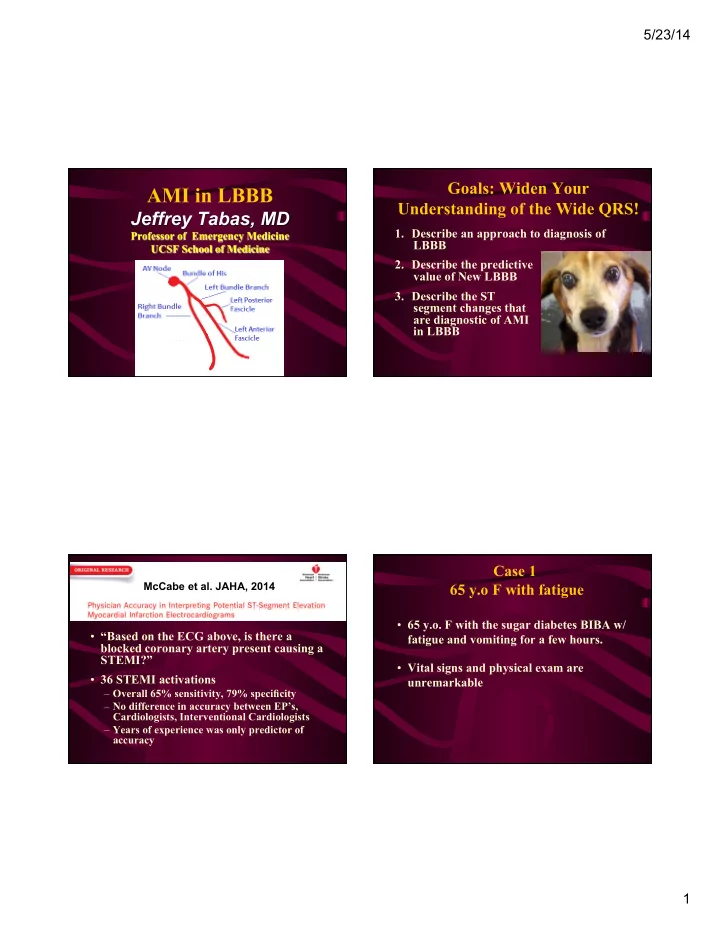
Goals: Widen Your Understanding of the Wide QRS! 1. Describe an - - PDF document

goals widen your understanding of the wide qrs
SMART_READER_LITE
LIVE PREVIEW

Goals: Widen Your Understanding of the Wide QRS! 1. Describe an - - PDF document

5/23/14 Goals: Widen Your Understanding of the Wide QRS! 1. Describe an approach to diagnosis of LBBB 2. Describe the predictive value of New LBBB 3. Describe the ST segment changes that are diagnostic of AMI in LBBB Case 1 McCabe et al.


slide-1
SLIDE 1

5/23/14 1

Goals: Widen Your Understanding of the Wide QRS!

  • 1. Describe an approach to diagnosis of

LBBB

  • 2. Describe the predictive

value of New LBBB

  • 3. Describe the ST

segment changes that are diagnostic of AMI in LBBB

  • “Based on the ECG above, is there a

blocked coronary artery present causing a STEMI?”

  • 36 STEMI activations

– Overall 65% sensitivity, 79% specificity – No difference in accuracy between EP’s, Cardiologists, Interventional Cardiologists – Years of experience was only predictor of accuracy McCabe et al. JAHA, 2014

Case 1 65 y.o F with fatigue

  • 65 y.o. F with the sugar diabetes BIBA w/

fatigue and vomiting for a few hours.

  • Vital signs and physical exam are

unremarkable

slide-2
SLIDE 2

5/23/14 2

1) 65 y.o. F with fatigue

Case 1 65 y.o F with fatigue

  • No Old ECG available
  • Called for records to another hospital

and faxed consent

  • While awaiting response, patient went

into Vfib, was resuscitated, rushed to cath and found to have 100% LAD

Case 1 65 y.o F with fatigue

3 Questions

  • 1. Is this LBBB?
  • 2. Is this NEW LBBB?
  • 3. Can we read ST segment abnormalities?
slide-3
SLIDE 3

5/23/14 3

  • The QRS is wide, usually > 0.14
  • Look at TERMINAL QRS wave in Lead V1

and Lead 1 (V6)

  • LBBB = Terminal R in 1 (V6) and Slurred S in V1

Left Bundle Branch Man

  • Left hand is up for LBBB
  • Left hand represents left side - lateral leads
  • Right hand represents right side – V1
  • Hand points in direction of the final wave of the

QRS (i.e. R wave points up, Q and S waves point down

LBBB

slide-4
SLIDE 4

5/23/14 4

2) Is this NEW LBBB?

Indications for PCI and Thrombolytics

  • 1mm ST elevation in 2 contiguous leads
  • r
  • Left Bundle Branch not known to be old

Predictive Value of New or Presumed New LBBB

Chang, Am JEM, 2009

  • 55 with New LBBB = 7.3% AMI
  • 136 with Old LBBB = 5.2% AMI
  • 7746 with no LBBB = 6.1% AMI

New LBBB is not predictive of AMI Indications for PCI and Thrombolytics

  • 1mm ST elevation in 2 contiguous leads
  • r
  • Left Bundle Branch not known to be old

2) Is this NEW LBBB?

2013 ACCF/AHA Guideline for the Management

  • f ST-Elevation Myocardial Infarction

“New or presumably new LBBB at presentation occurs infrequently, may interfere with ST-elevation analysis, and should not be considered diagnostic of acute MI in isolation.”

3) Can we read the ST segments (i.e. Dx AMI) in LBBB?

2013 ACCF/AHA Guideline for the Management

  • f ST-Elevation Myocardial Infarction
  • Criteria for ECG diagnosis of acute STEMI in

the setting of LBBB have been proposed (see Online Data Supplement 1)

slide-5
SLIDE 5

5/23/14 5

  • Iso-electric or
  • Discordant (ST segment opposite the terminal QRS)
  • This is true for

every lead

LBBB ACUTE MI in LBBB

CONCORDANT ST Elevation CONCORDANT ST Depression

ACUTE MI in LBBB

EXCESSIVE DISCONCORDANCE ST:S wave = 0.25 or more

slide-6
SLIDE 6

5/23/14 6

Acute MI in LBBB

Annals of EM, October 2008

Acute MI in LBBB

  • 1 mm Concordant ST elevation

– 10 studies with 1,614 patients – Sensitivity = 20% (NLR = 0.8) – Specificity of 98% (PLR = 7.9)

  • 5 mm Discordant ST elevation

– Specificity of 80% (PLR = 4.5)

Acute MI in LBBB

Annals of EM, August 2012

ST segments in AMI/LBBB

  • Excessive Discordance

– ST elevation: S wave >= 1:4 – ST depression: R wave >= 1:4 – Significant improvement in sensitivity and specificity

slide-7
SLIDE 7

5/23/14 7

1) 65 y.o. F with fatigue

28 9

STEMI! 1) 65 y.o F with fatigue – baseline LBBB

22 3

NOT STEMI! Another pt with LBBB and Chest Pain

c

4 16 2 4

Yet another pt with LBBB and Chest Pain

c

slide-8
SLIDE 8

5/23/14 8

ACUTE MI in Paced Rhythms

  • Same as with LBBB!

80 y.o. M with CP and pacer Prior ECG Take Home Points Dx of AMI in LBBB

  • 1. Determine if LBBB

– LBBB man

  • 2. Do not use New LBBB to predict AMI
slide-9
SLIDE 9

5/23/14 9

Take Home Points Dx of AMI in LBBB

  • 3. Determine if AMI is present

Expected ST segments – Opposite terminal R or S wave – or isoelectric – in every lead

Take Home Points Dx of AMI in LBBB

  • 3. Determine if AMI is present

Acute MI

  • 1 mm Concordant ST segments (in same direction

as last wave of QRS) in any lead

  • Excessive Discordance of ST segments (opposite

to terminal R or S wave) – ST:S wave ratio > = 1:4

Treatment of Chest Pain with LBBB or a Paced Rhythm

  • If ST changes diagnostic of AMI then

– Reperfuse immediately (Lytics or Cath Lab) if

  • If no concerning ST changes then

– Involve cardiology consultant early if possible – Reperfuse for high suspicion of STEMI (> 50%?) – Use cardiac markers or formal echo to rule out AMI in the rest

Widen your knowledge and lighten your load!