1 Acuitas Medical, Swansea, United Kingdom, 2 University Hospital - - PowerPoint PPT Presentation

1 acuitas medical swansea united kingdom 2 university
SMART_READER_LITE
LIVE PREVIEW

1 Acuitas Medical, Swansea, United Kingdom, 2 University Hospital - - PowerPoint PPT Presentation

1 Acuitas Medical, Swansea, United Kingdom, 2 University Hospital Llandough, United Kingdom, 3 University of Cambridge School of Clinical Medicine, Cambridge, United Kingdom, 4 Swansea University, Swansea, United Kingdom Selective 1D highly


slide-1
SLIDE 1

1Acuitas Medical, Swansea, United Kingdom, 2University Hospital Llandough, United Kingdom, 3University of Cambridge School of Clinical Medicine, Cambridge, United Kingdom, 4Swansea
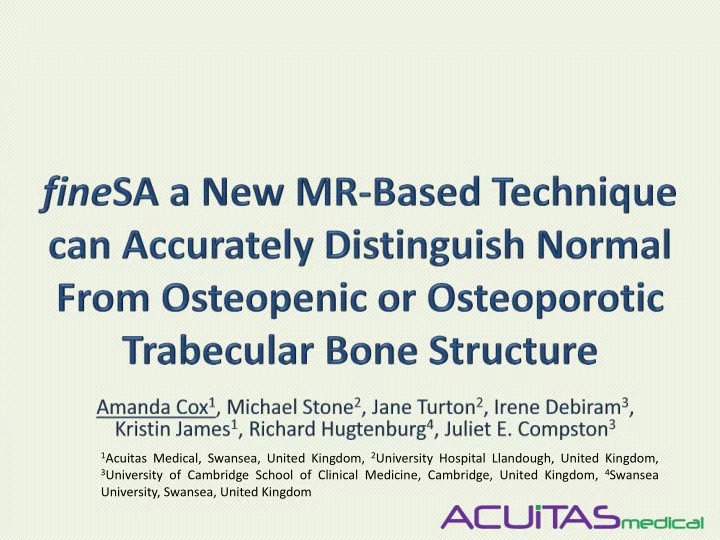
University, Swansea, United Kingdom

slide-2
SLIDE 2

Fourier based analysis of profile within region

  • f

interest gives fine structure spectra – Noise and confidence interval calculations from multiple repetitions. Inverse Fourier transform echo gives 1D signal intensity profile as function of position along the prism. Define regions of interest. 1D highly sampled, spatially encoded complex echoes along r. Multiple repetitions. → Significant signal advantage

  • ver

imaging. Selective excitation

  • f

internal volume - “prism” - through modified pulse

sequence.

0.0 0.2 0.4 0.6 0.8 1.0 1.2 1.4 1.6 1.8 2.0

Intensity Structural wavelength (mm)

Spectrum Mean Noise 68% CI

20 40 60 80 100 120 140 0.5 1 1.5 2 2.5 x 10

  • 6

Position along prism (mm) Magnitude

r

r

MRI voxel fineSA “voxel”

slide-3
SLIDE 3

0.5 1 1.5 2 Structural Wavelength (mm)

slide-4
SLIDE 4
  • The study was run at the University of Cambridge Wolfson

Brain Imaging Centre using a Siemens 3T MRI scanner.

  • Cohort:
  • All patients were recruited from Professor Juliet Compston’s clinic at

Addenbrookes Hospital.

  • 20 post-menopausal women aged >55 years.
  • Not receiving treatment with Teriparatide, Strontium Ranelate, or intra-

venous bisphosphonates.

  • Not been treated with oral bisphosphonates for longer than six months
  • Had undergone DXA scan to assess bone health.
  • 6 classified as normal by DXA using WHO criterion, 6 classified as
  • steopenic, 8 classified as osteoporotic.
slide-5
SLIDE 5

ML AP SI ML SI AP

slide-6
SLIDE 6

0.0 0.5 1.0 1.5 2.0 2.5 Structural wavelength (mm)

t -0.4 t -1.9 t -2.8

0.0 0.5 1.0 1.5 2.0 2.5 Structural wavelength (mm) Age 23 normal Postmenopausal

  • steoporotic

Age matched normal BMD

slide-7
SLIDE 7

Hip M/L fineSA Hip A/P fineSA Spine S/I fineSA Spine M/L fineSA Correlation with T- Score r=-0.5316 p=0.0192 r= 0.5787 p=0.0075 r= 0.4705 p=0.0363 r=0.5318 p=0.0158

slide-8
SLIDE 8
  • Sensitive to changes in bone
  • Current resolution around 0.3mm
  • 1 minute acquisition
  • Ionising radiation free
  • Applicable to the central skeleton
  • No additional hardware required
slide-9
SLIDE 9
  • A larger in-vivo study led by Dr. Diego Martin is

underway with University of Arizona, Tucson.

  • A two centre study of treatment induced bone loss in
  • ncology patients is underway in the US and UK.
  • A version of the tool is slated for release at the end of

this year.