The Wide QRS Complex Goals: Widen Your Jeffrey Tabas, MD - - PDF document

the wide qrs complex
SMART_READER_LITE
LIVE PREVIEW

The Wide QRS Complex Goals: Widen Your Jeffrey Tabas, MD - - PDF document

2/5/2013 The Wide QRS Complex Goals: Widen Your Jeffrey Tabas, MD Understanding! Professor of Emergency Medicine 1. Describe the ECG findings of left UCSF School of Medicine bundle branch block 2. Describe the diagnosis of acute MI when


slide-1
SLIDE 1

2/5/2013 1

The Wide QRS Complex

Jeffrey Tabas, MD

Professor of Emergency Medicine UCSF School of Medicine

Goals: Widen Your Understanding!

  • 1. Describe the ECG findings of left

bundle branch block

  • 2. Describe the

diagnosis of acute MI when LBBB pattern is present

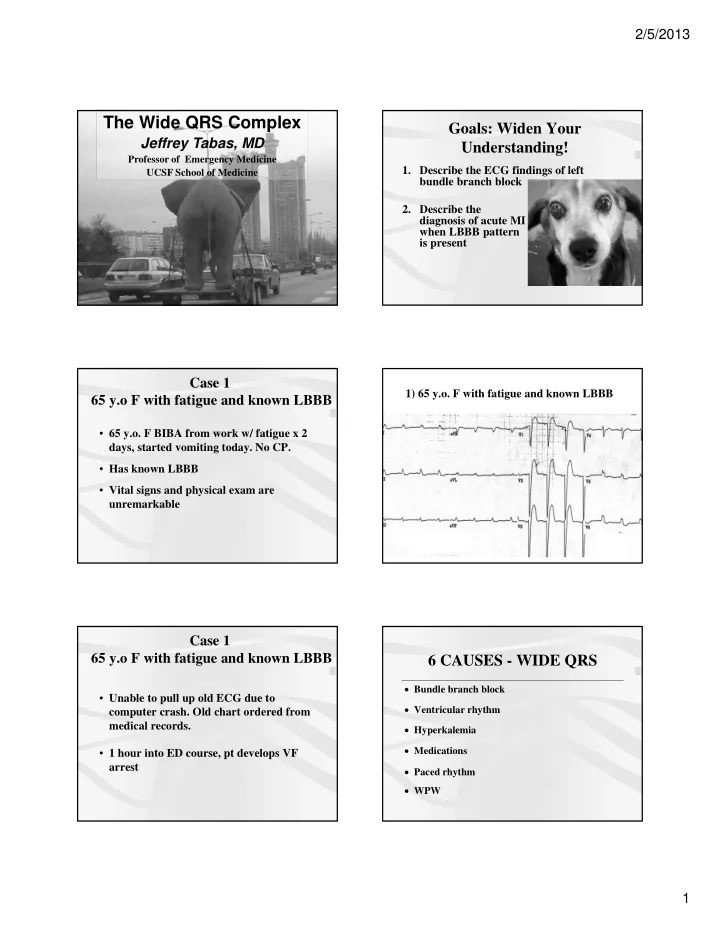
Case 1 65 y.o F with fatigue and known LBBB

  • 65 y.o. F BIBA from work w/ fatigue x 2

days, started vomiting today. No CP.

  • Has known LBBB
  • Vital signs and physical exam are

unremarkable 1) 65 y.o. F with fatigue and known LBBB

Case 1 65 y.o F with fatigue and known LBBB

  • Unable to pull up old ECG due to

computer crash. Old chart ordered from medical records.

  • 1 hour into ED course, pt develops VF

arrest

6 CAUSES - WIDE QRS

 Bundle branch block  Ventricular rhythm  Hyperkalemia  Medications  Paced rhythm  WPW

slide-2
SLIDE 2

2/5/2013 2 Case 1 - Questions

  • How do we diagnose LBBB?
  • Can we read ST deviation?

Terminal QRS T Wave P Wave QRS

BUNDLE BRANCH BLOCKS

 The QRS is wide, usually > 0.14  Look at TERMINAL portions of the QRS in Lead V1 and Lead 1 (V6)

 RBBB = Terminal R in V1 and Slurred S in 1 (V6)  LBBB = Terminal R in 1 (V6) and Slurred S in V1

 The ST segments are opposite to the terminal portion of the QRS

slide-3
SLIDE 3

2/5/2013 3 Left Bundle Branch Man

LBBB: Normal ST Segments

 Iso-electric or  Discordant (ST segment opposite the terminal QRS)  This is true for every lead

ACUTE MI in LBBB

 Concordant ST segments (same direction as QRS) - 1 mm in any lead OR  Excessively Discordant ST segments (opposite QRS but inappropriately large: ST height to S wave height = 1/4 or more)

Ischemic Findings in LBBB

Annals of EM, October 2008

Ischemic Findings in LBBB

  • 1 mm Concordant ST elevation

–10 studies with 1,614 patients –Sensitivity = 20% (NLR = 0.8) –Specificity of 98% (PLR = 7.9)

  • 5 mm Discordant ST elevation

–Specificity of 80% (PLR = 4.5)

slide-4
SLIDE 4

2/5/2013 4

Ischemic Findings in LBBB

Annals of EM, August 2012

Ischemic Findings in LBBB

  • Excessive Discordance

–ST:S wave = 1:4 or more –Sensitivity 58% (vs 30%)

ACUTE MI in LBBB

CONCORDANT ST Elevation CONCORDANT ST Depression

ACUTE MI in LBBB

EXCESSIVE DISCONCORDANCE ST:S wave = 0.25 or more 1) 65 y.o F with known LBBB - baseline Another pt with LBBB and Chest Pain

c

slide-5
SLIDE 5

2/5/2013 5

Yet another pt with LBBB and Chest Pain

c

2) 86 F with CP/SOB and pacer 86 F with CP/SOB and pacer

5 4 1 15 3

2) Prior ECG How About LBBB “Not Known to be Old?”

Current Indications for PCI and Thrombolytics

  • 1mm ST elevation in 2 contiguous leads
  • r
  • Left Bundle Branch not known to be old

New or Presumed New LBBB

Chang, Am JEM, 2009

  • 55 with New LBBB = 7.3% AMI
  • 136 with Old LBBB = 5.2% AMI
  • 7746 with no LBBB = 6.1% AMI

New LBBB is not predictive of AMI

slide-6
SLIDE 6

2/5/2013 6 Neeland, JACC, July 2012

For LBBB

  • Use Sgarbossa criteria
  • If absent, use rapid serial cardiac biomarkers,

bedside echo, or both

Take Home Points Dx of AMI in LBBB/Pacing

  • Determine if LBBB is present

– LBBB man - Monophasic R in V1, Slurred S in 1 (V6)

  • Expected ST segments

– Opposite terminal QRS – or isoelectric – in all leads

Take Home Points Dx of AMI in LBBB/Pacing

Acute MI

  • Concordant ST segments (in same direction as

QRS) – 1 mm in any lead

  • Excessively Discordant ST segments (opposite

direction as QRS) – ST:S wave = 1:4 or more – ST >=5 mm (not as accurate)

Pearls Dx of AMI in LBBB not known to be old

AHA/ACC Approach

  • Presumed New LBBB is an indication for

reperfusion

  • However, this is not predictive of AMI

My Approach

  • Activate cath lab if moderate suspicion (>25%)
  • Initiate thrombolytics for high suspicion (> 50%)
  • Use cardiac markers or formal echo for the rest.

Involve consultant as early as possible