SLIDE 1
Inequality
SLIDE 2
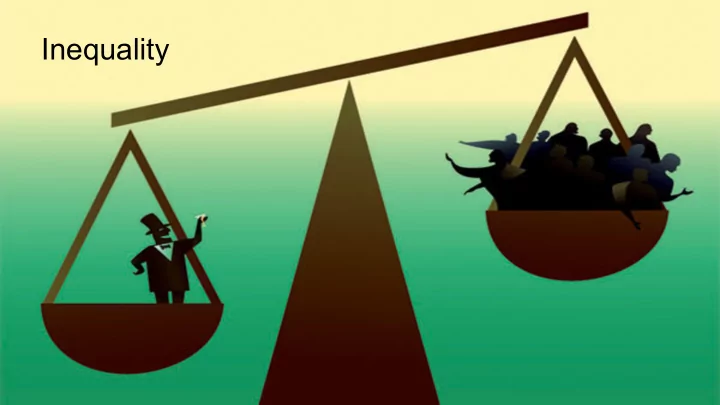
This lesson considers the issue of inequality and whether new technology will widen the gap between the rich and the poor. It is based on the idea that artificial intelligence will bring about massive changes in the way we live. Read through the PPT and the attached article, and answer the questions at the end of the PPT
SLIDE 3 Inequality Inequality is a feature of the society in which we live. Indeed, inequality has been a feature of all societies over the past 13,000 years. However, the gap between the ‘haves’ and the ‘have-nots’ appears to be widening. For example, the number of people ‘rough sleeping’ in Britain has increased by
- ver 200% over the past ten years – during this same time, the very rich have
increased their share of the nation’s wealth. Should we be concerned about inequality, or is it an inevitable featire of all societies?
SLIDE 4
SLIDE 5
Global Inequality And it is not just in Britain where you will find inequality. In every single country on the planet, there are those who live in desperate poverty, whilst the rich live comfortably with food and housing to spare. It is estimated that over 2.5 billion people (that’s roughly a third of all people living on the planet!) do not have access to clean water and basic sanitations (toilets)
SLIDE 6
SLIDE 7
SLIDE 8
So, what is your view of inequality? – Answer these questions . . . . [01] Is inequality inevitable? [02] Is it something that need to be challenged and changed? [03] If we do need to tackle inequality, how would a government do so? [04] Do those people living in poverty have only themselves to blame for their social situation? [05] Do the rich deserve their wealth?
SLIDE 9
SLIDE 10
This is a homeless person in the UK. He sometimes does ‘bad’ things, such as taking drugs or stealing from shops. He is also incredibly poor. He relies on handouts from the public and if he can afford it, sleeps in a shelter: he ‘lives’ in poverty.
SLIDE 11
Is he ‘poor’ because he does (and has done) ‘bad’ things? Does he do (and has done) ‘bad’ things because he is poor? Which of these two statements do you agree with? Which one do you think most sociologists agree with?
SLIDE 12 https://www.youtube.com/watch?v=ehV-MmuvVMU
Watch this short video on the evolution of homo-sapiens (you may be forgiven for thinking that this is a Biology lesson!)
SLIDE 13 Read the attached by Yuval Noah Harari – he warns of the danger
- f artificial intelligence, and how this has the potential to create
even greater inequality in the future.
SLIDE 14
Yuval Noah Harari wrote this brilliant book – ‘Sapiens’. If you want something interesting to read over the summer break, then try this (it is a mixture of Sociology, History, Politics and Biology)
SLIDE 15
Answer these short questions (you may need to research the answers) [01] What is meant by ‘artificial intelligence’? [02] What is meant by the ‘polarisation of wealth’? [03] What is capitalism? [04] What is communism? [04] The article mentions the ideologies (ideas) of humanism, liberalism and socialism: what do these three terms mean? [04] I’d like to know your opinion to this last question: Should we be trying to make society more equal, or is inequality just an inevitable feature of all societies? (write a paragraph on this)