legal considerations for dynamic management in the high seas - - PowerPoint PPT Presentation

legal considerations for
SMART_READER_LITE
LIVE PREVIEW

legal considerations for dynamic management in the high seas - - PowerPoint PPT Presentation

Beyond static spatial management: scientific and legal considerations for dynamic management in the high seas Guillermo Ortuo Crespo, Joanna Mossop, Daniel Dunn, Kristina Gjerde, Elliott Hazen, Gabriel Reygondeau, Robin Warner, Patrick


slide-1
SLIDE 1

Beyond static spatial management: scientific and legal considerations for dynamic management in the high seas

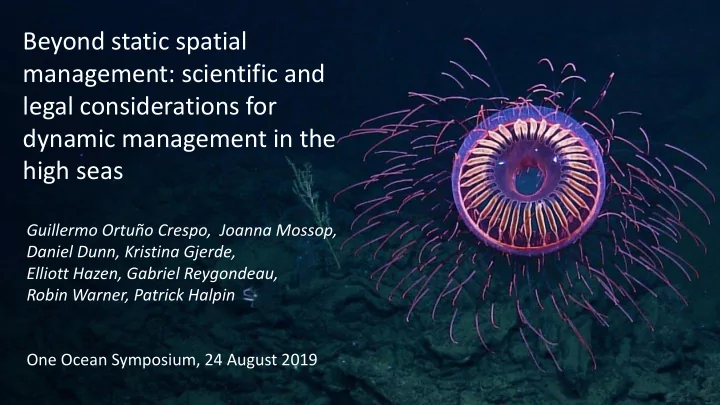
Guillermo Ortuño Crespo, Joanna Mossop, Daniel Dunn, Kristina Gjerde, Elliott Hazen, Gabriel Reygondeau, Robin Warner, Patrick Halpin One Ocean Symposium, 24 August 2019

slide-2
SLIDE 2

Overview

  • The oceanography of the high seas

changes across a wide range of temporal scales.

  • Outline of temporal scales that may be

relevant to ABMTs

  • Ephemeral
  • Intra-annual
  • Inter-annual
  • Multi-decadal
  • Suggestions for text to ensure the

BBNJ ILBI is future-proof.

slide-3
SLIDE 3

Sig ignif ificant advancements and opportunities sin ince UNCLOS

  • The processes at each temporal scale have

unique impacts on the distribution, abundance, composition and size of BBNJ.

  • Technological and computational advancements

allow us to map, monitor and predict the distribution of humans and BBNJ in near-real time and into the future.

  • Opportunities for capacity development, increase

efficiency of industry and reduce BBNJ impacts.

slide-4
SLIDE 4

Ephemeral: technological advancements allow for monitoring

Advances in geospatial technologies (e.g. satellite imagery or AIS tracking technology) allow for near-real time monitoring and modelling of BBNJ and H(umans)BNJ.

Howell et al., 2008 Dynamic Ocean Management

slide-5
SLIDE 5

Intra-annual: reliable & predictable

Dunn et al, Policy Brief: Deep, Distant and Dynamic 2017

  • Seasonal

/ predictable changes in

  • ceanographic

conditions

  • r

persistent features may allow for efficient intra-annual closures or rules to fishing and shipping to reduce impacts on BBNJ.

slide-6
SLIDE 6

Inter-annual: semi-predictable – ‘shocks’ to BBNJ

  • Inter-annual climatic cycles change the

biology, physics and chemistry of the high seas in semi-predictable ways.

  • If unaccounted for shift in climatic indices

may deem intra-annual closures ‘useless’.

  • Large-scale ocean die-offs & redistribution
  • f resources and BBNJ is well documented.
  • Serious implications for industry. BBNJ can

increase knowledge and work with sectoral

  • rganizations.

El Niño Southern Oscillation

slide-7
SLIDE 7

Multidecadal: preparing for future oceans

  • We expect changes in the…

[1] abundance; [2] vertical & horizontal distribution; [3] phenology (‘biological clock’); [4] size; [5] behavior; [6] extinction risk; [7] predator-prey relationships; … of BBNJ under climate change.

slide-8
SLIDE 8

Textual Recommendations: Art 1

“… a tool for a defined area, through which one or several sectors

  • r activities are managed across temporal or spatial scales with

the aim of achieving particular conservation and sustainable use

  • bjectives”
slide-9
SLIDE 9

Proposals for ABMTs: Article 17

(4) Proposals shall contain the following elements: (a) A description of the area that is the subject of the proposal based

  • n geographic or other characteristics

… (f) A description of the proposed conservation and management measures to be adopted to achieve the specified objectives Query whether additional provision is needed: (bis) Delineation of zones within the proposed area, if relevant, and any specific management measures to be adopted within each of those zones

slide-10
SLIDE 10

Monitoring and Review: Art 21

  • 4. Following the review the COP shall, as necessary, take decisions on the

revision of ABMTs, including MPAs, including any associated conservation and management measures, on the basis of an adaptive management approach and taking into account the best available scientific information including traditional knowledge, the precautionary approach, the ecosystem approach, and the goal that any revision should achieve the original

  • bjective of the ABMT as much as practicable.

[Alt 2] …The duration of MPAs and related conservation and management measures shall be specified. These areas and related measures shall terminate automatically upon the expiration of the time period, unless

  • therwise decided by the same body that decided on the initial

establishment.

slide-11
SLIDE 11

Thank you!

slide-12
SLIDE 12

Just like human beings, biodiversity in the high seas respond to processes across a wide range of temporal scales High seas oceanography Homo sapiens Temporal scales of relevance

U.S. recession time series (‘shocks’ to the system) ENSO cycle (‘shocks’ to the system) Dynamic features affect short-term distribution and behavior Predictable seasonal patterns of productivity and consumption Multi-annual cyclical or partially cyclical shocks Multidecadal change – uncertainty and scenarios

slide-13
SLIDE 13

High seas oceanography Homo sapiens Temporal scales of relevance

U.S. recession time series (‘shocks’ to the system) ENSO cycle (‘shocks’ to the system)

Dynamic features affect short-term distribution and behavior

Predictable seasonal patterns of productivity and consumption

Multi-annual cyclical or partially cyclical shocks Multidecadal change – uncertainty and scenarios

Global human population trends

Monthly change in chlorophyll productivity Dynamic changes in distribution and behavior