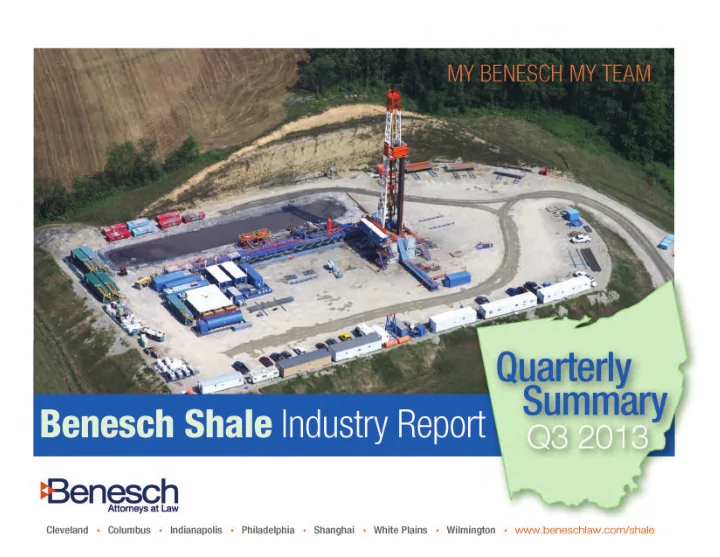
2 1. Top Issues and Considerations Considerations Top Issues - - PowerPoint PPT Presentation

2
SMART_READER_LITE
LIVE PREVIEW

2 1. Top Issues and Considerations Considerations Top Issues - - PowerPoint PPT Presentation

Contents 1. Top Issues and Considerations 3 2. Shale Industry Moves 4 3. Ohio Shale Infrastructure 7 4. Government 10 5. School Districts 11 2 1. Top Issues and Considerations Considerations Top Issues Interest from drillers is


slide-1
SLIDE 1
slide-2
SLIDE 2

Contents

  • 1. Top Issues and Considerations

3

  • 2. Shale Industry Moves

4

  • 3. Ohio Shale Infrastructure

7

  • 4. Government

10

  • 5. School Districts

11

2

slide-3
SLIDE 3

Top Issues

Considerations

Interest from drillers is shifting south into Harrison, Belmont, Monroe, Guernsey and Noble counties, which have become the drilling hot spot in eastern

  • Ohio. The trend is said to lead to Washington County,

“the next ground zero” for the Ohio O&G boom. The unveiling of well results are redefining the shale landscape for several players. Chesapeake, an early lessee in the Utica rush, seems slightly out of target at the moment, while Gulfport is well positioned. Aubrey McClendon’s American energy, which has received funds from PE firms and is now acquiring acreage, is running ads and trying to lease land in these counties. Work on the $1.5-billion Blue Racer Midstream project is progressing nicely. The $500-million Natrium cryogenic processing plant in northern West Virginia is up and running, and two other processing plants, each capable of handing 200 Mmcf/d, will be built in Monroe and Mahoning counties. The Blue Racer project also secured a five-year, $800-million credit facility, which can be expanded to $1 billion in the future. Plenty of other infrastructure projects are also progressing, but Blue Racer is one of the biggest. The positive development of this major project is good news for drillers, who will be able to increase their production. Other big infrastructure projects competing for who will be first to put processing and pipeline projects into service are Bluegrass Pipeline and ATEX. Chesapeake cut a total of 1,200 jobs this year, with the latest swing of the ax hitting its Oklahoma

  • perations the hardest (640 jobs cuts). Its PR

department in the Utica and Marcellus was also eliminated, as well as many other jobs across the

  • rganization.

The cuts are part of the company’s efforts to restructure, following the departure of Aubrey McClendon. Carl Icahn – who owns close to 10% of the company now – is an influential force pushing for these changes. Although CEO Doug Lawler said the restructuring is now done, he also mentioned there could be “future asset sales”. This is in line with corporate raid tactics, and raises speculations that Chesapeake might soon – or already - be on sale.

  • 1. Top Issues and Considerations

3

slide-4
SLIDE 4
  • 2. Shale Industry Moves

E&P company news

  • Chesapeake Energy reported Q2 profit of $457 million, a sharp drop from $929

million YOY, but last year's Q2 was bolstered by the sale of its gas gathering and processing business. Total revenue improved 38% to $4.67 billion, and average daily production increased 6.3% to 369 Bcfe of natural gas. CEO Doug Lawler praised the Utica play, and expects its production to increase sharply in late 2013, thanks to the start-up of gas processing facilities.

  • American Energy Partners already raised $1.2 billion in equity and debt financing

for deals in Ohio, much of it from PE firms Energy & Minerals Group ($500 million) and First Reserve ($200 million). American Energy is also buying drilling leases on more than 22,500 acres in southeastern Ohio for $284.3 million, and acquired some properties from Shell.

  • Gulfport Energy produced less oil than a year ago after selling off its Permian wells

and acreage to Diamondback, but saw a big increase in production of natural gas and NGLs. Natural gas production was up more than sixfold, while liquids production more than doubled. Gulfport increased their Utica Shale acreage by an additional 8,000 acres, and now own 145,000 leased Utica acres. The company also signed 10-year agreements with both Dominion East Ohio and Dominion Transmission to transport eastern Ohio’s natural gas to the Midwest and connecting pipelines.

  • Antero Resources' borrowing base under its bank credit facility was increased to

$2 billion, $250-million more than its previous borrowing base. In addition, lender commitments under the facility were increased by $300 million to $1.75 billion.

4

slide-5
SLIDE 5
  • 2. Shale Industry Moves

E&P company news (cont.)

  • Hess Energy reported Q2 net income of $1.431 billion, up from $549 million YOY.

Total revenue increased 23.6% to $4.1 billion. Q2 production was 341 MBOE/d, down 20.5% YOY, due in part to asset sales in Russia, the U.K. and Azerbaijan. This was offset by higher oil and gas prices and higher Bakken production.

  • Anadarko Petroleum reported earnings of $929 million, compared with a year-

earlier loss of $89 million. Revenue increased 8.5% YOY to $3.5 billion. Anadarko said daily sales volume increased to 750,000 Boe/d from 742,000 last year.

  • Halcon Resources’ Q2 revenues reached $214.3 million, compared to $23.3

million a year earlier. Net production increased 646% YOY to an average of 29,165 Boe/d. Q2 production was comprised of 83% oil, 5% NGLs and 12% natural gas. The Utica is also drawing interest from new players:

  • U.S. Petroleum Exploration, a company created by an investor from the

Mahoning Valley and Canada, set up shop in the Mahoning Valley to play a part in the Utica development. It has acreage in Coshocton, Guernsey and Belmont counties.

  • Magnum Hunter Resources sold its acreage in the Eagle Ford to turn its focus to

the Utica, explaining that the EUR of each well in the Utica could be double (or greater) than what it was seeing in the Eagle Ford.

5

slide-6
SLIDE 6
  • 2. Shale Industry Moves

Other E&P News

  • Representatives from the Utica Landowners Group of Coshocton and Muskingum

counties, which has hundreds of landowners in each county and about 90,000 acres

  • f potentially oil-rich land enrolled, have joined together to get the most bang for

their acreage buck from energy companies, without the need for attorney fees. Their minimum position reportedly stands at $5,000 an acre and 20% royalty.

  • EQT and Green Field Energy Services successfully completed multiple fracturing

stages using pumps powered by 100% "field" gas supplied directly from a nearby Marcellus natural gas well. Private equity

  • Eclipse Resources acquired Oxford Oil, with approximately 184,000 net acres in

Ohio and 13.8 Bcfe of proved developed producing reserves. Eclipse now owns 90,000 acres in Belmont, Guernsey, Monroe, Noble and Harrison counties.

6

slide-7
SLIDE 7
  • 3. Ohio Shale Infrastructure

Midstream More crude oil is moving around the U.S. on trucks, barges and trains than at any point since the government began keeping records in 1981. New pipeline projects are popping up and existing ones are progressing:

  • Antero Resources will spend over half a billion dollars on a pipeline to transport

water from the Ohio River to fracking sites in Ohio and West Virginia.

  • The Rockies Express pipeline is looking to to reverse its direction of flow in order

to move gas westward out of the Marcellus/Utica plays and into Midwest markets.

  • Gulfport signed 10-year agreements with both Dominion East Ohio and Dominion

Transmission to transport up to 100 Mmcf/d of eastern Ohio’s natural gas to the Midwest and connecting pipelines. Another 150 Mmcf/d of capacity will be available for shipment to two pipelines by late 2014.

  • Hess agreed to terms with PVR Partners for it to build, own and operate a 45-mile

natural gas trunkline of at least 20 in. and 450-Mmcfd capacity to serve Hess's lean gas production in eastern Ohio. The total capital investment will be in the range of $125-150 million.

  • Kinder Morgan and MarkWest signed a letter of intent to form a midstream JV to

pursue two projects in Ohio, Pennsylvania and West Virginia: The first project is a 400-MMcf/d cryogenic processing complex in Tuscarawas County, Ohio, while the second involves the development of a 200,000-bpd, C2+ NGL pipeline. The two are also planning another $1-billion natural-gas processing plant and pipeline in Uhrichsville, Ohio to carry liquids to the Gulf Coast.

  • Sunoco Logistics Partners’ pipeline, which can handle up to 50,000 barrels per

day, will begin to ship ethane extracted in western Ohio and western Pennsylvania to refineries in Canada. Sunoco also plans to construct an 85,000-barrel-per-day pipeline to move petroleum from Fostoria, Ohio to Pittsburgh, Pa.

7

slide-8
SLIDE 8
  • 3. Ohio Shale Infrastructure

Midstream (cont.)

  • The first phase of the UEO Midstream project, a JV owned by Access Midstream,

M3 and EV Energy Partners, is now in service. It is the first fully-integrated gathering, processing and fractionation complex in operation in eastern Ohio. UEO Midstream also awarded a $5-million engineering and procurement support contract to ENGlobal for a 200-MMcfd cryogenic gas processing plant in Carroll County.

  • Pinto Energy said it will build a 2,800-bpd gas-to-liquids plant in Ashtabula

County, converting natural gas from the Utica and Marcellus shale plays into specialty products such as solvents, lubricants and waxes.

  • The board of directors of Williams Companies signed off on its plan to construct the

Bluegrass pipeline to move NGLs from the Utica/Marcellus to the Gulf Coast.

  • EQT Corp is selling its Sunrise pipeline to EQT Midstream Partners for $500
  • million. The assets include a 41.5-mile pipeline between W.V. and Pa., a compressor

station and an interconnect with the Texas Eastern pipeline in Greene County. Other midstream news include:

  • The Wheeling Planning Commission voted to allow GreenHunter to proceed with

the first phase of its project to transport natural gas fracking waste by barge. As it awaits approval to actually barge the waste, the company’s subsidiary GreenHunter Water opened a brine injection plant in Newport, Washington County.

  • Over the past two and a half years, the O&G industry reportedly spent more than $9

million on road upgrades in Jefferson County as part of road-use agreements.

  • Ohio Jobs and Commerce will provide Salem township with $250,000 for road

upgrades to Buckeye Transfer Realty transloading facility, which handles trainloads

  • f fracking sand and is anticipating an increase in heavy traffic to the facility.
  • NiSource said it would spend $1.5 million to improve roads in Mahoning County

damaged by the company's construction of a pipeline and processing facility.

8

slide-9
SLIDE 9
  • 3. Ohio Shale Infrastructure

Downstream

  • CNG Fuel, an India-based company, finalized the site location for a fueling station

for CNG in Harrison Township. The station will cost from $1.2 million to $2 million.

  • Construction is complete on a CNG filling station in Millersburg, Ohio, to supply CNG

to anchor fleets Mt. Eaton Pallet and Trademark Exteriors.

  • The agriculture industry could also benefit from shale development, as natural gas

is a key element in the production of nitrogen fertilizer used in farming. As an example, the Andersons Inc., which sells fertilizer from a Trumbull County location, is building a 1.5-million-gallon fertilizer storage tank in Lordstown, constructing a 3,500-square-foot building and planning to build six 30,000-gallon storage tanks that would hold specialty fertilizers. Supply chain

  • Ohio Oil Gathering, a subsidiary of Crosstex Energy, reactivated its Black Run

rail terminal located on the Ohio Central Railroad, the first facility to move light oil condensate out of the region to refinery and petrochemical markets.

  • The Muskingum Watershed Conservancy District approved a water sale deal to

Antero from Seneca Lake for August through October. Antero will pay $6 per 1,000 gallons, and the deal sets a maximum amount of 138 million gallons of water. In total, the MWCD has reportedly sold over 59 million gallons for $500,000 in short- term water sales. It also made over $77 million since 2011 thanks to leases signed with Utica Shale.

9

slide-10
SLIDE 10
  • 4. Government

Regulatory

  • The ODNR said the state’s reporting system for horizontal wells will change from an

annual basis to a quarterly basis starting Jan. 2014.

  • Five Ohio municipalities (Broadview Heights, Euclid, Mansfield, North Royalton and

Amesville) weighed in on behalf of home rule protections against fracking operations in the Beck Energy - Munroe Falls Ohio Supreme Court case, and for the first time, Ohio’s highest court will hear a case that challenges the law that gives the ODNR sole authority to permit and regulate oil and gas drilling.

  • A bill sponsored by Rep. Mike Pompeo (R.-Kan.) could see the approval of natural

gas lines move faster. Regulatory agencies are currently required to act within 90 days of the completion of an environmental study by the FERC, but the bill would provide an automatic permit approval if an agency hasn't acted within 90 days, or 120 days if the agency can show cause for an extension.

  • State Reps. Sean J. O'Brien (D-Trumbull) and David Hall (R-Holmes) are preparing

legislation to give state tax credits to people and companies who buy or convert trucks and cars to burn both natural gas and gasoline. Economic Development

  • The biennial budget signed into law by Ohio Gov. John Kasich did not include his

long-sought increase in the tax rate on oil and gas produced by fracking. Kasich said he'd push that issue until an increase is approved by lawmakers.

  • Following a decision by the federal government to deny state governments their

50% share of royalties and lease payments for oil, gas and coal extraction from federal lands, Western lawmakers and governors protested, and the U.S. Department of the Interior changed course. The money will be returned, and so far totals approximately $111 million. Of that, Ohio will receive $11,798.

10

slide-11
SLIDE 11
  • 5. Schools/Training
  • Ohio State University is interested in studying a working shale well on university

land to research subjects such as waste water treatment. OSU researchers also want to open the school’s Eastern Agricultural Research Station to shale drilling to closely examine how fracking alters the environment.

  • Pipelines are said to be easing school budget cuts in Ohio, as they increase property

value of land they are buried under as well as its tax rates. For example, Springboro schools take in $3.5 million from the existing pipelines, expected to double to $7 million in 2015.

  • Hess Corporation partnered with the Eastern Gateway Community College

Foundation to offer $10,000 in scholarship funds to assist displaced workers and

  • ther students to pursue higher education at the local community college. Hess

anticipates several scholarships to be awarded, valued at up to $1,000 each.

  • West Virginia University's engineering school reported a significant increase in its oil

and gas program: projected fall 2013 enrollment shows there will be an estimated 276 undergraduate students, 45 graduate students and 14 Ph.D. students.

11