Introducing 2) Develop skills to utilize the online GENIE GENIE - - PDF document

introducing
SMART_READER_LITE
LIVE PREVIEW

Introducing 2) Develop skills to utilize the online GENIE GENIE - - PDF document

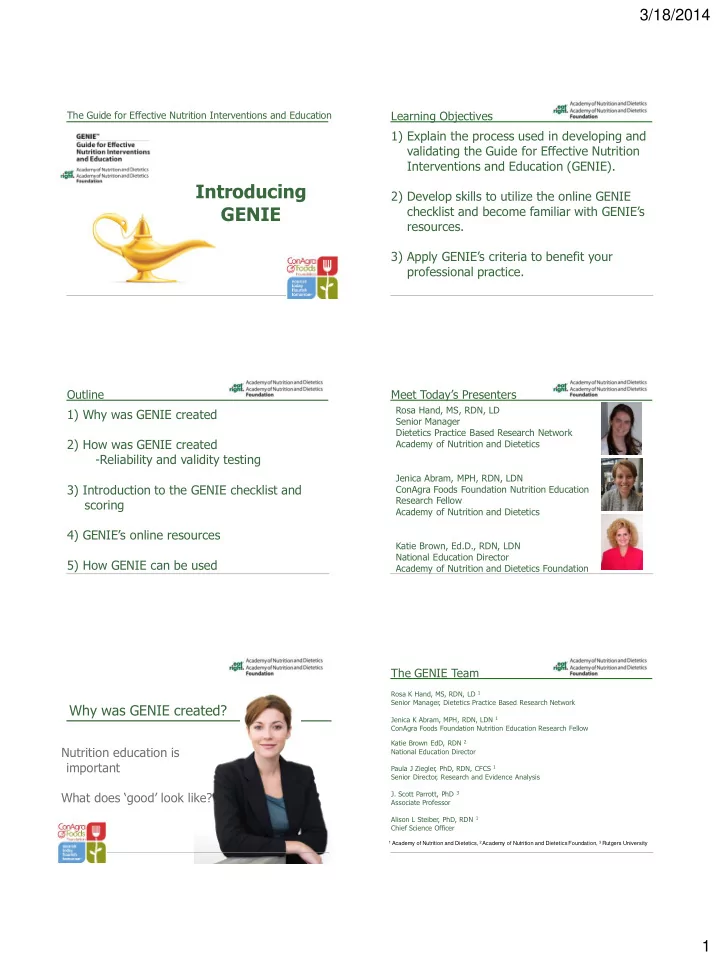
3/18/2014 The Guide for Effective Nutrition Interventions and Education Learning Objectives 1) Explain the process used in developing and validating the Guide for Effective Nutrition Interventions and Education (GENIE). Introducing 2) Develop


slide-1
SLIDE 1

3/18/2014 1

Introducing GENIE

The Guide for Effective Nutrition Interventions and Education

Learning Objectives

1) Explain the process used in developing and validating the Guide for Effective Nutrition Interventions and Education (GENIE). 2) Develop skills to utilize the online GENIE checklist and become familiar with GENIE’s resources. 3) Apply GENIE’s criteria to benefit your professional practice.

Outline

1) Why was GENIE created 2) How was GENIE created

  • Reliability and validity testing

3) Introduction to the GENIE checklist and scoring 4) GENIE’s online resources 5) How GENIE can be used

Meet Today’s Presenters

Rosa Hand, MS, RDN, LD Senior Manager Dietetics Practice Based Research Network Academy of Nutrition and Dietetics Jenica Abram, MPH, RDN, LDN ConAgra Foods Foundation Nutrition Education Research Fellow Academy of Nutrition and Dietetics Katie Brown, Ed.D., RDN, LDN National Education Director Academy of Nutrition and Dietetics Foundation

Nutrition education is important What does ‘good’ look like?

Why was GENIE created?

3/18/2014

The GENIE Team

Rosa K Hand, MS, RDN, LD 1 Senior Manager , Dietetics Practice Based Research Network Jenica K Abram, MPH, RDN, LDN 1 ConAgra Foods Foundation Nutrition Education Research Fellow Katie Brown EdD, RDN 2 National Education Director Paula J Ziegler , PhD, RDN, CFCS 1 Senior Director , Research and Evidence Analysis

  • J. Scott Parrott, PhD 3

Associate Professor Alison L Steiber , PhD, RDN 1 Chief Science Officer

1 Academy of Nutrition and Dietetics, 2 Academy of Nutrition and Dietetics Foundation, 3 Rutgers University

slide-2
SLIDE 2

3/18/2014 2

Academy Fellowships

Provides opportunities:

  • Work solely on one project
  • Mentorship by Academy staff
  • Meet experts in the area
  • Publish and present results of work

Goal is a mutually beneficial experience Fellow is selected by Academy staff based on application and interview

GENIE fellowship

  • First time this model has been used
  • Received 28 applications
  • Has resulted in 3 accepted conference

sessions, 2 pending manuscript submissions, and 1 pending abstract submission

  • Provided proof of concept for the fellowship

model

  • Unique opportunity for collaboration between

Foundation and Research team

What is GENIE?

  • A simple-to-use online

checklist

  • A rigorously validated

tool for designing, modifying or comparing nutrition education programs

  • A tool kit of resources

for program planners

Background

  • Nutrition education

program planners

  • Program reviewers

and funders

Who should use GENIE?

3 Step Process

  • Criteria development

and expert panel

  • Reviewer testing
  • Systematic literature

review

How was GENIE created?

Study Flow Chart

  • 1. Establish

Face and Content Validity

  • Identify thought leaders to participate in testing

(n=10).

  • Identify proposals to be reviewed (n=16).

Proposals sent to thought leaders for review and evaluation without knowledge of the new tool.

  • Expert Panel Meeting
  • Day One-Expert panel to come to consensus on

quality of each proposal (criterion establishment)

  • Day Two- Expert panel to determine essentiality

and clarity of each element of GENIE (Face and Content validity).

slide-3
SLIDE 3

3/18/2014 3

Study Flow Chart

  • 2. Criterion

Validity and Inter- rater Reliability

  • Develop data collection tool and procedures

for evaluating proposals, based on thought leader group input.

  • Recruit 13 reviewers from Academy's

Dietetics Practice Based Research Network (DPBRN)

  • Training in person at Academy Headquarters;

completion of three calibration proposals

  • Assessment of 12 proposals completed by 13

reviewers

Results

Reviewers agreed with experts

  • Strong relationship between expert and reviewer

score groups

Reviewers agreed with each other

  • Good agreement between reviewers across

proposals and across categories

Reviewer characteristics had no influence

  • Differences among reviewers accounted for a

low proportion of differences in proposal scores

Conclusions

GENIE performs well across reviewers and across various proposals- can be applied to a variety of programs Trained reviewer GENIE scores agreed with expert panel assessments- high degree of validity Trained reviewers agreed with each other- high degree of reliability

GENIE Format

GENIE Categories

1) PROGRAM DESCRIPTION AND IMPORTANCE 2) PROGRAM GOAL 3) PROGRAM FRAMEWORK 4) PROGRAM SETTING, RECRUITMENT AND RETENTION PLAN 5) INSTRUCTIONAL METHODS 6) PROGRAM CONTENT 7) PROGRAM MATERIALS 8) EVALUATION 9) SUSTAINABILITY

sm.eatright.org/GENIE The GENIE Checklist

slide-4
SLIDE 4

3/18/2014 4

GENIE Criteria Checklist Features GENIE checklist, con’t. GENIE checklist, con’t. GENIE checklist, con’t. GENIE checklist, con’t.

slide-5
SLIDE 5

3/18/2014 5

GENIE checklist, con’t. Checklist Features GENIE Score Page GENIE Score Page GENIE Score Page

This seems like a lot of work…

slide-6
SLIDE 6

3/18/2014 6

  • 3. PROGRAM FRAMEWORK

3.1 The proposed program uses research or best practice examples to show how a model or framework integrates with the program goal.

  • 6. PROGRAM CONTENT

6.2 The proposed program content is based on best practice examples or related research with citations from relevant research or government/health society guidance.

In one POS intervention, which factor was a better predictor of people using the information?

A) Participants needed to like the information B) Participants needed to understand the information

Participants needed to like the information

“This finding highlights the need for communication efforts and research to move beyond a focus on “understanding of nutrition information” and to emphasize more the liking and attractiveness of information formats.”

Hoefkens, Christine, Zuzanna Pieniak, John Van Camp, and Wim Verbeke. "Explaining the effects of a point-

  • f-purchase nutrition information intervention in university canteens: a structural equation modeling analysis."

International Journal of Behavioral Nutrition and Physical Activity 9.1 (2012): 111.

“…information characteristics (e.g. display size, color scheme), which are key determinants

  • f consumers’ attention to nutrition

information and liking of the information, may offer a window of opportunity to improve the effectiveness of nutrition information in terms of targeted dietary change.”

Hoefkens, Christine, Zuzanna Pieniak, John Van Camp, and Wim Verbeke. "Explaining the effects of a point-

  • f-purchase nutrition

information intervention in university canteens: a structural equation modeling analysis." International Journal of Behavioral Nutrition and Physical Activity 9.1 (2012): 111.

What can we learn from effective advertising models, such as AIDA (Attention, Interest, Desire, Action)? What can we learn from behavior change models, such as the Transtheoretical Model? How can we apply evaluations from other interventions into your design? What can we learn from other types of POS interventions?

  • 7. PROGRAM MATERIALS

7.1 The program cites and explains that the materials have social and cultural relevance including language, reading level, food likes/dislikes, household status, food/diet needs, interests, age/development stage matched, learning style and/or format. EVALUATION 8.3 The proposed program's evaluation method is cited, based on related research, best practice or includes pilot testing to support its use.

slide-7
SLIDE 7

3/18/2014 7

The Effectiveness of Interventions to Increase Physical Activity A Systematic Review Signs were effective for both obese and non-obese people, but greater for those who were obese; Among obese people, linking stair use to the potential for weight loss was more effective than signs for general health benefits; Effects on African Americans was mixed; This type of intervention is effective, when adapting the messages for the population.

Hoefkens, Christine, Zuzanna Pieniak, John Van Camp, and Wim Verbeke. "Explaining the effects of a point-of-purchase nutrition-information intervention in university canteens: a structural equation modelling analysis."International Journal of Behavioral Nutrition and Physical Activity 9.1 (2012): 111.

Screen shot Resource Kit tab

Resource Kit

39

Videos Tutorials

42

slide-8
SLIDE 8

3/18/2014 8

Additional Resources GENIE Resources

45

Sample Proposals First Draft- Page 2 Scoring Benchmarks

slide-9
SLIDE 9

3/18/2014 9

Criterion 1.1 Example First Draft Coded Color Coding Color Coding Revised Drafts How GENIE can be used

Your hospital wants to start a nutrition

  • utreach program in the local middle school.

It doesn’t make sense for you to design a program from scratch, so you decide to select an existing curriculum to implement.

slide-10
SLIDE 10

3/18/2014 10

How GENIE can be used

You counsel clients at three locally owned fitness facilities. For the past year, you’ve been paid on commission, but you’ve built up a large clientele and now the facility is considering adding you as a salaried employee with benefits. They’ve given you the next year to show that your work helps clients and creates revenue.

How GENIE can be used

Twice a year, you are asked to provide a training to a group of afterschool care

  • providers. The group already uses an

established nutrition education program, but has some autonomy in deciding how the program is implemented. The providers look to you for guidance on how the program should be implemented.

Thank you to the individuals and organizations who shared their proposals for the purposes of this study. Expert panelists: Maria Ali, Amanda Birnbaum, Karen Chapman- Novakofski, Sarah Colby, Phyllis Crowley, Amy Knoblock- Hahn, Donna McDuffie, Megan Nechanicky, Sandy Proctor, Margie Tate DPBRN reviewers: Sara Beckwith, Elsa Ramirez Brisson, Frances Catinella, Mary Ellen DiPaolo, Sari Edelstein, Beth Gillham, Heather Heefner, Kate Hoy, Jill Kennedy, Kate Machado, Robin Nwankwo, Susan Parks, Kathy Tigue

Acknowledgements

sm.eatright.org/GENIE

The Guide for Effective Nutrition Interventions and Education

GENIE was supported through an educational grant from the ConAgra Foods Foundation.