International Nomenclature and Standards in International - - PowerPoint PPT Presentation

international nomenclature and standards in international
SMART_READER_LITE
LIVE PREVIEW

International Nomenclature and Standards in International - - PowerPoint PPT Presentation

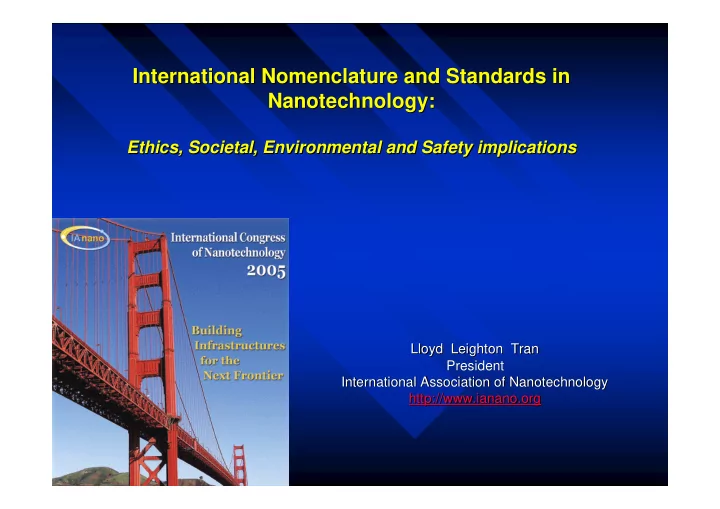
International Nomenclature and Standards in International Nomenclature and Standards in Nanotechnology: Nanotechnology: Ethics, Societal, Environmental and Safety implications Ethics, Societal, Environmental and Safety implications Lloyd


slide-1
SLIDE 1

Lloyd Leighton Tran Lloyd Leighton Tran President President International Association of Nanotechnology International Association of Nanotechnology http://www.ianano.org http://www.ianano.org

International Nomenclature and Standards in International Nomenclature and Standards in Nanotechnology: Nanotechnology:

Ethics, Societal, Environmental and Safety implications Ethics, Societal, Environmental and Safety implications

slide-2
SLIDE 2

Why International Nanotechnology Standards are needed ? Why International Nanotechnology Standards are needed ?

  The Standard Project will develop interoperability specification

The Standard Project will develop interoperability specifications for s for nanomaterials, devices and nanoscale structures and systems. nanomaterials, devices and nanoscale structures and systems.   To set international standards for testing methods and process To set international standards for testing methods and processes so es so data is reported uniformly and results can be compared and verif data is reported uniformly and results can be compared and verified ied   This will help researchers, designers, manufacturers and suppl This will help researchers, designers, manufacturers and suppliers as iers as well as customers to communicate effectively and harmonize best well as customers to communicate effectively and harmonize best practices practices worldwide. worldwide.  To optimize the manufacturing processes while ensure the trus To optimize the manufacturing processes while ensure the trust and t and confidence of customers and public at large confidence of customers and public at large   Without standards the emerging field cannot grow to become an Without standards the emerging field cannot grow to become an major major industry. industry.

International Association of Nanotechnology International Association of Nanotechnology– by Lloyd L. Tran by Lloyd L. Tran
slide-3
SLIDE 3

International nomenclature and standards in International nomenclature and standards in Nanotechnology are urgently needed for Nanotechnology are urgently needed for

  • Research laboratory

Research laboratory

  • Publication

Publication

  • Patent Protection

Patent Protection

  • Communication

Communication

  • Clinical study

Clinical study

  • Manufacturing

Manufacturing

  • Commercialization

Commercialization

International Association of Nanotechnology International Association of Nanotechnology– by Lloyd L. Tran by Lloyd L. Tran

slide-4
SLIDE 4

International Association of Nanotechnology International Association of Nanotechnology– by Lloyd L. Tran by Lloyd L. Tran

http://www.mb.tn.tudelft.nl/images/AnimatedTube.gif

Example of some nanotechnology nanotechnology terms:

 “Bottom Bottom-

  • up

up” ”   “ “Top Top-

  • down

down” ”   “ “Wet/wet Wet/wet” ”, , “ “wet/dry wet/dry” ”, , “ “dry/dry dry/dry” ”  Nano Nano-

  • scale hybrid materials

scale hybrid materials  Taxonomy of carbon Taxonomy of carbon nanostructured nanostructured: : carbon black, diesel exhaust, filtration carbon, carbon black, diesel exhaust, filtration carbon, C C60,

60, fullerene, single

fullerene, single-

  • wall carbon nanotubes,

wall carbon nanotubes, multiwall multiwall carbon nanotubes carbon nanotubes

slide-5
SLIDE 5

Scientific landscape in Nanotechnology Scientific landscape in Nanotechnology

Nanomaterials Nanoparticles Nanoelectronics Nanomedicine Nano Tools Nanophotonics Nanolithography

Knowledge based Nanoscience and Nanotechnology (known Knowledge based Nanoscience and Nanotechnology (known-

  • known)

known)

International Association of Nanotechnology International Association of Nanotechnology– by Lloyd L. Tran by Lloyd L. Tran

slide-6
SLIDE 6

Unchartered Territory (Known Unknown)

Scientific Landscape in Nanotechnology Scientific Landscape in Nanotechnology

Known Known Un Un-

  • chartered Territory : great opportunities in exploring the unkno

chartered Territory : great opportunities in exploring the unknown wn

International Association of Nanotechnology International Association of Nanotechnology– by Lloyd L. Tran by Lloyd L. Tran

slide-7
SLIDE 7

International Association of Nanotechnology International Association of Nanotechnology– by Lloyd L. Tran by Lloyd L. Tran

Known Unknown

Unknown Unknown

Scientific Landscape in Nanotechnology Scientific Landscape in Nanotechnology

Known Known

slide-8
SLIDE 8

International Association of Nanotechnology International Association of Nanotechnology– by Lloyd L. Tran by Lloyd L. Tran

Current Nomenclature & Standards Development Effort Current Nomenclature & Standards Development Effort

  IEEE has had standard for electrical characteristics of carbon n

IEEE has had standard for electrical characteristics of carbon nanotubes anotubes  IUPAC and CAS have had some nomenclature frameworks for fuller IUPAC and CAS have had some nomenclature frameworks for fullerene ene  American National Standard Institute (ANSI) initiated a Nanote American National Standard Institute (ANSI) initiated a Nanotech panel 11/04 ch panel 11/04   ASTM and ASME has recently begun metrology effort ASTM and ASME has recently begun metrology effort   ISO has begun development of international standards in nanote ISO has begun development of international standards in nanotechnology chnology

slide-9
SLIDE 9

International Association of Nanotechnology International Association of Nanotechnology– by Lloyd L. Tran by Lloyd L. Tran

Nanotechnology Standard Development: Nanotechnology Standard Development:

1. 1. Metrology and test Methods: Metrology and test Methods: 2. 2. Properties and characteristics of nanomaterials Properties and characteristics of nanomaterials 3. 3. Risk assessment and management Risk assessment and management 4. 4. Toxicology study Toxicology study 5. 5. Environmental impact Environmental impact

slide-10
SLIDE 10

International Association of Nanotechnology International Association of Nanotechnology– by Lloyd L. Tran by Lloyd L. Tran

Nanotechnology Standards Nanotechnology Standards

  • Aggregation

Aggregation

  • Agglomeration

Agglomeration

  • Airborn

Airborn concentration concentration

  • Aspect ratio

Aspect ratio

  • Dispersivity

Dispersivity

  • Hydroxylation

Hydroxylation

  • Zeta potential

Zeta potential

  • Light scattering absorbance

Light scattering absorbance

  • Mass concentration

Mass concentration

  • Surface area/ concentration

Surface area/ concentration

  • Standards for calibration

Standards for calibration

  • Statistical significance

Statistical significance

and others and others…

  • 1. Metrology and test methods:
  • 1. Metrology and test methods:
slide-11
SLIDE 11

International Association of Nanotechnology International Association of Nanotechnology– by Lloyd L. Tran by Lloyd L. Tran

1. Metrology/measurement test methods 2. Properties and characteristics of nanomaterials Properties and characteristics of nanomaterials

  • naturally occurring vs. engineered particles

naturally occurring vs. engineered particles

  • size, shape, morphology

size, shape, morphology

  • surface area

surface area

  • porosity

porosity

  • solubility

solubility

  • magnetic

magnetic

  • electrical

electrical

  • bioactive

bioactive

  • composite, etc

composite, etc… …

Nanotechnology Standard Development: Nanotechnology Standard Development:

slide-12
SLIDE 12

Single Wall Carbon Single Wall Carbon Nanotube Nanotube contains contains Redox Redox-

  • Active Iron

Active Iron

Source: Valerie E. Kagan, Dept. Environmental & Occupational Health, University of Pittsburgh

slide-13
SLIDE 13

International Association of Nanotechnology International Association of Nanotechnology– by Lloyd L. Tran by Lloyd L. Tran

1. Metrology/measurement test methods: 2. Properties and characteristics 3. Risk Assessment and management Risk Assessment and management

  • exposure assessment

exposure assessment

  • hazard identification

hazard identification

  • dose

dose-response assessment response assessment

  • risk characterization

risk characterization

  • containment procedures

containment procedures

  • threshold levels

threshold levels

  • adverse effect report

adverse effect report

  • etc

etc… …. .

Nanotechnology Standard Development: Nanotechnology Standard Development:

slide-14
SLIDE 14

International Association of Nanotechnology International Association of Nanotechnology– by Lloyd L. by Lloyd L. Tran Tran

1. Metrology/measurement test methods: 2. Properties and characteristics 3. Risk Assessment and management 4. Toxicology study Toxicology study

  • bioavailability

bioavailability

  • bioaccumulation

bioaccumulation

  • bio

bio-

  • interaction

interaction

  • pathogenicity

pathogenicity

  • toxic levels:

toxic levels: ppm ppm, ppb , ppb

  • acute

acute vs vs chronic chronic

  • in vitro vs. in vivo

in vitro vs. in vivo

  • by

by-products, metabolites, degradation products products, metabolites, degradation products

  • exposure route: external, ingestion and inhalation,

exposure route: external, ingestion and inhalation,

  • animal toxicity vs. human toxicity

animal toxicity vs. human toxicity

  • susceptibility: children vs. adult exposure

susceptibility: children vs. adult exposure

  • short

short-

  • term and long term toxicity

term and long term toxicity Etc Etc… …

Nanotechnology Standard Development: Nanotechnology Standard Development:

slide-15
SLIDE 15

International Association of Nanotechnology International Association of Nanotechnology– by Lloyd L. Tran by Lloyd L. Tran

1. Metrology/measurement test methods: 2. Properties and characteristics 3. Risk Assessment and management 4. Toxicology study 5. Environmental impact Environmental impact

  • water and air quality

water and air quality

  • land and soil quality

land and soil quality

  • energy conservation

energy conservation

  • pollution and life cycle

pollution and life cycle

  • waste disposal

waste disposal

  • route of exposure

route of exposure

  • measures of exposure

measures of exposure

  • distribution of hazardous waste

distribution of hazardous waste

  • balanced risk/benefit evaluation

balanced risk/benefit evaluation

  • pollution prevention

pollution prevention Etc Etc… …

Nanotechnology Standard Development: Nanotechnology Standard Development:

slide-16
SLIDE 16

Developing Developing “ “Gold Standards Gold Standards “ “ in Nanotechnology? in Nanotechnology?

International Association of Nanotechnology International Association of Nanotechnology– by Lloyd L. Tran by Lloyd L. Tran

slide-17
SLIDE 17

International Association of Nanotechnology International Association of Nanotechnology– by Lloyd L. Tran by Lloyd L. Tran

Nanoparticle Characterization : Nanoparticle Characterization :

1. 1. What are the forms in which particles are presented to host, cel What are the forms in which particles are presented to host, cells and ls and

  • rganelles?
  • rganelles?

2. 2. What are residual solvents, processing variables, impurities and What are residual solvents, processing variables, impurities and excipients? excipients? 3. 3. What are validated assays to detect and quantify nanoparticles i What are validated assays to detect and quantify nanoparticles in in n in vitro and in vivo? vitro and in vivo? 4. 4. How do we determine long and short How do we determine long and short-

  • term stability of nanomaterials?

term stability of nanomaterials? 5. 5. How do you analyze the degradation of nanoparticles How do you analyze the degradation of nanoparticles 6. 6. How to maintain quality assurance in scaling How to maintain quality assurance in scaling-

  • up to mass production.

up to mass production. 7. 7. What are the reference materials and manufacturing standardizati What are the reference materials and manufacturing standardization

  • n
slide-18
SLIDE 18

International Association of Nanotechnology International Association of Nanotechnology– by Lloyd L. Tran by Lloyd L. Tran

Nanoparticle Safety Nanoparticle Safety

 What are the nanoparticle What are the nanoparticle’ ’ pathways inside the human body? pathways inside the human body?   How long do the nanoparticles How long do the nanoparticles remain in the tissues and how are remain in the tissues and how are they cleared? they cleared?   What effects do nanoparticles What effects do nanoparticles have on cellular and tissue have on cellular and tissue functions? functions?  Can nanoparticles gain access to Can nanoparticles gain access to the systemic circulation from the systemic circulation from dermal exposure? If nanoparticles dermal exposure? If nanoparticles enter skin cells, is there an effect enter skin cells, is there an effect

  • n cellular functions?
  • n cellular functions?

  What are unanticipated reactions What are unanticipated reactions in vivo? in vivo?

slide-19
SLIDE 19

International Association of Nanotechnology International Association of Nanotechnology– by Lloyd L. Tran by Lloyd L. Tran

Nanomaterial Environmental Issues: Nanomaterial Environmental Issues:

  How to protect workers from exposure to nanoparticles? How to protect workers from exposure to nanoparticles?   Following human and animal use, can nanoparticles be Following human and animal use, can nanoparticles be released or excreted into the environment released or excreted into the environment  How to determine the extent of quantity of nanoparticle How to determine the extent of quantity of nanoparticle release in the environment? release in the environment?   What might the nanoparticles effect on the environment? What might the nanoparticles effect on the environment?

slide-20
SLIDE 20

International Association of Nanotechnology International Association of Nanotechnology– by Lloyd L. Tran by Lloyd L. Tran

 

Guidelines for evaluating biological safety for pharmaceutical p Guidelines for evaluating biological safety for pharmaceutical products roducts

Guidelines for nanoparticles are in development Guidelines for nanoparticles are in development

FDA Standard Test Methods for Biological Responses FDA Standard Test Methods for Biological Responses

slide-21
SLIDE 21

International Association of Nanotechnology International Association of Nanotechnology– by Lloyd L. Tran by Lloyd L. Tran

Toxic Substances Control Act Toxic Substances Control Act

15 U.S.C. 15 U.S.C. s/s s/s 2601 et seq. (1976) 2601 et seq. (1976)   The Toxic Substances Control Act (TSCA) of 1976 was enacted b The Toxic Substances Control Act (TSCA) of 1976 was enacted by y Congress to give EPA the ability to track the 75,000 industrial Congress to give EPA the ability to track the 75,000 industrial chemicals chemicals currently produced or imported into the United States. currently produced or imported into the United States.  EPA repeatedly screens these chemicals and can require report EPA repeatedly screens these chemicals and can require reporting or ing or testing of those that may pose an environmental or human testing of those that may pose an environmental or human-

  • health hazard.

health hazard.  EPA can ban the manufacture and import of those chemicals tha EPA can ban the manufacture and import of those chemicals that pose t pose an unreasonable risk. an unreasonable risk.

slide-22
SLIDE 22

European Union European Union’ ’s REACH s REACH

International Association of Nanotechnology International Association of Nanotechnology– by Lloyd L. Tran by Lloyd L. Tran

Registration Evaluation Authorization of Chemic Registration Evaluation Authorization of Chemicals als · New chemicals New chemicals. A new chemical is defined as one that does not appear on the . A new chemical is defined as one that does not appear on the EINECS (European Inventory of Existing Commercial Substances) in EINECS (European Inventory of Existing Commercial Substances) inventory. ventory. When a new chemical is produced, before introduction to the mark When a new chemical is produced, before introduction to the market, the producer et, the producer

  • f that chemical is required to conduct testing, and in the mean
  • f that chemical is required to conduct testing, and in the meantime take such

time take such precautions as are practicable. The level of testing required is precautions as are practicable. The level of testing required is determined by the determined by the mass produced, with the lowest mass trigger currently set at 10k mass produced, with the lowest mass trigger currently set at 10kg per annum. g per annum. Only changes in chemical structure constitute a new substance, w Only changes in chemical structure constitute a new substance, whereas changes hereas changes in form (for example size or shape) do not. An exception is made in form (for example size or shape) do not. An exception is made for polymers: for polymers: those produced entirely from EINECS listed monomers are exempt f those produced entirely from EINECS listed monomers are exempt from rom notification. notification. · Mass (tonnage) triggers Mass (tonnage) triggers: Essentially, the more of an existing substance that is : Essentially, the more of an existing substance that is produced, the more data on its properties are required by regula produced, the more data on its properties are required by regulators. tors.

slide-23
SLIDE 23

A case study: Asbestos A case study: Asbestos

Scanning electron micrograph of asbestiform amphibole from a former vermiculite mining site near Libby, Montana. Source: U.S. Geological Survey and U.S. Environmental Protection Agency, Region 8, Denver, Colorado.

slide-24
SLIDE 24

Asbestos: over the past century has caused millions of deaths an Asbestos: over the past century has caused millions of deaths and d asbestos toll exceeds 100,000 per year around the world asbestos toll exceeds 100,000 per year around the world

slide-25
SLIDE 25

http://www.ohiotoxicmold.com/images/IAQ%20Images/exposure.gif

Health Effects of Asbestos

After asbestos are inhaled, they can remain and accumulate in the lungs. Asbestos can cause lung cancer, mesothelioma (a cancer of the chest and abdominal linings), and asbestosis (irreversible lung scarring that can be fatal). Symptoms of these diseases do not show up until many years after exposure began.

slide-26
SLIDE 26
slide-27
SLIDE 27

Argentina Australia Austria Belgium Chile Cyprus* Czech Republic* Denmark Estonia* Finland France Gabon Germany Greece* Honduras Hungary* Iceland Ireland Italy Japan

[Major restrictions on asbestos use were introduced in October, 2004; Japanese asbestos consumption has fallen by more than 90% ]

Kuwait Latvia Lithuania* Luxembourg Malta* Netherlands Norway Poland Portugal* Saudi Arabia Seychelles Slovakia* Slovenia Spain Sweden Switzerland United Kingdom (including England, Scotland, Wales and

Northern Ireland)

Uruguay South Africa (Planning Major Restrictions on Chrysotile Use)

(Source: compiled by Laurie Kazan-Allen)

CURRENT ASBESTOS BANS AND RESTRICTIONS (Revised January 4, 2005) National Asbestos Bans:

slide-28
SLIDE 28

The USA, Canada and Russia are 3 major The USA, Canada and Russia are 3 major developed countries that have not banned developed countries that have not banned Asbestos Asbestos

International Association of Nanotechnology International Association of Nanotechnology– by Lloyd L. Tran by Lloyd L. Tran

slide-29
SLIDE 29

Asbestos with its known toxicity has killed Asbestos with its known toxicity has killed millions people over the past 100 years. millions people over the past 100 years. Yet, asbestos is still not banned in the USA. Yet, asbestos is still not banned in the USA. What about any new toxic nanoparticles? What about any new toxic nanoparticles?

slide-30
SLIDE 30
  • In 1979 EPA issued a notice of its intent to regulate asbestos u

In 1979 EPA issued a notice of its intent to regulate asbestos under the authority of Section 6 of the nder the authority of Section 6 of the Toxic Substances Control Act (TSCA). Toxic Substances Control Act (TSCA).

  • Asbestos producers and the Canadian government began to pres

Asbestos producers and the Canadian government began to pressure the Reagan Administration to sure the Reagan Administration to halt halt EPA's EPA's efforts. Canada took a particular interest in the matter becaus

  • efforts. Canada took a particular interest in the matter because 95 percent of the 85,000 tons of

e 95 percent of the 85,000 tons of asbestos used in the US came from Canada, primarily Quebec. asbestos used in the US came from Canada, primarily Quebec.

  • In 1989, after conducting a ten year study, EPA announced th

In 1989, after conducting a ten year study, EPA announced that it would phase out and ban virtually all at it would phase out and ban virtually all products containing asbestos. products containing asbestos.

  • EPA's stated rationale for the ban was simple: "

EPA's stated rationale for the ban was simple: "asbestos is a human carcinogen and is one of the most asbestos is a human carcinogen and is one of the most hazardous substances to which humans are exposed in both occupat hazardous substances to which humans are exposed in both occupational and non ional and non-

  • occupational settings
  • ccupational settings."

."

  • Proposals to ban asbestos in the United States were announc

Proposals to ban asbestos in the United States were announced on June 18, 2002 by Senator Patty ed on June 18, 2002 by Senator Patty Murray Murray

  • Asbestos product manufacturers and industry organizations sw

Asbestos product manufacturers and industry organizations swiftly filed a lawsuit challenging the ban's iftly filed a lawsuit challenging the ban's validity under TSCA in Corrosion Proof Fittings v. EPA. validity under TSCA in Corrosion Proof Fittings v. EPA.

  • The Fifth Circuit vacated the ban, finding that EPA failed t

The Fifth Circuit vacated the ban, finding that EPA failed to present "substantial evidence" to justify the

  • present "substantial evidence" to justify the

ban under TSCA. ban under TSCA.

  • The administration of George Bush chose not to appeal the d

The administration of George Bush chose not to appeal the decision to the Supreme Court. ecision to the Supreme Court.

  • Many Americans are unaware that the use of asbestos is sti

Many Americans are unaware that the use of asbestos is still permitted in the USA. ll permitted in the USA.

Failed effort to ban asbestos in the USA Failed effort to ban asbestos in the USA

International Association of Nanotechnology International Association of Nanotechnology– by Lloyd L. Tran by Lloyd L. Tran

slide-31
SLIDE 31

International Association of Nanotechnology International Association of Nanotechnology– by Lloyd L. Tran by Lloyd L. Tran

Policy/ Regulation Policy/ Regulation Economic Framework Economic Framework Scientific Framework Scientific Framework

  • Nomenclature

Nomenclature

  • Methodology

Methodology

  • Measurement

Measurement

  • Peer Reviews

Peer Reviews

  • Standards

Standards

  • Costs vs. Benefits

Costs vs. Benefits

  • Utilization

Utilization

  • Intellectual Property

Intellectual Property

  • Value

Value

  • Profits

Profits

  • Public Trust

Public Trust

  • Ethical

Ethical

  • Societal

Societal

  • Environmental

Environmental

  • Health Safety

Health Safety Public Engagement Public Engagement ?

slide-32
SLIDE 32

It is difficult to assess the risk factors of It is difficult to assess the risk factors of nanomaterials without internationally nanomaterials without internationally adopted standards adopted standards

International Association of Nanotechnology International Association of Nanotechnology– by Lloyd L. Tran by Lloyd L. Tran

slide-33
SLIDE 33

Challenges in developing Challenges in developing international nomenclature/ standards: international nomenclature/ standards:

International Association of Nanotechnology International Association of Nanotechnology– by Lloyd L. Tran by Lloyd L. Tran

  Communication across multi Communication across multi-

  • disciplines

disciplines  National and international geo National and international geo-political differences political differences  Intellectual Property protection Intellectual Property protection   Confidential business information Confidential business information   Lack of funding for this long term endeavor Lack of funding for this long term endeavor  Concern about speeding up government regulation and public pol Concern about speeding up government regulation and public policy icy

slide-34
SLIDE 34

Conclusion Conclusion

International Association of Nanotechnology International Association of Nanotechnology– by Lloyd L. Tran by Lloyd L. Tran

Recognize the known Recognize the known-

  • unknown and unknown

unknown and unknown-

  • unknown

unknown   International nomenclature and standards are urgently needed International nomenclature and standards are urgently needed   Societal, environmental and safety are to be part of the prio Societal, environmental and safety are to be part of the priority & criteria rity & criteria   Pro Pro-

  • active risk management to prevent abuse and unintended misuse

active risk management to prevent abuse and unintended misuse  Public engagement should be part of the decision making proce Public engagement should be part of the decision making process ss

slide-35
SLIDE 35

THANK YOU ! THANK YOU !

Lloyd L. Tran Lloyd L. Tran President President International Association of Nanotechnology International Association of Nanotechnology

http://www.ianano.org http://www.ianano.org Email: Email: ltran@ianano.org ltran@ianano.org