International Metropolis Conference: The Promise of Migration - - PowerPoint PPT Presentation

international metropolis conference the promise of
SMART_READER_LITE
LIVE PREVIEW

International Metropolis Conference: The Promise of Migration - - PowerPoint PPT Presentation

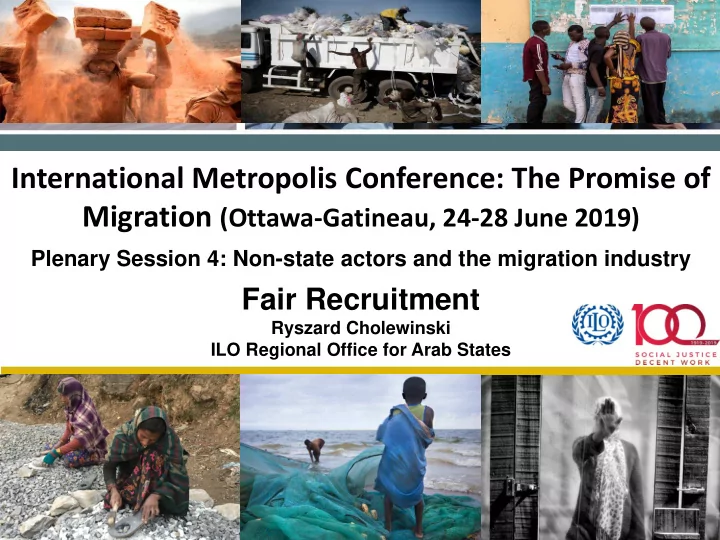
International Metropolis Conference: The Promise of Migration (Ottawa-Gatineau, 24-28 June 2019) Plenary Session 4: Non-state actors and the migration industry Fair Recruitment Ryszard Cholewinski ILO Regional Office for Arab States Fair

slide-1
SLIDE 1

International Metropolis Conference: The Promise of Migration (Ottawa-Gatineau, 24-28 June 2019)

Plenary Session 4: Non-state actors and the migration industry

Fair Recruitment

Ryszard Cholewinski ILO Regional Office for Arab States

slide-2
SLIDE 2

Fair recruitment in context

164 million migrant workers

  • 58% men and

42% women 258 million international migrants in 2017 48 per cent women migrants 260,000

Private Employment Agencies worldwide Low-skilled workers, both migrants and nationals, are particularly at risk of recruitment abuses and forced labour Up to 10 billion USD in illegal recruitment fees are collected annually from migrant workers

slide-3
SLIDE 3

Why fair recruitment matters?

  • High cost of labour migration, including recruitment

fees and related costs, for low-skilled migrant workers

  • Risk of trafficking and forced labour
  • Limited labour market integration – discrimination

and/or exploitation, low wages, poor working conditions

  • Underutilization of skills - skills recognition and skills

matching

Factors limiting positive effects of migration

slide-4
SLIDE 4

Why fair recruitment matters?

Key challenges for workers

  • Charging of recruitment fees and related costs
  • Threats and intimidation, abuse and violence
  • Deception with regard to contracts, working and living conditions
  • Restriction of freedom of movement and retention of passports
  • Recruitment below working age or into hazardous work

Key challenges for governments/ policymakers

  • Ensuring effective regulatory frameworks are in place and enforced
  • Ensuring bilateral or regional agreements are in place, effectively

monitored and protect workers

  • Addressing rapidly changing migration landscape and labour

market characteristics

slide-5
SLIDE 5

Why fair recruitment matters?

Key challenges for employers

  • Employers can also face high costs
  • Information asymmetry
  • Need to match workers’ skills to those needed by the

employer

Key challenges for recruitment agencies

  • Lack of appropriate government regulation and
  • versight can create commercial uncertainties
  • Increasing cost to business especially when corruption

and bribery occur in the recruitment process

  • Overly complex regulation can impede fair labour

recruiters from entering the market

slide-6
SLIDE 6

Growing consensus on reducing migration and recruitment costs

Relevant international initiatives

  • UN Secretary-General’s Report to UN High-level Dialogue on International

Migration and Development 2013

  • UN 2030 Agenda: SDG 10.7.1 Recruitment cost borne by employee as a

proportion of yearly income earned in country of destination

  • ILO General Principles and Operational Guidelines for Fair Recruitment and

Definition of recruitment fees and related costs

  • The UN Global Compact for Safe, Orderly and Regular Migration, Objective 6
  • Abu Dhabi Dialogue: Colombo Ministerial Declaration, 24 Jan 2017 / ADD

SOM Communiqué (May 2018)

  • Several multi-stakeholders initiatives (WEC, IHRB, RBA, ITUC-MRA, IOM-IRIS)

Relevant national / bilateral initiatives

  • More than 90 countries regulate recruitment fees
  • Bilateral agreements with specific provisions on recruitment
slide-7
SLIDE 7

Fair Recruitment Initiative

  • 1. Enhance global knowledge of national and international

recruitment practices

 SDG Indicator 10.7.1 methodology testing  Research, thematic studies and tools

  • 2. Improve laws, policies and enforcement to promote fair

recruitment

 General Principles and Operational Guidelines for Fair Recruitment  Definition of recruitment fees and related costs  Promotion of relevant standards, e.g. ILO Convention No. 181

  • 3. Promote fair business practices:

 Develop tools and guidance for business and labour recruiters  Support model to undertake due diligence

  • 4. Empower and protect workers

 Support social dialogue mechanisms to address unfair recruitment practices.  Assist trade unions to organize workers and protect their rights  Support cooperation between trade unions and CSOs

slide-8
SLIDE 8

Central America: Guatemala - Mexico corridor Africa: Tunisia, Madagascar, Ethiopia, Soon to commence in Morocco, Ghana, Nigeria and Egypt Corridors in Asia: Philippines – Hong Kong (China) (Domestic work) Nepal-Jordan (Garment sector, business case) Nepal – Malaysia (Electronics, business case) Sri Lanka/Pakistan – Middle East Country level: Vietnam, Cambodia, Thailand, Myanmar, Bangladesh Middle East, including GCC

ILO’s recruitment-related work

Global Level work

  • Principles and Operational

Guidelines for Fair Recruitment (2016)

  • Definition of Recruitment

Fees and Related Costs (2018)

  • SDG 10.7.1 indicator piloting
  • Fair Recruitment Initiative

launched in 10 pilot countries

  • Global training course on fair

recruitment

  • Global toolkit for

journalists

  • Alliance 8.7 and forced

labour business network

  • ILO-IOM study examining

e-recruitment platforms

slide-9
SLIDE 9

Thank you for your attention!

ilo.org/100 # ilo100