Intelligent Assistance for Conversational Storytelling Using Story - - PDF document

intelligent assistance for conversational storytelling
SMART_READER_LITE
LIVE PREVIEW

Intelligent Assistance for Conversational Storytelling Using Story - - PDF document

Hi, my trip to Spain was ! Intelligent Assistance for Conversational Storytelling Using Story Patterns Pei-Yu (Peggy) Chi and Henry Lieberman MIT Media Lab IUI 2011, Palo Alto, CA, USA Capturing everyday life moments 2 Lack of connected


slide-1
SLIDE 1

Intelligent Assistance for Conversational Storytelling Using Story Patterns

Pei-Yu (Peggy) Chi and Henry Lieberman MIT Media Lab

IUI 2011, Palo Alto, CA, USA

Hi, my trip to Spain was !

2
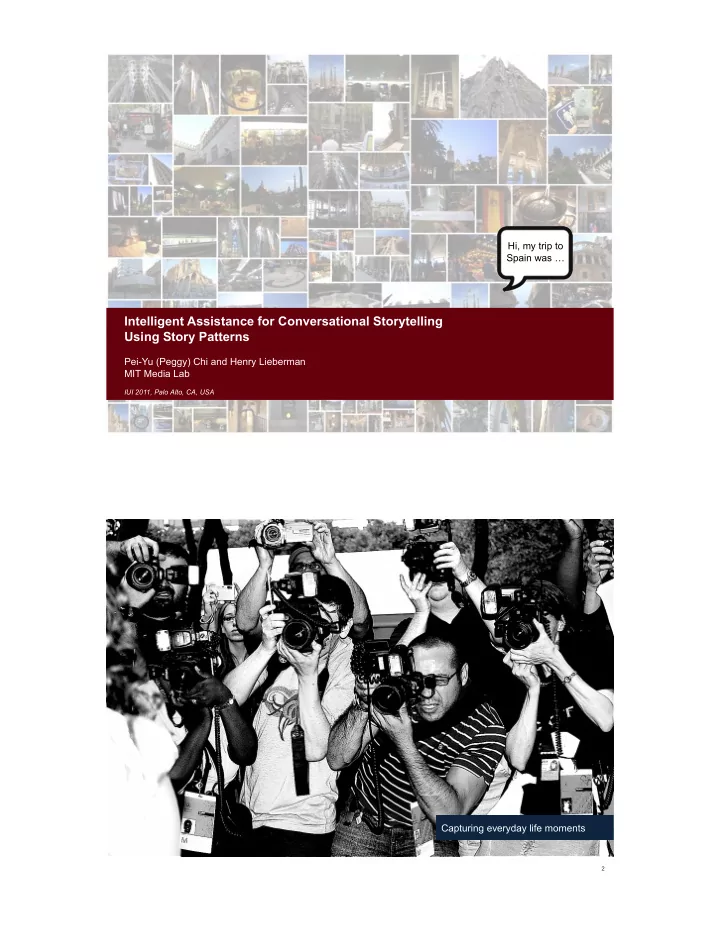
Capturing everyday life moments

slide-2
SLIDE 2

3

Lack of connected points

4

slide-3
SLIDE 3

5

humans = storytellers

Raconteur : from chat to stories

6

story teller story viewer

  • What do viewers want to know?
  • How do I connect the story?
  • What are they interested to see?

!"#$%&%'"()%*(%+%,-.-(/%)0-1%2+3)%'""."(4$% 5**.%+)%'6+)%&%7+1)80"4$% 9*'$%&%2*:"%)6*3"%16*)*3%*(%)6"%,"+76;% 96"0"%4-4%#*8%/*<% &)%'+3%+%*("=4+#%)0-1%)*%>+1"%>*4%'-)6%?#% @0-"(43;%9"%,-."4%)6"0"%ABC%

  • Have degrees of control
  • Participate in the

story creation process

  • IUI’10: single user, preliminary study
  • IUI’11: multi-user, chats, user study
  • CHI’11: social media aspects
slide-4
SLIDE 4

Raconteur demo

7

Analogical Inference Multimedia data Commonsense KB Raconteur User Interface Textual annotation Story developer

Narration Processing

Teller Viewer

messages, edits messages

User messages

Narration Processing

Edited files

suggestions suggestions

Raconteur System

slide-5
SLIDE 5

Raconteur Interface

9

Annotated Multimedia Repository

10

“This installation art by Dali showed up on the way to the museum. It was a big surprise because we didn’t expect to see this in such a local park.”

Given a link to an online album (e.g. Picasa)

“Two singers were performing the famous aria “None Shall Sleep” from the

  • pera “Turandot” in this street corner in
  • Barcelona. Again, art can be so close to

daily life.”

photo video (1’00”)

http://code.google.com/apis/picasaweb/

= media elements = story units

  • Unannotated files: kept in the system, but not analyzed
slide-6
SLIDE 6

System goal

match chat messages with relevant annotated files

11

1) Narration Processing

12

using Natural Language Toolkit (NLTK)

BIRD, S. KLEIN, E, LOPER, E. AND BALDRIDGE, J. Multidisciplinary Instruction with the Natural Language Toolkit. In Proc. of TeachCL '08: the 3rd Workshop on Issues in Teaching Computational Linguistics, 2008.

Named entity recognition (NER)

  • Story characters: “Peter”, “Gaudi”, “Dali”
  • Organizations: schools, museums
  • Geographical areas: Spain, Barcelona
  • Time: one hour, July 4th

“This installation art by Dali showed up on the way to the museum.” “This installation art by Dali show up on the way to the museum.” N N N V N N

Part of speech (POS) tagging Stemming and lemmatization,

To identify words including verbs, nouns, adjectives, adverbs, and conjunction markers

(“installation”, “art”, “show”, “way”, “museum”)

Remove interjection:

Yeah, god, gosh, oh, huh, uh, man, well, so, right, yes, .

and non-story-world Clause:

I think, I mean, I said, I guess, I did, you know, you mean, you see, You wouldn’t believe it, that’s all, .

slide-7
SLIDE 7

2) Relevant Files Finding using Commonsense

  • common sense knowledge = a set of assumptions and beliefs that

are shared among people in our everyday life.

  • “Art is beautiful.”
  • “An airport is used for travel.”
  • “You would smile because you are happy.”
  • “! for the everyday necessities of recognizing what a person is

"talking about" given that he does not say exactly what he means,

  • r in recognizing such common occurrences and objects.”

– Sociologist H. Garfinkel 1967

13 GARFINKEL, H. Common Sense Knowledge of Social Structures: The Documentary Method of Interpretation in Lay and Professional Fact Finding. In Studies in Ethnomethodology, 1967

Commonsense Knowledge Tool: OMCS and ConceptNet

  • 20 two-place relations

– AtLocation(art, museum) vs. “Something you find at a museum is art.” – PartOf(sculpture, art) vs. “Sculpture is a kind of art.” – HasProperty(art, inspiring) vs. “Art is inspiring.”

  • > 1 million assertions in English

14 LIU, H. AND SINGH, P. ConceptNet: a Practical Commonsense Reasoning Toolkit. In BT Technology Journal, vol 22 (4), 2004.

slide-8
SLIDE 8

Commonsense Reasoning Tool: AnalogySpace

  • Get an ad-hoc category of a concept

– “art”, “sculpture”, “painting”, “museum”, and “artist”

  • Measure the similarity of different concepts

– Are “art” and “park” conceptually related?

  • Confirm if an assertion is true

– Are you likely to find art in a park?

15

using Singular Value Decomposition (SVD)

SPEER, R., HAVASI, C., AND LIEBERMAN, H. AnalogySpace: Reducing the Dimensionality of Common Sense Knowledge. AAAI2008.

Associate Computable Media Files

16

! (“installation”, “art”, “show”, “way”, “museum”) ! Vectors (vinstallation, vart, vshow, vway, vmuseum) “This installation art by Dali showed up on the way to the museum.”

concept vectors photo/video caption concepts

i.e. Transform an media file to a list of computable vectors V

A chat message with M concepts Vchat = ( v1 , v2, ! , vM ) A media file n with N concepts Vn = ( v1 , v2, ! , vN ) V’chat = ! vi

i=1 M

V’n = ! vj

j=1 N

  • 1. concept vectors
  • 2. add up

V’chat = V’chat |V’chat|

"

V’n = V’n |V’n|

"

  • 3. normalize

V’chat

"

V’n

"

  • s =
  • 4. take the dot product

s > Threshold : this file is conceptually relevant to the chat message

slide-9
SLIDE 9

Media Files Association

17

storyteller

Story viewer

3) Consider Story Patterns

  • Story structure/grammar/skeleton

– help connect and comprehend a story – might alter listening experience – make impressive points

18

intent (story structure) info info info info personal experience (memory structure) info info info info understand the intent respond

storyteller

Story viewer

SCHANK, R. C. Tell Me a Story: A New Look at Real and Artificial Intelligence, Northwestern University Press, 1991. SCHANK, R. C. Explanation Patterns: Understanding Mechanically and Creatively, Psychology Press, 1986. BLACK, J. B. AND WILENSKY, R. An Evaluation of Story Grammars. In Cognitive Science, vol. 3 (3), 1979.

slide-10
SLIDE 10

3) Story Patterns Finding

  • Problem and Resolution

– Common pattern in travel stories

  • “leaving for Spain” vs. “flight was delayed/cancelled because of the storm”
  • “buying fresh food in a local market” vs. “wallet got stolen”
  • “putting up the tent” vs. “trouble with assembling the tent poles”

– To identify problem: Vector vperson-desire from AnalogySpace – Then connect those related events

19 SCHANK, R. C. Explanation Patterns: Understanding Mechanically and Creatively, Psychology Press, 1986.

Problem related concepts Dot product value Non-problem related concepts Dot product value traffic jam

  • 0.993

sunshine 0.695 delay

  • 0.992

famous 0.687 rain

  • 0.457

earn 0.025 wait

  • 0.243

relax 0.022 lose

  • 0.110

travel 0.018 steal

  • 0.032

win 0.017

User Interactions

20

slide-11
SLIDE 11

User Interactions

21

Teller: drag & drop items to enhance

  • r chat on any item

Viewer: response with comments or questions

Evaluation

  • 10 Participants in 5 pairs

– All frequent users of social networking sites – Storytellers were asked to bring samples of personal media files

  • Procedure:

– Pre-test interview – Asked storytellers to select, upload, and annotate files – Introduced Raconteur UI to each pair – Conducted storytelling session for each pair – Post-test interview and questionnaire (Likert-5 scale)

22

slide-12
SLIDE 12

Results of Material and Chats

  • 5 collected repositories:

– Average size: 70.2 media elements

  • 98.0% of photos vs. 2% of video clips (most < 30 seconds)

– 97.2% of the files were annotated

  • Average length of captions: 10.0 English words

– 3 of media sets were originally also uploaded to Facebook

  • Chats:

– Average time: 23 minutes – 117.6 messages:

  • 52.7% from storytellers (ave. 6.5 words)
  • 47.3% from viewers (ave. 5.6 words)
  • " number of events

– e.g. “Check this out.”, “You know what?”

23

  • 98.2% followed Raconteur’s suggestions
  • 33.1% of files were used

– no obvious relation between the size of repository and the number of used elements

Results of Media Used

24

raw repository

(1.8%)

suggested match

(75.7%)

suggested patterns

(22.5%)

  • Styles of interaction:

drag-and-drop

(71.2%)

click-and-chat

(28.8%)

  • Source of edits:

“ (!) I soon realized I was connecting my experiences together. ”

slide-13
SLIDE 13

User Feedback

1. Create Stories as Easily as in Daily Conversation

– “ (!) helped me recall and brainstorm my stories. I was not thinking alone! ”

2. Make Impressive Points During the Chat

– Reflected storytellers themselves: “ (!) my demo was a hot spot. I’ve even collected drawings from more than 80 participants.” – Viewers were all able to recount the memorable points

3. High Level of Audience Engagement in the Stories

– helped the audience control of the story content: “I also could see how my

friend chose the specific scenes based on my questions.”

  • Problems:

– A created story was less structural for reviewing afterwards – It was less easy to retell the friend’s stories in a clear sequence – The update speed of system’s suggestion was sometimes too fast

25

Intelligent Assistance for Conversational Storytelling Using Story Patterns

Pei-Yu (Peggy) Chi and Henry Lieberman MIT Media Lab

IUI 2011, Palo Alto, CA, USA

Hi, my trip to Spain was ! Raconteur:

  • enhances real-time chat

for sharing life stories

  • suggests multimedia items

using NLP and commonsense reasoning

  • identifies story patterns