INTEGRATING NEGLECTED TROPICAL DISEASES INTO GLOBAL FUND AGENDA - - PowerPoint PPT Presentation

integrating neglected tropical diseases into global fund
SMART_READER_LITE
LIVE PREVIEW

INTEGRATING NEGLECTED TROPICAL DISEASES INTO GLOBAL FUND AGENDA - - PowerPoint PPT Presentation

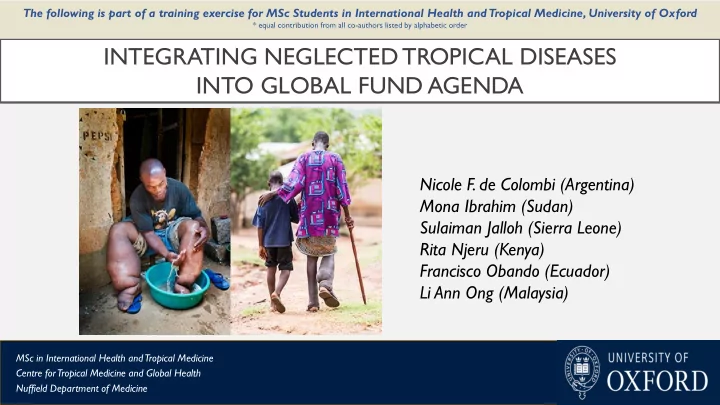
The following is part of a training exercise for MSc Students in International Health and Tropical Medicine, University of Oxford * equal contribution from all co-authors listed by alphabetic order INTEGRATING NEGLECTED TROPICAL DISEASES INTO


slide-1
SLIDE 1

Nicole F. de Colombi (Argentina) Mona Ibrahim (Sudan) Sulaiman Jalloh (Sierra Leone) Rita Njeru (Kenya) Francisco Obando (Ecuador) Li Ann Ong (Malaysia)

INTEGRATING NEGLECTED TROPICAL DISEASES INTO GLOBAL FUND AGENDA

MSc in International Health and Tropical Medicine Centre for Tropical Medicine and Global Health Nuffield Department of Medicine

The following is part of a training exercise for MSc Students in International Health and Tropical Medicine, University of Oxford

* equal contribution from all co-authors listed by alphabetic order

slide-2
SLIDE 2

PRESENTATION OUTLINE

  • 1. Overview

Neglected Tropical Diseases (NTDs) Global Fund (GF)

  • 2. Entry points

Health and economic impact stemming from co-endemicity Impact NTDs on host susceptibility to HIV

  • 3. Opportunities for integration

Operational synergies for NTDs and GF programmes Health systems strengthening

  • 4. Concluding messages

Thoughts for action

slide-3
SLIDE 3

OVERVIEW OF NTDS AND GLOBAL FUND

  • 4 billion USD per year to address HIV, Tuberculosis and

Malaria initiatives in LMIC

  • 27% of investment towards strengthening health systems
  • Funded a joint programme for Malaria & lymphatic

filariasis in Togo

  • Affecting 1/6 of global population, causing substantive

morbidity

  • Paucity of recognition, surveillance and funding
  • Treatment costs billions USD per year

vs prevention with MDA costing 0.5 USD per person

slide-4
SLIDE 4

Health Outcomes

  • Enhanced anaemia
  • Increased mortality,

stunting and cognitive impairment STH + Malaria

  • Mutually reinforcing
  • Accelerating disease

progression Leishmaniasis + HIV

Diagnosis and Treatment

  • Difficult to diagnose
  • High rates of

treatment failure

  • High rates of relapse

Leishmaniasis + HIV

Economic Impact

  • Longer duration of

illness

  • Direct and indirect

costs e.g. Liver and bleeding complications Dengue + Malaria

Rise in Vector-Borne Diseases

  • Climate change
  • Urbanisation
  • Global travel

Dengue + Malaria

THE RELEVANCE OF NTDS IN GLOBAL FUND AGENDA

Co-morbidity stemming from co-infections

slide-5
SLIDE 5

Increased susceptibility to HIV Increases HIV transmission risk Undermines HIV control

Schistosomiasis

  • Female urogenital disease increasing risk of HIV acquisition and

transmission

  • WHO-recommended policy of Praziquantel treatment in

school children needs to be extended to adults in endemic areas

Lymphatic filariasis

  • Doubles the risk of HIV
  • LF can influence the success of HIV programmes

Important to integrate NTDs control to reduce the burden of HIV in co-endemic region

THE RELEVANCE OF NTDS IN GLOBAL FUND AGENDA

NTDs increase host susceptibility and transmission risk of HIV

slide-6
SLIDE 6

Ivermectin MDA during high Malaria transmission season  NTD + Malaria control School based programme IPT Malaria + NTDs  Reduction in anaemia  Improved attention and recall in the children Pregnant women IPT Malaria + Helminths  Target anaemia from multi-infections

OPERATIONAL SYNERGIES

Opportunity for integrated control of NTDs into Global Fund agenda

Malaria Schistosomiasis

  • 1. Enhanced benefits

Intermittent Preventative Treatment

Disruption of malaria parasite transmission for weeks Ivermectin MDA against Scabies, LF & Onchocerciasis IVERMAL study Ivermectin safety & mosquitocidal

  • 2. Synergistic benefits

Mass Drug Administration

slide-7
SLIDE 7

Currently Global Fund uses insecticide treated bed nets and indoor residual spraying for Malaria. Opportunities for integration

  • 1. Co-endemicity of multiple vectors amenable to

integrated vector control strategy

e.g. Dengue, Malaria, Lymphatic Filariasis

  • 2. One method is unlikely to be effective

Increasing resistance to pesticide and environment pollution

  • 3. Prevention is the more cost effective

e.g. Leishmaniasis

Integrated Vector Control Personal protection

Chemical Source reduction Biological Health education

OPERATIONAL SYNERGIES

Integrated Vector Management

slide-8
SLIDE 8

 27% of investment goes towards

strengthening health systems

 Applicants are required to assess their

health system

 Outcomes

  • Gathering quality data in the DRC
  • Improving efficiency of supply

chains to reduce costs in Nigeria

  • Retaining and training health

workers in Zimbabwe and Senegal

GF works with the Mozambique government to refurbish storage facilities, outsource transportation to improve delivery of medicine and train warehouse employees in supply chain management. Source: Global Fund

STRENGTHENING HEALTH SYSTEMS

Strategic Objective of the Global Fund

slide-9
SLIDE 9

FURTHERING THE GLOBAL FUND’S IMPACT ON HEALTH OUTCOMES

 Improve metrics to measure the

effectiveness of health systems

Current allocation utilisation and absorptive capacity

 Understand the opportunity cost of a

country investing heavily in the three diseases

Does limited capacity of Ministry’s of Health lead to disregarding other health priorities?

PC: Commonwealth Secretariat 2019 Global Fund Replenishment Conference in Montréal. September 17, 2016 PC: Government of Canada

slide-10
SLIDE 10

Allocate funding where there is the greatest potential for gains from synergies Increase support and funding towards strengthening Health Systems Advance R&D through partnership Strengthen Global Funds’ capacity to identify synergistic programmes Monitor and evaluate the opportunity cost of funding three diseases

CONCLUDING MESSAGES

Integrating NTDs into Global Fund Agenda

slide-11
SLIDE 11

QUESTIONS?

slide-12
SLIDE 12

IVERMECTIN MOSQUITOCIDAL EFFICACY

slide-13
SLIDE 13