SLIDE 1
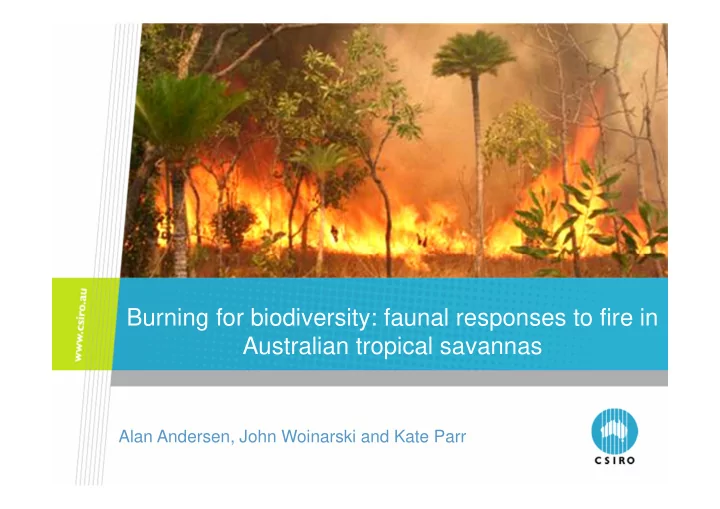
Burning for biodiversity: faunal responses to fire in Australian tropical savannas
Alan Andersen, John Woinarski and Kate Parr
SLIDE 2
Tropical savanna faunas
SLIDE 3
Tropical savanna faunas
SLIDE 4
Fire in Australia’s tropical savannas
SLIDE 5
Small mammal decline across the north
SLIDE 6
Small mammal decline in Kakadu
SLIDE 7
Severe range contraction in the rabbit rat Conilurus penicillatus
SLIDE 8 The Kapalga fire experiment
Kakadu National Park
Kilometres 10
SLIDE 9 Kilometres 10
The Kapalga fire experiment
Unburnt Annual Early Annual Late
FEB '89 MAY '89 FEB '90 MAY '90 FEB '91 MAY '91 FEB '92 MAY '92 FEB '93 MAY '93 FEB '94 MAY '94 FEB '95 MAY '95
5 10 15 20
PRE-BURN POST- BURN
SLIDE 10 Number of species Number affected by fire
11 1 16 5 25 4
The Kapalga fire experiment
Kilometres 10
SLIDE 11
- The Kruger long-term fire experiment
SLIDE 12
Mopane woodland (450 mm)
Ant diversity in relation to fire at Kruger NP (Parr 2004)
SLIDE 13
Acacia savanna (550 mm)
Ant diversity in relation to fire at Kruger NP (Parr 2004)
SLIDE 14
Acacia savanna (550 mm)
Ant diversity in relation to fire at Kruger NP (Parr 2004)
SLIDE 15 “(Birds) are likely to be robust to all but the most extreme fire
- policies. A hands-off fire policy is unlikely to affect bird communities
negatively”
- M. S. L. Mills (2005), Koedoe
Fire and birds at Kruger
SLIDE 16 Fire and biodiversity in tropical savannas
- Biota extremely resilient
- Very limited pyrodiversity
needed
SLIDE 17
Small mammal decline across the north
SLIDE 18 Kilometres 10
The Kapalga fire experiment
200 400 600 1989-90 1990-91 1991-92 1992-93 1993-94 1994-95
Years Total captures
Early Late Progressive Unburnt
SLIDE 19
Rabbit-rat story – experimental translocation
fire
Experimental translocation of rabbit rats
SLIDE 20
Rabbit-rat extinction modeling
Fire regime Likelihood of extinction (within 10 years)
No fire 78% Late dry fire every 10 years 89% Late dry fire every 3 years 97% Late dry fire every year 100%
SLIDE 21
Fire interactions with other threatening processes
SLIDE 22
Fire management for small mammal conservation
SLIDE 23
Fire management for small mammal conservation
SLIDE 24 Burning for savanna biodiversity: research priorities
- 1. Identifying species with special pyrodiversity requirements
SLIDE 25
“My species X does best under fire regime Y, and so the conclusion from my study is that fire regime Y should be implemented”
What species prefer and what species need
FROM:
SLIDE 26
“My species X does best under fire regime Y, and so the conclusion from my study is that fire regime Y should be implemented”
What species prefer and what species need
FROM: TO: “What taxa that are under threat at the landscape scale by prevailing fire regimes, and need special management attention?”
SLIDE 27 Burning for savanna biodiversity: research priorities
- 1. Identifying species with special pyrodiversity requirements
- 2. Within-fire patchiness
SLIDE 28 Burning for savanna biodiversity: research priorities
- 1. Identifying species with special pyrodiversity requirements
- 2. Within-fire patchiness
- 3. Fire/cat interaction and small mammal declines in Australia
SLIDE 29 Burning for savanna biodiversity: research priorities
- 1. Identifying species with special pyrodiversity requirements
- 2. Within-fire patchiness
- 3. Fire/cat interaction and small mammal declines in Australia
- 4. Carbon/biodiversity trade-offs