Integrated solution for Operational Metering, Surveillance and - - PowerPoint PPT Presentation

integrated solution for
SMART_READER_LITE
LIVE PREVIEW

Integrated solution for Operational Metering, Surveillance and - - PowerPoint PPT Presentation

Integrated solution for Operational Metering, Surveillance and Condition Based Maintenance Luca Letizia Subsea Processing and Flow Assurance OneSubsea Agenda Introduction to Challenges Solution Requirements & Objectives


slide-1
SLIDE 1

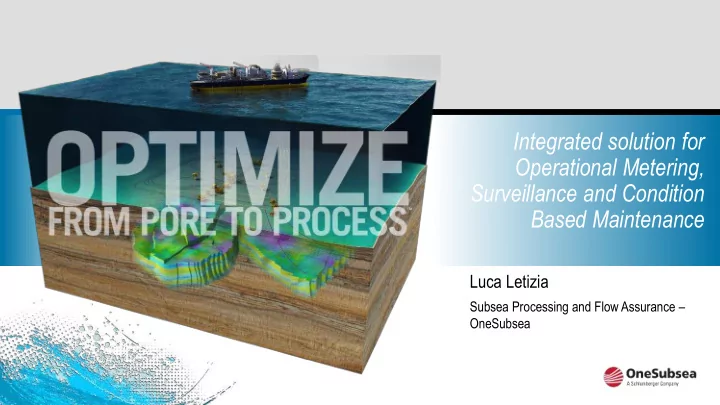
Integrated solution for Operational Metering, Surveillance and Condition Based Maintenance

Luca Letizia

Subsea Processing and Flow Assurance – OneSubsea

slide-2
SLIDE 2

2

Agenda

  • Introduction to Challenges
  • Solution Requirements & Objectives
  • Example Workflows

 Virtual Flow Metering  Reservoir Monitoring, Management & Optimization

  • Equipment Surveillance & Condition Based Maintenance
  • Conclusion
slide-3
SLIDE 3

3

Production Assurance from Pore to Process

Condition Based Maintenance Reservoir to Facility Optimization 24/7 Equipment Surveillance Production Optimization Operational Services Design Verification Concept Selection Control System Checkout Operator Training Flawless Commissioning Startup Virtual / Combined Metering Reservoir to Facility Optimization

slide-4
SLIDE 4

4

Condition Based Maintenance

Early detection, proactive responce

Reservoir to Facility Optimization

Increase recovery and production

24/7 Equipment Surveillance

Reliable subsea installations

Production Optimization

Increase production and reduce OPEX

Operational Services

Handle unplanned situations

Virtual / Combined Metering

Reliable and Accurate Production Data

Design Verification

Avoid costly redesign in operation

Concept Selection

CAPEX

Control System Checkout

Save commissioning time

Operator Training

Accurate hands on training

Flawless Commissioning Startup

Safe startup

Reservoir to Facility Optimization

Increase recovery and production

Production Assurance from Pore to Process

slide-5
SLIDE 5

5

Operational Challenges (example for gas condensate field)

Reservoir Management

  • Well drawdown management
  • Determine back allocation of flow
  • Risk of water breakthrough/production

Hydrate control

  • Hydrates can plug flowlines deferring or losing production
  • Expensive chemical inhibition needed
  • MEG Ops. based on predictions (affected by uncertainty)

Liquid management

  • Liquid inventory (water/condensate/inhibitor) in long flow lines
  • Rate changes (ramp-up surges)
  • Flow instability (slugging)
  • Onshore liquid handling

Low temperature management

  • Wellhead and flowline shut-in pressure
  • Temperature management during well restart

High Pressure management

  • Packing / de-packing
  • HIPPS activation and reset
  • Shut-in pressure

Erosion monitoring Corrosion & Scale Future Interventions / PLT

slide-6
SLIDE 6

6

Reservoir Wells Surface Networks Facilities / Processing

Service Company Support Centers Client Support Centers

Bridging technology, information, people, process & organization

Client Central Control Room

Solution Facilitating Multidiscipline Collaboration

slide-7
SLIDE 7

7

Integrated Production Management Solution (IPMS)

slide-8
SLIDE 8

8

Proposed Solution – Multi-Site Collaboration Virtual Metering

Vendor Domain Experts Operator Reservoir Engineer

Client Control Room Client Support Centers SLB Support Centers

Operator identifies changes in well rates from Meters Production engineers checks virtual metering is alligned with equipment Vendor ensure data reconciliation and virtual metering correctly history matched

slide-9
SLIDE 9

9

Proposed Solution – Multi-Site Collaboration Reservoir Management

Vendor Domain Experts Operator Reservoir Engineer

Client Control Room Client Support Centers SLB Support Centers

Operator identifies changes in well performance and must understand what is happening Res.Engineer uses downhole data to run different scenarios Vendor ensure model quality through calibration and Eng. assistance on demand

slide-10
SLIDE 10

10

Integrated Production Management Solution (IPMS)

slide-11
SLIDE 11

11

Virtual Flow Metering – Surveillance, Reconciliation and Calibration

  • Short loop – Data Surveillance

–Monitor Aqua Watcher, MPFMs and VFM values to detect changes/drift with alarms/warnings

  • Medium loop – Data Reconciliation

–VFM uncertainty calculation –Apply “correction” factors to the VFM flow rates as they are compared to inlet separator metered rates

  • Long loop – Solution Calibration

–VFM instrument failure detection / sensor drifting –Use of well test data and historic data analysis to identify VFM quality, drift and calibration requirement – e.g. fluid property changes

–VFM holistic flow rate reconciliation –Operational performance indicators (OPIs)

slide-12
SLIDE 12

12

Virtual Flow Metering – Surveillance, Reconciliation and Calibration

  • Short loop – Data Surveillance

–Monitor Aqua Watcher, MPFMs and VFM values to detect changes/drift with alarms/warnings

  • Medium loop – Data Reconciliation

–VFM uncertainty calculation –Apply “correction” factors to the VFM flow rates as they are compared to inlet separator metered rates

  • Long loop – Solution Calibration

–VFM instrument failure detection / sensor drifting –Use of well test data and historic data analysis to identify VFM quality, drift and calibration requirement – e.g. fluid property changes

–VFM holistic flow rate reconciliation –Operational performance indicators (OPIs)

slide-13
SLIDE 13

13

CIMV AquaWatcher WGFM VFM PT, TT Sensors Tank Sensors DEG flowrate Formation water detection Water production rate Gas Production Rate PT, TT DEG tank levels DEG quality

  • Virtual Flow Metering
  • Inhibitor distribution in pipeline
  • Arrival flow estimation
  • Look-ahead prediction of

settle-out pressure

  • Look-ahead prediction of

wellhead shut-in pressure

  • Cooldown/No-touch time

prediction

  • Equipment condition

monitoring & Surveillance

 Real-time recommendations on optimum chemical injection rates  Adjust dosage  Optimise utilities / energy consumption  Optimise future unit sizes or extend life  Inventory and consumption management  Recommendation for proactive equipment maintenance Production Management Recommendations Hydrate Inhibitor Optimization Workflow

  • Online production system

monitoring and surveillance

  • RT multiphase flow modelling
  • RT conditioning monitoring
  • Unified Platform

Hydrate Inhibitor Optimization Workflow

slide-14
SLIDE 14

14

AquaWatcher WellWatcher Flux temp arrays WellWatcher Flux temp arrays WellWatcher Flux PT gauges Xmas Tree gauges Formation water detection Water production rate Sandface DTS along flow zones Stabilized flow:

  • Perm per layer
  • Prod flow profile

Annular PT Tubing PT WHFP & WHFT

  • Refined flow profile
  • Refined Perm/layer
  • Parameter Constrains for

further interpretation

  • Water saturation per layer
  • Zonal layer depletion tracking
  • Drawdown monitoring

 Real-time recommendations on optimum well drawdown / production rates  Risk of water breakthrough  Reduce risk of reservoir damage (avoid excessive drawdown / damage to skin)  Optimize production rates  RT updates of reservoir models (perm/skin/water saturation)  Recommendation for proactive intervention requirements  Extend life of well / field Production Management Recommendations Reservoir Production Optimization Workflow

  • Stabilized Flow Surveillance

period

  • Transient monophasic gas

production monitoring

  • P,T,Q transient gas & water

zonal flow monitoring

  • RT near-wellbore surveillance

Reservoir Monitoring, Management & Optimization - Workflow

slide-15
SLIDE 15

15

Real-time Interactive Monitoring

  • Unified platform for flow assurance, reservoir and

equipment condition monitoring

–Intuitive and cross-discipline friendly GUIs –Data deployed back into the field’s operation system

  • Know the health of hardware and logical components

–Condition and performance based monitoring leads to predictive maintenance

  • Warnings and alarms issued
slide-16
SLIDE 16

16

Condition Based Maintenance

Instrument system for performance evaluation

  • Pressure
  • Temperature
  • Vibration
  • Load
  • ….

Real time condition monitoring of system

  • Understand health

degradation function

Estimate Remaining Useful Life – RUL

  • Predict future health

condition

  • Time to maintenance critical
  • Time to end of life

Optimize maintenance schedule

  • Spare parts
  • Logistics
  • Personnel

Reduce OPEX cost by optimizing maintenance planning based on actual condition of system – and not run to failure

slide-17
SLIDE 17

17

Example portal: WGFM, VMS and PMS with quality indicators

slide-18
SLIDE 18

18

Conclusion

  • Everything start from the reservoir and well performance;
  • Equipment and software is a continuum;
  • Client knowledge and supplier knowledge are complimentary;
  • Supplier can support the operator if
  • Has deep knowledge over the equipment;
  • Has deep knowledge over the production systems;
  • Can reconcile both.
  • Virtual system allow inherent redundancy if properly matched with real systems.