Integrated landscape approach Integrated landscape approach Terry - - PowerPoint PPT Presentation

integrated landscape approach integrated landscape
SMART_READER_LITE
LIVE PREVIEW

Integrated landscape approach Integrated landscape approach Terry - - PowerPoint PPT Presentation

Integrated landscape approach Integrated landscape approach Terry Sunderland Terry Sunderland Ani Adiwinata Nawir Ani Adiwinata Nawir Capacity-building workshop for South East Asia on ecosystem conservation and restoration to support


slide-1
SLIDE 1

THINKING beyond the canopy

Capacity-building workshop for South East Asia on ecosystem conservation and restoration to support achievement of the Aichi Biodiversity Targets Jambi, 29 April 2014
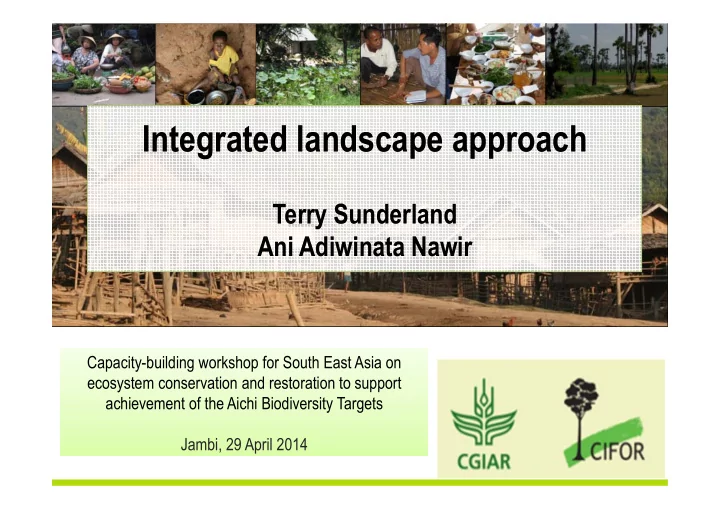
Integrated landscape approach

Terry Sunderland Ani Adiwinata Nawir

Integrated landscape approach

Terry Sunderland Ani Adiwinata Nawir

slide-2
SLIDE 2

THINKING beyond the canopy

  • 1. Understanding the landscape approach
  • 2. Ten principles for a landscape approach

& AICHI Targets

  • 3. Lessons learnt from reviewing forest

rehabilitation initiatives (& case studies)

  • 4. An approach in Forest Landscape

Restoration in Indonesia

  • 5. Conclusions

Presentation highlights

slide-3
SLIDE 3

THINKING beyond the canopy

  • 1. Understanding the landscape approach
slide-4
SLIDE 4

THINKING beyond the canopy

Whose landscapes?

slide-5
SLIDE 5

THINKING beyond the canopy

  • Combination of separate land units with

different functions (spatial segregation)

  • Different functions on the same unit of land

but separated in time (temporal segregation)

  • Different functions on the same unit of land at

the same time (functional integration or real multi-functionality)

Multi-functionality

slide-6
SLIDE 6

THINKING beyond the canopy

Various components in a landscape

slide-7
SLIDE 7

THINKING beyond the canopy

Plantation Forest Agriculture

But in reality, segregation is the norm

slide-8
SLIDE 8

THINKING beyond the canopy

  • Collecting economic data at

various levels, engaging most stakeholders

  • Spatial data: administrative

boundaries, land cover change and current land uses

  • “Governance landscape”

including local (traditional) institutions

  • Focus on ecosystem services and

agricultural productivity and away from protected areas alone

Landscape assessment for development

slide-9
SLIDE 9

THINKING beyond the canopy

  • “Eco-agriculture” (Scherr and McNeely 2006)
  • “Agroecology is complimentary to conventional agriculture and

needs scaling up” (United Nations 2011)

  • “New agriculture needed…” (UNDP 2011)
  • “Agro-ecological approach” (World Bank 2011)
  • “Integrated management of biodiversity for food and agriculture”

(FAO 2011)

New approaches for integrating agriculture and NRM?

slide-10
SLIDE 10

THINKING beyond the canopy

  • Since 2008, CIFOR and multiple partners working on defining and

refining broad “landscape approaches” building on previous initiatives

  • How? Review of published literature, multiple workshops for

consensus building, conferences/side events, e.g. Diversitas, IUFRO, CBD Bonn, Nagoya

  • Validated by extensive survey of field practitioners
  • Based on this on-going work, SBSTTA - Subsidiary Body on

Scientific, Technical and Technological Advice - commissioned CIFOR to draft report “sustainable use of biodiversity at the landscape scale” (see http://www.cbd.int/doc/meetings/sbstta/sbstta- 15/official/sbstta-15-13-en.pdf)

  • Global Landscape Forum was launched during COP

in Warsaw (16 November 2013)

New (landscape) approaches

slide-11
SLIDE 11

THINKING beyond the canopy

  • 2. Ten principles for a landscape approach &

AICHI Targets

slide-12
SLIDE 12

THINKING beyond the canopy

Integrated landscape approach Aims to reconcile agriculture, conservation, and

  • ther competing land uses.
slide-13
SLIDE 13

THINKING beyond the canopy

Key references

slide-14
SLIDE 14

THINKING beyond the canopy

1. Continual learning and adaptive management 2. Common concern entry point: shared objectives & values 3. Multiple scales: external influences & constraints 4. Multi-functionality: multiple uses by different stakeholders 5. Multi-stakeholders: at various levels 6. Negotiated and transparent change 7. Clarification of rights and principles: negotiated & accepted 8. Participatory and user-friendly monitoring 9. Resilience: recognizing of threats & vulnerabilities

  • 10. Strengthened stakeholder capacity

Ten principles for a landscape approach

slide-15
SLIDE 15

THINKING beyond the canopy THINKING beyond the canopy

Strategic goal A: Address the underlying causes of biodiversity loss by mainstreaming biodiversity across government and society

slide-16
SLIDE 16

THINKING beyond the canopy

Strategic goal B: Reduce the direct pressures on biodiversity and promote sustainable use

slide-17
SLIDE 17

THINKING beyond the canopy

Strategic goal C: To improve the status of biodiversity by safeguarding ecosystems, species and genetic diversity

Strategic goal D: Enhance the benefits to all from biodiversity and ecosystem services

slide-18
SLIDE 18

THINKING beyond the canopy

Strategic goal E: Enhance implementation through participatory planning etc.

slide-19
SLIDE 19

THINKING beyond the canopy

  • 3. Lessons learnt from reviewing forest

rehabilitation initiatives (in Asia and Latin America)

country reports can be found at http://www/cifor.cgiar.org ( Funded by Government of Japan, 2004-2007)

slide-20
SLIDE 20

THINKING beyond the canopy

(3) Favourable conditions: creating the right incentives

Designing & implementing restoration initiatives to ensure local economies are improved

Sustainable initiative & practice (1) Addressing direct and underlying causes of ecological system & function Multiple socioeconomic benefits for local stakeholders involved (tangible & intangible) Improvements in ecological conditions (2) Socioeconomically feasible technical interventions

Clear land status & full access for a community to manage the areas Engaging with markets (Tangible & intangible benefits)

slide-21
SLIDE 21

THINKING beyond the canopy

(1) Addressing the causes of deforestation and land degradation in line with technical interventions

slide-22
SLIDE 22

THINKING beyond the canopy

Framework to identify the causes of deforestation & degraded land condition

The direct & underlying causes: continuing disturbance threatens for sustainable practices

Natural conditions Resulting from human activities

Direct causes

Market & policy failures Governance weaknesses Socioeconomic & political causes

Concession holders, investors in estate crops, slash-and-burn farmers, smallholders, mining & oil companies

Agents

Underlying causes

slide-23
SLIDE 23

THINKING beyond the canopy

Technical intervention is very expensive

(Cost/ha ranges from: USD 115 – 15,221) (2) It is crucial to ensure the feasibility & cost-effectiveness

  • f restoration practices from

socioeconomic & technical perspectives

Feasibility: technical intervention is feasible taking

into account social, economic & technical costs

Cost-effectiveness: there is an optimum level of

adoption by local stakeholders, especially community

An exit strategy: reinvestment mechanisms as part of the

project’s financial plan to ensure funding sustainability

slide-24
SLIDE 24

THINKING beyond the canopy

(3) Designing the right economic & social incentives tailored to local needs, so: livelihood benefits can be generated to ensure long- term community commitment beyond the project time

slide-25
SLIDE 25

THINKING beyond the canopy

Enabling Incentives

(e.g. land tenure and resource security, market development, credit facilities)

Framework to develop incentives

Direct incentives

(e.g. seedlings, cost- sharing arrangements)

Sectoral

(e.g. harvesting restriction, trade tariffs)

Macro-economic

(e.g. polices on interest rates, income taxes)

Indirect incentives Variable incentives

slide-26
SLIDE 26

THINKING beyond the canopy

Case studies

slide-27
SLIDE 27

THINKING beyond the canopy

Protection of water dam (Central Java): soil erosion & sedimentation problems from the surrounding watersheds Watershed management Floods & erosion (-) micro climates (+) Ecotourism (+) Sedimentation rate decreased Land terrace system implemented Forest cover increased Land productivity improved Agricultural production increased Community income increased Green landscape & belt (+)

slide-28
SLIDE 28

THINKING beyond the canopy

Forest cover increased Water resources & micro climates maintained

Private farm forestry (Gunungkidul): land & soil fertility problems – important to conserve water for local community

Private farm forestry development (tree planting using teak) Forest & land productivity improved Product supply improved (timber, fodder, fuel wood) Community incomes increased Improved financial capacity for primary needs, education & health services, social needs (e.g. weddings)

slide-29
SLIDE 29

THINKING beyond the canopy

Key messages from case studies:

  • 1. Multiple benefits have resulted from improved

ecological conditions that have subsequently generated economic & social benefits

  • 2. Developed based on local needs/ecological problems

(stimulating community participation)

  • 3. Clear engagement with markets (ecotourism, timber)
slide-30
SLIDE 30

THINKING beyond the canopy

  • 4. An approach in Forest Landscape Restoration:

Forest Management Unit (FMU) - Kesatuan Pengelolaan Hutan (KPH): Case of Sumbawa, Eastern Indonesia

Kanoppi Project: Timber & non-timber in an integrated production and marketing system (ACIAR Project, FST/2012/039, April 2013 – Dec 2016)

slide-31
SLIDE 31

THINKING beyond the canopy

Upstream forests: honey trees (Boan:Tetramales nudiflora) Downstream area: City of Sumbawa Sumbawa island

Conserving watersheds: upstream forests Main program of FMU in Sumbawa: Batulanteh - 32,776 Ha (Limited production forest – 55%, production forest – 23%, protected forest – 22%)

Main watersheds

slide-32
SLIDE 32

THINKING beyond the canopy

Problems & threats

slide-33
SLIDE 33

THINKING beyond the canopy

(1) Managing protected forest while enhancing livelihoods (4) Rehabilitating degraded area while enhancing livelihoods District capital city: Sumbawa Besar (3) Illegal logging in state-own company rehabilitated forests (2) Forest encroachment

slide-34
SLIDE 34

THINKING beyond the canopy

A landscape-platform of a certain ecological function that allows: Conservation, rehabilitation and economic and sociocultural activities can be complementary implemented in addressing ecological problems, as well socioeconomic and tenurial conflicts under an integrated management Interaction between key stakeholders, including local communities, to collaborate in managing the resources and resolve conflicts participatively

Forest Management Unit (Kesatuan Pengelolaan Hutan-KPH)

Fits: Forest Landscape Restoration

slide-35
SLIDE 35

THINKING beyond the canopy

  • 5. Conclusions
slide-36
SLIDE 36

THINKING beyond the canopy

  • The landscape approach has been re-defined to include

societal concerns related to conservation and development trade-offs and negotiate for them

  • Increased integration of poverty alleviation goals
  • Increased integration of agricultural production and food

security

  • Emphasis is on adaptive management, stakeholder

involvement and multiple objectives

  • Means to achieve AICHI targets
  • In line with Forest Landscape Restoration approach and for

facilitating successful forest rehabilitation programs

slide-37
SLIDE 37

THINKING beyond the canopy THINKING beyond the canopy

The Center for International Forestry Research (CIFOR) is one of the 15 centres supported by the Consultative Group on International Agricultural Research (CGIAR)

Thank you!

www.cifor.cgiar.org