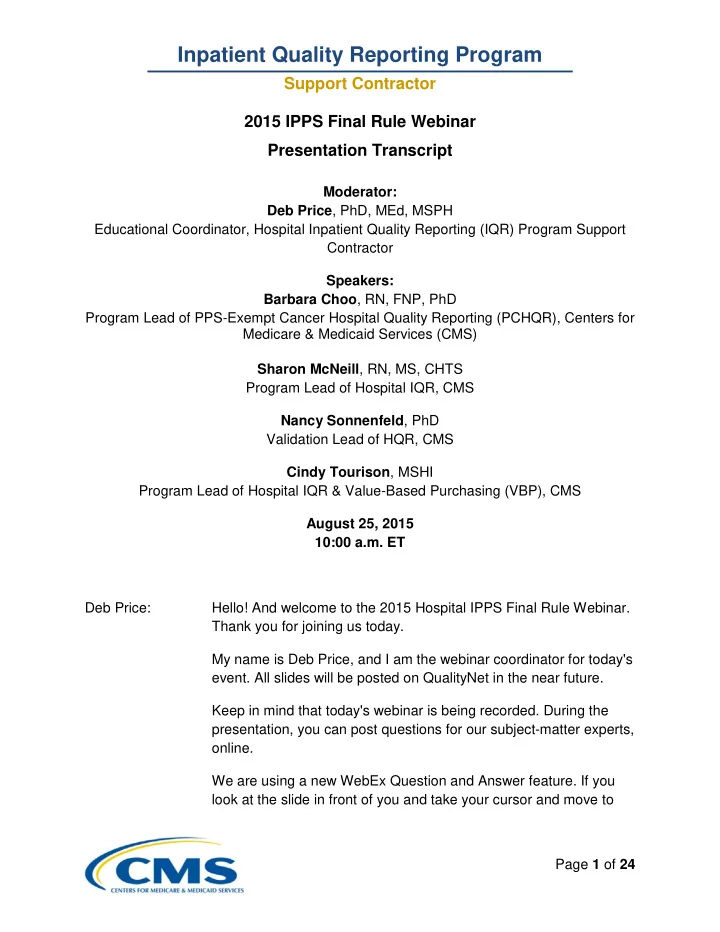
Inpatient Quality Reporting Program Support Contractor 2015 IPPS - - PDF document

inpatient quality reporting program
SMART_READER_LITE
LIVE PREVIEW

Inpatient Quality Reporting Program Support Contractor 2015 IPPS - - PDF document

Inpatient Quality Reporting Program Support Contractor 2015 IPPS Final Rule Webinar Presentation Transcript Moderator: Deb Price , PhD, MEd, MSPH Educational Coordinator, Hospital Inpatient Quality Reporting (IQR) Program Support Contractor


slide-1
SLIDE 1

Inpatient Quality Reporting Program

Support Contractor

Page 1 of 24

2015 IPPS Final Rule Webinar Presentation Transcript

Moderator: Deb Price, PhD, MEd, MSPH Educational Coordinator, Hospital Inpatient Quality Reporting (IQR) Program Support Contractor Speakers: Barbara Choo, RN, FNP, PhD Program Lead of PPS-Exempt Cancer Hospital Quality Reporting (PCHQR), Centers for Medicare & Medicaid Services (CMS) Sharon McNeill, RN, MS, CHTS Program Lead of Hospital IQR, CMS Nancy Sonnenfeld, PhD Validation Lead of HQR, CMS Cindy Tourison, MSHI Program Lead of Hospital IQR & Value-Based Purchasing (VBP), CMS August 25, 2015 10:00 a.m. ET Deb Price: Hello! And welcome to the 2015 Hospital IPPS Final Rule Webinar. Thank you for joining us today. My name is Deb Price, and I am the webinar coordinator for today's

  • event. All slides will be posted on QualityNet in the near future.

Keep in mind that today's webinar is being recorded. During the presentation, you can post questions for our subject-matter experts,

  • nline.

We are using a new WebEx Question and Answer feature. If you look at the slide in front of you and take your cursor and move to

slide-2
SLIDE 2

Inpatient Quality Reporting Program

Support Contractor

Page 2 of 24 the top of the screen, you'll see a green bar. That green bar, if you put your cursor over it, will drop down, and you’ll see in the right- hand side that there's an arrow pointing down. Click the arrow, and the top item to click is going to be q-and-a. You click on the q-and- a, and that's where you're going to be typing your questions. During the program, our subject matter experts are going to be answering your questions. At the end of the event, we will read many of the questions live, and get responses from our subject- matter experts. If we don't get to your question, no problem ... We will answer all questions after the event, and we will have a [tran]script. We will post the [tran]script on QualityNet. The purpose of the WebEx is to provide you with an overview of the final changes to the Fiscal Year 2015 Inpatient Perspective Payment-System Rule related to PPS-Exempt Cancer Hospital Quality Reporting (PCHQR), Inpatient Quality Reporting (IQR), the alignment of IQR and Electronic Health Record (EHR) Incentive Program, and Hospital Value-Based Purchasing (HVBP). http://www.cms.gov/Medicare/Medicare-Fee-for-Service- Payment/AcuteInpatientPPS/FY2015-IPPS-Final-Rule-Home- Page.html The rule is currently on display at the link shown above. At the conclusion of the presentation, participants will be able to identify changes within the Fiscal Year 2015 Final Rule. Let me now introduce our speakers from CMS. They all work in [the] Centers for Clinical Standards in Quality [for CMS], and each plays a key role in the quality reporting programs we will cover in today's meeting. And now, Barbara Choo, program lead for PCHQR, will begin with our first presentation. Barbara? Barbara Choo: Thank you, Deb. Good afternoon, I'm Barb Choo, and I will be going over the PPS Exempt Cancer Hospital Quality Reporting program. The PPS-Exempt Cancer Hospital Quality Reporting Program was developed by Section 3005 of the Affordable Care Act. This year,

slide-3
SLIDE 3

Inpatient Quality Reporting Program

Support Contractor

Page 3 of 24 CMS has finalized all policy decisions with an additional adoption of the external-beam radiotherapy measure for Fiscal Year 2017 and beyond. We have also finalized three measures for public-reporting

  • purposes. These are: cancer-specific measure in 2015, and

CLABSI and CAUTI no later than 2017. Additional program requirements are reflected in red in this table. I won't go over the details, but please contact Henrietta Hight, who is

  • ur support contractor [lead], if you need additional information.

To date, there are 19 measures finalized under the PCHQR

  • Program. This slide summarizes all 19 measures and applicable

program requirements. Please refer to the final rule for all applicable reporting periods. This concludes our overview of existing PCHQR policy. Now I will turn over the time to Sharon McNeill, who's our Hospital Inpatient Quality Reporting Program lead. Sharon? Sharon McNeil: Good afternoon. This is Sharon McNeill, and I am the program lead for Hospital Inpatient Quality Reporting for the Centers of Clinical Standards and Quality for CMS. There were five new measures added to the Inpatient Quality Reporting Program. An all-cause readmission measure for patients who undergo CABG surgery will provide hospitals with an incentive to reduce readmission through prevention, early recognition, and treatment of post-operative complications, by improving coordination of perioperative care and discharge planning. An all-cause mortality measure for patients who undergo CABG surgery w[as] also add[ed] and will improve hospitals with an incentive to reduce mortality through improved coordination and discharge planning. Variation in the mortality rates suggests that there is room for

  • improvement. We have adopted the Pneumonia Episode of Care

measure because it is one of the leading causes of hospitalization for Americans 65 and over, and pneumonia patients incur roughly $10 billion in aggregate healthcare costs annually. We have

slide-4
SLIDE 4

Inpatient Quality Reporting Program

Support Contractor

Page 4 of 24 adopted the Heart Failure Episode of Care measure because it is also one of the leading causes of hospitalization, and it costs roughly $34 billion annually. The purpose of the Chart-Abstracted Severe Sepsis and Septic Shock measure is to support standardized screening protocols for early goal-directed therapy and the efficient, effective, and timely delivery of high quality sepsis care in support of the Institute of Medicine's aim for quality improvement. The sepsis bundle provides a standard treatment protocol for early risk stratification and management of a patient with sepsis. CMS will delay collection of this measure until further notice as we gather more information from the NQF and measures’ [inaudible].The duration of this delay is not yet determined. However, this delay does not affect any data collection period for any other Hospital Inpatient Quality Program measures. Now, this slide is a little busy, but it actually depicts the measures determined to be topped out. In order to determine topped-out status, we finalized the following criteria:

  • Statistically and distinguishably, performance at 75, the 75th and

90th percentiles; and

  • Truncated coefficient of variation less than or equal to 0.10.

The coefficient of variation, or the CV, is a common statistic that expresses the standard deviation as a percentage of the sampled mean in a way that is independent of the units of observation. After consideration of public comments we've received, we are clarifying [whether] the hospital should report a single count per enrolled facility and not a CCN for the previous finalized influenza immunization coverage among healthcare personnel. We will require facilities to collect and submit a single immunization count for each healthcare facility enrolled in NHSN, by facility

  • rganization ID number. This modifies our statement and the

proposed rule indicating that facilities should submit data by CCN, and better aligns with our fiscal year 2015 Outpatient Proposed Rule, as well as NHSN guidance documents.

slide-5
SLIDE 5

Inpatient Quality Reporting Program

Support Contractor

Page 5 of 24 The currently adopted and feature[d] Condition Specific Claims- Based measures beginning with fiscal year 2017 payment determination and subsequent years were finalized to use three years of data to calculate the measures, unless otherwise specified. In other words, this reporting period would apply to all future calculations of Condition Specific measures already adopted and the Hospital IQR Program, and any Condition Specific measures that may be subsequently adopted in the future. Sorry for the technical difficulties. Now we turn it over to Nancy Sonnenfeld, who is the Validation lead for Hospital Inpatient Quality Reporting. Nancy? Nancy Sonnenfeld: Good afternoon! My name is Nancy Sonnenfeld, and I'm the Validation lead for the Hospital Inpatient Quality Reporting

  • Program. I'll be discussing modifications to the hospital IQR

validation process, as we finalize them in FY 2015 by PPS rules. The first policy that I'll be discussing relates to Healthcare- Associated Infection measure data. That's HAI data. This is not actually a validation policy, but because we made the policy primarily to support validation and using CMS authority to conduct validation, I'm the one who's talking about it. For the FY 2016 payment determination and subsequent years, we clarified our data reporting and submission requirements for the HAI, that's Healthcare-Associated Infection measures, required for the hospital IQR program. By adopting the CDC's data reporting and submission procedures, we intended that hospitals reporting all patient-level data elements designated as required on any [inaudible] forms, are also a requirement for the CDC [and] the CMS Hospital IQR Program. We further clarified that the data collected by [the] CDC will be shared with CMS for the Hospital IQR Program and VBP Program, administration monitoring and evaluation activities, including validation, appeals review, program impact and evaluation, and development of quality measure

  • specification. We finalized that we will receive access from CDC to

voluntarily submitted name and race identifying information with respect to the Hospital IQR Program required measures. The

slide-6
SLIDE 6

Inpatient Quality Reporting Program

Support Contractor

Page 6 of 24 submitted name and race information, as well as the other data submitted, will be used to ensure accurate matching between patient charts submitted for HAI validation that cannot be matched to any existing Medicare beneficiary identification numbers. In addition, these data will [only] be used as appropriate for program evaluation. I want to note that this policy has absolutely no impact at all on what hospitals are required to submit to meet Hospital IQR Program requirements. CMS is just trying to make transparent that we may physically access the patient-level data that are housed by the CDC that hospitals have already submitted on behalf of the IQR Program. My next set of slides is about the changes to the process for Validation of Chart-Abstracted measures. I wanted to start with the basic overview of the process as it exists today, noting that we haven't made changes to this general outline of the process. The steps are as follows: CMS selects hospitals participating in the Hospital IQR program for

  • validation. We select annually 400 randomly-selected hospitals and

another targeted sample of up to about 200 hospitals. For each selected hospital, CMS samples a subset of patient medical charts that are part of the IQR Program and are used in

  • validation. For the Clinical Process of Care measures, we use the

data submitted to the clinical data warehouse for sampling. For the Healthcare-Associated Infection measures, we use validation templates for the sampling. This is actually quite a complicated

  • process. We could have a session just on that, but it's not a change

to our process, so I'm not going to go into detail here. Our clinical data-abstraction contractor is CDAC, and they request medical records from hospitals in writing, which then submit the requested medical records within the 30-day time frame required. CDAC conducts validation and provides the information to hospitals so that they have feedback on how they did and then CMS makes

slide-7
SLIDE 7

Inpatient Quality Reporting Program

Support Contractor

Page 7 of 24 an annual payment determination, requiring a 75% reliability. Hospitals may request reconsideration of the APU determination as they would for any other aspect of an APU determination within the IQR Program. I also thought it would be helpful to show this process that I just described graphically, displaying the time that it takes from when hospitals first deliver care to when CMS completes the process and makes a payment determination. For example, for the FY 2017 payment determination, which we finalized in the FY 2015 IPPS rule, the quarters used in validation are Quarters 3, 2014, which starts in July of 2014, through Quarter 2, 2015, which ends in March of 2015. Because of the various requirements associated with validation that occur after service delivery at the end of March 2015, CMS completes validation for these four quarters in April or May of 2016, which is what we then use to make the payment determination for FY 2017. Again, there were no changes to this basic timeline, but I thought it would be helpful for you to have an understanding of the process. So we changed the definition of a Validation Eligible Hospital, and the change was that a Validation Eligible Hospital is one that is a subsection (d) hospital that successfully submits at least one case to the Hospital IQR clinical data warehouse during the quarter containing the most recently available data. The quarter containing that data will be defined based on when the random sample is

  • drawn. The purpose of this change was simply to provide greater

flexibility for when CMS can sample hospital data that will allow us to use the most recent data available to select hospitals. What this means for hospitals is that you can expect to be notified if you're in the random sample a few months earlier for the FY 2017 payment determination than you were in previous years. No change is being made to the timing of selection of hospitals for the targeted validation. We also finalized a change for the FY 2017 payment determination, to reduce the total number of medical charts submitted for

slide-8
SLIDE 8

Inpatient Quality Reporting Program

Support Contractor

Page 8 of 24 validation from 97 to 72 charts per year, or 18 per quarter. Of the 18 charts to be submitted per quarter, 10 will be submitted to validate HAI measures, and eight will be submitted to validate clinical process of care measures. Note that this is an increase of

  • ne chart per quarter for HAI, and it's seven fewer for the Clinical

Process of Care measures. We made the change to require more HAI charts than Clinical Process of Care charts because of the greater relative scoring weight that infection has in the Hospital Value-Based Purchasing Program relative to the clinical Process of Care domain in the current program. This change and other changes were made in the Validation Program to better align the Hospital IQR Program validation process with the Hospital Value- Based Purchasing and Healthcare Acquired Condition Reduction Program incentives and penalties. In addition to reducing the number of clinical Process of Care charts being included in validation, we made a fundamental change in the sample design for the Clinical Process of Care measures. Previously, CMS sampled separately three charts each for five specific topic areas: AMI, heart failure, pneumonia, SCIP, and

  • immunization. For the FY 2017 payment determination of

subsequent years, we finalized the policy to separate policy IMM topic area from all the other topic areas and then to have another, which includes all the topic areas continuing required measures aside from those immunization and perinatal topic areas. So, this approach accomplishes a few different goals. First, it emphasizes validation of the IMM topic area. This topic area is particularly important because it contains a required measure within the HVBP

  • Program. Therefore, we are emphasizing the topic area to align the

Hospital IQR Program validation process with Hospital VBP Program goals. There are two other topic areas, which contain required measures in the Hospital VBP Program, one of which is perinatal care. Because perinatal care data are actually submitted in aggregate, it would require a completely different validation

  • process. So we're still developing a process to validate perinatal

care data. The other topic area that's in HVBP is AMI. The measure

  • f AMI-7A applies almost exclusively to small rural hospitals.

Because we did not want to single-out these hospitals unfairly, we

slide-9
SLIDE 9

Inpatient Quality Reporting Program

Support Contractor

Page 9 of 24 are validating AMI-7A in the "other" category, instead of including it in the special category that's aligned with HVBP. So, the first goal was to align our approach with the Hospital Value-Based

  • Purchasing. The second goal that this new policy accomplishes is

to ensure that all measures required in the Hospital IQR Program are included in validation. For example, measures in the ED, VTE, and stroke topic areas had not previously been validated, and now they will be. In addition, the policy permits CMS to validate every measure required by the Hospital IQR Program every year without having to propose changes to the validation process. If it's in the IQR Program in a given year, you can expect that it will be

  • validated. If it's not in the IQR Program in a given year, it will not be

validated. So, as I just stated, we finalized the policy to separate out the IMM topic area from all the other topic areas containing required measures for validation. However, because flu is seasonal, the allocation of charts to be sampled each quarter from among the eight allocated for clinical Process of Care charts was especially

  • tricky. Therefore, we're only validating IMM in the two quarters that

it's relevant to validate for influenza vaccine. For quarters 4 and 1, five of the eight cases will be drawn from a systematic random sample of charts for immunization and pre-charts from the "other"

  • category. For quarters 2 and 3, when vaccinating patients,

influenza is not actually indicative of quality. Eight cases will be drawn from a systematic random sample from the "other" category. Again, the "other" category includes all topic areas continuing required measures aside from those in the immunization and perinatal care topic areas. As I just finished stating, a goal was to align our validation processes with the Hospital Value-Based Purchasing process. From that perspective, we also wanted to align the weights that we allocated to each chart after it had been validated. This table shows the relative importance of the weights that will be included to combine the scores in validation. The Hospital-Associated Infection measures, the HAI measures, will account for two-thirds of the total validation score, with the

slide-10
SLIDE 10

Inpatient Quality Reporting Program

Support Contractor

Page 10 of 24 Clinical Process of Care measures accounting for one-third. Of that

  • ne-third, the immunization measures will account for 22%, and the

"other" category will account for 11%, so the whole thing adds up to 100%. These changes will also require adjustments to the formulas applied to compute the actual confidence interval, which is what we use to make the final APU determination. And we intend to post a specific formula used to compute the confidence interval on the QualityNet website as we do every year. We also finalized a proposal to expand the options for secure transmission of electronic versions of patient medical records. Hospitals currently have the option of submitting records in paper format, or as digital images, that is as a PDF on portable media, such as a CD-ROM or a DVD. In the last Final Rule, we've added a third option, which is to use a secure file transfer portal on the QualityNet website. This portal will allow hospitals to transfer files through either a web-based portal, or directly from a client application using a secure-file-transfer protocol. The system provides a mechanism for securely exchanging documents continuing sensitive information such as protected health information or personally identifiable information. So, that's all I have to say about the Chart-Abstracted Clinical Process of Care measures and the current requirements. The next slides are actually about voluntary validation requirements. This is an open invitation to you to help us create a great process for validating electronic clinical quality measure data. We didn't propose any requirements for validation of electronic clinical quality measures for the FY 2017 payment determination, but we recognize that to support the policies we finalized in terms of reporting eCQM data in an FY 2015 IPPS rule, we will need to develop a validation methodology in the future. We need to know that we're going to have ECQM data that are accurate and reliable. We conducted an environmental scan to study what was already known about validation of the eCQM data, and we identified three key areas that present threats to data accuracy. These include the design of the product itself, such as misspecification as the vendor built it, and customization for specific hospitals.

slide-11
SLIDE 11

Inpatient Quality Reporting Program

Support Contractor

Page 11 of 24 There may be differences, plus the accuracy as they come from provider practices and documentation. Providers may simply not use the EHR as it was designed. I may place key information in unstructured fields that makes it impossible for the practice part of an eCQM. The third threat is that the standards and specifications for the EHR and/or the eCQM may itself threaten data accuracy, if some kind of error were made. We're interested in looking at all these threats to data accuracy. To do so, we are inviting hospitals to participate in the pilot test. We're looking for up to 100 volunteer

  • hospitals. To participate, the hospital must meet EHR Incentive

Programs Stage 2 criteria and, in particular, be able to produce QRDA-1, a revision to extract the data for at least six of the 16 measures in the stroke, VTE, that's venous thromboembolism, ED, that's emergency department, and PC measure sets. The goals of the eCQM pilot test are: to assess the accuracy and completeness of electronic clinical quality measure data; to assess Hospital IQR Program readiness for electronic clinical quality measure reporting requirements; to identify the need for and implement updates to measure specifications and standards; and to plan for future validation requirements, including detailed

  • perational instructions and sample size.

So, to participate in this, hospitals will be asked to allow CDAC to view records remotely in real time, using secure software, with the hospital staff on the phone, and the hospital will be asked to show the CDAC selected records, such as laboratory records and patient medical history, navigating through the EHR system as directed by

  • CDAC. To support this process, hospitals will also have to provide

CDAC with patient lists for patients eligible for measures in each of the four topic areas: stroke, VTE, ED, and PC, and generate QRDA Category 1 files, extracted automatically, from an EHR. Ideally, hospitals would be able to do these latter-two processes, that is, generate the patient list and the QRDA Category 1 files, in real- time, remotely, while CDAC is on the phone. But, we recognize that not all hospitals will have these capabilities for real-time generation. So we will be flexible in when we get this information, so that as many hospitals as possible can participate in the pilot. During this remote real-time session, CDAC will file the specifications for the

slide-12
SLIDE 12

Inpatient Quality Reporting Program

Support Contractor

Page 12 of 24 data elements contributing to each electronic clinical quality measure to extract relevant information from up to 10 different sources, for example, for medication administration records, lab reports, and patient histories. CDAC will also abstract data following the chart-abstracted manual specifications for a given eCQM, for example, there is both a chart-abstracted version of the ED1 measure and an ECQM version. So, CDAC will do an abstraction using the chart-abstracted manual specifications. Then CDAC will compare the abstracted data from the 10 different sources with both the outcome from the chart-abstracted manual process and with the QRDA-1 file process. Based on this, CDAC will then asses and refine its own operational processes and will also compare the data. But that's on the next slide. So after CDAC goes through this comprehensive abstraction of data from the medical records, CMS and its contractors will assess the reliability between the extracted and abstracted measures, with the goal of working with measures to refine specifications, if that's

  • necessary. Or, for any measures that are actually in good shape,

we can say that they're ready to be reported and that can really help assess our readiness for reporting requirements. We will share conflicting findings, all conflicting findings, in great detail with the hospitals that agree to participate. Then we'll de-identify that process to find common patterns and just show patterns of conflicting findings and make those available to the general community, including all the stakeholders, vendors, hospitals, et

  • cetera. We'll also produce statistics to estimate sample size and

reduce hospitals. And we will reimburse the hospitals for up to 16 hours of their time to participate. So I would encourage all of you to participate in this highly interactive process. I'm going to pass this off now to Cindy Tourison, who will introduce

  • herself. Thank you.

Cindy Tourison: Thanks, Nancy. This is Cindy Tourison. I'm program lead over Hospital Value-Based Purchasing and the alignment of Hospital IQR to the EHR Incentive Program for eligible hospitals and critical access hospitals.

slide-13
SLIDE 13

Inpatient Quality Reporting Program

Support Contractor

Page 13 of 24 As we continue our goal of aligning the EHR Incentive Program with the Hospital IQR Program, we identified a challenge in the different reporting and submission timelines for the EHR Incentive program, which operates on the federal fiscal year basis, while the reporting and submission timeline for the Hospital IQR Program currently operates on the calendar year basis. Our solution, we finalized the proposal to the line, the reporting and submission timelines of both programs, on the calendar year, for clinical quality measures that are reported electronically. Please note that hospitals demonstrating meaningful use for the first time in 2015 would still be required to report CQM by attestation for a continuous 90-day period in FY 2015 or report CQMs electronically for a three- month calendar year quarter by July 1st of 2015, to avoid the Medicare penalty of the subsequent year. In our most recent final rule for FY 2017 payment determination, we kept an electronic eCQM voluntary option such that providers may select to voluntarily report 16 or 28 hospital IQR electronic clinical quality measures, which align with the Medicare EHR Incentive Program, as long as those 16 measures span three different NQS

  • domains. The 28 measures are listed in the next three slides.

You'll note that only 28 of the 29 measures adopted in the Medicare EHR Incentive program are applicable for the Hospital IQR Program because the measure ED-3, Median Time from ED Arrival to ED Departure for Discharged ED patients, is in fact, an

  • utpatient quality measure and therefore, not included.

We believe that the collection and reporting of data through health information technology will greatly simplify and streamline reporting for many CMS quality reporting programs. Through electronic reporting, hospitals will be able to leverage EHRs to capture, calculate, and electronically submit quality data that is currently manually chart abstracted and submitted to CMS for the Hospital IQR Program. In order to remain aligned with the Hospital IQR Program, we proposed to expand it so that providers may select to voluntarily report any of the 16 of the 28 Hospital IQR electronic clinical quality measures that align with the EHR Incentive Program, again, across three NQS domains.

slide-14
SLIDE 14

Inpatient Quality Reporting Program

Support Contractor

Page 14 of 24 This is a table of 12 measures, which are required under IQR, and these can be voluntarily submitted by way of chart abstraction or as electronic clinical quality measures. If a hospital chooses to submit these data via chart abstraction, a full year's data are required in accordance with IQR's chart abstracted submission deadlines. However, if a hospital chooses to voluntarily report these measures as eCQMs for one calendar year quarter by the submission deadline of November 30th, they are not required to submit the data via chart abstraction. Under the voluntary reporting pilot, we have two options. The first

  • ption is to electronically report eCQMs through QualityNet in the

QRDA-1 files, which are on the April 2014 measure specifications. [These] may be submitted in one of three quarters, either the first quarter of CY 2015, the second quarter of CY 2015, or the third quarter of CY 2015. Option 2 allows those who may be on an older version of the measure specification (2012, 2013, or 2014) to attest aggregate results for the entire reporting period for the EHR Incentive Program, which begins October 1, 2014 through September 30, 2015, and is to be reported through the Registration Attestation System. This table displays the 2015, the 28 clinical quality measures, which may be reported under IQR as voluntary or under the EHR Incentive Program. We have divided these up with a color code, which indicates which national quality strategy domain is addressed by selecting that specific CQM. This slide indicates 16 CQMs that were chosen from the 28 CQMs and would fulfill at least three of the six national quality strategy

  • domains. In fact, in this scenario, you can see that we're covering

four of the domains. We finalized a policy so that we will only publicly report the names

  • f those hospitals who successfully submit CY 1, CY 2, or CY 3

electronic clinical quality measure data by November 30, 2015

  • deadline. We will indicate these hospitals with a symbol on Hospital

Compare to recognize their advanced ability to submit data

slide-15
SLIDE 15

Inpatient Quality Reporting Program

Support Contractor

Page 15 of 24

  • electronically. We will not publicly report actual data or performance

rates of electronic clinical quality measures at this time. This table represents the available quarters for submission under the voluntary electronic reporting option. This is CY 2015, Quarter 1, 2, or 3. We will not be collecting CY Quarter 4 for the 2015 calendar year. Please note that the submission deadlines are for electronic clinical quality measures only and do not impact chart- abstracted measures. In the EHR Incentive Program's Stage 2 Final Rule, we finalized two options for eligible hospitals and CAHs to electronically submit CQMs in 2014 under the Medicare EHR Incentive Program. Option 1 is to report QRDA-1 files and to electronically submit patient-level data using the QRDA-1 format. Again, that's for CY Q1, Q2, or Q3. Option 2 is to aggregate the results and report through the CMS registration attestation system. Again, you must submit one full year's data, which is measurement period October 1, 2014 through September 30, of 2015. This aggregate reporting option is only applicable to the Medicare EHR Incentive Program. And we also noted in the final rule that QRDA-3 is not feasible for collection for eligible hospitals and CAHs under the Medicare EHR Incentive Program in 2015. Eligible hospitals and CAHs that do not wish to report CQMs electronically using the most recent version or the April 2014 version of the electronic specifications would be allowed to report CQM data by attestation for the Medicare EHR Incentive Program. We expect eligible hospitals and CAHs to adopt EHR technology that includes CQMs relevant to each hospital or CAH's patient mix. We understand, however, that there are situations in which hospitals do not have data to report on a particular CQM, and its EHR is not certified to additional CQMs that can be used to replace that CQM with another for which it has data. If eligible hospitals’ or CAHs’ EHRs are certified to a CQM that the eligible hospital or CAHs did not have patients that meet the denominator criteria of that CQM, the eligible hospital or CAH can submit a zero in the denominator for that CQM. Submission of a zero in a denominator

slide-16
SLIDE 16

Inpatient Quality Reporting Program

Support Contractor

Page 16 of 24 for a CQM counts as a successful submission for that CQM for both the EHR Incentive Program and the Hospital IQR Program. If an eligible hospital or CAH’s EHR is certified to a CQM and the EHR's producing a zero for that CQM at the time of reporting, the eligible hospital or CAH may submit a zero in that denominator for that eCQM. In the EHR Incentive Program Stage 2 Final Rule, we finalized the policy that eligible hospitals and CAHs that have five or fewer discharges per quarter in the same quarter as their reporting period in FY 2014, or 20 or fewer discharges per full FY reporting period beginning in 2015 for which data are being electronically submitted as defined by the clinical quality measures denominator population are exempted from reporting the CQM. To be eligible for the exemption, eligible hospitals and CAHs must submit their aggregate population and sample count for the Medicare/non- Medicare discharges for the CQM for the reporting period. We believe this policy better reflects our intent for eligible hospitals and CAHs to report on only those measures for which their EHRs are certified, while meeting the reporting requirements for the EHR Incentive Program and the Hospital IQR Program. Again, the case threshold exemption can be used when the hospital EHR system is certified to report the data that have five or fewer discharges during the relevant EHR reporting period, or 20 or fewer discharges during the year. Beginning in 2014, the eligible hospital or CAH would need to qualify for greater than 13 eCQMs to report fewer than 16 required

  • CQMs. Case thresholds are evoked but do not cover the three
  • domains. Therefore, the hospital would be exempt from the mean
  • requirement. If the eligible hospital or CAH does not meet the

criteria for exemption, it would be able to report at least 16 CQMs. Our policy requires that an eligible hospital or CAH that claims a case threshold exemption for one eCQM must choose another eCQM on which to submit data or continue to invoke the case threshold exemption until it exceeds 13 case threshold exemptions and may therefore report fewer than the 16 required CQM. This policy assumes that the eligible hospital or Critical Access Hospital has an EHR that is certified to more than the minimum of 16 CQMs

slide-17
SLIDE 17

Inpatient Quality Reporting Program

Support Contractor

Page 17 of 24 and that the hospital has other CQMs in its EHR to choose from for

  • reporting. We realize, however, that there could be many EHRs that

are certified to only the minimum of 16 CQMs required by the ONC's regulation, and for eligible hospitals and CAHs using those EHRs, this policy may result in the hospital needing to submit data

  • n an eCQM for which the EHR is not certified. It is not our intent to

have eligible hospitals or CAHs report on measures for which their EHRs are not certified. Therefore, beginning in 2015, the threshold exemption policy changes. If an eligible hospital or CAH qualifies for an exemption for a particular CQM, the exemption would count toward the 16 required CQMs. Okay, now we're moving into Hospital Value-Based Purchasing

  • Program. In the Final Rule, we finalize scoring methodology,

domains, and measures for the Fiscal Year 2017. We adopted our proposal to align the Hospital VBP's quality measurement domain with a national quality strategy. The Patient and Caregiver- Centered Experience of Care/Care Coordination domain, continuing the HCAHPS dimensions, is weighted at 25%. The efficiency and cost reduction domain containing the Medicare spending for beneficiary measure is weighted at 25%. The safety domain containing the healthcare-associated infections listed on the slide and the RPSI-90 composite is weighted at 20%. The clinical care domain has two subdomains, outcomes and process. The clinical care outcome subdomain contains the three 30-day mortality measures and is weighted at 25%. The clinical care process subdomain containing AMI-7A, IMM-2, and PC-01 is weighted at 5% of the total performance score. When proposing and adopting the new measures listed on this slide, we considered which measures are eligible for adoption, based on statutory requirements, including specification under the Hospital IQR Program posting date on the Hospital Compare website, and our priorities for quality improvements as outlined in the National Quality Strategy. For the FY 2017 Hospital VBP Program, we finalized the adoption of three measures, MRSA, C. diff, and PC-

  • 01. The MRSA measure is a risk-adjusted measure monitoring
  • nset MRSA blood-streaming sections, using the standardized

infection ratio among all patients in the facility, and is reported by

slide-18
SLIDE 18

Inpatient Quality Reporting Program

Support Contractor

Page 18 of 24 the CDC's National Healthcare Safety Network or NHSN. We remain concerned about the persistent public health threat presented by MRSA infection. According to a 2013 study available at the National Institute of Health website, MRSA results in longer hospitalization, increased expenses, and poor patient prognosis, and has been swiftly increasing worldwide over the past several

  • decades. Invasive MRSA infections may cause about 18,000

deaths during a hospital stay per year. C. diff is a risk-adjusted measure monitoring hospital onset of hideous infections using standardized infection ratio among all inpatients in the facility and has also been reported by the CDC's NHSN. According to a 2012 study, infection with C. diff is associated with poor outcomes for

  • patients. Previous work has determined that regardless of the

baseline risk of death, for every 10 patients that acquire C. diff in the hospital, one patient will die. C. diff is also associated with increased healthcare costs. One of the primary mechanisms by which C. diff increases costs is by increasing the length of time patients spend in the hospital. The PC-01 measure, elective delivery prior to 39 completed weeks’ gestation, is a chart- abstracted measure. Although this is a chart-abstracted measure, we finalized our policy in FY 2013 IPPF's final rule, indicating that this is a measure that would be collected in aggregated counts per hospital via a web-based tool. The Strong Start initiative was launched to help reduce early elective births. At launch, the HHS secretary stated that more than half a million infants are born prematurely in America each year. Fortunately, the early elective birth rate has steadily decreased. In 2012, the number of early elective births had decreased to approximately 456,000, or 11.55%,

  • f the total number of births. Early elective births are a public health

problem that has significant consequences for families well into a child's life. Based on our evaluation of the most recently available data, we believe that the measures listed on the slide under "Measures Removed" heading are all now topped out. Therefore, we are removing these six measures from the FY 2017 Hospital VBP measure set, because measuring hospital performance on these

slide-19
SLIDE 19

Inpatient Quality Reporting Program

Support Contractor

Page 19 of 24 measures will have no meaningful effect on a hospital's total performance score. This table summarizes the proposed baseline and performance periods for FY 2017 Hospital Value-Based Purchasing program. This slide and the following slide contain a summary of the FY 2017 performance standards across all domains and subsequent measures in the VBP Program. There are two performance standards for each of the measures. The benchmark is the mean of the top percentile across all hospitals during a baseline period, and the achievement threshold is the median across all hospitals during the baseline period. PC-01 is a reverse measure, meaning lower values signify better quality. The FY 2015 IPPS Proposed Rule incorrectly displayed the value as a rate of 1 or 100%, instead of zero or 0%. The flow is corrected in the final rule. The Medicare Spending per Beneficiary measure with the efficiency and cost reduction does not have values listed on the slide for the benchmark and achievement threshold performance standard. With respect to the MSPB measure, we do not believe it is helpful for hospitals to be compared against performance standards constructed from the baseline period data, given the potential changes in market forces and utilization practices that occur over

  • time. Thus, the performance standards will be calculated from the

performance period data. The FY 2017 performance standards for HCAHPS dimensions are displayed on this slide. The benchmark and achievement threshold are displayed for each of the HCAHPS

  • dimensions. In addition, the floor is the worst-performing hospitals'

performance rate during the baseline period. In the Final Rule, we also finalized the ability to make non-substantive technical updates to the performance standards in the Hospital Value-Based Purchasing Program. During the long interval between the time we first display the performance standards for all measures except MSPB and the time we calculate the achievement and improvement scores for those measures based on actual hospital performance, one or more of those measures might have been technically updated in a way that inhibits our ability to ensure we

slide-20
SLIDE 20

Inpatient Quality Reporting Program

Support Contractor

Page 20 of 24 are making appropriate comparisons between the baseline and performance period. The statistical modeling we use to adjust measure calculations for PSI-90 and HCAHPS also needs to be periodically updated to incorporate coefficient factors that more properly account for the patient mix and the HCAHPS survey data collection mode. These types of technical updates do not substantively affect the measure rate calculation methodology, but they do sometimes affect our ability to make appropriate comparisons between the baseline and performance periods. For example, the baseline performance standards are tabulated using one version of the software, and the hospital performance during the subsequent performance is tabulated with another. We believe that in order to make the most accurate comparison of hospital performance across time, we should use the most updated version of the measure that is available at the time we calculate that performance because the updated version will produce the most valid measure rates. We will inform hospitals of these technical updates through our postings on

  • ur Hospital VBP Program website, the QualityNet website, and
  • ther educational outreach effort, and/or the scoring of reports that

we provide for the hospital each program year. This slide shows the domain and measure minimal reporting

  • requirement. We adopted the specified case minimums listed on

the slide for FY 2016 and expand the proposal for FY 2017 to cover the additional domains for Hospital Value-Based Purchasing Program in subsequent years. In the safety domain, a minimum of three cases for any underlying indicator for the PSI-90 measure and a minimum of one predicted infection for the NHSN HAI measures are required to receive measure scores. We finalized a minimum number of three measures receiving measure scores for the safety domain for the FY 2017 and subsequent years. In the clinical care outcome subdomain, we are requiring a minimum of two of the three 30-day mortality measures be scored in order to receive a subdomain score. In order to receive a score for the 30- day mortality measures, a minimum of 25 eligible cases is required during the performance period. We are aware that relatively few hospitals report data for the AMI-7A measure and the proposed

slide-21
SLIDE 21

Inpatient Quality Reporting Program

Support Contractor

Page 21 of 24 PC-01 measure, which will only include hospitals that provide maternity services. In accordance with our preference for including as many hospitals as possible in Hospital Value-Based Purchasing, while ensuring the reliability of the domain score, we are proposing to require hospitals to report a minimum of 10 cases in one measure for the clinical process subdomain. As in previous years, we are proposing that in order to receive a measure score and subsequent domain score in the efficiency and cost reduction domain, a hospital must meet the minimum of 25 episodes of care for the MSPB measure. Because the HCAHPS survey measure remains the only measure in the Patient and Caregiver-Centered Experience of Care/Care Coordination domain for FY 2017, we are proposing to require that all hospitals submit 100 completed HCAHPS surveys in order to receive a domain score. In the first years of hospital CVP program, we required that all domains must be scored in order to receive a total performance

  • score. For the FY 2015 and the FY 2016 program years, we

adopted methodology at which the total performance score, or TPS, may be awarded to hospitals that receive scores in at least two of the four domains. We were concerned that requiring just two out of the four national quality strategy-based domains in order to receive a TPS may be insufficient a position to ensure robust quality measurement under the program. We believe that requiring three

  • ut of the four NQS-based domains appropriately balances our

desire to be as inclusive as possible with Hospital VBP Program requirements, while ensuring TPS scores under the program are sufficiently reliable. For the purpose of the clinical care domain, we will consider the clinical care process and clinical care outcome subdomain as one domain, in order to meet this proposed

  • requirement. However, we would only re-weight hospitals' TPS
  • nce and will therefore not reallocate the clinical care process and

clinical care outcomes subdomains' weightings within the clinical care domain if a hospital does not have sufficient data for one of the subdomains. By adopting these policies, we believe that we will continue to allow as many hospitals as possible to participate in the program, while ensuring the reliable total performance score result.

slide-22
SLIDE 22

Inpatient Quality Reporting Program

Support Contractor

Page 22 of 24 We will now move into the question-and-answer portion of our call. Debbie? Deb Price: Hi! Thank you, Cindy. We now have an online CE certificate process. Please complete the WebEx survey that will automatically pop up at the end of our

  • presentation. At the end of that survey, click "done." Then click on

either "new user" or "existing user" to access the Learning Management Center for your CE certificate. A one-time registration is required, and the facility must allow automatic e-mails. If not, please contact your IT department to open up the following domain

  • n your desktops: LMC@hsag.com.

This slide shows the licensing boards that are available to receive

  • CEs. If you're not a Florida-licensed professional, please print out

your certificate and send it to your own board. We will now have our subject matter experts review questions with us. We're going to start with our IQR Programs. Candace, are you ready to share any questions with us? Candace Jackson: Thank you. This is Candace Jackson with IQR. Some of the universal questions that have been submitted regarding IQR include, “Is The Joint Commission aligning with CMS regarding the topped-out measures?” At this time, CMS and The Joint Commission have not met to determine how The Joint Commission will handle these measures. The Addendum for the January 1, 2015 discharges is expected to be posted in October, which will include all the changes to the Specifications Manual as a result of the Final Rule. If a hospital is submitting chart-abstracted measures only, the required IQR measures will then be AMI-7A, IMM-2, SCIP IMM-4, ED-1 and -2, Stroke 1, 4, 6, and 8, and VTE-1, -2, -5, and -6, along with the web- based PC-01 measure. And that is, again, if the hospital is submitting chart-abstracted measures only.

slide-23
SLIDE 23

Inpatient Quality Reporting Program

Support Contractor

Page 23 of 24 Those were the two main questions that we received through the IQR queue. Deb Price: Thank you, Candace. Now we'll move onto Value-Based Purchasing with Bethany. Bethany: Hi! We received a few questions regarding Value-Based

  • Purchasing. The first one is, “PC-01 does not include adequate

exclusion criteria to be used as VBP.” We thank you for your

  • comment. If you or others would like your comments or concerns to

be addressed, please submit a comment in the FY 2016 IPPS Proposed Rule. The next question is, “SCIP IMMF-4 was suspended for the FY 2016 VBP Program. Are there any plans to add SCIP IMM-4 back into the VBP Program in the future?” Once again, we thank the commenters for the questions. And for future policies regarding the Hospital VBP Program, you may reference the IPPS Proposed and the Final Rules for future fiscal years. If you have a comment or concern, please do not hesitate to submit a comment to the IPPS proposed rules in the future. With that, I'll turn the floor back over to Deb. Deb Price: Thank you, Bethany. Now we're going to move on to eCQM with Artrina. Artrina? Make sure you unmute your button.

  • Okay. This is Deb, again. We are going to move down to Validation

with Jordan. Jordan:

  • Hello. We have a couple questions that have come in. One of them

is related to the process for changing your contact information for validation records. And for any changes, you can send those to the Validation e-mail box at: the address is validation@hcqis.org. The next question is, "What is included in the ‘other’ validation group?" This would include for FY17 payment determination, the

slide-24
SLIDE 24

Inpatient Quality Reporting Program

Support Contractor

Page 24 of 24 quarters are 3rd quarter and 4th quarter of 2014, and first quarter and second quarter of 2015. So that means for quarters 3 and 4 of 2014, the topic areas will be AMI, ED, heart failure, pneumonia, SCIP, stroke, and VTE, and then for first and second quarters of 2015, the other category would include AMI, ED, SCIP, stroke, VTE and sepsis, if that would come required again. The next question is, "Can hospitals still participate in the eCQM- validation pilot? And how do they sign up?” Again, if you want to sign up or be included in the validation pilot, please send an email to the Validation email box, which is validation@HCQIS.org. And that's all I have. Thank you. Deb Price: Thank you, Jordan. Now we're going to move down to cancer, with

  • Henrietta. Henrietta?

Henrietta Hight: Thank you, Deb. This is Henrietta. At this point, there are no questions that have been received regarding the PPS-Exempt Cancer Hospital Quality Reporting Program, but we welcome your

  • questions. So please feel free to use the email address that was

provided on one of the beginning slides that Barbara Choo

  • provided. I welcome your questions. Thank you.

Deb Price: Okay, and now we're going to fall back to Artrina with eCQMs. Artrina, are you on the line now? Well, okay. This concludes our program for today. I'd like to thank

  • ur four team lead speakers. Nancy Choo, Sharon McNeill --

excuse me -- Barbara Choo, Sharon McNeill, Nancy Sonnenfeld, and Cindy Tourison, as well as all our subject matter experts. If we did not get to your question, it will be published online and our q-and-a line that you have been typing questions into will remain

  • pen until 3:30.

Thank you, and enjoy the rest of your day. END

This material was prepared by the Hospital Inpatient Value, Incentives, and Quality Reporting (VIQR) Outreach and Education Support Contractor, under contract with the Centers for Medicare & Medicaid Services (CMS), an agency of the U.S. Department of Health and Human

  • Services. HHSM-500-2013-13007I, FL-IQR-Ch8-09102014-02