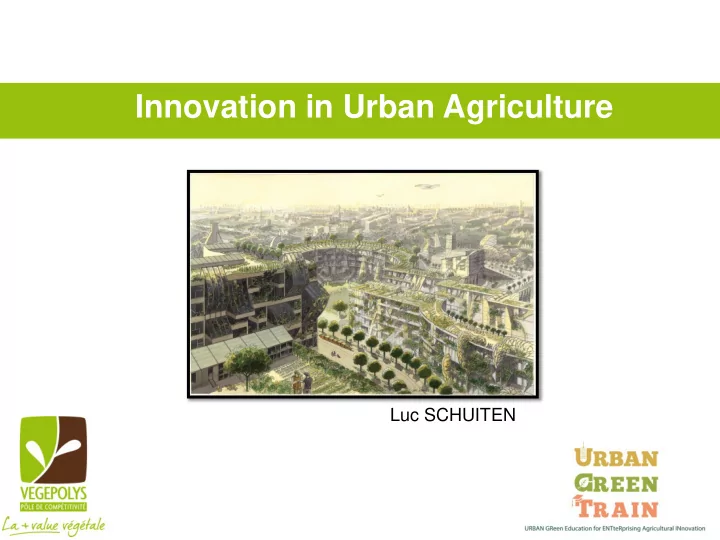
Innovation in Urban Agriculture Luc SCHUITEN Summary 1. Definition - - PowerPoint PPT Presentation

innovation in urban agriculture
SMART_READER_LITE
LIVE PREVIEW

Innovation in Urban Agriculture Luc SCHUITEN Summary 1. Definition - - PowerPoint PPT Presentation

Innovation in Urban Agriculture Luc SCHUITEN Summary 1. Definition and goals for companies 2. Different types of innovation 3. Innovation throughout the value chain 4. Different actors for different innovation needs 5. Levers to innovate in


slide-1
SLIDE 1

Innovation in Urban Agriculture

Luc SCHUITEN

slide-2
SLIDE 2

Summary

  • 1. Definition and goals for companies
  • 2. Different types of innovation
  • 3. Innovation throughout the value chain
  • 4. Different actors for different innovation

needs

  • 5. Levers to innovate in urban agriculture
slide-3
SLIDE 3

Summary

  • 1. Definition and goals for companies
slide-4
SLIDE 4
  • 1. Definition and goals for

companies

First definition: Oslo manual

OECD (Oslo Manual) : « The introduction of a good or service that is new or significantly improved with respect to its characteristics or intended uses. This includes significant improvements in technical specifications, components and materials, incorporated software, user friendliness or other functional

  • characteristics. »

Until 2005, innovation was considered as « implemented technologically new products and processes, and significant technological improvements in products and processes ». But innovation is not just technical… After 2005: « An innovation is the implementation of a new or significantly improved product (good or service), or process, a new marketing method, or a new organization method in business practices, workplace organization or external relations. » http://ec.europa.eu/eurostat/documents/3859598/5889925/OSLO-EN.PDF

slide-5
SLIDE 5

Invention vs Innovation

Invention: creative idea which helped to develop a new product, process, a new method, previously unknown. Innovation: every innovation is built on the basis of an invention which takes its place in the market and which has an impact on society and on the economy. When we talk about innovation, it is always an economic approach. From the early phases of the innovation process, the economic impact assessment (turnover generation) and social (job creation) can position its business model in the long term. Indeed, innovation allows companies to keep or achieve a leading position in its market, to go to new markets (Blue Ocean Strategy), to responding to new uses by changing its range… Organisations agility : through listening to its ecosystem, analysis of weak signals, of trends, companies can evolve their business and be more confident to innovate. This approach allows to assess the risks related to the proposed change. Many tools like prospective studies, economic watch newsletter, exhibitions visits... allow to understand these changes and make the decision

  • f changing.
  • 1. Definition and goals for

companies

slide-6
SLIDE 6

Strategic vigilance point : What kind of protection do you need to your innovations? According to your strategic goals, choices in terms of intellectual protection and control of your innovations will be different. In one case, rather oriented technology, intellectual protection of innovations ensures competitive advantage on the market. In another case, more oriented to social innovations, the inclusion of stakeholders in the functioning of the model ensures its sustainability and co-creation approach often results in open models. The fact of business on the service to users. http://www.ruaf.org/ua-magazine-no-28-grow-city- innovations-urban-agriculture

  • 1. Definition and goals for

companies

slide-7
SLIDE 7

According to the source of innovation, the objective in terms of intellectual property may be

  • different. This table illustrates several examples of innovations according to their location and

according to the strategic choice of protection that has been made. This table comes from the magazine UA Magazine no. 28 - GROW the City. Innovations in Urban Agriculture - December 2014 by RUAF.

  • 1. Definition and goals for

companies

http://www.ruaf.org/ua-magazine-no-28-grow-city-innovations-urban-agriculture

slide-8
SLIDE 8

Why to innovate in Urban Agriculture?

Urban agriculture is not new but demographic and economic challenges encourage reconciliation between production areas and consumption areas. This means inventing new technical models to produce in the cities and new business models more sustainable. Produce in an environment constrained like the city requires to innovate on the technical, social,

  • rganizational, marketing and institutional plans. These constraints are of different natures:
  • access to land surfaces, with acceptable prices and quality to produce.
  • access to resources, including water resources is access, access to resources,
  • waste management and risks of contaminants,
  • Quality management throughout the chain to ensure food security

These constraints can be reasoned by a circular economy approach and innovations…

  • 1. Definition and goals for

companies

slide-9
SLIDE 9

Summary

  • 2. Different types of innovation
slide-10
SLIDE 10
  • 2. Different type of innovation

Product, service or usage innovation

Organisational or procedural innovation Sales and marketing innovation Business model innovation Technological innovation Social innovation

Next generation innovation – BPIFrance 2015

slide-11
SLIDE 11

Product, service or use innovation

The project introduce a new product, a new service or a significant improvement in the nature of an existing product or service, its functionality or the way it is used*.

*Next generation innovation – BPIFrance 2015

  • A new product or service satisfies a need, solves a problem or create a new market
  • A product or service revision entails improvements to features, performance, ease of use,

quality, appearance…

  • A new usage for an existing product, service or technology enables clients/users to perform new

functions that meet different needs or provides clients/users with a different experience

https://vimeo.com/127910 916

New use oriented mobility smart jar New product + new service New virtual garden service

slide-12
SLIDE 12

Process and organisational innovation

This kind of innovation introduce a new design or production process, or unprecedented changes to the organization and management of the company, or in its process, logistics or suppliers relations management

  • Procedural or process innovation : implementing technical tools to improve productivity and

quality, make the company more responsive…

  • Organisational innovation : work organisation with all the stakeholders of the company
  • Managerial innovation : information diffusion, power and control : based on employee

autonomy and open innovation in the company

Next generation innovation – BPIFrance 2015

slide-13
SLIDE 13

Process and organisational innovation

https://youtu.be/1af08PSlaIs 3.26’

Blue economy as inspiration to innovate The analysis of the life cycle of a product, the use of waste resources, the integration of the value chain can create virtuous models, both in economic terms but also environmental and societal.

slide-14
SLIDE 14

Sales and marketing innovation

This kind of innovation introduce a new way to present, marketed, set the price or manage customer relationships.

  • branding, positioning, marketing and promotion
  • Packaging and presentation
  • Sales and distribution methods, channels and forms
  • Pricing levels, models, degree of customisation
  • Customer relations content, channels and quality

Next generation innovation – BPIFrance 2015

ultra fresh delivery service

slide-15
SLIDE 15

Business model innovation

The project is based on a new cost or revenue structure. It’s a new way of making money.

Next generation innovation – BPIFrance 2015

  • Based on costs : cost saving, cost generation,

cost recovery

  • Based on incomes : revenue generation,

profit maximisation

  • Disintermediation – reintermediation :
  • utsourcing or insourcing of skills, process ...
  • the functionality economy : do not sell

products but their use

  • Open models – free models
  • Blue Ocean models : how to capture hitherto

nonexistent markets? Portfolio diversification

slide-16
SLIDE 16

Business model innovation

A tool to innovate by business models Canvas: www.businessmodelgeneration.com

A way to describe its current business model, its business model envisaged and see what changes to implement, evaluate investments. With this tool, you can describe your product’s value proposition and everything you will need to succeed in producing. Link to module 5

slide-17
SLIDE 17

Technological innovation

Next generation innovation – BPIFrance 2015

The project rely on new technology development and/or integration, or the significant advancement of existing technologies.

  • Superior performance
  • Better price-performance ratio
  • Entirely new usages

FOR LIKE

  • New technology development
  • Existing technology enhancement
  • Original combination of largely advanced

technologies

Philips Plant light

slide-18
SLIDE 18

Social innovation

Next generation innovation – BPIFrance 2015

The project respond to poorly-satisfied or unmet social needs. Or create novel social relationships or collaborations. Social innovation include a social or societal mandate in their purpose, or be social in their practice. It create new social relationships or collaborations in which innovations ar co-produced by citizens, governments and market parties.

  • Target disadvantaged and vulnerable groups: make fresh food for customers with low incomes
  • Include social challenges such as integration of employees in the business model – co-creation
  • Include all the stakeholders in the decision process
  • Include users in every step of the project
  • Offer to share the added value of the project
slide-19
SLIDE 19

Key factors of success

Innovation results from a co-construction a multidisciplinary wealth An Integration of different stakeholders And beware of choice concerning intellectual property Innovation must be Open, Agile, User centered

slide-20
SLIDE 20

Open innovation

To be positioned in its ecosystem and observe all stakeholders (upstream and downstream). Create an ecosystem for innovation in project teams.

Next generation innovation – BPIFrance 2015

slide-21
SLIDE 21

User centred

Innovation must be understood by users and target the right people. One way to reduce risk-taking linked to innovation is the co- creation with users. Integrating the user from the upstream project phases to absorb risk-taking linked to innovation. This ensures that it is understood, it meets a need or a new use. A repeated iterations system allows users to test an idea and a concept and a prototype until it is ready to be marketed.

slide-22
SLIDE 22

Exercice

Design centred innovation

Step

  • 1. Who are the users?
  • 2. What is their path from idea to

acquire or use your product or service to the end of life or discontinuation of use?

  • 3. What are the constraints

encountered?

slide-23
SLIDE 23

Summary

  • 3. Innovation throughout the value chain
slide-24
SLIDE 24
  • 3. Innovation throughout the value

chain

Optimization of inputs Innovative cropping systems Marketing and sales systems Agro-écology Supply chain

Downstream Upstream Production

slide-25
SLIDE 25

Upstream of the value chain, optimizing inputs in these cities forced spaces must meet several objectives: reduce the use of synthetic products, reduce environmental impact and improve productivity in small spaces. The themes addressed by companies are:

  • varietal innovation : for varieties suited to controlled

conditions or to contracts referred to urban agriculture

  • Biostimulation : to improve plant resistance
  • plant nutrition
  • Biocontrol and Plant Protection
  • water optimization
  • energy optimization
  • Robotic and management tools for precision farming
  • 3. Innovation throughout the value

chain

Optimization of inputs

Downstream

slide-26
SLIDE 26

Innovative cropping systems Agro-écology Supply chain Low tech systems Importance of soil quality, risks of being on contaminated land Benefits of intercropping (permaculture) Combined systems for fish (aquaponics) training of technicians for associative gardens crop diversification and rotation control

  • 3. Innovation throughout the value

chain

slide-27
SLIDE 27

Innovative cropping systems Agro-écology Supply chain High tech systems Aboveground Systems Conditions partially or fully controlled Environmental management of the plant (lighting, water, air, nutrition ...)

  • 3. Innovation throughout the value

chain

slide-28
SLIDE 28

Innovation in production system under controlled conditions Example by Philips city farming

  • 3. Innovation throughout the value

chain

https://www.youtube.com/ watch?v=xRdsCu5CcQ8

slide-29
SLIDE 29

Closer to the market, innovations are at the heart of the urban ecosystem, i.e. by integrating into urban design and planning. Innovations at this stage are better interaction with

  • consumers. They can design templates and organize the

market:

  • Supply chain between production systems and customers
  • Transformation, Storage, Shipping - logistic distribution
  • Packaging
  • Distribution methods
  • Tools to self-production for individuals
  • 3. Innovation throughout the value

chain

Marketing and sales systems

Upstream

slide-30
SLIDE 30

https://www.youtube.com/watch?v =_jrvAjz0CHE

  • 3. Innovation throughout the value

chain

Innovation in logistic distribution Example by Amazon Fresh

slide-31
SLIDE 31

Summary

  • 4. Different actors for different innovation

needs

slide-32
SLIDE 32
  • 4. Different actors for different innovation

needs

Individuals Gardens/ Planters / Concepts Collectives Shared gardens / family gardens Canteen/company/restaurant roofing/ greenhouses / concepts Company production and sale roofing/ greenhouse / factory Indoor production company Greenhouse / factory

slide-33
SLIDE 33

From the expert to the total neophyte From the retirement person to plugged people tradition

  • nal

HIGH TECH from to

Needs

Rustic variety that support well-being and pleasure (taste, colour…) Inputs easy to use in small containers meeting a need for naturalness Tools and equipment simplifying and facilitating the production services ensuring the success of the production (digital advices…) Many tips (installation crops, monitoring…)

Characteristics Individuals Gardens/ Planters / Concepts

  • 4. Different actors for different innovation

needs

slide-34
SLIDE 34

Collective experience Enthusiastic people tradition

  • nal

More

Needs

Rustic and tasty varieties Simple and natural inputs and equipment services to facilitate the collective management sharing services (maintenance, production, expertise, …) Design advices

Characteristics

  • 4. Different actors for different innovation

needs

Collectives Shared gardens / family gardens

slide-35
SLIDE 35

Low expertise Few available

Needs

Rustic varieties and enjoyable / rewarding simple equipment, more reliable production support services for production digital services for sharing advice for the design and management

Characteristics

tradition

  • nal

HIGH TECH From to nonprofit

  • 4. Different actors for different innovation

needs

Canteen/company/restaurant roofing/ greenhouses / concepts

slide-36
SLIDE 36

Professionnals Production : 1 of the activity

Needs

varieties adapted to the mode of production and marketing Environment friendly inputs specific equipment Product Marketing supplements range services around

Characteristics

tradition

  • nal

HIGH TECH from to Sale of products and services

  • 4. Different actors for different innovation

needs

Company production and sale roofing/ greenhouse / factory

slide-37
SLIDE 37

Professionnals Short cycles, productivity

Needs

Adapted varieties to indoor production method adapted inputs (e.g. hydroponics) Specific equipment: gutters, lighting, robotics, ... solutions to reduce the energy bill product marketing logistics

Characteristics

HIGH TECH Sale of products

  • 4. Different actors for different innovation

needs

Indoor production company Greenhouse / factory

slide-38
SLIDE 38

Diversity of actors Diversity of needs :

  • Varieties
  • Inputs
  • Equipment
  • Advice
  • Services

An opportunity to suppliers

  • ffering products and services tailored
  • 4. Different actors for different innovation

needs

slide-39
SLIDE 39

Summary

  • 5. The levers to innovate according to business

models

slide-40
SLIDE 40

Objective: generic production of quality commodities at competitive prices

Focus on profitability

Competitive prices Optimize loads Key factors of success:

Technology to increase productivity and reduce costs The expertise and technical mastery The organization of the supply chain The City of heart Logistics The enlargement of the scale Mass or niche market

The products are generally sold in generic markets with no extra cost.

slide-41
SLIDE 41

Objective: Producing a product with a distinctive quality to differentiate mass products and be able to achieve a higher price for products.

Focus on product differentiation

Premium quality Differentiating product

Key factors of success:

The production of different varieties of high value crops, the taste specific production methods (organic, eco) Conversion of the product on site The organization of the chain (e.g. circular economy) The control of distribution

The products are generally positioned on a niche or premium market

La boite à champignon

Cultures en ville

slide-42
SLIDE 42

Objective: beyond food production, the strategy aims to offer

  • ther products and services, such as:

Cares, tourism and recreation; Restoration, Education, Ecosystem Services Waste Management.

Diversified incomes Multi- functionality

Key factors of success:

territorial coverage, community support Diversification of agricultural practices and technical mastery Service culture and customer proximity poly competence

Offers a coherent and clear target customers / consumers / users

Focus on company diversification

Les jardins de l’avenir Topager

slide-43
SLIDE 43

Objective: the company has a clear social function and the relationship with the broader social and community networks is of paramount importance for the operation of the farm. This model is based on intermediation

wide range of services participating management Key factors of success: Community participation Fundraising / substantial investments Digital zoom and user experience (notes given by the community) strong cultural approach (dependent on the local context)

Bring a "playful", and pass the bridge between the virtual and the real

Focus on share economy

slide-44
SLIDE 44

Objective: Develop innovative production methods and technologies

durability Setting prototyping

Key factors of success: Technology transfer / development methods Opportunities across the chain dies crossing: learn to understand Technical know-how

Define innovative for incrementing technical references

Focus on experimentation

AMP FUL

slide-45
SLIDE 45

Objective: provide authentic experiences through the sale of a story rather than a product. non-profit projects to bring a lot of pedagogy

services

Story telling

Key factors of success: Sale of history Shooting decision, leisure, training, social links wide range of stakeholders (farmers, designers, artists, citizens ...) Community involvement, neighborhood, resources available

Be careful of the renewal of services, entertainment and creativity

Focus on experience

La recyclerie Arvaia

slide-46
SLIDE 46

Levers

Recruitment: managers, marketers, engineers, technicians, web/mobile developers Les nouveaux entrants- do it yourself character… Finance the outsourcing of specialist skills like design, communication, web marketing… Technology Use

slide-47
SLIDE 47

References

Oslo manual: Guideline for collecting and interpreting innovation data – Third edition (OECD 2005) UA Magazine no. 28 - GROW the City. Innovations in Urban Agriculture - December 2014 by RUAF. Next generation innovation – BPIFrance 2015

slide-48
SLIDE 48

Retrouvez-nous sur

www.vegepolys.eu

@POLE_VEGEPOLYS

VEGEPOLYS POLE DE COMPETITIVITE