PROJECT INTRODUCTION langley urban agriculture demonstration project - - PDF document

project introduction
SMART_READER_LITE
LIVE PREVIEW

PROJECT INTRODUCTION langley urban agriculture demonstration project - - PDF document

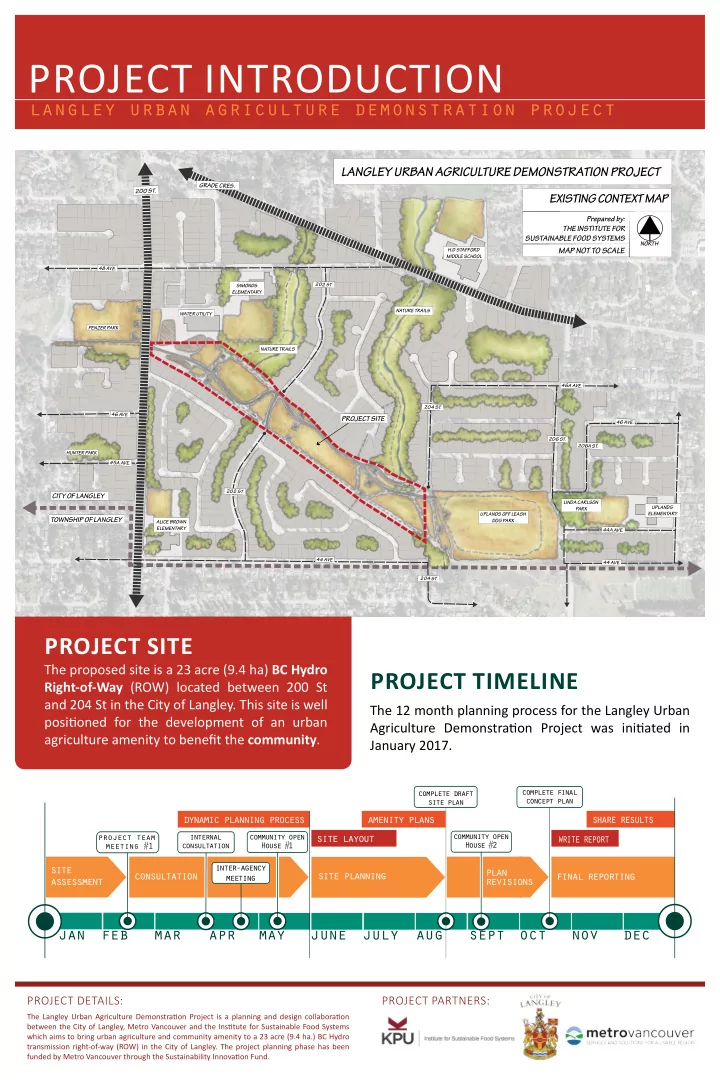
PROJECT INTRODUCTION langley urban agriculture demonstration project LANGLEY URBAN AGRICULTURE DEMONSTRATION PROJECT G R A D E C R E S . 200 ST. EXISTING CONTEXT MAP Prepared by: THE INSTITUTE FOR SUSTAINABLE FOOD SYSTEMS NORTH MAP


slide-1
SLIDE 1

The Langley Urban Agriculture Demonstratjon Project is a planning and design collaboratjon between the City of Langley, Metro Vancouver and the Instjtute for Sustainable Food Systems which aims to bring urban agriculture and community amenity to a 23 acre (9.4 ha.) BC Hydro transmission right-of-way (ROW) in the City of Langley. The project planning phase has been funded by Metro Vancouver through the Sustainability Innovatjon Fund.

PROJECT PARTNERS: PROJECT DETAILS:

PROJECT SITE CITY OF LANGLEY TOWNSHIP OF LANGLEY

200 ST. G R A D E C R E S .

48 AVE. 44 AVE. UPLANDS OFF LEASH DOG PARK ALICE BROWN ELEMENTARY SIMONDS ELEMENTARY H.D STAFFORD MIDDLE SCHOOL 204 ST. 206 ST. 46A AVE. 46 AVE. PENZER PARK WATER UTILITY 45A AVE. HUNTER PARK 204 ST. 202 ST. 202 ST. 46 AVE. 206A ST. 44A AVE. 44 AVE. LINDA CARLSON PARK UPLANDS ELEMENTARY NATURE TRAILS NATURE TRAILS

MAP NOT TO SCALE

NORTH

LANGLEY URBAN AGRICULTURE DEMONSTRATION PROJECT

Prepared by: THE INSTITUTE FOR SUSTAINABLE FOOD SYSTEMS

EXISTING CONTEXT MAP

site assessment

mar feb jan

internal consultation

may

consultation dynamic planning process

project team meeting #1

site planning

complete draft site plan

site layout amenity plans final reporting

community open House #1

write report

share results

apr may june july aug sept

  • ct

nov dec

complete final concept plan

inter-agency meeting

community open House #2

plan revisions

PROJECT SITE PROJECT TIMELINE

The 12 month planning process for the Langley Urban Agriculture Demonstratjon Project was initjated in January 2017.

langley urban agriculture demonstration project

PROJECT INTRODUCTION

The proposed site is a 23 acre (9.4 ha) BC Hydro Right-of-Way (ROW) located between 200 St and 204 St in the City of Langley. This site is well positjoned for the development of an urban agriculture amenity to benefjt the community.

slide-2
SLIDE 2

The Langley Urban Agriculture Demonstratjon Project is a planning and design collaboratjon between the City of Langley, Metro Vancouver and the Instjtute for Sustainable Food Systems which aims to bring urban agriculture and community amenity to a 23 acre (9.4 ha.) BC Hydro transmission right-of-way (ROW) in the City of Langley. The project planning phase has been funded by Metro Vancouver through the Sustainability Innovatjon Fund.

PROJECT PARTNERS: PROJECT DETAILS:

PROJECT PRINCIPLES

langley urban agriculture demonstration project

PRINCIPLES & OUTCOMES

  • 1. Prioritjze food productjon and educatjon in community asset

development.

  • 2. Ensure community fjt and compatjbility.
  • 3. Educate the public about the integratjon of

agriculture, energy, environment and community.

  • 4. Develop a replicable process for planning, design

and community engagement for urban agriculture projects in right-of-way and

  • ther urban areas in the region.

FARMER TRAINING

COMMUNITY EDUCATION

FOOD PRODUCTION

ECOLOGICAL ENHANCEMENT

ASSET DEVELOPMENT SOCIAL CONNECTION

Food productjon

  • pportunitjes can be created

for the community and local food access can be facilitated. Design and programming elements will combine to create a unique community asset on previously underutjlized public lands. Opportunitjes for community connectjon can be created through design, programming and meaningful partnerships. Demonstratjon of urban agriculture will create

  • pportunitjes for learning

and knowledge sharing within the community. Opportunitjes to enhance ecological assets on and adjacent to the site increasing overall sustainability. Space for food productjon can build the skills and capacity of new farmers and increase awareness about agricultural career optjons.

Project outcomes refmect how the community will be served by an urban agriculture project. It also demonstrates a comprehensive approach to design and planning that aims to achieve a variety of

  • utcomes through the implementatjon of

this project.

PROJECT OUTCOMES

slide-3
SLIDE 3

The Langley Urban Agriculture Demonstratjon Project is a planning and design collaboratjon between the City of Langley, Metro Vancouver and the Instjtute for Sustainable Food Systems which aims to bring urban agriculture and community amenity to a 23 acre (9.4 ha.) BC Hydro transmission right-of-way (ROW) in the City of Langley. The project planning phase has been funded by Metro Vancouver through the Sustainability Innovatjon Fund.

PROJECT PARTNERS: PROJECT DETAILS:

langley urban agriculture demonstration project

WHAT IS URBAN AGRICULTURE?

Urban Agriculture (UA) is any combinatjon

  • f actjvitjes that produce, process, and

distribute food and other products, on land in urban areas, applying intensive productjon methods to yield a diversity of crops and livestock.

The primary outcome of UA is food productjon, but many projects also provide multj-functjonal benefjts that align with broader social and ecological sustainability goals.

MULTI FUNCTIONAL URBAN AGRICULTURE

FOOD PRODUCTION EDUCATION CULTURE & HERITAGE BIODIVERSITY ENHANCEMENT

slide-4
SLIDE 4

The Langley Urban Agriculture Demonstratjon Project is a planning and design collaboratjon between the City of Langley, Metro Vancouver and the Instjtute for Sustainable Food Systems which aims to bring urban agriculture and community amenity to a 23 acre (9.4 ha.) BC Hydro transmission right-of-way (ROW) in the City of Langley. The project planning phase has been funded by Metro Vancouver through the Sustainability Innovatjon Fund.

PROJECT PARTNERS: PROJECT DETAILS:

langley urban agriculture demonstration project

WHAT IS URBAN AGRICULTURE?

COMMUNITY DEVELOPMENT URBAN GREENING WASTE MANAGEMENT HEALTH & WELL BEING ECONOMIC DEVELOPMENT ENVIRONMENTAL CONSERVATION

slide-5
SLIDE 5

The Langley Urban Agriculture Demonstratjon Project is a planning and design collaboratjon between the City of Langley, Metro Vancouver and the Instjtute for Sustainable Food Systems which aims to bring urban agriculture and community amenity to a 23 acre (9.4 ha.) BC Hydro transmission right-of-way (ROW) in the City of Langley. The project planning phase has been funded by Metro Vancouver through the Sustainability Innovatjon Fund.

PROJECT PARTNERS: PROJECT DETAILS:

langley urban agriculture demonstration project

URBAN AGRICULTURE IN HYDRO ROWS

BC Hydro outlines site infrastructure and actjvitjes that may be restricted in ROW areas, including:

  • Permanent structures
  • Temporary structures over 3m
  • Mature vegetatjon over 3m
  • Metallic materials (i.e. fencing, lightjng)
  • Mechanical irrigatjon
  • Commercial parking lots
  • Grade changes over 0.5m
  • Interference with utjlity work or

equipment

HYDRO ROWs RESTRICTIONS

The City of Langley is commitued to working with BC Hydro to create an urban agriculture amenity with specifjc consideratjon to:

  • public safety
  • physical restrictjons imposed by utjlity
  • operatjons and future use of hydro utjlity

HYDRO RIGHT-OF-WAY SAFETY

Agriculture is considered a compatjble use in hydro right-

  • f-way (ROW) areas. Both crop productjon and livestock

grazing are commonly practjced, and there are no risks associated with consuming food produced under high- voltage powerlines.

BC HYDRO PARTNERSHIP

IS THE FOOD SAFE?

Exposure to Electromagnetjc Fields (EMF)

Transmission power lines are an “extremely low frequency” source

  • f

electromagnetjc fjelds (EMF). Other sources of exposure include household appliances, telecommunicatjons infrastructure, and building wiring. EMF are becoming increasingly present in the modern

  • environment. Most of the interest in possible health

efgects concern magnetjc fjelds and is measured in milligluass (mG). Magnetjc fjeld strength is directly related to the amount

  • f current and diminishes quickly when you move away

from the source. Thoughtgul site design and layout could help to mitjgate unnecessary exposure to EMF when designing UA project in hydro ROW areas. Scientjfjc research about the health impacts of exposure to EMF is ongoing and a variety of health outcomes have been looked at. Summarized research suggests that there is no cause-efgect relatjonship between exposure and human health outcomes. General guidelines for short term exposure to EMF for the general public is 2000 mG.

Transmission Line Voltage Under Transmission Lines (0m) Edge of Right-

  • f-Way (~20m)

Outside Right-

  • f-Way (30m)

230 Kv 38mG 28mG 8mG 500 Kv 81mG 51mG 33mG

Ensuring public health and safety is a primary concern in the development of community amenitjes in hydro ROW areas. This ROW contains two 500 kv transmission lines and one 230 kv transmisson line.

Source: BC Hydro, Understanding Electromagnetjc Fields

Household Source of EMF At Source (5-10 cm) ~ 1m from Source

Hair Dryer 300 mG 0.1 - 6 mG Dish Washer 20 mG 1 mG Washing Machine 20 mG 0.1 - 2 mG Power Saw 200 mG 4 mG Vacuum 300 mG 1-10 mG

Source: United States Environmental Protectjon Agency

slide-6
SLIDE 6

The Langley Urban Agriculture Demonstratjon Project is a planning and design collaboratjon between the City of Langley, Metro Vancouver and the Instjtute for Sustainable Food Systems which aims to bring urban agriculture and community amenity to a 23 acre (9.4 ha.) BC Hydro transmission right-of-way (ROW) in the City of Langley. The project planning phase has been funded by Metro Vancouver through the Sustainability Innovatjon Fund.

PROJECT PARTNERS: PROJECT DETAILS:

langley urban agriculture demonstration project

URBAN AGRICULTURE AMENITIES

URBAN AGRICULTURE AMENITIES

Amenity Descriptjon Precedents

Accessibility Garden Elevated growing areas to make gardening accessible for those with physical disabilitjes and mobility challenges Usually wheelchair accessible. Children’s Garden Growing space designed for children with a focus on ecological systems and/or the link to food productjon. Community Farm A farm where productjon, processing, distributjon of food takes place where direct connectjons with communitjes are cultjvated. Community Garden A piece of land divided into plots that is gardened collectjvely producing food for personal use or for the community. Community Orchard A collectjon of fruit and/or trees planted in a public space where there is shared access to the open space and the food produced. Demonstratjon Garden A garden that focuses on testjng difgerent methods and techniques for food productjon and hortjculture (i.e. drought resistant gardening, organic productjon etc.) Ecological/ Habitat Areas Integrated into farming landscapes these areas increase wild biodiversity and provide educatjonal opportunitjes about the links between ecology and food productjon. Incubator Farm Small farm plots accessible to new farmers to practjce agricultural skills, gain experience and launch their farming businesses Indigenous Garden Space for Indigenous communitjes to express cultural identjty and educate non-Indigenous people about traditjonal food systems. Livestock In urban farming context livestock can include; chickens, honey bees, goats, sheep, pigs or fjsh. Outdoor Classroom Dedicated outdoor space for learning and educatjonal programming. Pollinator Garden Gardens designed to increase habitat for other wild pollinators (i.e. bees, butuerfmies). School Garden Spaces designed and managed to connect directly to student learning objectjves, ofuen located on or adjacent to school propertjes. Training Farm Working farms that also ofger some kind of formalized training (course or program) to train people for careers in agriculture.

Urban agriculture amenitjes are the combined design and programming elements that will be integrated into the project site to achieve desired outcomes. This is a comprehensive list of possible amenity optjons. The most appropriate amenitjes will be chosen based

  • n consultatjon with community members and project

stakeholders.

slide-7
SLIDE 7

SHARE YOUR IDEAS HERE!

PROJECT SITE

200 ST.

UPLANDS OFF LEASH DOG PARK ALICE BROWN ELEMENTARY 2 4 S T . 2 2 S T . 2 2 S T . NATURE TRAILS NATURE TRAILS

We want to hear from neighbourhood residents and community stakeholders.

slide-8
SLIDE 8

The Langley Urban Agriculture Demonstratjon Project is a planning and design collaboratjon between the City of Langley, Metro Vancouver and the Instjtute for Sustainable Food Systems which aims to bring urban agriculture and community amenity to a 23 acre (9.4 ha.) BC Hydro transmission right-of-way (ROW) in the City of Langley. The project planning phase has been funded by Metro Vancouver through the Sustainability Innovatjon Fund.

PROJECT PARTNERS: PROJECT DETAILS:

langley urban agriculture demonstration project

NEXT STEPS

Thank you for your interest in the LANGLEY URBAN AGRICULTURE DEMONSTRATION PROJECT!

BEFORE YOU GO...

  • Complete a Community Open House Survey.
  • Leave your email address to receive future project communicatjons.
  • Make sure you have shared all your comments and feedback about the project.

FOR MORE INFORMATION:

Contact: Roy Beddow, Deputy Director Economic Development and Development Services, City of Langley rbeddow@langleycity.ca Emily Hansen, Research Associate, Instjtute for Sustainable Food Systems - KPU

emily.hansen@kpu.ca

Visit the project website:

city.langley.bc.ca/business-development/sustainability/langley-urban-agriculture-demonstratjon-project

Create site and amenity plans in consultatjon with City of Langley, Metro Vancouver and BC Hydro. SITE & AMENITY PLANNING REVIEW & REVISE DRAFT PLANS FINAL PLAN & PROJECT REPORTING

June - Sept Nov - Dec Sept - Oct

Share drafu site and amenity plans with stakeholders. Host Community Open House #2 to share drafu site and amenity plans. Share fjnal site plan and project report with stakeholders and community members. CONSULTATION REPORTING

May

Consult with external partners and stakeholders as needed.