
https://www.cs.ubc.ca/~tmm/courses/436V-20
Information Visualization Marks & Channels
Tamara Munzner Department of Computer Science University of British Columbia
Lect 4/5, 16/21 Jan 2020
9 and 26
- How can you visually represent these two numbers?
–Solo: quickly sketch 3 ideas –Pair: compare with your neighbor
- Q: how many matched?
–Together: sketch 2 more different ones
- Keep pix for Foundations 2
- (snap a picture so each of you has it)
- Many possibilities!
Exercise: Two numbers
2
https://visual.ly/blog/45-ways-to-communicate-two-quantities/
Marks and Channels
3
Visual encoding
- how to systematically analyze idiom structure?
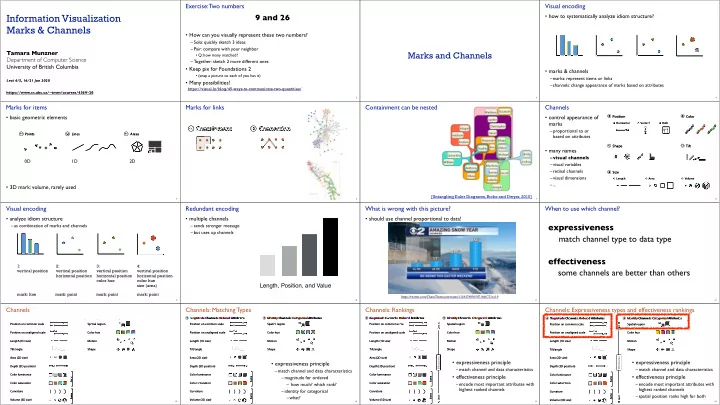
- marks & channels
–marks: represent items or links –channels: change appearance of marks based on attributes
4 5
Marks for items
- basic geometric elements
- 3D mark: volume, rarely used
Points Lines Areas
0D 1D 2D
Marks for links
6
Containment Connection Containment can be nested
7
[Untangling Euler Diagrams, Riche and Dwyer, 2010]
Channels
- control appearance of
marks
–proportional to or based on attributes
- many names
–visual channels –visual variables –retinal channels –visual dimensions –...
8
Horizontal
Position
Vertical Both
Color Shape Tilt Size
Length Area Volume
Visual encoding
- analyze idiom structure
–as combination of marks and channels
9
1: vertical position mark: line 2: vertical position horizontal position mark: point 3: vertical position horizontal position color hue mark: point 4: vertical position horizontal position color hue size (area) mark: point
Redundant encoding
- multiple channels
–sends stronger message –but uses up channels
10
Length, Position, and Value
What is wrong with this picture?
- should use channel proportional to data!
11
https://twitter.com/ChaseThomason/status/1118478036507164672?s=19
When to use which channel?
12
expressiveness match channel type to data type effectiveness some channels are better than others
13
Channels: Expressiveness types and effectiveness rankings
Magnitude Channels: Ordered Attributes Identity Channels: Categorical Attributes Spatial region Color hue Motion Shape Position on common scale Position on unaligned scale Length (1D size) Tilt/angle Area (2D size) Depth (3D position) Color luminance Color saturation Curvature Volume (3D size)
Channels: Matching Types
- expressiveness principle
–match channel and data characteristics –magnitude for ordered – how much? which rank? –identity for categorical –what?
14
Magnitude Channels: Ordered Attributes Identity Channels: Categorical Attributes Spatial region Color hue Motion Shape Position on common scale Position on unaligned scale Length (1D size) Tilt/angle Area (2D size) Depth (3D position) Color luminance Color saturation Curvature Volume (3D size)
15
Channels: Rankings
Magnitude Channels: Ordered Attributes Identity Channels: Categorical Attributes Spatial region Color hue Motion Shape Position on common scale Position on unaligned scale Length (1D size) Tilt/angle Area (2D size) Depth (3D position) Color luminance Color saturation Curvature Volume (3D size)
- expressiveness principle
–match channel and data characteristics
- effectiveness principle
–encode most important attributes with highest ranked channels
16
Channels: Expressiveness types and effectiveness rankings
Magnitude Channels: Ordered Attributes Identity Channels: Categorical Attributes Spatial region Color hue Motion Shape Position on common scale Position on unaligned scale Length (1D size) Tilt/angle Area (2D size) Depth (3D position) Color luminance Color saturation Curvature Volume (3D size)
- expressiveness principle
–match channel and data characteristics
- effectiveness principle
–encode most important attributes with highest ranked channels –spatial position ranks high for both