Independence, conditional distributions So far density of X specified - - PDF document

independence conditional distributions so far density of
SMART_READER_LITE
LIVE PREVIEW

Independence, conditional distributions So far density of X specified - - PDF document

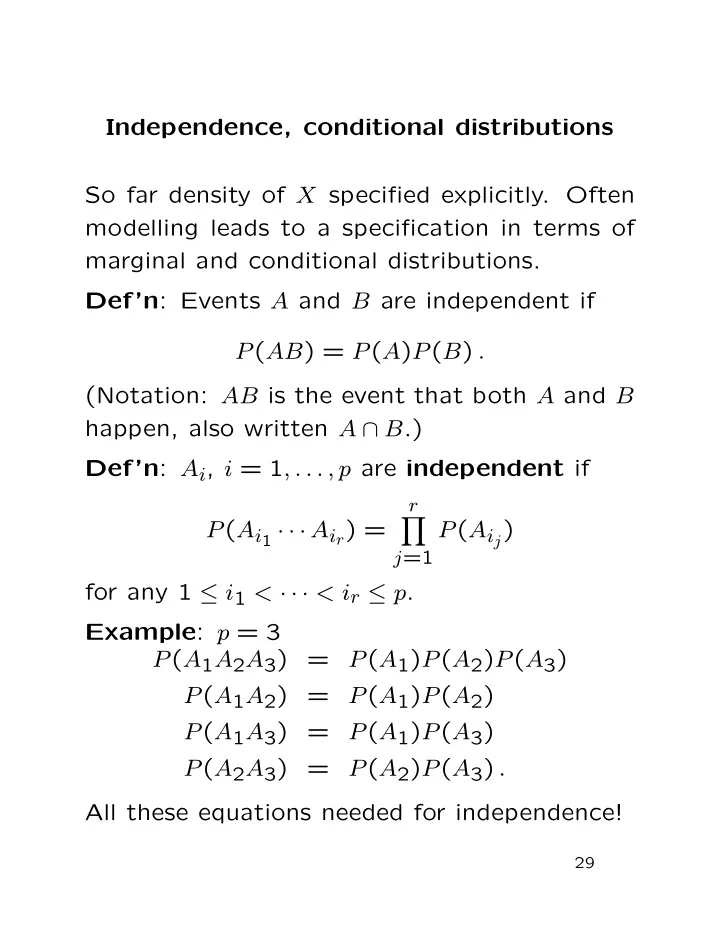
Independence, conditional distributions So far density of X specified explicitly. Often modelling leads to a specification in terms of marginal and conditional distributions. Defn : Events A and B are independent if P ( AB ) = P ( A ) P ( B ) .


slide-1
SLIDE 1

Independence, conditional distributions So far density of X specified explicitly. Often modelling leads to a specification in terms of marginal and conditional distributions. Def’n: Events A and B are independent if P(AB) = P(A)P(B) . (Notation: AB is the event that both A and B happen, also written A ∩ B.) Def’n: Ai, i = 1, . . . , p are independent if P(Ai1 · · · Air) =

r

  • j=1

P(Aij) for any 1 ≤ i1 < · · · < ir ≤ p. Example: p = 3 P(A1A2A3) = P(A1)P(A2)P(A3) P(A1A2) = P(A1)P(A2) P(A1A3) = P(A1)P(A3) P(A2A3) = P(A2)P(A3) . All these equations needed for independence!

29

slide-2
SLIDE 2

Example: Toss a coin twice. A1 = {first toss is a Head} A2 = {second toss is a Head} A3 = {first toss and second toss different} Then P(Ai) = 1/2 for each i and for i = j P(Ai ∩ Aj) = 1 4 but P(A1 ∩ A2 ∩ A3) = 0 = P(A1)P(A2)P(A3) . Def’n: X and Y are independent if P(X ∈ A; Y ∈ B) = P(X ∈ A)P(Y ∈ B) for all A and B. Def’n: Rvs X1, . . . , Xp independent: P(X1 ∈ A1, . . . , Xp ∈ Ap) =

  • P(Xi ∈ Ai)

for any A1, . . . , Ap.

30

slide-3
SLIDE 3

Theorem:

  • 1. If X and Y are independent then for all x, y

FX,Y (x, y) = FX(x)FY (y) .

  • 2. If X, Y independent, joint density fX,Y then

X, Y have densities fX, fY , and fX,Y (x, y) = fX(x)fY (y) .

  • 3. If X, Y independent, marginal densities fX,

fY then (X, Y ) has joint density fX,Y (x, y) = fX(x)fY (y) .

  • 4. If FX,Y (x, y) = FX(x)FY (y) for all x, y then

X and Y are independent.

  • 5. If (X, Y ) has density f(x, y) and there ex-

ist g(x) and h(y) st f(x, y) = g(x)h(y) for (almost) all (x, y) then X and Y are inde- pendent with densities given by fX(x) = g(x)/

−∞ g(u)du

fY (y) = h(y)/

−∞ h(u)du .

Theorem: If X1, . . . , Xp are independent and Yi = gi(Xi) then Y1, . . . , Yp are independent. Moreover, (X1, . . . , Xq) and (Xq+1, . . . , Xp) are independent.

31

slide-4
SLIDE 4

Conditional probability Def’n: P(A|B) = P(AB)/P(B) if P(B) = 0. Def’n: For discrete X and Y the conditional probability mass function of Y given X is fY |X(y|x) = P(Y = y|X = x) = fX,Y (x, y)/fX(x) = fX,Y (x, y)/

  • t

fX,Y (x, t) For absolutely continuous X P(X = x) = 0 for all x. What is P(A|X = x) or fY |X(y|x)? Solution: use limit P(A|X = x) = lim

δx→0 P(A|x ≤ X ≤ x + δx)

If, e.g., X, Y have joint density fX,Y then with A = {Y ≤ y} we have P(A|x ≤ X ≤ x + δx) = P(A ∩ {x ≤ X ≤ x + δx}) P(x ≤ X ≤ x + δx) =

y

−∞

x+δx

x

fX,Y (u, v)dudv

x+δx

x

fX(u)du

32

slide-5
SLIDE 5

Divide top, bottom by δx; let δx → 0. Denom converges to fX(x); numerator converges to

y

−∞ fX,Y (x, v)dv

Define conditional cdf of Y given X = x: P(Y ≤ y|X = x) =

y

−∞ fX,Y (x, v)dv

fX(x) Differentiate wrt y to get def’n of conditional density of Y given X = x: fY |X(y|x) = fX,Y (x, y)/fX(x) ; in words “conditional = joint/marginal”.

33