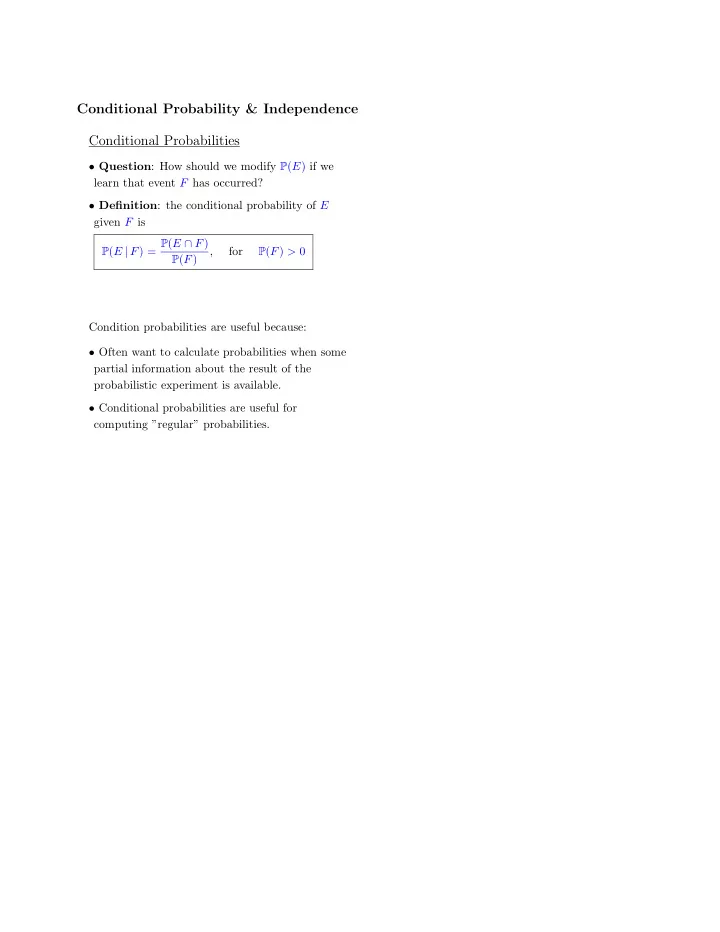
SLIDE 1 Conditional Probability & Independence Conditional Probabilities
- Question: How should we modify P(E) if we
learn that event F has occurred?
- Definition: the conditional probability of E
given F is P(E | F) = P(E \ F) P(F) , for P(F) > 0 Condition probabilities are useful because:
- Often want to calculate probabilities when some
partial information about the result of the probabilistic experiment is available.
- Conditional probabilities are useful for
computing ”regular” probabilities.
SLIDE 2 Example 1. 2 random cards are selected from a
deck of cards.
- What is the probability that both cards are aces
given that one of the cards is the ace of spaces?
- What is the probability that both cards are aces
given that at least one of the cards is an ace?
SLIDE 3
Example 2. Deal a 5 card poker hand, and let
E = {at least 2 aces}, F = {at least 1 ace}, G = {hand contains ace of spades}. (a) Find P(E) (b) Find P(E | F) (c) Find P(E | G)
SLIDE 4
SLIDE 5 Cond prob satisfies the usual prob axioms.
Suppose (S, P(·)) is a probability space. Then (S, P(· | F)) is also a probability space (for F ⇢ S with P(F) > 0).
!∈S P(ω | F) = 1
- If E1, E2, . . . are disjoint, then
P([∞
i=1Ei | F) = ∞
X
i=1
P(Ei | F) Thus all our previous propositions for probabilities give analogous results for conditional probabilities.
Examples
P(Ec | F) = 1 P(E | F) P(A [ B | F) = P(A | F) + P(B | F) P(A \ B | F)
SLIDE 6 The Multiplication Rule
- Re-arranging the conditional probability
formula gives P(E \ F) = P(F) P(E | F) This is often useful in computing the probability
- f the intersection of events.
- Example. Draw 2 balls at random without
replacement from an urn with 8 red balls and 4 white balls. Find the chance that both are red.
SLIDE 7 The General Multiplication Rule
P(E1 \ E2 \ · · · \ En) = P(E1) ⇥ P(E2 | E1) ⇥ P(E3 | E1 \ E2) ⇥ · · ·⇥P(En | E1 \E2 \· · ·\En−1)
Example 1. Alice and Bob play a game as
- follows. A die is thrown, and each time it is
thrown it is equally likely to show any of the 6
- numbers. If it shows 5, A wins. If it shows 1, 2 or
6, B wins. Otherwise, they play a second round, and so on. Find P(An), for An = {Alice wins on nth round}.
SLIDE 8 Example 2. I have n keys, one of which opens a
- lock. Trying keys at random without replacement,
find the chance that the kth try opens the lock.
SLIDE 9 The Law of Total Probability
- We know that P(E) = P(E \ F) + P(E \ F c).
Using the definition of conditional probability, P(E) = P(E | F) P(F) + P(E | F c) P(F c)
- This is extremely useful. It may be difficult
to compute P(E) directly, but easy to compute it
- nce we know whether or not F has occurred.
- To generalize, say events F1, . . . , Fn form a
partition if they are disjoint and Sn
i=1 Fi = S.
- Since E \ F1, E \ F2, . . . E \ Fn are a disjoint
partition of E. P(E) = Pn
i=1 P(E \ Fi).
- Apply conditional probability to give the law
- f total probability,
P(E) = Pn
i=1 P(E | Fi) P(Fi)
SLIDE 10
Example 1. Eric’s girlfriend comes round on a
given evening with probability 0.4. If she does not come round, the chance Eric watches The Wire is 0.8. If she does, this chance drops to 0.3. Find the probability that Eric gets to watch The Wire.
SLIDE 11 Bayes Formula
- Sometimes P(E | F) may be specified and we
would like to find P(F | E).
Example 2. I call Eric and he says he is
watching The Wire. What is the chance his girlfriend is around?
- A simple manipulation gives Bayes’ formula,
P(F | E) = P(E | F) P(F) P(E)
- Combining this with the law of total probability,
P(F | E) = P(E | F) P(F) P(E | F) P(F) + P(E | F c) P(F c)
SLIDE 12
- Sometimes conditional probability calculations
can give quite unintuitive results.
Example 3. I have three cards. One is red on
both sides, another is red on one side and black
- n the other, the third is black on both sides. I
shuffle the cards and put one on the table, so you can see that the upper side is red. What is the chance that the other side is black?
- is it 1/2, or > 1/2 or < 1/2?
Solution
SLIDE 13 Example: Spam Filtering
- 60% of email is spam.
- 10% of spam has the word ”Viagra”.
- 1% of non-spam has the word ”Viagra”.
- Let V be the event that a message contains
the word ”Viagra”.
- Let J be the event that the message is spam.
What is the probability of J given V ?
Solution.
SLIDE 14
Discussion problem. Suppose 99% of people
with HIV test positive, 95% of people without HIV test negative, and 0.1% of people have HIV. What is the chance that someone testing positive has HIV?
SLIDE 15 Example: Statistical inference via Bayes’ formula
Alice and Bob play a game where R tosses a coin, and wins $1 if it lands on H or loses $1 on T. G is surprised to find that he loses the first ten times they play. If G’s prior belief is that the chance
- f R having a two headed coin is 0.01, what is his
posterior belief?
- Note. Prior and posterior beliefs are assessments
- f probability before and after seeing an outcome.
The outcome is called data or evidence.
Solution.
SLIDE 16 Example: A plane is missing, and it is equally
likely to have gone down in any of three possible
- regions. Let αi be the probability that the plane
will be found in region i given that it is actually
- there. What is the conditional probability that
the plane is in the second region, given that a search of the first region is unsuccessful?
SLIDE 17 Independence
- Intuitively, E is independent of F if the chance
- f E occurring is not affected by whether F
- ccurs. Formally,
P(E | F) = P(E) (1)
- We say that E and F are independent if
P(E \ F) = P(E) P(F) (2)
- Note. (2) and (1) are equivalent.
Note 1. It is clear from (2) that independence is
a symmetric relationship. Also, (2) is properly defined when P(F) = 0.
Note 2. (1) gives a useful way to think about
independence; (2) is usually better to do the math.
SLIDE 18
- Proposition. If E and F are independent, then
so are E and F c.
Proof.
SLIDE 19
Example 1: Independence can be obvious
Draw a card from a shuffled deck of 52 cards. Let E = card is a spade and F = card is an ace. Are E and F independent?
Solution Example 2: Independence can be surprising
Toss a coin 3 times. Define A={at most one T}={HHH, HHT, HTH, THH} B={both H and T occur}={HHH, TTT}c. Are A and B independent?
Solution
SLIDE 20 Independence as an Assumption
- It is often convenient to suppose independence.
People sometimes assume it without noticing.
- Example. A sky diver has two chutes. Let
E = {main chute opens}, P(E) = 0.98; F = {backup opens}, P(F) = 0.90. Find the chance that at least one opens, making any necessary assumption clear.
- Note. Assuming independence does not justify
the assumption! Both chutes could fail because of the same rare event, such as freezing rain.
SLIDE 21 Independence of Several Events
- Three events E, F, G are independent if
P(E \ F) = P(E) · P(F) P(F \ G) = P(F) · P(G) P(E \ G) = P(E) · P(G) P(E \ F \ G) = P(E) · P(F) · P(G)
- If E, F, G are independent, then E will be
independent of any event formed from F and G.
- Example. Show that E is independent of F [ G.
Proof.
SLIDE 22 Pairwise Independence
- E, F and G are pairwise independent if E is
independent of F, F is independent of G, and E is independent of G.
- Example. Toss a coin twice. Set E ={HH, HT},
F ={TH, HH} and G ={HH, TT}. (a) Show that E, F and G are pairwise independent. (b) By considering P(E \ F \ G), show that E, F and G are NOT independent.
- Note. Another way to see the dependence is that
P(E | F \ G) = 1 6= P(E).
SLIDE 23
Example: Insurance policies
Insurance companies categorize people into two groups: accident prone (30%) or not. An accident prone person will have an accident within one year with probability 0.4; otherwise, 0.2. What is the conditional probability that a new policyholder will have an accident in his second year, given that the policyholder has had an accident in the first year?
SLIDE 24 Note: We can study a probabilistic model and
determine if certain events are independent or we can define our probabilistic model via independence.
Example: Supposed a biased coin comes up
heads with probability p, independent of other flips P(n heads in n flips) = pn P(n tails in n flips) = (1 p)n P(exactly k heads n flips) = n
k
P(HHTHTTT) = p2(1p)p(1p)3 = p]H(1p)]T