
SLIDE 1
Increasing the ALMA data rate
Mark Lacy
Data Services Lead, NAASC, NRAO
ALMA NA Development Workshop 2016
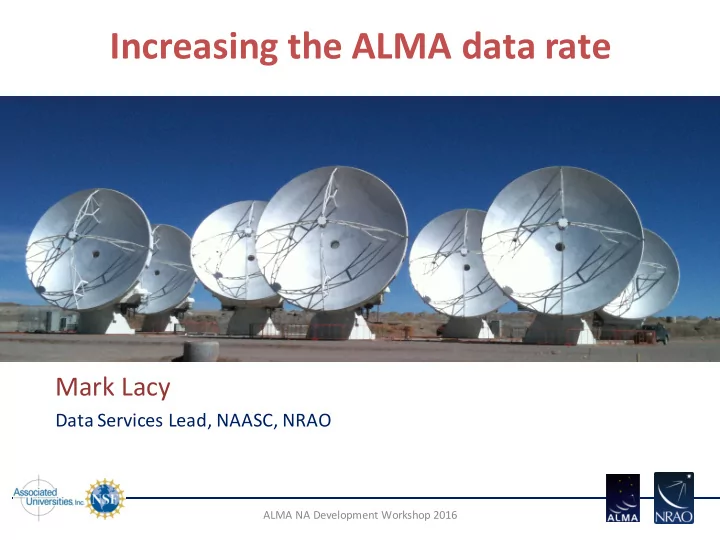
Increasing the ALMA data rate Mark Lacy Data Services Lead, NAASC, - - PowerPoint PPT Presentation
Increasing the ALMA data rate Mark Lacy Data Services Lead, NAASC, NRAO ALMA NA Development Workshop 2016 Some science cases for high(er) data rates and their implications Larger bandwidths More continuum sensitivity. More lines
Data Services Lead, NAASC, NRAO
ALMA NA Development Workshop 2016
– More continuum sensitivity. – More lines (at the same resolution) per observation. – Probably ~OK with scaling of existing data transfer infrastructure for up to ~32GHz bandwidth.
– On the fly interferometry (fast surveys) – Probably ~OK with scaling of existing raw data transfer infrastructure, major issue will be imaging.
– Potential huge increase in survey speed – Depending on size of arrays (and if they are installed on all antennas, not just TP and/or ACA), may need a dramatic change in the data management plan.
program gives 2.5Gb/s from AOS to Santiago:
– OSF to Calama fiber built 2014; waiting on revised environmental impact report before “official” use, unofficially is now working. – Calama to Antofagasta provided by Telefonica – Antofagasta to SCO from EVALSO/REUNA (Chilean academic network provider) – Redundant fiber loop via Argentina planned
– Main provider is Amlight (Florida International University).
– Early (Cycle-1/2) fears that this data rate would be greatly exceeded have not been founded (helped by Phase-2 policies and user education), and data rate justification has been removed from proposals.
– (in practice 200TB/yr as data will be stored both WVR corrected and uncorrected, but this should only be temporary) – Image products are currently only ~10% of data, but this is expected to increase significantly when the imaging pipeline is fully operational.
Cycle 4), the ops plan estimate is probably good, will need to increased depending on the size of the products (largely dictated by processing resources). We are assuming 500TB/yr in Full Science operations (Cycle 5+).
– Low enough that for some projects (long baseline [short sampling time]) and full resolution spwwe hit this limit (especially when taking both WVR corrected and uncorrected data streams). – No problem getting this to Santiago over 2.5Gb/s link. – Could (fairly) easily boost SCO->MIA link to this capacity. – An improvement would allow better long baseline observations, and a richer archive.
at present. (Other ARCs not quite so well situated, but solutions could be found.)
processing (dominated by organizational issues).
– Until now, reference images only generated. Pipeline into operation in Cycle 4. – Imaging demands depend on configuration (problem scales with longest baseline squared).
channels at full resolution to the edge of the primary beam.
snapshots, imaging process can run for weeks (radio interferometry can be a very efficient compression algorithm!).
configurations.