FPGA Accelerated Seam Carving for Video B2: Kimberly Lim, Eshani - - PowerPoint PPT Presentation

fpga accelerated seam carving for video
SMART_READER_LITE
LIVE PREVIEW

FPGA Accelerated Seam Carving for Video B2: Kimberly Lim, Eshani - - PowerPoint PPT Presentation

FPGA Accelerated Seam Carving for Video B2: Kimberly Lim, Eshani Mishra, Shruti Narayan Use Case Scale Crop Seam Content-aware re-scaling takes into account features within the frame, and intelligently targets parts of the frame to remove or


slide-1
SLIDE 1

FPGA Accelerated Seam Carving for Video

B2: Kimberly Lim, Eshani Mishra, Shruti Narayan
slide-2
SLIDE 2

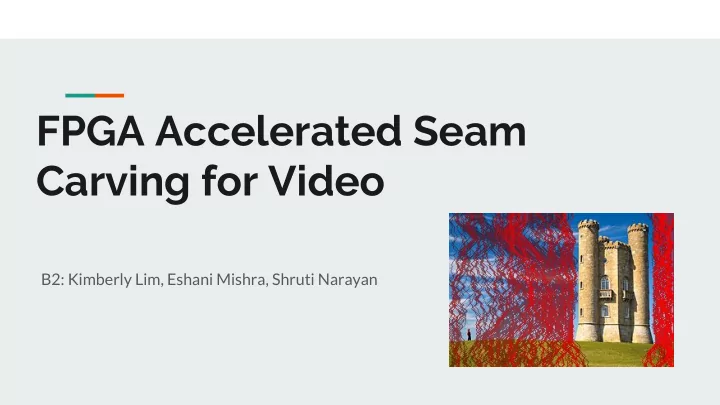
Use Case

Content-aware re-scaling takes into account features within the frame, and intelligently targets parts of the frame to remove or interpolate during the re-scaling process. Computational complexity becomes the bottleneck of the implementation of the

  • algorithm. A hardware-oriented seam carving algorithm using FPGA is proposed to

improve performance. ECE Areas: Hardware (FPGA), Software (Seam Carving Algorithm)

Scale Crop Seam

slide-3
SLIDE 3

Requirements

  • Resize video for different display sizes, while maintaining

important content integrity

  • Video processing on FPGA with a 10x speedup over

using only software processing

  • Static seams: most useful when the camera is stationary,

and the foreground and background are separated

  • Access and process user uploaded videos with a

maximum resolution of 480p x 360p with a max length of 5 seconds at 30fps through microSD card

  • Convert processed video into viewable format on the

monitor by converting from binary to .bmp file

slide-4
SLIDE 4

Potential Extensions

  • Forward Energy
  • Adding Seams (make videos larger)
  • Process videos taken with FPGA camera
  • Object/face detection
  • Graph cut: useful for videos with moving

subjects or a moving camera (out of scope due to memory constraints )

Input Forward energy No forward energy

slide-5
SLIDE 5

Technology

  • DE2-115 FPGA board (for computation)
  • OV7670 CMOS camera (to interface with board and provide live video)
  • Monitor (for projection)
  • HDMI cable (FPGA connection to monitor)
  • Micro SD card (storing video files)
  • Raspberry Pi (conversion of .bmp to .hex file; potentially for post-processing of
  • utput into viewable format)
slide-6
SLIDE 6

Solution Approach

  • User can upload videos to a library which our system will be able to access (to SD

card)

  • Read pictures to the FPGA from stored files on SD-card using pre-processed images

that’s been converted to proper format (binary)

  • Preprocess video data for use in the algorithm
  • Based on traditional seam carving, the algorithm can be divided into 3 steps

(sequential)

  • We will modularize this part of the project based on those 3 steps and remove

static seams

  • Video carving with a speedup over using only software processing
  • Speedup would be achieved through parallel processing capabilities of the FPGA,

as well as eliminating latency from using interpreted languages

  • Convert processed video into viewable format on the monitor
slide-7
SLIDE 7

FPGA Memory Utilization

  • Rough time estimate for algorithm: 30 cycles per pixel = 6*10^-7 s ~ 1 μs per pixel
  • 5 second Youtube 360p video has 480 by 360 pixel resolution, 30fps
  • FPGA has 3,080,000 bits for memory
  • Spatial map is the most time/space consuming operation in the algorithm
  • Without parallelization:
  • 480 * 360 * 6* 10^-7 s/pixel * 30 fps * 5s = 15.552 seconds per seam
  • Parallelize the work by row
  • make groupings of each cell in the row and surrounding 8 and copy into RAM
  • 360 pixels/row * 9 pixels* 8 bits/pixel = 25,920 bits (much more space left on

FPGA - can parallelize more rows)

  • 480 rows * 6* 10^-7 s/pixel * 30 fps * 5s = 0.0432 seconds per seam
  • Other proposed blocking methods to explore
  • Parallelize more rows at a time
slide-8
SLIDE 8

Testing + Meeting Requirements

Video resizing of different display sizes Compare our implementation to videos to those presented in research paper of the algorithm Speedup of processing on FPGA Benchmark energy-map computation implemented C and compare to our FPGA using cycle counts Static Seam removal Identify all important features in test videos and print viewable seam lines on frames to ensure most important features are being preserved Convert processed video into human-viewable format Third party independent tester for verifying video output matches resolution

slide-9
SLIDE 9

Verification

  • Meets use cases and customer needs if:
  • Our final video preserves content better than alternative

cropped, scaled, or low resolution versions

  • Performs at least 10x faster than software solution
  • Resizes video to correct resolution without distorting important

features in the video (improvement over running the algorithm separately over every frame)

  • Resized video is viewable on monitor
slide-10
SLIDE 10

Metrics

Quality Compare to frame by frame of baseline. Identify objects of importance in video and analyze level of distortion after resizing Utility Must be able to process any user supplied video within scope requirements and remove the desired amount of seams Performance Compare time to

  • pen software (both

interpreted and compiled)

Metric

slide-11
SLIDE 11

Tasks + Division of Labor

Post processing of result

Eshani

  • Conversion from HEX to BMP
  • Write result to SD
  • Display result to monitor

System Implementation

Shruti Kim

  • Files for energymap, pathsum, main
  • restitch of video for next seam
  • Top module to repeat steps

System & Algorithm Design Shruti Kim Eshani

  • Spatial & temporal energy map
  • Accumulation matrix with weights
  • Path-sum calculation and min
  • Min-seam removal

Preprocessing of data Eshani

  • BMP to HEX file
  • Load Image into FPGA
slide-12
SLIDE 12

Schedule

slide-13
SLIDE 13

System Diagram

SD Card

1 5-second-video of 30 fps is converted to 150 images of the same

  • resolution. (1 .mp4 file
  • > 150 .bmp file)

Convert each .bmp to .hex file and store into SD card

FPGA

Read binary files from SD card and process video frames according to algorithm

SD Card

Store post-processed frames in SD card due to memory limit of

  • FPGA. At end of

program, all result frames are on SD card. 150 .hex files post-processed

Monitor

Use HDMI or VGA on FPGA to output processed-video.