ALMA Digital Back End Antenna Article Ephraim Ford & Sylas - - PowerPoint PPT Presentation

alma digital back end antenna article ephraim ford sylas
SMART_READER_LITE
LIVE PREVIEW

ALMA Digital Back End Antenna Article Ephraim Ford & Sylas - - PowerPoint PPT Presentation

ALMA Digital Back End Antenna Article Ephraim Ford & Sylas Ashton ALMA Future Science Development Program Workshop 1 Digital Back End Antenna Article Design Study Overview Intent is to investigate potential solutions for increasing the


slide-1
SLIDE 1

1

ALMA Future Science Development Program Workshop
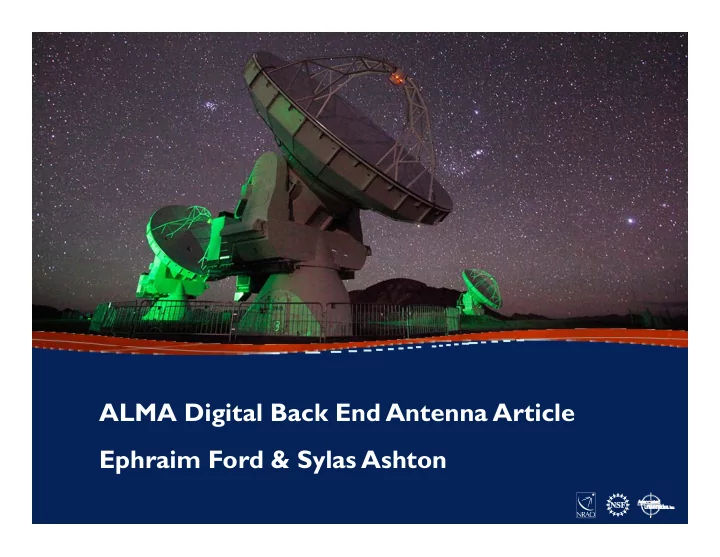
ALMA Digital Back End Antenna Article Ephraim Ford & Sylas Ashton

slide-2
SLIDE 2

2

ALMA Future Science Development Program Workshop

Digital Back End Antenna Article Design Study

Overview

  • Intent is to investigate potential solutions for increasing the

sampled IF bandwidth, aligning with 2030 Pathways.

  • An initial study of digitally downconverting the entire current

8GHz per IF is proposed. Can be broadened to 16 GHz/IF.

  • Result will be a better understanding of technical risks and issues

and the path towards a deployable all-digital Back End for ALMA, interfacing with an upgraded correlator.

slide-3
SLIDE 3

3

ALMA Future Science Development Program Workshop

Collaborators

NAME INSTITUTION EMAIL Ephraim Ford NRAO eford@nrao.edu Sylas Ashton NRAO sashton@nrao.edu Doug Gerrard NRAO dgerrard@nrao.edu Chris Langley NRAO clangley@nrao.edu Mike Revnell NRAO mrevnell@nrao.edu Matt Luce NRAO mluce@nrao.edu Alan Erickson NRAO aerickso@nrao.edu Richard Lacasse NRAO rlacasse@nrao.edu Alejandro Saez JAO/NRAO asaez@nrao.edu Chris Carilli NRAO ccarilli@nrao.edu Luca Ricci Harvard‐Smithsonian Luca.ricci@cfa.harvard.edu

slide-4
SLIDE 4

4

ALMA Future Science Development Program Workshop

Current Back End Antenna Article

As installed in Chile

  • 2 racks, populated

with RF shielded modules, divided into RF and digital domains.

  • Converts the 4-12

GHz IFs (2 Pol) to 4 baseband channels.

  • Digitizes at 4 GS/s at

3 bits and delivers to correlator.

slide-5
SLIDE 5

5

ALMA Future Science Development Program Workshop

Study Goals

  • Goal is a design study for a digital Back End that fits within the

current ALMA interfaces while allowing for future enhancements.

  • Study will lay a foundation for future work, leading to a

deployable article on an antenna.

  • Deliverables:

– Development assembly/platform (PCB with chosen design and hardware for study). – Firmware – Outcomes reports with board and ADC characterizations and recommendations for future work or proposals.

slide-6
SLIDE 6

6

ALMA Future Science Development Program Workshop

Design Areas of Focus

  • Approach two key risks:

– Exercise current COTS digitizers to determine their suitability.

  • Can they provide the high-speed sampling at 24GHz as specified by the

manufacturers?

– At a wider IF, development of DSP throughput rates higher than the Field Programmable Gate Array (FPGA) digital clock.

  • Hittite AD5831 3-bit 26GS/s digitizers likely to be used, clocked

at 24 GHz.

  • Some design investigation has begun, as described in the proposal.
slide-7
SLIDE 7

7

ALMA Future Science Development Program Workshop

Potential Design Block Diagram

Digital Backend USB P0 +48dB 0‐31.5dB Variable Attenuator ADC FPGAs LSB P0 +48dB

  • Var. Att.

ADC USB P1 +48dB

  • Var. Att.

ADC LSB P1 +48dB

  • Var. Att.

ADC SPF+ 10GBs fiber TX

SPF+ 10GBs fiber TX SPF+ 10GBs fiber TX SPF+ 10GBs fiber TX SPF+ 10GBs fiber TX SPF+ 10GBs fiber TX SPF+ 10GBs fiber TX SPF+ 10GBs fiber TX SPF+ 10GBs fiber TX SPF+ 10GBs fiber TX SPF+ 10GBs fiber TX SPF+ 10GBs fiber TX

Optical Mux To Correlator DGCK x6 24GHz x4 4GHz 250MHz LORR 125MHz TE x2 DDS 300MHz x4 Total Power Detector TPD TPD TPD Total Power ADC

slide-8
SLIDE 8

8

ALMA Future Science Development Program Workshop

Next Steps

  • Kickoff meeting in October
  • Proof of Concept design & review (3 months)
  • Fabrication of hardware & design of firmware (3 months)
  • On-hardware FW development & ADC analysis (4 months)
  • Project closeout (1 month)
  • Project end of study in September 2017.
  • Comments and feedback are welcome now.
slide-9
SLIDE 9

9

ALMA Future Science Development Program Workshop

Simplified Current Back End Analog Rack

slide-10
SLIDE 10

10

ALMA Future Science Development Program Workshop

Simplified Current Back End Digital Rack

slide-11
SLIDE 11

11

ALMA Future Science Development Program Workshop

www.nrao.edu science.nrao.edu public.nrao.edu

The National Radio Astronomy Observatory is a facility of the National Science Foundation

  • perated under cooperative agreement by Associated Universities, Inc.