
SLIDE 1
1
Media Briefing Workshop Centre for Science and Environment New Delhi December 27, 2017
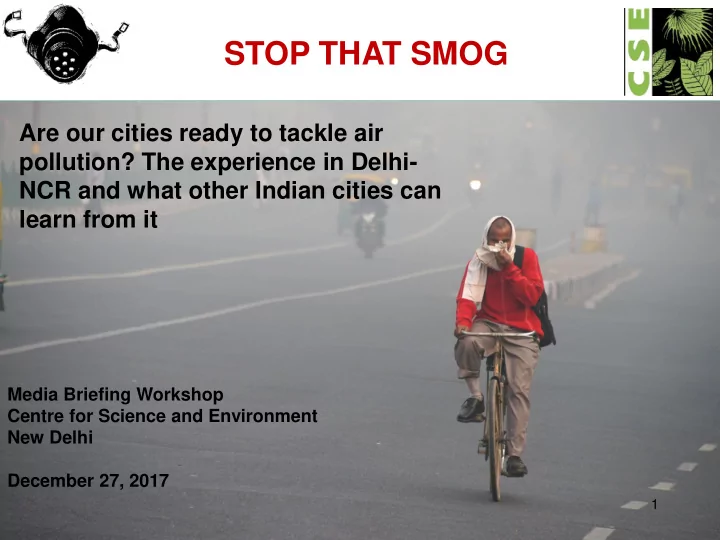
STOP THAT SMOG Are our cities ready to tackle air pollution? The - - PowerPoint PPT Presentation
STOP THAT SMOG Are our cities ready to tackle air pollution? The experience in Delhi- NCR and what other Indian cities can learn from it Media Briefing Workshop Centre for Science and Environment New Delhi December 27, 2017 1 Air
1
Media Briefing Workshop Centre for Science and Environment New Delhi December 27, 2017
2
3
4
Out of the 46 cities with more than a million population:
Source: NAQI portal
5
6
7
Source: Centre for Science and Environment of CPCB air quality data submitted to Rajya Sabha for 44 cities
Cities with critical level of PM10 (more than 1.5 times the standards) has increased from 60% in 2007 to 88% in 2016.
8
Source: Centre for Science and Environment of CPCB air quality data submitted to Rajya Sabha for 44 cities
to 29% in 2016. In 2007 not a single city was in critical category. In 2016 there 12% cities are.
Mumbai, PimpriChinchwad, Pune, Thane, and Vijaywada
9
Source: Centre for Science and Environment of CPCB air quality data submitted to Rajya Sabha for 44 cities
44 big cities with close to 40%
urban population,
which 91% live in cities with PM10 levels exceeding standards
Source2015, Norwegian Institute for Air Research, International Institute for Applied Systems Analysis, IITM
Daily PM2.5 mean
Source: Sagnik Dey 2016, Indian Institute of Technology Delhi,
Annual PM2.5 mean
11
Source: Centre for Science and Environment of CPCB air quality data submitted to Rajya Sabha for 44 cities
12
Source: Centre for Science and Environment of CPCB air quality data submitted to Rajya Sabha for 44 cities
13
Source: Centre for Science and Environment of CPCB air quality data submitted to Rajya Sabha for 44 cities
14
28 cities out of 44 million plus cities show increasing trend of PM10 concentration between 2007 and 2016
Source: Centre for Science and Environment of CPCB air quality data submitted to Rajya Sabha for 44 cities
15
16
Source: Centre for Science and Environment of CPCB air quality data submitted to Rajya Sabha for 44 cities
17
Source: Centre for Science and Environment of CPCB air quality data submitted to Rajya Sabha for 44 cities
18
Source: Urban Emissions, 2017, http://www.urbanemissions.info/wp-content/uploads/apna/frontpage/index.html
Source: S Guttikunda, SIM Air , 2012 and IIT Kanpur 2015
Delhi
Source: S IIT Kanpur
20
Union Ministry of Health and Family Welfare Report of Steering committee on air pollution and health related Issues’, More important to know how close we are to the pollution source, what are we inhaling, and how much time we spend close to the pollution source than what
and weather. Shift from concentration management to exposure management Ambient concentrations do not always well represent human exposures, Ambient concentration is not a good surrogate for total air pollution risk, -- cannot indicate exposure and health outcome Chennai
PM2.5 emission apportionment PM2.5 exposure apportionment Source: S Guttikunda – SIM Air
21
Source: India’s Health of Nation’s States Report, 2017: IHME-ICMR
a risk factor went up in Arunachal Pradesh, Assam, Bihar, Chattisgarh, Haryana, Himachal Pradesh, Odisha, Rajasthan and Uttar Pradesh.
Bengal though lowered
respiratory diseases, and cancers have increased substantially. In Delhi COPD has moved from rank 13 to rank 3. Ischemic heart disease gone up from rank 5 to number 1 etc.
Age group between ages 35 and 60 most vulnerable to non- communcable diseases. Increases vulnerability to air pollution
Source: India State Level Disease Burden,Lancet, 2017
25 Sputum cytology of a taxi driver
Source: CNCI
26
27
28
100 200 300 400 500 600 24-hr PM2.5 concentration in microgramme per cum Post Diwali Smog Episode Se Severe re Eme Emerge rgency 24-hr Standard Source: CSE’s analysis of CPCB air quality data
National Air Quality Index and Health advisory
Graded response action plan notified
Moderate – When PM2.5 is between 61-90 µg/m3
250 µg/m3
Poor – When PM2.5 levels are between 91- 120 µg/m3 or PM10 levels are between 251- 350 µg/m3 Very Poor - When PM2.5 levels are between 121- 250 µg/m3 or PM10 levels are between 351-430 µg/m3
security staff to avoid open burning by them
restrict outdoor movement. Severe - When PM2.5 levels are above 250 µg/m3 or PM10 levels are above 430 µg/m3
high dust generation. Severe + or Emergency
cross 300 µg/m3 or PM10 levels cross 500 µg/m3 (5 times above the standard) and persist for 48 hours or more
33
Source: CSE’s analysis of CPCB air quality data, based on 4 stations Mandir Marg, RK Puram, Punjabi Bagh and Anand Vihar
34
EPCA-CSE investigation: Extremely high sulphur levels -- more than 20,000 ppm to 74,000 ppm in contrast to only 50 ppm sulphur in BS-IV transport fuels Import of Petcoke increased more than 14 times, since 2010- 11 -- Compounded Annual Growth Rate of 45.92%. Lower prices incite its use. Under GST, these fuels are in 18%
industry, -- effective tax rate is 0% Cleaner alternatives such as Natural Gas and Electricity are taxed high – as high as 26% in some states.
(Left) Sample of Fuel/ Furnace Oil (Bottom) Sample of Petroleum Coke
restrictions.
and local bans on new power plants have closed this supply from US.
considering regulation petcoke imports.
Supreme Court Directive October 24, 2017
problem confined only to the NCR region but appears to be a problem faced by almost all the States and Union Territories in the country… we request all the State Governments and Union Territories to consider taking similar measures …”
38
2020
Narendra Prayavaran Sewa Samiti, Bulandshahr, Centre code- 687
Chaman Prayavaran Sewa Samiti, Anoopshahr, Bulandshahr, Centre code- 908
Source: 2016, Road Transport Yearbook, MoRTH
Source: 2016, Road Transport Yearbook, MoRTH
Source: 2016, Road Transport Yearbook, MoRTH
truck entry into city
ECC.
Delhi.
trucks being diverted by the Haryana and UP government - an average of 6,300 trucks daily.
entry of non-destined trucks into Delhi.
Source: Census of India, 2011 Note: Personal mode – Two wheelers and Cars, Public Transport: Bus, Train, IPT
48
Source: Google Earth
Badarpur Power Plant Flyash dumping site
Badarpur coal based power plant
50
Delhi and NCR
been shut for winter. It will be permanently shut from July 2018.
Revised standards for coal based Thermal Power Plants were notified by MOEF in December 2015– to be implemented by December 7, 2017 MoEF& CC and Central Electricity Authority, along with the power industry seeking extension of deadline to 2022-24 – more than 7 years delay.
delayed
51
Solid waste management rules – Poorly enforced
Rs. 50,000/- for not covering the construction sites. Make households and institutions accountable for decentralised management, segregation, reuse and recycle, Charge and penalty Need No landfill policy ‘Not In My Backyard’ – an opportunity
55
100 Million Tonnes/yr in 2008-09
in 3 states – Punjab, Haryana and Uttar Pradesh
Madhya Pradesh, Chhattisgarh, Jharkhand, Odisha, Maharashtra and Telangana, amongst others
attributable to Paddy Straw, 22% to Wheat Residue and 20% to Sugarcane
data show large-scale biomass burning during April and May as well
shortage f labour, cropping pattern are contributing to this trend.
Satellite Image of India on April 11, 2017, where each red dot indicates a biomass based fire. Source: NASA MODIS data
In field solution Mulch and mix with soil; Can reduce fertiliser cost for farmers Provide subsidy for agricultural implements and promote co-ownership of implements Ex-situ solution Utilize crop-residues fuel in biomass-based power plants Use of crop residues for production of biofuels and fertilizers Utilize as raw material for biomass pellets and other uses R&D and crop diversification Create a uniform decentralized mechanism for the collection, storage and commercial sale of crop residue
58
Improve air quality monitoring ; Implement smog alert & emergency action Reduce emissions from vehicles Complete transition to BSVI emissions standards by April 2020 Scale up public transport, walking and cycling; restrain car usage Reduce emissions from power plants Implement new emissions standards without delay Shift to natural gas for power – insist GOI provides clean and cheaper gas Reduce emissions from air polluting industry Ban pet coke and furnace oil; implement industrial NOx and SOx standards Reduce emissions from generator sets Tighter emission standards for generator sets Improve electricity access; Energy efficiency measures Action on open burning Decentralised segregation, reuse, recycling and zero landfill approach Road dust and construction activities Adopt dust control measures for construction industry, and roads Control episodic pollution from crop residue burning Need legal compliance frame work to meet clean air target
60