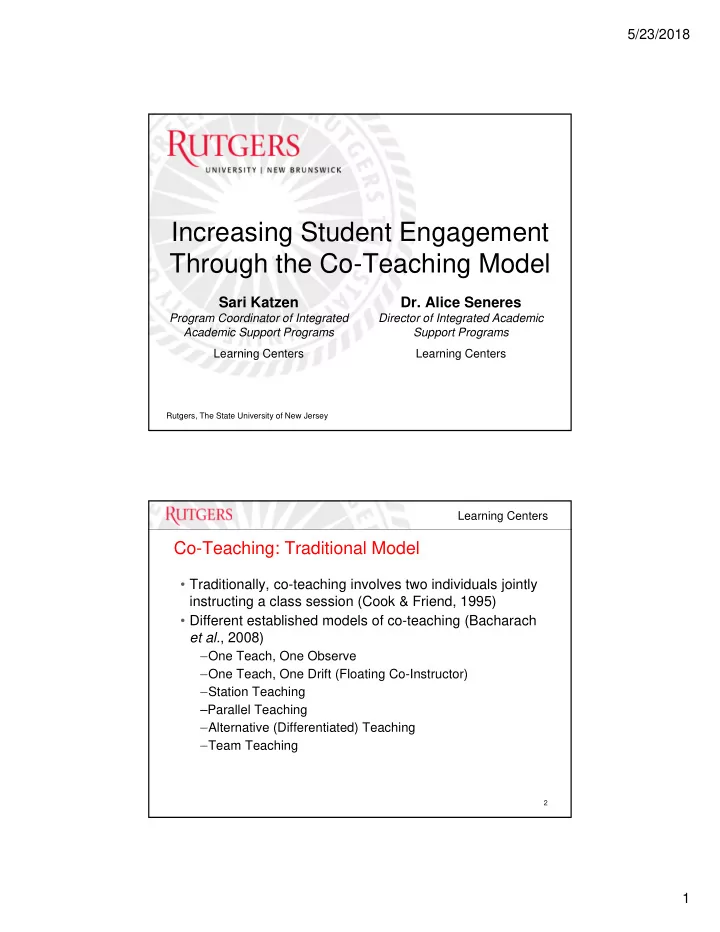
Increasing Student Engagement Through the Co-Teaching Model Sari - - PDF document

increasing student engagement through the co teaching
SMART_READER_LITE
LIVE PREVIEW

Increasing Student Engagement Through the Co-Teaching Model Sari - - PDF document

5/23/2018 Learning Centers Increasing Student Engagement Through the Co-Teaching Model Sari Katzen Dr. Alice Seneres Program Coordinator of Integrated Director of Integrated Academic Academic Support Programs Support Programs Learning


slide-1
SLIDE 1

5/23/2018 1

Learning Centers

1

Rutgers, The State University of New Jersey

Increasing Student Engagement Through the Co-Teaching Model

Sari Katzen

Program Coordinator of Integrated Academic Support Programs Learning Centers

  • Dr. Alice Seneres

Director of Integrated Academic Support Programs Learning Centers Learning Centers

2

Co-Teaching: Traditional Model

  • Traditionally, co-teaching involves two individuals jointly

instructing a class session (Cook & Friend, 1995)

  • Different established models of co-teaching (Bacharach

et al., 2008)

–One Teach, One Observe –One Teach, One Drift (Floating Co-Instructor) –Station Teaching –Parallel Teaching –Alternative (Differentiated) Teaching –Team Teaching

slide-2
SLIDE 2

5/23/2018 2

Learning Centers

3

Variety of Co-Teaching Models

One Teach, One Drift (Floating Co-Instructor) One Teach, One Observe (Team Observations) Station Teaching Parallel Teaching Alternative (Differentiated) Teaching Team Teaching

Adapted from Image Source: https://www.pinterest.com/explore/co-teaching/

Learning Centers

4

Background of Peer Instructor Education Course (PIE)

  • Co-teaching implemented into Peer Instructor

Education course since Fall 2011 (first year)

–Offered through the Learning Centers –300-level, 3-credit, 3-hour course –Began with two sections taught only in fall –Required for Learning Assistants (undergraduate peer leaders)

slide-3
SLIDE 3

5/23/2018 3

Learning Centers

5

Background of PIE Course

  • Pedagogy Dynamics

–Active learning environment and flipped classroom –Advantageous for co-instructors

  • Flipped classroom

–Students read articles outside of class each week –In-class group activities based on readings –Reading guides for quizzes

Learning Centers

6

Feedback on Active Learning Components

  • 21 of 25 students from Spring 2018 “strongly agreed” or “agreed”

that the reading guides helped them to more fully understand the content and to prepare for in-class discussions.

  • “I learned that instructors are not the center of the class, instead

students are expected to be the center. Additionally, group activities should be thought highly of due to their effectiveness in enhancing students' exchange ideas & constructing proper mental models & facilitating conceptual changes. Also, I valued the group discussion during this course…”

slide-4
SLIDE 4

5/23/2018 4

Learning Centers

7

Background of PIE Course

  • Structure and curriculum changed over last

seven years

–Up to 7 sections offered in fall and up to 2 sections in spring –Now open to all peer leaders at Rutgers and students interested in peer education

Learning Centers

8

First Semester of PIE Course

slide-5
SLIDE 5

5/23/2018 5

Learning Centers

9

Progression of Co-Teaching in PIE Course

Learning Centers

10

Identifying Teaching Strategies Activity

  • Brainstorm at least 1 – 2 different teaching

strategies that you currently use in class.

  • How could your strategies be implemented with

two co-teaching instructors? What co-teaching model would you use?

  • What would be the benefits of having two co-

teaching instructors? Limitations?

slide-6
SLIDE 6

5/23/2018 6

Learning Centers

11

Student PIE Course Evaluations

  • Fall 2017

–1 team-teaching section (consistent each week) –4 single-instructor sections (floating co-instructor in class once during semester) –New question added to student evaluation: Specifically for the weeks that were co-taught (by two or more teachers), describe the benefits and drawbacks of this form of instruction.

  • Spring 2018

–1 team-teaching section and 1 single-instructor section Learning Centers

12

Fall 2017 & Spring 2018 Student Evaluations

Fall 2017 Students Spring 2018 Students Completed Course 107 26 Completed Course Evaluations 104 25 Team-Teaching Sections 24 16 Single-Instructor Sections with Floating Co-Instructor 80 N/A Single-Instructor Sections N/A 9

slide-7
SLIDE 7

5/23/2018 7

Learning Centers

13

Fall 2017 & Spring 2018 Student Evaluations

  • Question: Specifically for the weeks that were co-taught (by

two or more teachers), describe the benefits and drawbacks

  • f this form of instruction.

Total Number

  • f

Students Identified Only Benefits Identified Both Benefits and Drawbacks Identified Only Drawbacks Indifferent No Answer Team- Teaching Section 40 33 5 2 Single- Instructor Sections with Floating Co- Instructor 80 43 16 7 7 7

Learning Centers

14

83% 13% 0% 0% 5% 54% 20% 9% 9% 9% 0% 20% 40% 60% 80% 100% Identified Only Benefits Identified Both Benefits and Drawbacks Identified Only Drawbacks Indifferent No Answer

Fall 2017 & Spring 2018 Student Responses to PIE Co-Teaching Models

Single-Instructor Sections (Weekly) with Floating Co-Instructor Team-Teaching Section (Weekly)

slide-8
SLIDE 8

5/23/2018 8

Learning Centers

15

Positive Feedback for Fall 2017 & Spring 2018 Team-Teaching Sections

  • Overall positive experience
  • Multiple instructor perspectives and increased student

engagement

  • More stability in having same co-instructors week-to-

week and time for connections to deepen

Learning Centers

16

  • “Both instructors kept each other on track, offered

different ideas and interpretations, and were able to effectively help the small groups.”

  • “Because the co-teachers worked together with a lot of

synergy, co-taught sessions felt more cohesive, comprehensive, and complete, co-teaching also helped to model how LAs might coordinate with instructors.”

slide-9
SLIDE 9

5/23/2018 9

Learning Centers

17

Constructive Feedback for Fall 2017 & Spring 2018 Team-Teaching Sections

  • Having two instructors may take more time to share

same material but in different ways

  • Floating co-instructor felt more chaotic since there

were three instructors in the room at once

Learning Centers

18

Feedback for Fall 2017 Single-Instructor Sections with Floating Co-Instructor

  • Positive

–Different instructor perspectives and varied class pace –More attention given to students with at least 2 instructors in room

  • Constructive

–Felt disjointed or unorganized when new instructor joined; unsure of what to expect

slide-10
SLIDE 10

5/23/2018 10

Learning Centers

19

  • “Having the instructors was nice because we got more

time with an instructor in our small group

  • discussions. The drawbacks is sometimes the

instructors operate differently and its weird to have two instructors with very different styles or sometimes contradict.”

Learning Centers

20

Advantages & Cautions of Co-Teaching

slide-11
SLIDE 11

5/23/2018 11

Learning Centers

21

Future Thoughts & Suggested Improvements

  • Informal observations conducted in Fall 2016 & Fall 2017

–Using a feedback form may help to standardize what elements of the classroom environment and dynamics we are focusing on

  • Identify strengths & areas of improvement of instructor’s

teaching

  • Observe student responses and reactions
  • Analyze the structure of activities, group structures and
  • utcomes

–Need to consider if course coordinators will view team observation reports Learning Centers

22

Future Thoughts & Suggested Improvements

  • Student evaluations (at the start and end of the course)

–More targeted questions related to the co-teaching experience & to the presence of a floating co-instructor –Specifically for co-taught sections: “What is your definition

  • f co-teaching? Provide an example.”
  • Integration of the floating co-instructor

–Examining most beneficial co-teaching model to use during class sessions

slide-12
SLIDE 12

5/23/2018 12

Learning Centers

23

References

  • Bacharach, N., Heck, T. W., & Dahlberg, K. (2008). Co-

teaching in higher education. Journal of College Teaching & Learning, 5(3), 9–16.

  • Cook, L. & Friend, M. (1995). Co-Teaching: Guidelines for

creating effective practices. Focus on Exceptional Children, 28(3).

Learning Centers

24

Acknowledgments

  • Aisha Ciafullo- Developmental Specialist, Training &

Professional Development Programs, Learning Centers

–Co-creator of slides

  • Stacey Blackwell- Senior Director, Learning Centers

–First co-instructor for Peer Instructor Education

  • Dr. A.J. Richards- Assistant Professor of Physics, TCNJ

–First co-instructor for Peer Instructor Education

slide-13
SLIDE 13

5/23/2018 13

Learning Centers

25

Questions?

Sari Katzen – skatzen@echo.rutgers.edu

  • Dr. Alice Seneres – alice.seneres@rutgers.edu

Aisha Ciafullo – aisha.ciafullo@rutgers.edu