InAs InAs nanowire nanowire based cooper pair based cooper pair - - PDF document

inas inas nanowire nanowire based cooper pair based
SMART_READER_LITE
LIVE PREVIEW

InAs InAs nanowire nanowire based cooper pair based cooper pair - - PDF document

CooPairEnt CooPairEnt www.nanoelectronics.ch InAs InAs nanowire nanowire based cooper pair based cooper pair splitter splitter Sz Csonka Budapest University of Technology and Economics & University of Basel Motivation CooPairEnt


slide-1
SLIDE 1

1

www.nanoelectronics.ch

CooPairEnt CooPairEnt InAs InAs nanowire nanowire based cooper pair based cooper pair splitter splitter

Sz Csonka Budapest University of Technology and Economics & University of Basel

www.nanoelectronics.ch

CooPairEnt CooPairEnt

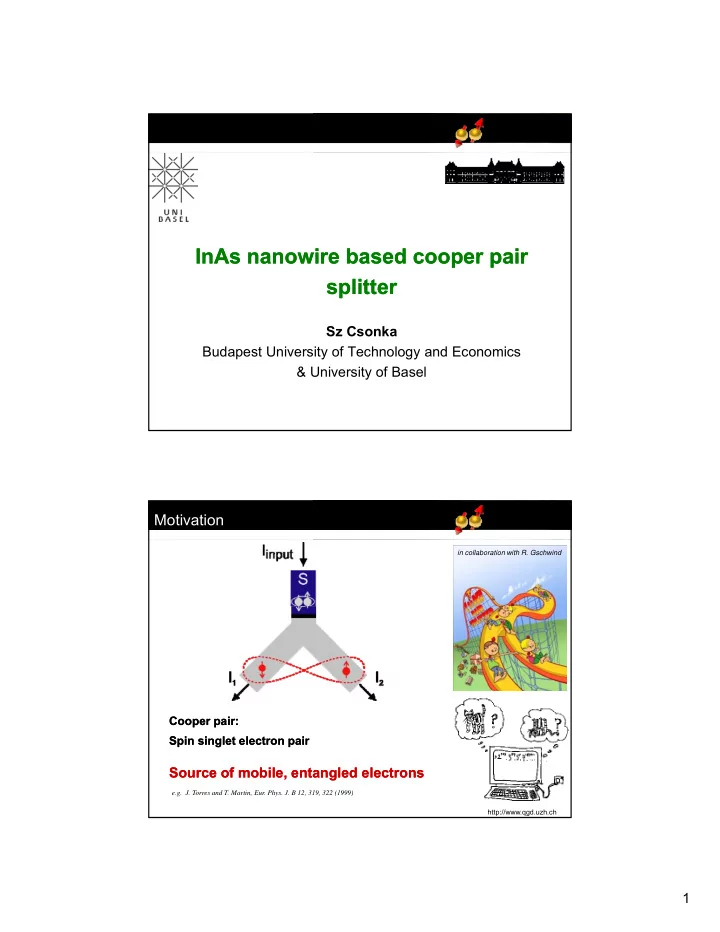
Motivation

in collaboration with R. Gschwind

Cooper pair: Cooper pair: Spin singlet electron pair Spin singlet electron pair

Source of mobile, entangled electrons Source of mobile, entangled electrons

e.g. J. Torres and T. Martin, Eur. Phys. J. B 12, 319, 322 (1999) http://www.qgd.uzh.ch

slide-2
SLIDE 2

2

www.nanoelectronics.ch

CooPairEnt CooPairEnt

Beckmann et al.; PRL 93, 197003 (2004)

Metallic nanostructures

Russo et al.; Phys. Rev. Lett. 95, 027002 (2005) Beckmann et al.; Appl. Phys. A 603 (2007) Cadden-Zimansky et al., Phys. Rev. Lett. 97, 237003 (2006) Cadden-Zimansky et al., New J. of Phys. 9, 116 (2007)

  • A. Kleine et al., EPL 87, 27011 (2009)
  • A. Kleine et al., Nanotechnology 21, 274002 (2010)

www.nanoelectronics.ch

CooPairEnt CooPairEnt

  • J. Torres and T. Martin, Eur. Phys. J. B 12, 319{322 (1999)
  • P. Recher, E.V. Sukhorukov, and D. Loss, Phys. Rev. B 63, 165314 (2001)
  • N. M.Chtchelkatchev et al. Phys. Rev. B 66, 161320 (2002)

h d h ( )

Andreev entangler

  • P. Recher and D. Loss, Phys. Rev. B 65, 165327 (2002)
  • C. Bena, S.Vishveshwara et al. PRL 89, 037901 (2002)
  • O. Sauret, D. Feinberg, T. Martin PRB 70, 245313 (2004)

slide-3
SLIDE 3

3

www.nanoelectronics.ch

CooPairEnt CooPairEnt

Andreev entangler

Efficient and controlled pair splitting? Efficient and controlled pair splitting?

see also: O. Sauret, D. Feinberg, T. Martin PRB 70, 245313 (2004) …

Experiments: Experiments: p

  • L. Hofstetter, S. C. et al., Nature 461, 960-963 (2009)

Herrmann et al., PRL 104, 026801 (2010)

www.nanoelectronics.ch

CooPairEnt CooPairEnt

Entangler based on Qdots

~1/U ~1/Δ ~1

Direct pair tunneling Direct pair tunneling Cooper pair splitting Cooper pair splitting

Recher et al. PRB, 63, 165314 (2001)

slide-4
SLIDE 4

4

www.nanoelectronics.ch

CooPairEnt CooPairEnt

Entangler based on Qdots

~1/U ~1/Δ ~1

Direct pair tunneling Direct pair tunneling Cooper pair splitting Cooper pair splitting

Recher et al. PRB, 63, 165314 (2001)

www.nanoelectronics.ch

CooPairEnt CooPairEnt

Device

S electrode connected to two tunable QDs S-electrode connected to two tunable QDs

  • InAs NW: d ≈ 80nm
  • superconductor (Ti/Al), w ≈ 200nm
  • top gates with surface oxide
  • 2 InAs NW QDs separately tuned

by top gates (VSG and VTG)

  • QDs: U ≈ 2-4meV
  • clear subgap feature: Δ ≈ 160μV
  • very weak (≈1/1000) cross capacitance

ΔVSG/ΔVTG; ΔGS(ΔVSG) = ΔGS(ΔVTG)

  • L. Hofstetter, S. C. et al., Nature 461, 960-963 (2009)
slide-5
SLIDE 5

5

www.nanoelectronics.ch

CooPairEnt CooPairEnt

Vac

S

VSG VTG

sensing gate tuning gate

Measurement principle

I/V sensing qdot tuning qdot

S

I/V

IS IT

NONLOCAL MEASUREMENT: NONLOCAL MEASUREMENT:

current measurement of sensing qdot while sweeping the gate of the tuning qdot Cooper pair splitting contributes to IS; depends on sensing QD and tuning QD

G =IS

S ac

/V G =I /V

T T ac

Gnonlocal(VTG) = GS(VTG) -(α+βVTG)

  • L. Hofstetter, S. C. et al., Nature 461, 960-963 (2009)

www.nanoelectronics.ch

CooPairEnt CooPairEnt

0.50 0.25

d [mV]

0.00

S (G0) 0.2 0.3 0.4

G0)

0.28 0.29 0.30

Measurement principle

  • 0.0050

0.0025

  • 0.25
  • 0.50

VSG [V] Vs 0.0 0.2 0.4

VSG (mV)

2

  • 3

GS VSG (mV)

1.5 2.0 2.5 3.0 0.0 0.1

GS ( VTG (mV)

0.24 0.25 0.26 0.27 65 70 75 80 85

GS [G0]

  • quantum dot with U ≈ 2-4meV, ε ≈ 1meV
  • clear subgap feature, gap visible, Δ ≈ 160μV
  • very weak (≈1/1000) cross capacitance

cross capacitance = ΔVSG/ΔVTG; ΔGS(ΔVSG) = ΔGS(ΔVTG)

  • L. Hofstetter, S. C. et al., Nature 461, 960-963 (2009)
slide-6
SLIDE 6

6

www.nanoelectronics.ch

CooPairEnt CooPairEnt

0.50 0.25

d [mV]

0.00

S (G0) 0.2 0.3 0.4

G0)

0.28 0.29 0.30

Measurement principle

  • 0.0050

0.0025

  • 0.25
  • 0.50

VSG [V] Vs 0.0 0.2 0.4

VSG (mV)

2

  • 3

GS VSG (mV)

1.5 2.0 2.5 3.0 0.0 0.1

GS ( VTG (mV)

0.24 0.25 0.26 0.27 65 70 75 80 85

GS [G0]

  • quantum dot with U ≈ 2-4meV, ε ≈ 1meV
  • clear subgap feature, gap visible, Δ ≈ 160μV
  • very weak (≈1/1000) cross capacitance

cross capacitance = ΔVSG/ΔVTG; ΔGS(ΔVSG) = ΔGS(ΔVTG)

  • L. Hofstetter, S. C. et al., Nature 461, 960-963 (2009)

www.nanoelectronics.ch

CooPairEnt CooPairEnt

0.50 0.25

d [mV]

0.00

Measurement principle

S (G0) 0.2 0.3 0.4

G0)

0.28 0.29 0.30

  • 0.0050

0.0025

  • 0.25
  • 0.50

VSG [V] Vs 0.0 0.2 0.4

VSG (mV)

2

  • 3

GS VSG (mV)

1.5 2.0 2.5 3.0 0.0 0.1

GS ( VTG (mV)

0.24 0.25 0.26 0.27 65 70 75 80 85

GS [G0]

  • clear subgap feature, gap visible, Δ ≈ 160μV
  • very weak (≈1/1000) cross capacitance
  • averaging (~102) necessary to make signal visible
  • L. Hofstetter, S. C. et al., Nature 461, 960-963 (2009)
slide-7
SLIDE 7

7

www.nanoelectronics.ch

CooPairEnt CooPairEnt

0.5 1.0 0.000

B = 120mT

Results

1.0 0.0 0.002

GNonlocal [G0]

  • 0.004

GT [G0] B = 0mT

Current in sensor dot (IS): iti l l i l

0.070 0.075 0.080 0.085 0.0 0.5

  • 0.006
  • 0.002

VTG [V]

  • positive non local signal

while sweeping the VTG at B = 0 !

  • background, GS ~ 0.15 G0

⇒ signal few %

  • B > Bc signal changes sign and

corresponds to the classical circuit response (no fitting parameters)

www.nanoelectronics.ch

CooPairEnt CooPairEnt

Results

0.5 1.0 0.000

B = 120mT

1.0 0.0 0.002

GNonlocal [G0]

  • 0.004

GT [G0] B = 0mT

Current in sensor dot (IS): iti l l i l

0.070 0.075 0.080 0.085 0.0 0.5

  • 0.006
  • 0.002

VTG [V]

  • positive non local signal

while sweeping the VTG at B = 0 !

  • background, GS ~ 0.15 G0

⇒ signal few %

  • B > Bc signal changes sign and

corresponds to the classical circuit response (no fitting parameters)

slide-8
SLIDE 8

8

www.nanoelectronics.ch

CooPairEnt CooPairEnt

Regime: U >> Δ >> T; ε > Δ, Γ ≈ Δ; ξ ≈ wS Transport happens in pairs of electrons we observe the Cooper pair splitting Locally separated (entangled) electrons

Explanation

Cooper pair splitting CPS Direct pair tunneling DPT Direct pair tunneling DPT

  • L. Hofstetter, S. C. et al., Nature 461, 960-963 (2009)

www.nanoelectronics.ch

CooPairEnt CooPairEnt

IS = IDPT + ICPS/2

Simple non-interacting tunneling picture (Ti<<1) TS TT

Explanation

]

I ~ T · T I ~ T · T

0.070 0.075 0.080 0.085 0.0 0.5 1.0

  • 6
  • 2

2

GNonlocal [10

  • 3G0]

GT [G0]

IDPT TS TS ICPS TS TT

GNonlocal ~ TT

Since GT≈IT

DPT~TT 2, GNonlocal~GT 1/2

  • L. Hofstetter, S. C. et al., Nature 461, 960-963 (2009)
slide-9
SLIDE 9

9

www.nanoelectronics.ch

CooPairEnt CooPairEnt

Explanation

Simple non-interacting tunneling picture (Ti<<1)

IS = IDPT + ICPS/2

TS TT

GT)1/2

I ~ T · T I ~ T · T

GNonlocal [10-2G0], (G

IDPT TS TS ICPS TS TT

GNonlocal ~ TT

Since GT≈IDPT~TT

2, GNonlocal~GT 1/2

  • L. Hofstetter, S. C. et al., Nature 461, 960-963 (2009)

www.nanoelectronics.ch

CooPairEnt CooPairEnt

0 004 0.000 0.004 0.066 0.068 0.070 0.066 0.068 0.070 0.25 0.50

VTG [V] GT [G VTG [V]

Control of Cooper pair splitting

0 000 0.004

  • 0.004

0.000 0.004 0.000 0.004

  • 0.004

0.00

0.2 0.3

GNonlocal [G0]

GS [G0

0]

GNonlocal [G0]

the sign of the non-local signal depends

0.066 0.068 0.070

  • 0.004

0.000 0.004

  • 0.004

0.000

0.001 0.002 0.0 0.1

VTG [V]

0]

VSG [V]

  • n the state of the sensing qdot:

dotsensing out of resonance: GNonlocal follows GT Cooper pair splitting dotsensing in resonance: “classical” filtering of DPT is not efficient

  • L. Hofstetter, S. C. et al., Nature 461, 960-963 (2009)
slide-10
SLIDE 10

10

www.nanoelectronics.ch

CooPairEnt CooPairEnt

Control of Cooper pair splitting

0 004 0.000 0.004 0.066 0.068 0.070 0.066 0.068 0.070 0.25 0.50

VTG [V] GT [G0 VTG [V]

0 000 0.004

  • 0.004

0.000 0.004 0.000 0.004

  • 0.004

0.00

0.2 0.3

GNonlocal [G0]

GS [G0

0]

GNonlocal [G0]

the sign of the non-local signal depends

0.066 0.068 0.070

  • 0.004

0.000 0.004

  • 0.004

0.000

0.001 0.002 0.0 0.1

VTG [V]

0]

VSG [V]

  • n the state of the sensing qdot:

dotsensing out of resonance: GNonlocal follows GT Cooper pair splitting dotsensing in resonance: “classical” filtering of DPT is not efficient

  • L. Hofstetter, S. C. et al., Nature 461, 960-963 (2009)

www.nanoelectronics.ch

CooPairEnt CooPairEnt

Temperature dependence

non local signal i h t 200 K b t

  • vanishes at ~ 200mK but

superconducting gap still visible up to 600mK (TC = 1.2 K)

  • T dependence on top, left

and right side of sensing qdot’s Coulomb blockade

  • monotonous decay of the

nonlocal signal with T q peak

  • L. Hofstetter, S. C. et al., Nature 461, 960-963 (2009)
slide-11
SLIDE 11

11

www.nanoelectronics.ch

CooPairEnt CooPairEnt

Discussion

ICPS ~ p(δr): taking electrons of CP at distance δr Efficiency of Pair Splitting ΔGNonlocal/(GS+GT) ≈ few % ≈ few % ICPS p(δr): taking electrons of CP at distance δr

p(δr) ~ [sin(kFδr)/(kFδr)]2·exp(-δr/ξ) (ball. limit) p(δr) ~ 1/(kFδr)· 1/kFl ·exp(-δr/ξ) (diff. limit)

  • CPs tunnel first into NW underneath the contact:

lower kF , geometrical confinement p(δr) increases

λF=3.5Å, l=5nm δr =150nm,

~ 10-5–10-7

Recher et al. PRB, 63, 165314 (2001), D. Feinberg Eur. Phys. J. B 36, 419 (2003)

For our Cooper pair splitter: U >> Γ, Γ ≈ Δ

Direct Pair Tunneling is not strongly suppressed

www.nanoelectronics.ch

CooPairEnt CooPairEnt

Beckmann et al.; PRL 93, 197003 (2004)

Metallic nanostructures

Russo et al.; Phys. Rev. Lett. 95, 027002 (2005) Beckmann et al.; Appl. Phys. A 603 (2007) Cadden-Zimansky et al., Phys. Rev. Lett. 97, 237003 (2006) Cadden-Zimansky et al., New J. of Phys. 9, 116 (2007)

  • A. Kleine et al., EPL 87, 27011 (2009)
  • A. Kleine et al., Nanotechnology 21, 274002 (2010)

Measurements at finite bias

slide-12
SLIDE 12

12

www.nanoelectronics.ch

CooPairEnt CooPairEnt

Finite bias measurements

Elastic co- tunneling Direct pair tunneling Cooper pair splitting = Crossed Andreev reflection

Finite bias

  • Competition of CPS and EC

p

Lowest order CPS and EC compensates Metallic nanostructures: difficult to separate CPS and EC, no experimental knob With QDots at S/N interface: energy dependent DOS and possible to change the position of the resonance.

www.nanoelectronics.ch

CooPairEnt CooPairEnt

When QD1 is at resonance:

Finite bias measurements

When QD1 is off-resonance:

Due to peak in DOS of QD1 the maxi- mal contribution of CPS and EC is expected at different UN2

slide-13
SLIDE 13

13

www.nanoelectronics.ch

CooPairEnt CooPairEnt

Finite bias measurements

When QD1 is at resonance: Nonlocal measurement: dI1

ac vs. UN2 dc @ N1 capacitively coupled

When QD1 is off-resonance:

CPS Due to peak in DOS of QD1 the maxi- mal contribution of CPS and EC are expected at UN2 with different sign. EC

Summary & Summary & Outlook Outlook

Quantum dot based Cooper pair splitter Competition of CPS & EC at finite bias

CooPairEnt CooPairEnt

Improve efficiency Implement controllable spin detectors Test entanglement,

i t noise measurement

slide-14
SLIDE 14

14

thanks to thanks to thanks to thanks to

Swiss National Science Foundation National Center on Nanoscale Science and Swiss Nanoscience Institute

CooPairEnt CooPairEnt

and group of J. Nygaard (Niels Bohr Institute Copenhagen)

Hybrid Nanocircuits Hybrid Nanocircuits

Financial support

Thank you for your attention! Thank you for your attention!

CooPairEnt CooPairEnt