In vitro (Tissue Culture) Propagation of Asimina triloba A - - PowerPoint PPT Presentation

in vitro tissue culture propagation of asimina triloba a
SMART_READER_LITE
LIVE PREVIEW

In vitro (Tissue Culture) Propagation of Asimina triloba A - - PowerPoint PPT Presentation

Fourth International Pawpaw Conference September 2016 In vitro (Tissue Culture) Propagation of Asimina triloba A challenge pictures: KYSU Bock Bio Science GmbH, Bremen Core competences Breeding Tissue culture


slide-1
SLIDE 1

Fourth International Pawpaw Conference September 2016

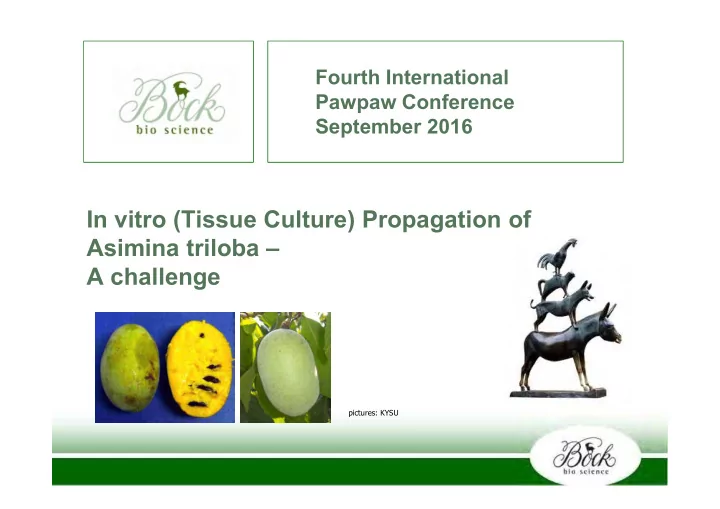
In vitro (Tissue Culture) Propagation of Asimina triloba – A challenge

pictures: KYSU
slide-2
SLIDE 2

Bock Bio Science GmbH, Bremen

slide-3
SLIDE 3

Core competences

  • Breeding
  • Tissue culture
  • Development of culture protocols
  • Industrial propagation of plants
  • R&D in Green biotechnology
slide-4
SLIDE 4

Tissue culture – medium preparation and processing

slide-5
SLIDE 5

Tissue culture - Growing

slide-6
SLIDE 6

Meristem Propagation

Meristem tissue from single selected plants is regenerated to whole plants and propagated exponantially in a sterile environment. Addition of different types and concentrations of plant hormones to the nutrition media induces growth, shoot and root development

slide-7
SLIDE 7

Propagation of Asimina

  • From seed: genetically heterogenous, yield and taste of fruits
  • ften not satisfying, growth not uniform
  • Cuttings:

no rooting

  • Grafting:
  • f valuable genotypes, rootstock: seedlings

small quantity of available scions losses no defined rootstock clones prices high growth heterogenous demand exceeds supply

slide-8
SLIDE 8

Tissue culture

Steps:

  • Preparation
  • Initiation
  • Propagation
  • Rooting
  • Adaptation

Parameter:

  • 1. Part of plant, cutting technique

shoot meristems, root meristems, receptacle, leaves

  • 2. Time of preparation
  • 3. Sterilizing method

axenic culture

  • 4. Nutrition media

macro- / micronutrients, sugar, pH, gelling agent

  • 5. Hormons

concentrations, combinations

  • 6. Light

day length, intensity, quality (wavelength), changes in light regime

  • 7. Temperature

changes in temperature

  • 8. Air humidity/ Ventilation

(9. horticultural measurements)

Young plant C U L T U R A L P R O T O C O L

slide-9
SLIDE 9

Development of a culture protocol

Given 10 options per parameter and free combinations of the 8 different parameters there would be 108 = 100 million different possibilities

?

slide-10
SLIDE 10

Development of a culture protocol

Given 10 options per parameter and free combinations of the 8 different parameters there would be 108 = 100 million different possibilities

?

  • Dr. Maria Blondeau

?

?

?

slide-11
SLIDE 11

Success Rates – Valuable Genotypes

Preparation / Initiation

2013: 1.186 explants in total

  • f 13 fruit varieties ( 148 mother plants)

2- 11 clean and vital explants each of 10 varieties no vital explant of 3 varieties 2014: Preparation of 3 fruit varieties: 161 explants no vital explant Preparation of 5 Peterson varieties, shoots of woody sticks supplied by KYSU no vital explant

slide-12
SLIDE 12

Success Rates – Seedling Lines

Preparation / Initiation

2013: sterilization and stratification treatment of seeds germination of 200 Asimina seeds 3 seeds steril and germinating propagation of 3 seedling lines 2014: preparation of young plants (seeds germinated in the green house) 1-2 clean and vital explants of each seedling Juvenility plays an important part concerning the success of the initiation step 10 seedling lines for experimental purposes

slide-13
SLIDE 13

Success Rate

Propagation (seedlings & clones)

  • 10 out of 13 varieties are successfully established in our

laboratory

  • 10 seedling lines are used for experimental purposes
  • test of more than 40(!) different media compositions for

initiation and propagation

  • development of a nutrition medium, which ensures a very good

plant quality for a long period of subculture passages

  • the propagation ratio is 1:2 to 1:4
  • the subculture period is 6-8 weeks
slide-14
SLIDE 14

Success Rates

Propagation

10 varieties successfully established: 1102 Mango 1103 Overleese 1105 Sunflower 1106 Prolific 1107 Taylor 1110 Mary Foos 1111 Rebecca‘s Gold 1112 Taytoo 1113 Belle 1108 NC-1 (endogenous bacteria) not successfull: Prima 1216 (Montanari) Davis Ithaca Sweet Alice

slide-15
SLIDE 15

Success Rates

Rooting

Rooting of Asimina is very difficult… Many experiments showed ZERO success and proceedings only came very slowly by varying nearly each parameter Honestly, the initial enthusiasm was beginning to "melt"

THEN – 1. September 2015A

slide-16
SLIDE 16

Success Rates

Rooting

  • the rooting rate of fruit varieties was improved

up to a ratio of 40%

  • 58 different compositions of medium – including multiple changes of

medium - were tested.

  • the application of biogene amines improved the results
  • 8 different gelling agents and substrates were tested
  • physical parameters have to be changed during the process
  • seedling lines root better than fruit varieties

(juvenility).

slide-17
SLIDE 17

Success Rates

Rooting ratios

1102 Mango 36% 1103 Overleese 29% 1105 Sunflower 15% 1106 Prolific 12% 1107 Taylor 37% 1110 Mary Foos 11% 1111 Rebecca´s Gold 42% 1112 Taytoo 38% 1113 Belle 38%

slide-18
SLIDE 18

Rooting Impressions

slide-19
SLIDE 19

Adaptation

clone 1102 = variety „Mango“

conditions for adaptation process worked out unsolved problem: some plants stop growth, terminal bud goes dormant

Clone 1113 = variety „Belle“

slide-20
SLIDE 20

Proof of Variety Genuineness (microsatellite genotyping)

slide-21
SLIDE 21

Proof of Variety Genuineness (microsatellite genotyping)

slide-22
SLIDE 22

Pedigree

Sunflower Mango Tatoo Rebecca Taylor S1 and S3 from

  • ne fruit

seedling lines Fruit varieties

slide-23
SLIDE 23

Variety Genuineness and Pedigree

  • no confusions within the fruit varieties
  • epigentic differences depending on origin / individuum
  • Seedlings and fruit varieties build subgroups

interesting for the search of molecular markers for fruit quality

  • The difference among the seedlings is bigger than the

differences among the fruit varieties (graphic representation is slightly distorted)

slide-24
SLIDE 24

Availability

from spring 2017 onwards first trials of self rooted young plants varieties:

  • Mango
  • Taylor
  • Rebecca‘s Gold
  • Taytoo
  • Belle

sterile microplugs

slide-25
SLIDE 25

Thank you for your kind attention