SLIDE 1
In Defense of Natural Cement: A Critical Examination of the Evolution of Concrete Technology at Fort Totten, New York
Richard M. P. Lowry, MA, MS, MIFA Heritage Officer , Bermuda Government
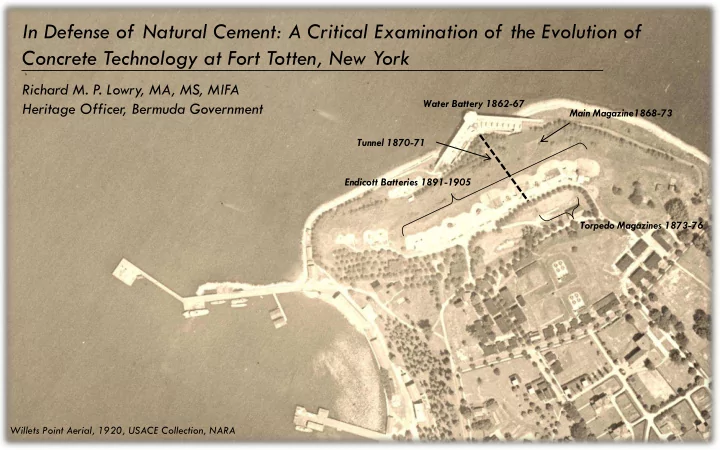
Willets Point Aerial, 1920, USACE Collection, NARA Water Battery 1862-67 Endicott Batteries 1891-1905 Tunnel 1870-71 Torpedo Magazines 1873-76 Main Magazine1868-73
SLIDE 2 US Army Corps of Engineers at Willets Point
USACE electromagnet, Fort Totten, 1892 (Fort Totten Museum Collection)
(1831-1927)
Willets Point/Fort Totten HQ of the Corps of Engineers (1866- 1901) Engineering Depot (1866-1901) Engineering School of Application (1867- 1901) Torpedo School (1869- 1908) Essayons Club (1868-1882)
SLIDE 3 Changes in Fortification Construction: Masonry to Concrete
Construction of the batteries and magazines at Fort Totten, ca. 1890s, showing wooden formwork (BHS Collection) Endicott Battery Graham 1 (1892-1896) Endicott Battery Graham 1 (1892-1896) with later extensions (1903-1905) Endicott Battery Sumner1 (1891-1897) with later extensions (1903-1905) Fort at Willets Point, N.Y. View of Excavations and Embankments’, ca. 1863 (NARA)
- No. 3 Plan of Fort at Willet's Pt., L.l. June 25, 1863,
Sections and Plan of the Main Magazine (NARA) Plan, Elevation and Sections for Battery Mahan, Fort Totten, built 1898-1900 (NARA)
SLIDE 4
Fort Totten Fortifications: Structures examined
Water Battery (1863-1867) Masonry with coarse infill NC concrete Tunnel (1870-1871) NC concrete Torpedo Magazines (1873-76) NC concrete Battery Sumner (1891-97) NC concrete with later PC concrete additions Battery Graham (1892-98) NC concrete with later PC concrete additions Battery Mahan (1898-1905) PC concrete
SLIDE 5
Concrete Development at Fort Totten: Changes in mix design
Coarse infill NC concrete showing plenty of strained quartz river gravel used at the Water Battery (1862-67) Exposed NC concrete north entrance of the Tunnel (1870-1871) Exposed NC concrete showing large unbroken gravel aggregate in the Tunnel (1870-1871) Partially completed doorway cut through the NC concrete sidewall Torpedo Magazine III (1873-1876) Coarse NC concrete foundations of Battery Graham I (1892-1897) PC concrete lifts with diabase aggregate Battery Mahan I (1898-1900)
SLIDE 6
Natural Cement Concrete Conditions: Torpedo Magazines
Crack between Torpedo Magazines I and II (1873-1876) Vertical crack in Torpedo Magazine IV (1873-1876) Interior of Torpedo Magazine V (1873-1876)
SLIDE 7
Natural Cement Concrete Conditions: Main Magazine, Battery Sumner and Battery Graham
Spalling and cracking along emplacements at Battery Graham I (1892-1897) Interior of the Main Magazine (1868-1873) Cracking along emplacements at Battery Sumner I (1891-1897)
SLIDE 8
Portland Concrete Conditions: Battery Mahan
Significant failure along concrete lifts at the traverse of Battery Mahan 1 (1898-1900) Cracking along traverse at Battery Mahan I (1898-1900) Expansion cracking along traverse extension of Battery Mahan I (1902-1905)
SLIDE 9
Polarized Light Microscopy: Natural Cement and Portland Cement Identification
Belite, PC from sample G2U-2A Battery Graham II (1892-1897) Alite, PC from sample M1L-1B Battery Mahan I (1898-1900) NC grain, from sample G2U-2A Battery Graham II (1892-1897)
SLIDE 10
Polarized Light Microscopy: Lift Boundaries
Precipitated calcite crystals along the lift boundary of NC sample S1UC.2 Battery Sumner I (1881-97), evidence of freeze/thaw cycling Lift boundary from NC sample S1U-C2 Battery Sumner I (1891-97) showing carbonation Depleted calcium hydroxide along the lift boundary of PC sample M1U.C (1898-1900)
Ettringite Ettringite
SLIDE 11
Polarized Light Microscopy: Alkali Silica Reaction
Possible ASR, from NC sample S2U-1B Battery Sumner II (1896-98) below Classic ASR seen at the High Line, Manhattan, NY Image courtesy of Andre Georges, Robert Silman Associates
SLIDE 12
Interesting Findings: Surface Coatings
PC pargetting on NC sample G2U-2A Battery Graham (1892/98) below Ground slag inclusions, from NC sample G1L-1A Battery Graham I Foundations (1892-97) below Limewash coating on NC concrete, from NC sample TM4.3A2 Torpedo Magazine IV (1873/4) below
slag
3” 2”
SLIDE 13
Interesting Findings: Entrained Air
Entrained air, from PC sample M2L-1A Battery Mahan 2 Extension (1903-1905) PC sample M2L-1A taken from concrete window lintel at Battery Mahan 2 Extension (1903-1905)
SLIDE 14
Conclusions
No evidence of an inherent problem with the natural cement concrete fortifications at Fort Totten Appropriateness of design, subsidence, and lack of expansion joints Switch to portland cement: greater workability, better suited to reinforced concrete in ea. 20thC Other factors to consider: economics and domestic production Clear development of concrete mix design and evidence of experimentation FURTHER RESEARCH Archival research on cement brands used Historic graffiti in Tunnel Analyze concrete in Main Magazine, Tunnel, Barbette Magazines
SLIDE 15 Thank You
Special thanks to
- Prof. Norman Weiss and Prof. Joan Berkowitz, Columbia University
John Walsh, Highbridge Materials Testing John Krawchuck, NYC Parks and Recreation Ken Uracius & Chris Perry, Stone & Lime Inc. rmlowry@gov.bm http://academiccommons.columbia.edu/