
SLIDE 1
The Saga of Mathematics A Brief History Lewinter & Widulski 1
Lewinter & Widulski Lewinter & Widulski The Saga of Mathematics The Saga of Mathematics 1 1
A Century of Surprises A Century of Surprises
Chapter 11 Chapter 11
Lewinter & Widulski Lewinter & Widulski The Saga of Mathematics The Saga of Mathematics 2 2
The 19 The 19th
th Century
Century
- Critical examination of Euclidean
Critical examination of Euclidean geometry. geometry.
- Especially the
Especially the parallel postulate parallel postulate which Euclid took for granted. which Euclid took for granted.
- Euclidean versus Non
Euclidean versus Non-
- Euclidean
Euclidean geometry. geometry.
Lewinter & Widulski Lewinter & Widulski The Saga of Mathematics The Saga of Mathematics 3 3
The Parallel Postulate The Parallel Postulate
- If a straight line falling on two straight
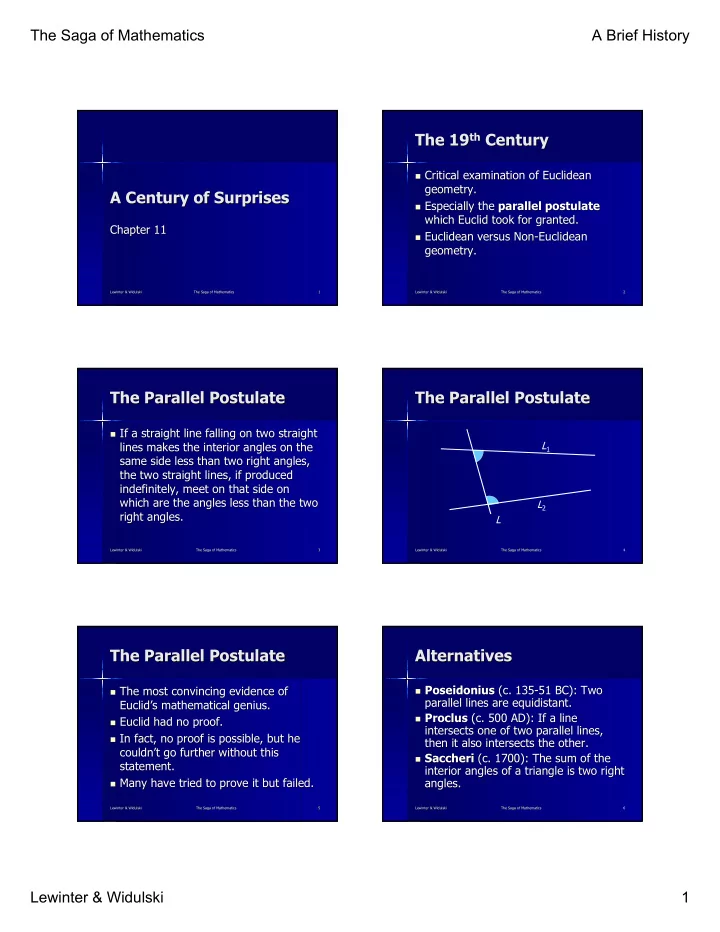
If a straight line falling on two straight lines makes the interior angles on the lines makes the interior angles on the same side less than two right angles, same side less than two right angles, the two straight lines, if produced the two straight lines, if produced indefinitely, meet on that side on indefinitely, meet on that side on which are the angles less than the two which are the angles less than the two right angles. right angles.
Lewinter & Widulski Lewinter & Widulski The Saga of Mathematics The Saga of Mathematics 4 4
The Parallel Postulate The Parallel Postulate
L L1 L2
Lewinter & Widulski Lewinter & Widulski The Saga of Mathematics The Saga of Mathematics 5 5
The Parallel Postulate The Parallel Postulate
- The most convincing evidence of
The most convincing evidence of Euclid’s mathematical genius. Euclid’s mathematical genius.
- Euclid had no proof.
Euclid had no proof.
- In fact, no proof is possible, but he
In fact, no proof is possible, but he couldn’t go further without this couldn’t go further without this statement. statement.
- Many have tried to prove it but failed.
Many have tried to prove it but failed.
Lewinter & Widulski Lewinter & Widulski The Saga of Mathematics The Saga of Mathematics 6 6
Alternatives Alternatives
- Poseidonius
Poseidonius (c. 135 (c. 135-
- 51 BC): Two
51 BC): Two parallel lines are equidistant. parallel lines are equidistant.
- Proclus
Proclus (c. 500 AD): If a line (c. 500 AD): If a line intersects one of two parallel lines, intersects one of two parallel lines, then it also intersects the other. then it also intersects the other.
- Saccheri