Improving Primary Care: Building Blocks for Success and Opportunities - - PDF document

improving primary care building blocks for success and
SMART_READER_LITE
LIVE PREVIEW

Improving Primary Care: Building Blocks for Success and Opportunities - - PDF document

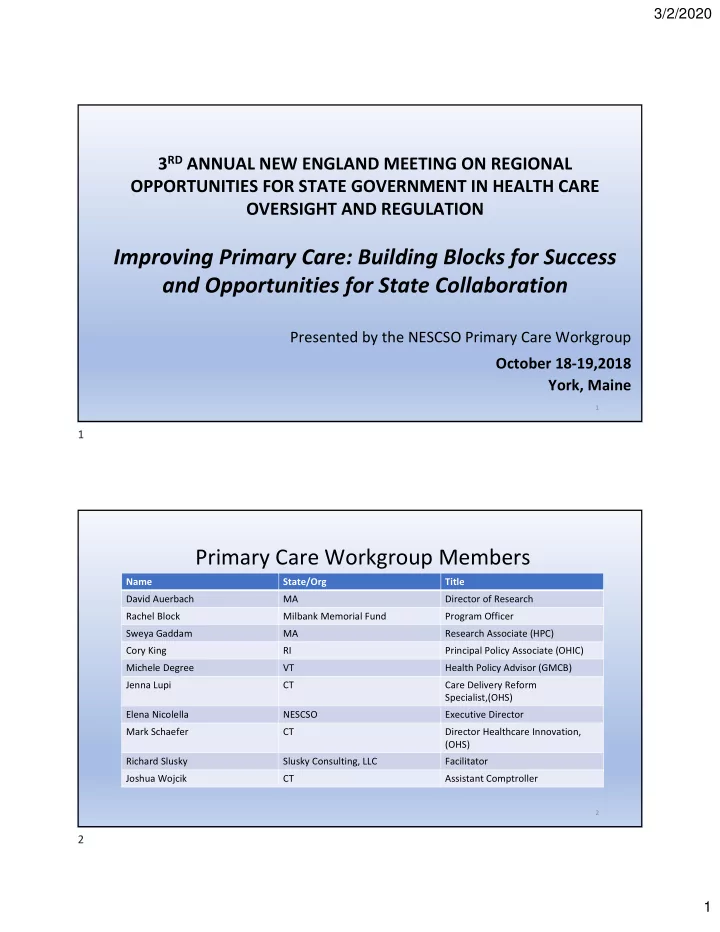
3/2/2020 3 RD ANNUAL NEW ENGLAND MEETING ON REGIONAL OPPORTUNITIES FOR STATE GOVERNMENT IN HEALTH CARE OVERSIGHT AND REGULATION Improving Primary Care: Building Blocks for Success and Opportunities for State Collaboration Presented by the NESCSO


slide-1
SLIDE 1

3/2/2020 1

3RD ANNUAL NEW ENGLAND MEETING ON REGIONAL OPPORTUNITIES FOR STATE GOVERNMENT IN HEALTH CARE OVERSIGHT AND REGULATION

Improving Primary Care: Building Blocks for Success and Opportunities for State Collaboration

Presented by the NESCSO Primary Care Workgroup October 18‐19,2018 York, Maine

1

Primary Care Workgroup Members

Name State/Org Title David Auerbach MA Director of Research Rachel Block Milbank Memorial Fund Program Officer Sweya Gaddam MA Research Associate (HPC) Cory King RI Principal Policy Associate (OHIC) Michele Degree VT Health Policy Advisor (GMCB) Jenna Lupi CT Care Delivery Reform Specialist,(OHS) Elena Nicolella NESCSO Executive Director Mark Schaefer CT Director Healthcare Innovation, (OHS) Richard Slusky Slusky Consulting, LLC Facilitator Joshua Wojcik CT Assistant Comptroller

2

1 2

slide-2
SLIDE 2

3/2/2020 2

Discussion Points

  • 1. Define Primary Care and Primary Care Spending
  • 2. Why Should States Consider Increasing Investments in Primary Care

Providers and Primary Care Practices?

  • 3. Components of Primary Care Investments
  • 4. Tools States Can Use to Determine Primary Care Investments
  • 5. Measures of Success
  • 6. Opportunities For Collaboration Among the States
  • 7. Next Steps

3

Link to the Milbank Study on Measurement of Primary Care Spending

4

  • Published July 2017
  • Work conducted under

contract with Bailit Health Purchasing and subcontract with RAND

  • https://www.milbank.org/

publications/standardizing ‐measurement‐ commercial‐health‐plan‐ primary‐care‐spending/

3 4

slide-3
SLIDE 3

3/2/2020 3

How Do We Define Primary Care?

Primary Care is: “The provision of integrated, accessible health care services by clinicians who are accountable for addressing a large majority of personal health care needs, developing a sustained partnership with patients, and practicing in the context

  • f family and community."

Institute of Medicine, 1996

5

How Much of Our Health Care Dollars Go to Support Primary Care?

  • If primary care is so important to society, do our collective payments reflect

it?

  • Defining primary care is harder than it first seems. Should we define it by the

type of provider offering the service? The type of services available, regardless of provider?

  • As quality improvement experts remind us, we improve what we measure.
  • The United States is in the midst of an unprecedented era of provider

payment reform. Assessing the effects of these innovations on a known contributor to high value care—our primary care infrastructure—should be a high priority. 1

  • 1. Milbank Memorial Fund Report: “Standardizing the Measurement of Commercial Health Plan Primary Care Spending by Michael H. Bailit,

Mark W. Friedberg, and Margaret L. Houy (July 2017)

6

5 6

slide-4
SLIDE 4

3/2/2020 4

Why Should States Consider Increasing Payments to Primary Care Providers/Practices?

  • There is near‐unanimity that a truly reformed U.S. health

care system will require at its foundation a robust system of primary care.

  • Implementing increased investments in primary care

through value‐based payment reforms will result in primary care practices’ evolving over time toward the medical home ideal.

  • Improving primary care is the key to better care, smarter

spending, and healthier people and communities.

7

The Status of Primary Care Payments in Selected New England States

State Source of Payments Year Total Medical Payments Primary Care Claims‐ Based Payments Primary Care Non‐Claims‐ Based Payments Primary Care Total Payments as % of Total Medical Claims Connecticut State Employee Health Plan 2017 $1,485,422,512 $63,702,850 $5,749,504* 4.7% Massachusetts APCD (Top 3 Commercial Payers) 2015 $10,024,456,211 $665,795,472 ‐‐‐‐‐‐‐‐‐ 6.6% Rhode Island Fully Insured Commercial Claims Paid (Largest Payers) Oct. 2016 $636,173,241 $38,716,942 $37,377,915 11.5% Vermont 2016 VHCURES All Payers 2016 $1,311,282,144 $127,036,478 ‐‐‐‐‐‐‐‐ 9.69%

8

*CT Includes Care Coordination and Shared Savings Quality Payments Only

7 8

slide-5
SLIDE 5

3/2/2020 5

Components of Primary Care Investments

  • 1. Scope of Services a Primary Care Provider should provide
  • 2. Who provides primary care services
  • 3. Components of Primary Care Payments:
  • Claims‐based (CPT Codes)
  • Non‐Claims Based
  • 4. Total Medical Payments ‐‐ The Denominator
  • 5. Measures of Success

9

Scope Of Services A Primary Care Provider Should Provide

ACUTE CARE CHRONIC CARE COORDINATION OF CARE PREVENTIVE CARE EDUCATION AND SCREENING

10

Primary Care is: Integrated Accessible Accountable Majority of Care Partnership with Patients Context of Family and Community 9 10

slide-6
SLIDE 6

3/2/2020 6

Who Provides Primary Care?

Health Care Providers Specializing in Primary Care Include:

  • Family Practice
  • Internal Medicine
  • Geriatrics
  • Pediatrics
  • Nurse Practitioner (Primary Care)
  • Physician Assistant (Primary Care)
  • Others (For Consideration)
  • Gynecologists
  • Primary Mental Health Provider
  • Naturopath
  • Homeopath

11 Definitions from Vermont Primary Care Payment Workgroup 12/29/2015

Components of Primary Care Spending

12

Services provided by primary care providers Primary care services

The sum of spending for selected CPT codes and non claims‐based payments to primary care providers becomes the “numerator” in the spending calculation. Claims‐Based Payments Non Claims‐Based Payments

  • Capitation payments and provider salaries
  • Risk‐based payments
  • Payments for primary care medical home or

patient centered medical home recognition

  • Payments for achievement of quality/cost‐savings goals
  • Payments to develop capacity to improve care for

a defined population of patients, such as patients with chronic conditions

  • Payments to help providers adopt health information

technology, such as electronic health records

  • Payments or expenses for supplemental staff

such as practice coaches, patient educators, patient navigators or nurse care managers Non‐primary care services performed by primary care providers Primary care services Performed by specialists

11 12

slide-7
SLIDE 7

3/2/2020 7

How Can States Collect Information on Non‐ Claims Based Payments?

Can the States’ APCD be Configured to Reliably Collect Non Claims‐Based Payments? Can States Require Commercial Payers to Report Non Claims‐ Based Payments? (See Rhode Island Standards) Can Non Claims‐Based Payments be Collected From Medicaid, Medicare and Self‐ Insured Organizations?

13

Total Medical Payments – The Denominator

Categories of Services to be Considered in the Calculation of the Denominator – Include Payments to:

  • Hospitals
  • Physician Services
  • Dental Services
  • Other Professional
  • Home Health Care
  • Drugs and Supplies
  • Vision and DME
  • Skilled Nursing Care

Rhode Island includes the Following:

  • All payments made to RI facilities and

providers regardless of where the member resides. This includes Rx, behavioral health, lab, and imaging services, inclusive of any secondary payments

14

13 14

slide-8
SLIDE 8

3/2/2020 8

How Can States Achieve Goals Regarding the Percent of Total Health Care Expenditures that are Allocated to Primary Care?

15

Regulation (States Establish Rules and Measures of Accountability)

  • Certificate of Need Standards
  • Insurance Regulations
  • Legislation
  • Health Dept. Regulations
  • Other

Voluntary Participation of All Payers (Need A Critical Mass of Payers)

  • Commercial Fully Insured/Self

Insured

  • Medicaid
  • Medicare Advantage
  • Medicare
  • Next Gen Models
  • Demonstration Projects
  • State Specific Contracts with CMMI

Rhode Island’s Approach to Increasing Primary Care Spending and Supporting Primary Care Infrastructure

  • Standard One – Increase the proportion of primary

care investments by one percentage point per year for five years.

  • Standard Two – Require insurers to support an

expansion of the medical home initiative based on the chronic care model.

  • Standard Three – Insurers must Implement an

incentive program for physicians to adopt electronic health records.

  • Standard Four ‐ Insurers must transition to DRGs &

APCs for hospital services, incorporate quality incentives into their hospital contracts, and cap the annual rate increases that insurers can grant hospitals to the average percentage change in the Medicare IPPS plus 1 percent.

In 2009 the RI Office of the Health Insurance Commissioner began a process to strengthen and expand primary care in the state by rapidly increasing funding for primary care services through the promulgation of “Affordability Standards”

16

15 16

slide-9
SLIDE 9

3/2/2020 9

Connecticut: Primary Care Modernization

17

Design a new model for primary care to:

  • Expand and diversify care teams
  • Expand patient care and support outside of the

traditional office visit

  • Double investment in primary care over five years

through more flexible payments

  • Reduce trend in total cost of care

Foundational Assumptions for designing model:

  • Eligibility limited to practices in Advanced Networks/ACOs/FQHCs
  • Multi-payer
  • Existing MSSP or other shared savings arrangements remain in place, but model introduces downside risk (may propose

program adjustments)

  • Hybrid, partial or full bundle for primary care services

Connecticut: Capabilities Under Consideration

E‐Consults Patient generated data & Remote patient monitoring Behavioral Health Integration

Alternative Modes of Support & Engagement

Practice Specialization (e.g., geriatrics, chronic pain)

Technology

Pharmacists, Nurses Care Coordinators, Community Health Workers, Navigators Health Coaches, Nutritionists Phone/Text/e‐mail Telemedicine Home Visits Precision & Genomic Medicine

Diverse Care Teams Integration and Specialization

Community Integration 18

17 18

slide-10
SLIDE 10

3/2/2020 10

Supplemental Bundle Basic Bundle Fee for Service Payments

19

Connecticut: Payment Reform Model Options Under Consideration

MSSP or Other Shared Savings or Downside Model Risk Puts Pressure on Total Cost of Care

Options: Hybrid basic bundle (partial bundle with reduced fees for office visits) Combined bundle (single upfront payment that combines basic and supplemental bundles)

Massachusetts Health Policy Commission’s Policy and Research Work to Advance Primary Care Investment

The vision of the HPC’s care delivery transformation is that providers and payers are patient- centered and accountable for high-value care across a patient’s medical, behavioral, and health-related social needs.

The HPC sets all-payer care delivery standards for ACOs in the

  • Commonwealth. Massachusetts Medicaid requires all ACOs (both

commercial and Mass Health) to be certified in order to participate in their DSRIP program. Patient-centered primary care is a foundational standard for

  • ACO. The program also has standards around how funds flow from the ACO

to participating providers, including primary care.

ACO certification

  • Mandatory reporting of PCP rosters of nearly all provider groups
  • Analysis of primary care-based provider system variation in spending and

potentially avoidable utilization (e.g. low-value care, avoidable ED use).

  • Analysis and tracking of usage of alternative payment models among

primary-care-based provider system in the Commonwealth

Research

The HPC sets all-payer care delivery standards for patient-centered primary care in the Commonwealth, with a particular focus on behavioral health integration capabilities. The HPC also provides technical assistance at no cost to primary care practices to work on PCMH capabilities.

PCMH certification

19 20

slide-11
SLIDE 11

3/2/2020 11

Vermont’s Work to Advance Primary Care Investments

Blueprint for Health (PCMH)

  • Multi-payer PCMH program

launched in 2008

  • Nearly every primary care

practice in the state participates

  • PMPM payments to advanced

primary care practices (NCQA recognition required), with incentive payments based on community-wide quality performance

  • Multi-payer regional

community health teams support primary care practices across the state ACO Budget Review

  • ACO investments are primary

care centered (18 V.S.A. § 9551):

  • PMPMs (Basic/PCMH, Complex

Care Coordination, Independent Primary Care)

  • VBIF 70% of earnings returned

to attributing primary care providers, 30% to specialists within the network

  • 2019 will serve as a test year

for evaluating primary care spending within the ACO

Access to primary care is a foundational goal embedded in the All-Payer Model Agreement between the State of Vermont and CMMI

Verm Vermont PCMH PCMH and CHT and CHT Payments under Blueprin Payments under Blueprint for Health t for Health

$0 $5,000,000 $10,000,000 $15,000,000 $20,000,000 $25,000,000 2008 2009 2010 2011 2012 2013 2014 2015 2016 2017

PCMH and CHT Payments under Blueprint for Health

PCMH Core CHT

Year 2008 2009 2010 2011 2012 2013 2014 2015 2016 2017 Ave # PCMH 6 7 13 51 93 115 124 126 128 135

21 22

slide-12
SLIDE 12

3/2/2020 12

Broad Messages

9/24/2018 Slide 23

It is important to measure primary care investment It is feasible to develop and use primary care spending measures There is variation among payers – broader use

  • f the

measures will help explain why Measurement resources are required, need to plan for it – insurer side, state side It is important to have a process that is transparent and data that is trusted

Building a Movement ‐ Next Steps

Milbank Continues to Partner with State and National Groups to Advance this

  • Agenda. This

Includes:

  • Collaborating with primary care

specialty societies and researchers on refining definitions

  • Sponsoring additional research using

measures to establish Medicare FFS spending levels

  • Connecting with national organizations

developing and using measures (e.g., HCCI report includes primary care spending measure)

  • Working with states to replicate PC

spend measures, legislation and regulation including support for NESCSO convening

  • Disseminating these results at

professional meetings (e.g. PCPCC)

9/24/2018 Slide 24

23 24

slide-13
SLIDE 13

3/2/2020 13

What are Some Potential Measures to Ensure that Investments in Primary Care are Producing the Desired Results (ROI)?

Reduction in costs and/or reduced increase in total cost of care Reduction of health risk to the population and the rates

  • f chronic

conditions Reductions in avoidable usage of services (ER, hospital admissions lab and imaging ) Adherence to Community‐ Based Needs Assessments and/or State Health Plans Increased use

  • f preventive

care services Improvement in Patient Satisfaction Scores (Access, wait times, provider attentiveness, etc. Reductions in avoidable use

  • f high end

services for chronic care patients

25

Opportunities for Collaboration States Might Consider

Develop Common Definitions for:

  • Primary care

services

  • Primary care

providers

  • CPT Codes to

include in the calculation of payments

  • Define the

Denominator Agree on “measures

  • f success” related

to the increased investments such as cost reduction, improved access, improved quality, and impact on population health Define the data needed to support the “measures of success” and determine how that data will be collected and reported Collaborate to reconsider regulatory approaches (CON, Budget Review, Insurance Regulations) or

  • ther means to

ensure accountability

26

25 26

slide-14
SLIDE 14

3/2/2020 14

Appendix

Primary Care CPT Codes

Draft For Comment Only 27

Examples of Claims‐Based Payments (CPT Codes) that States Included for the Calculation of Primary Care Payments

States Need to Agree on Which Primary Care CPT Codes Should be Included in the Calculation

  • f Payments to Primary Care Providers

See Appendix Slides 29‐33 for a Comparative List

  • f CPT Codes that States are Currently Including

in their Calculations

28

27 28

slide-15
SLIDE 15

3/2/2020 15

Primary Care CPT Codes Currently Being Used for Calculation of Primary Care Payments

Procedure Codes

Description Mass. Rhode Island

  • CT. State

Employee Plan Analysis Vermont ACO Primary Care Spend Milbank Report [1] 2018 Primary Care Spending Report Oregon

Office Type Visits

98966 Non‐physician telephone services No No Yes No No Yes 98967 Non‐physician telephone services No No Yes No No Yes 98968 Non‐physician telephone services No No Yes No No Yes 98969 Online assessment, mgmt. services by non‐ physician No No Yes No No Yes 99201‐99205 Office or outpatient visit for a new patient Yes Yes Yes Yes Yes Yes 99211‐99215 Office or outpatient visit for an established patient Yes Yes Yes Yes Yes Yes 99241‐99245 Office or other outpatient consultations No No Yes Yes Yes Yes

Home/NH Visits

99339‐99340 Domiciliary or rest home multidisciplinary care planning No No No Yes No 99324‐99328, 99334‐ 99337 Domiciliary or rest home Custodial Care No No No Yes No No 99304‐99310, 99315‐ 99316, 99318 Nursing Facility Care No No No Yes No No 99341‐99345 Home visit for a new patient No No Yes Yes Yes Yes 99347‐99350 Home visit for an established patient No No Yes Yes Yes Yes 99354‐99355 Prolonged Service Office Visit No Yes No Yes No No 99358, 99359 Prolonged Service Office Visit No No No Yes No No 29 ilb k i l d “S d di i h f i l l h l i S di “ i h l ili k i db l 20

Primary Care CPT Codes Currently Being Used for Calculation of Primary Care Payments

Procedure Codes

Description Mass. Rhode Island

  • CT. State

Employee Plan Analysis Vermont ACO Primary Care Spend Milbank Report [1] 2018 Primary Care Spending Report Oregon

Preventive Visits

99381‐99385 Preventive medicine initial evaluation Yes Yes Yes Yes Yes Yes 99386‐99387 Initial preventive medicine evaluation Yes Yes Yes Yes Yes Yes 99391‐99395 Preventive medicine periodic reevaluation Yes Yes Yes Yes Yes Yes 99396‐99397 Periodic preventive medicine reevaluation Yes Yes Yes Yes Yes Yes 99401‐99404 Preventive medicine counseling and/or risk reduction intervention Yes No Yes Yes Yes Yes 99406‐99409 Smoking and tobacco use cessation counseling visit (Alcohol/Sustance Abuse Screenng) No No Yes Yes No Yes 99411‐99412 Group preventive medicine counseling and/or risk reduction intervention Yes No Yes Yes Yes Yes 99420 Administration and interpretation of health risk assessments Yes No Yes Yes Yes Yes 99429 Unlisted preventive medicine service Yes No Yes Yes Yes Yes 99442 Telephone calls for patient mgmt. No No Yes No Yes 99444 Non‐face‐to‐face on‐line Medical Evaluation No No Yes No Yes 99495‐99496 Transitional care management service No Yes Yes Yes Yes Yes 30

  • 1. Milbank Memorial Fund, “Standardizing the Measurement of Commercial Health Plan Primary Care Spending“, Michael Bailit, Mark Friedberg, Margaret Houy, July

2017

29 30

slide-16
SLIDE 16

3/2/2020 16

Primary Care CPT Codes Currently Being Used for Calculation of Primary Care Payments

Procedure Codes

Description Mass. Rhode Island

  • CT. State

Employee Plan Analysis Vermont ACO Primary Care Spend Milbank Report [1] 2018 Primary Care Spending Report Oregon

Medicare Visits

G0008‐G0009 Administration of influenza virus vaccine No No Yes Yes No Yes G0402 Welcome to Medicare visit No No Yes Yes Yes Yes G0438‐G0439 Annual wellness visit Yes No Yes Yes Yes Yes G0444 Annual depression screening No No Yes No Yes G0463 Hospital Outpatient Clinic Visit (Medicare) No No Yes Yes No No G0502‐G0507 Care management No No Yes No Yes T1015 Clinic visit, all‐inclusive(FQHC) No No Yes Yes No Yes 99487,99489,99490, G0506 Chronic Care Management No No Yes Yes No No 31

  • 1. Milbank Memorial Fund, “Standardizing the Measurement of Commercial Health Plan Primary Care Spending“, Michael Bailit, Mark Friedberg, Margaret Houy, July

2017

Primary Care CPT Codes Currently Being Used for Calculation of Primary Care Payments

Procedure Codes

Description Mass. Rhode Island

  • CT. State

Employee Plan Analysis Vermont ACO Primary Care Spend Milbank Report [1] 2018 Primary Care Spending Report Oregon

Immunizations and Injections

90460‐90461 Immunization through age 18, including provider consult No No Yes Yes No Yes 90471‐90474 Immunization by injection/oral/intranasal route No No Yes Yes No Yes 90649 Human Papilloma virus vaccine No No Yes No No Yes 90658 Influenza virus vaccine No No Yes No No Yes 90670 Pneumococcal conjugate vaccine No No Yes No No Yes 90686 Influenza virus vaccine No No Yes No No Yes 90688 Influenza virus vaccine No No Yes No No Yes 90715 Tetanus, diphtheria toxoids adsorbed No No Yes No No Yes 90732 Pneumococcal polysaccharide vaccine No No Yes No No Yes 90736 Zoster (shingles) vaccine No No Yes No No Yes 96372 Therapeutic, prophylactic, or diagnostic injection No No Yes No No Yes 32

  • 1. Milbank Memorial Fund, “Standardizing the Measurement of Commercial Health Plan Primary Care Spending“, Michael Bailit, Mark Friedberg, Margaret Houy,

July 2017

31 32

slide-17
SLIDE 17

3/2/2020 17

Primary Care CPT Codes Currently Being Used for Calculation of Primary Care Payments

Procedure Codes

Description Mass. Rhode Island

  • CT. State

Employee Plan Analysis Vermont ACO Primary Care Spend Milbank Report [1] 2018 Primary Care Spending Report Oregon

Obstetric Visits

59400 Routine obstetric care including vaginal delivery (global code) No No No Yes No Yes – 60% of payment 59610 Routine obstetric care including VBAC delivery (global code) No No No Yes No Yes – 60% of payment 59618 Routine obstetric care including attempted VBAC delivery (global code) No No No Yes No Yes – 60% of payment 99460‐99465 OB/GYN Evaluation and Management Services No No No Yes No No 33

  • 1. Milbank Memorial Fund, “Standardizing the Measurement of Commercial Health Plan Primary Care Spending“, Michael Bailit, Mark Friedberg, Margaret Houy, July

2017

QUESTIONS/DISCUSSION

Thank You

34

33 34