Improving Vocabulary In the Age of Common Core Standards: - - PowerPoint PPT Presentation

improving
SMART_READER_LITE
LIVE PREVIEW

Improving Vocabulary In the Age of Common Core Standards: - - PowerPoint PPT Presentation

Improving Vocabulary In the Age of Common Core Standards: Guidance for Early Childhood Educators Susan B. Neuman New York University Teacher s College Press, 2013 Tip of the iceberg o Knowledge o Symbolic representations o Build


slide-1
SLIDE 1

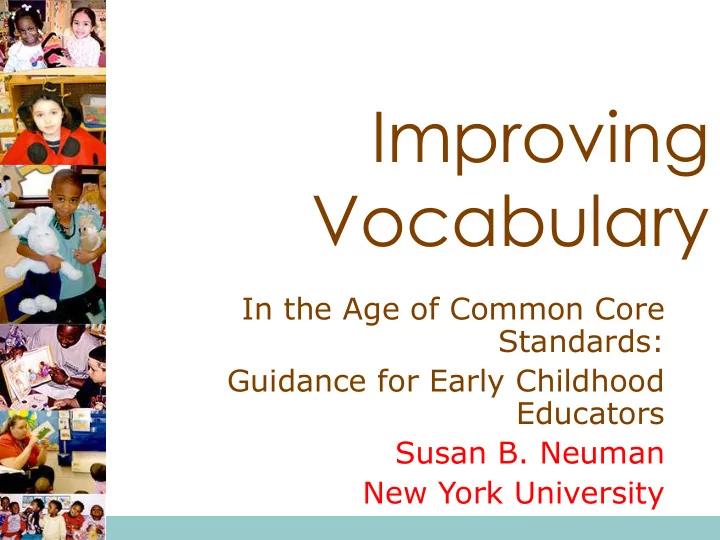
Improving Vocabulary

In the Age of Common Core Standards: Guidance for Early Childhood Educators Susan B. Neuman New York University
slide-2
SLIDE 2

Teacher’s College Press, 2013

slide-3
SLIDE 3

Tip of the iceberg

slide-4
SLIDE 4

All about words

  • Knowledge
  • Symbolic representations
  • Build concepts
slide-5
SLIDE 5

Relation to

  • ther skills
  • Vocabulary is THE strongest predictor
  • f children’s achievement
  • Not only in elementary school but in high

school

slide-6
SLIDE 6

Risk factors

  • Children of poor, marginalized

populations

  • Children of families who speak a

language other than English

  • Mother’s education
slide-7
SLIDE 7

Hart and Risley…

slide-8
SLIDE 8

Poverty

slide-9
SLIDE 9

NAEP 2012

slide-10
SLIDE 10

Common Core Standards

  • Cumulative model of expectations
  • Academic Vocabulary
  • Building knowledge through texts
  • Creating cross-textual experiences
  • Integrating technology and print
  • A focus on evidence
slide-11
SLIDE 11

NAEP 2012

slide-12
SLIDE 12

Poll question

slide-13
SLIDE 13

Common myths

  • Children are ‘word sponges’
  • They learn words through activities
  • Storybook reading
  • “I do it all the time”
slide-14
SLIDE 14
  • No. of words

children will need to know

  • The numbers are larger than you can

imagine

slide-15
SLIDE 15

Key principles

  • Children will need explicit AND implicit

instruction

  • Explicit: A ‘cave’ is a hole in the

mountain”

  • As opposed: What is a cave?
slide-16
SLIDE 16

Key principle

  • Be intentional in our word selection
  • Words from core reading program
  • Platypus
  • Around
  • OR:
  • Ride
  • move
  • Question: are these words important?
slide-17
SLIDE 17

Knowledge networks

  • INSTEAD: insects, antennae, segments,

legs

  • Parts of the body: brain, heart, lungs
slide-18
SLIDE 18

Key principle

  • Camouflage
  • Habitat
  • Survival
slide-19
SLIDE 19

Key principle

  • Ongoing professional development
slide-20
SLIDE 20

Poll question

slide-21
SLIDE 21

Creating a vocabulary rich environment

slide-22
SLIDE 22

Creating cozy spots for reading

slide-23
SLIDE 23

curiosity

slide-24
SLIDE 24
slide-25
SLIDE 25

Oral language

  • Purposeful talk: Why do you think?
  • Challenging words: meterologist
  • Extend and clarify
  • “Taking it up a notch”
  • Compare/contrast
  • If/then
slide-26
SLIDE 26

Eye to eye instruction

slide-27
SLIDE 27

Building vocabulary

  • Implicit instruction
  • Explicit instruction
slide-28
SLIDE 28

Poll question

slide-29
SLIDE 29

Building vocabulary

  • The problem
  • “A space probe is an unpiloted spacecraft that

leaves Earth’s orbit to explore the Moon, planets, asteroids, comets, or other objects in outer space as directed by onboard computers and/or instructions sent from Earth.”

  • Grade 6 text
slide-30
SLIDE 30

Difficult words

  • ‘asteroid’
  • ‘comet’
  • ‘Atmospheric conditions’
  • ‘space probes’
  • What is similar about them?
slide-31
SLIDE 31

thematic vs. categories

  • Traditionally, much instruction has

been designed around themes

food cart grocery store cash register

slide-32
SLIDE 32

thematic vs. categories

  • We teach children words and content

in categories

living things mosquito insect moth wasp alligator reptile

slide-33
SLIDE 33

Difficult words

  • Not necessarily ‘tier II’ words
  • Not necessarily ‘academic’ words
  • Rather they are ‘content-specific’

words: words that are essential for learning content

  • STEP 1
slide-34
SLIDE 34

An example

  • Plants
  • Stems, petals, leaves,
  • Photosynthesis; oxygen and carbon

dioxide

  • All about me
  • Heart, lung, brain, blood
slide-35
SLIDE 35

How do we go about teaching vocabulary?

  • A common teaching sequence
  • Identify words: 8-10
  • Child-friendly definition
  • “A dolphin is a marine mammal. It looks

like a fish but it has lungs and breathes air just like us”

  • STEP 2
slide-36
SLIDE 36

Step 3

  • Give children many opportunities for

guided practice.

  • Pictures; rhymes; riddles;
  • Call and response techniques
slide-37
SLIDE 37

Step 4

  • Distributed review
  • Over learning
  • Weekly, monthly, and over time
slide-38
SLIDE 38

Step 5

  • Progress monitor
slide-39
SLIDE 39

New words

slide-40
SLIDE 40

To summarize

  • Teach content-rich words (5-step series)
  • +
  • Make sure these words are related in

categories (to form a semantic network)

  • =
  • SELF TEACHING DEVICE
  • Ex: Is a spider an insect? A spider has 8

legs, and all others have 6, so it is not a spider

slide-41
SLIDE 41

Materials to use

  • Text sets
slide-42
SLIDE 42

Features of text sets

  • Focus on a topic of interest
  • A series of books that use multiple

genre

  • Pattern books or predictable books
  • Narrative nonfiction
  • Informational
slide-43
SLIDE 43

Activities

  • Daily readings of books in text sets
  • Start with predictable books (gives

children the names they can remember)

  • Move on to narrative nonfiction; spend

at least two times a week reading these books

  • Turn to Information books
slide-44
SLIDE 44

Why is it powerful?

  • Supports word knowledge and

conceptual development

  • Enables children to develop ‘inter-

textual links’ as they compare and contrast across genres

  • Helps them to learn the ‘features of

information books.’

slide-45
SLIDE 45

Evidence

slide-46
SLIDE 46

Poll question

slide-47
SLIDE 47

Reducing disparities

  • Principles:
  • The notion of acceleration
  • Content-rich vocabulary
  • Organization of word knowledge
  • Use of text sets
  • Gradual release of control
  • Lots of practice and distributed review
  • Don’t be afraid of challenging students;

they love it!

slide-48
SLIDE 48

Poll Question

slide-49
SLIDE 49

Contact information

Book: All About Words (Teachers ’College Press, 2013) Project Website: http://readytolearnresearch.org/ Contact: Prof. Susan B. Neuman Email: sbneuman@nyu.edu