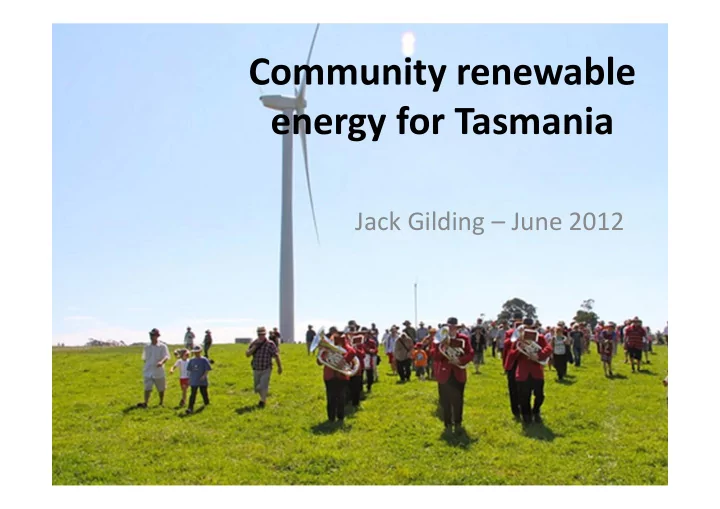
Community renewable energy for Tasmania Jack Gilding June 2012 - - PowerPoint PPT Presentation

community renewable energy for tasmania
SMART_READER_LITE
LIVE PREVIEW

Community renewable energy for Tasmania Jack Gilding June 2012 - - PowerPoint PPT Presentation

Community renewable energy for Tasmania Jack Gilding June 2012 Overview The Hepburn Wind experience The potential for community energy Tasmanias competitive advantages Challenges for community energy Support mechanisms


slide-1
SLIDE 1

Community renewable energy for Tasmania

Jack Gilding – June 2012

slide-2
SLIDE 2

Overview

  • The Hepburn Wind experience
  • The potential for community energy
  • Tasmania’s competitive advantages
  • Challenges for community energy
  • Support mechanisms
slide-3
SLIDE 3

Hepburn Wind

  • Scaled to local area: 2 turbines, 4.1 MW total
  • Co-operative model
  • 1900+ members raised $9.7 m
  • $13.5 m project
  • Wholesale and retail arrangements with Red

Energy

  • Created 3 jobs + upskilled many locals
  • 25 year sustainability dialogue
slide-4
SLIDE 4

Success factors

  • Community engagement
  • Stubbornness / commitment
  • Developer support (FE)
  • Government support (SV)
  • Professionalism
  • board members and staff
slide-5
SLIDE 5

Lessons learnt

  • Dynamics of fund-raising
  • seed capital
  • risk and reward stages
  • Administrative support
  • moving beyond volunteer capacity
  • Grid connection
  • need early professional advice
slide-6
SLIDE 6

The potential of community energy

  • Community action the origin of

the modern wind industry – Twindkraft 1978

  • In 2000, individual and

community owned wind turbines 84% of Danish wind power capacity

  • Embark submission 2009:

government investment of $100m could support the development of 100 CRE projects over 10 years.

slide-7
SLIDE 7

Benefits of community renewable energy

  • Taps the energy and enthusiasm of

communities

  • Demonstrates grass roots action on climate

change

  • Creates sense of pride in ownership
  • Provides an avenue for education about

energy issues

slide-8
SLIDE 8

Economic benefits of community renewable energy

  • Taps sources of capital not available to

commercial projects

  • Provides local economic development
  • pportunities in rural communities
  • Greater local retention of benefits
  • Can develop energy resources that are viable

but too small for utility scale development

  • Grid benefits of embedded generation
slide-9
SLIDE 9

Tasmania’s competitive advantages

  • Physical potential for renewable energy

– wind, hydro, solar, biomass, wave, tidal

  • Supportive government policies

– Tasmanian Renewable Energy Industry Development Board – Economic Development Plan

  • Skills base

– State owned enterprises, Hydro, Entura, Aurora – Small and medium scale businesses and consultancies

  • Existing projects

– King and Flinders Islands, Platypus hydro, Glenorchy landfill gas

  • Potential as an exporter of renewable energy via Basslink

– Builds on Tasmania’s ‘clean green’ image

slide-10
SLIDE 10

Challenges for the development of CRE

  • Grid connection costs and uncertainties
  • Energy sales issues (PPA, feed in tariffs, etc)
  • Choice of appropriate organisational and

financial structures

  • Regulatory issues (eg planning)
  • Economic externalities
slide-11
SLIDE 11

Support mechanisms

  • Embark
  • Emergence of a national sector
  • Tasmanian support project
slide-12
SLIDE 12

Embark

  • Founded out of the Hepburn

experience

  • Supporting the community

energy sector

  • Extensive advice and case

studies

  • Creating positive local

examples www.embark.com.au

slide-13
SLIDE 13

Emergence of a national sector

  • Diverse projects

– Wind: Mt Alexander Wind, New England, Freemantle – Warburton hydro – Canberra community solar – Yarra ranges solar

  • Established Google group for info sharing
  • Planning national conference and advocacy
  • rganisation
slide-14
SLIDE 14

Tasmanian support project

  • Being developed by pitt&sherry
  • 12 months project

– collaboration with other agencies

  • state and local government, regional bodies,

state owned enterprises, entrepreneurs, UTas

– awareness raising through publicity, public presentations, regional workshops – identification and support of at least three community projects and development of business cases – action research and advice on key issues and barriers

slide-15
SLIDE 15

more information

Jack Gilding

www.backroad.com.au jack.gilding@backroad.com.au (0407) 486-651

www.embark.com.au