Improving Heavy Vehicle Energy Productivity a a Mark Hammond, - - PowerPoint PPT Presentation

improving heavy vehicle energy productivity
SMART_READER_LITE
LIVE PREVIEW

Improving Heavy Vehicle Energy Productivity a a Mark Hammond, - - PowerPoint PPT Presentation

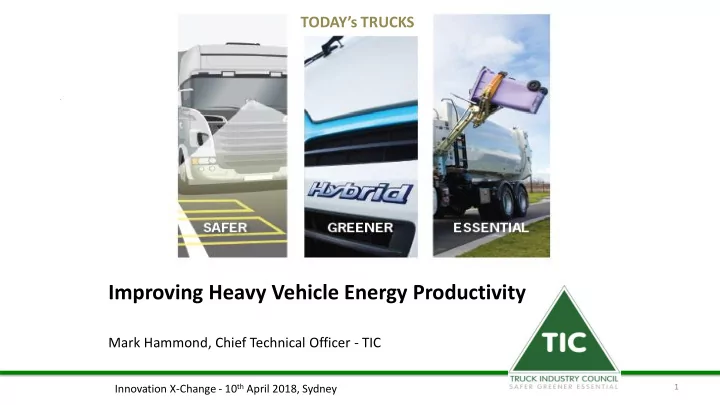
TODAYs TRUCKS Improving Heavy Vehicle Energy Productivity a a Mark Hammond, Chief Technical Officer - TIC Innovation X-Change - 10 th April 2018, Sydney 1 Who is TIC? Truck Industry Council (TIC) was formed in 2001 Industry organisation

slide-1
SLIDE 1

Innovation X-Change - 10th April 2018, Sydney

1

TODAY’s TRUCKS

Improving Heavy Vehicle Energy Productivity

a

a Mark Hammond, Chief Technical Officer - TIC

slide-2
SLIDE 2

Who is TIC?

Truck Industry Council (TIC) was formed in 2001 Industry organisation representing the truck manufacturers and importers in Australia Positioning Statement:

“Today’s Trucks: Safer, Greener, Essential”

8 Corporate Members,  17 truck brands 5 Associate Members (engine & major system suppliers) In 2017 TIC members supplied over 99% of all on-road trucks sold in Australia

Today’s Trucks: Safer, Greener, Essential 2

slide-3
SLIDE 3

Our Members

Today’s Trucks: Safer, Greener, Essential 3

slide-4
SLIDE 4

Today’s Trucks: Safer, Greener, Essential 4

The Future

slide-5
SLIDE 5

Today’s Trucks: Safer, Greener, Essential 5

The Future

slide-6
SLIDE 6

Today’s Trucks: Safer, Greener, Essential 6

The Future

slide-7
SLIDE 7

Today’s Trucks: Safer, Greener, Essential 7

The Future

slide-8
SLIDE 8

Today’s Trucks: Safer, Greener, Essential 8

The Future

slide-9
SLIDE 9

Today’s Trucks: Safer, Greener, Essential 9

The Future

slide-10
SLIDE 10

Heavy Vehicle Energy Productivity

Energy Productivity is the relationship between economic

  • utput and energy used (COAG 2015)

For trucks, moving MORE freight with LESS energy

Today’s Trucks: Safer, Greener, Essential 10

slide-11
SLIDE 11

Heavy Vehicle Operator Productivity

MUST consider Operator Productivity (financial bottom line $) Linehaul operations +250,000km/year ($):

Fuel costs, Driver wages…………………………………..Other

Urban distribution ($):

Driver wages…………………………………….Vehicle cost, Fuel costs….Other

Australian operator’s don’t like buying new trucks:

➢ Australia’s average truck fleet age is 14.0 years (Europe ~7 years) ➢ Alternate energy trucks made up 0.1% of new truck sales in 2017

Today’s Trucks: Safer, Greener, Essential 11

slide-12
SLIDE 12

Heavy Vehicle Energy Productivity

TIC has modeled 7 Energy Productivity strategies:

  • A. Additional 500kg Front + Rear axles
  • B. Incentivise fuel efficient trucks
  • C. Night-time deliveries (urban trucks)
  • D. Incentivise zero-emission urban trucks
  • E. A-Double / B-Triple vehicles for linehaul
  • F. B-Doubles replacing Semi-trailers
  • G. More High Productivity Vehicles

Today’s Trucks: Safer, Greener, Essential 12

slide-13
SLIDE 13

Heavy Vehicle Operator Productivity

These 6 offer Operator Productivity benefits too:

  • A. Additional 500kg Front + Rear axles
  • B. Incentivise fuel efficient trucks
  • C. Night-time deliveries (urban trucks)
  • D. Incentivise zero-emission urban trucks
  • E. A-Double / B-Triple vehicles for linehaul
  • F. B-Doubles replacing Semi-trailers
  • G. More High Productivity Vehicles

Today’s Trucks: Safer, Greener, Essential 13

slide-14
SLIDE 14

Heavy Vehicle Operator Productivity

These 3 offer STAND OUT Energy and Operator benefits:

  • A. Additional 500kg Front + Rear axles
  • B. Incentivise fuel efficient trucks
  • C. Night-time deliveries (urban trucks)
  • D. Incentivise zero-emission urban trucks
  • E. A-Double / B-Triple vehicles for linehaul
  • F. B-Doubles replacing Semi-trailers
  • G. More High Productivity Vehicles

Today’s Trucks: Safer, Greener, Essential 14

slide-15
SLIDE 15

More Axle Mass

Key assumptions:

➢ 500kg Front + 500kg Rear more axle mass on new trucks >15t GVM ➢ 65% of the trucks fleet is MASS constrained ➢ New trucks with advanced safety features (beyond current regulations)

  • Eg. AEBS & LKAS

+500kg = 17t +500kg = 7t +500kg = 9.5t +500kg = 7t

Today’s Trucks: Safer, Greener, Essential 15

slide-16
SLIDE 16

More Axle Mass

Benefits:

✓ Readily Deployable Technology ✓ Increased heavy vehicle safety ✓ Energy Productivity saving would lead to 0.9Mt less CO2/year ✓ Operational Benefits of up to $390 Million/year

Speed bumps:

❖ State Government’s control axle mass limits and do not currently support change

Today’s Trucks: Safer, Greener, Essential 16

slide-17
SLIDE 17

Key assumptions:

➢ 30% of the existing linehaul movements would be replaced by A- Double and/or B-Triple vehicles ➢ New Prime movers with advanced safety features (beyond current

regulations) Eg. AEBS & LKAS

➢ Current axle mass limits

Today’s Trucks: Safer, Greener, Essential 17

A-Doubles and B-Triples

Semi-trailer B-Double B-Triple A-Double

slide-18
SLIDE 18

Benefits:

✓ Readily Deployable Technology ✓ Less linehaul trucks on our highways ✓ Increased heavy vehicle safety ✓ 93% and 32% mass increase vs Semi-trailer and B-Double ✓ 100% and ~28% volume increase vs Semi-trailer and B-Double ✓ Energy Productivity saving would lead to 1.7Mt less CO2/year ✓ Operational Benefits of up to $727 Million/year ✓ Less pavement (road) damage

Speed bumps:

❖ State Government road infrastructure (principally some bridges) ❖ State Government’s control dimensional limits and don’t support change ❖ Negative public perception (bigger trucks)?

Today’s Trucks: Safer, Greener, Essential 18

A-Doubles and B-Triples

slide-19
SLIDE 19

Key assumptions:

➢ NSW-RMS data shows that 50% of heavy vehicle combinations running between Sydney and Melbourne are Semi-trailers ➢ 50% of the existing linehaul Semi-trailer combinations would be replaced by B-Double vehicles ➢ Current axle mass limits

Today’s Trucks: Safer, Greener, Essential 19

B-Doubles replacing Semi’s

Semi-trailer B-Double

slide-20
SLIDE 20

Benefits:

✓ Less heavy vehicle combinations on our highways ✓ B-Doubles are 30% less likely to be involved in a major crash than a Semi ✓ 45% mass increase vs Semi-trailer ✓ ~42% volume increase vs Semi-trailer ✓ Energy Productivity saving would lead to 1.3Mt less CO2/year ✓ Operational Benefits of up to $554 Million/year ✓ Less pavement (road) damage

Speed bumps:

❖ National B-Double registration charges 3 times higher than a Semi-trailer ❖ Smaller operators struggle to fully load a B-Double combination ❖ Negative public perception (more “big” trucks)?

Today’s Trucks: Safer, Greener, Essential 20

B-Doubles replacing Semi’s

slide-21
SLIDE 21

TIC’s National Truck Plan

TIC will be releasing the 2018 edition of our National Truck Plan within the next 2 months:

➢ Update of the age of the Australia truck fleet ➢ Fully detail all 7 Energy Productivity scenarios ➢ New Heavy Vehicle safety improvements and technologies ➢ Avoided health cost benefits of retiring older more polluting trucks ➢ Review global incentive schemes and propose Federal and State Government initiatives

Today’s Trucks: Safer, Greener, Essential 21

slide-22
SLIDE 22

Contact Details

Mark Hammond Chief Technical Officer, The Truck Industry Council M: 0408 225 212 E: m.hammond@truck-industry-council.org Web: www.truck-industry-council.org

Today’s Trucks: Safer, Greener, Essential 22