
SLIDE 1
Vehicle Idling
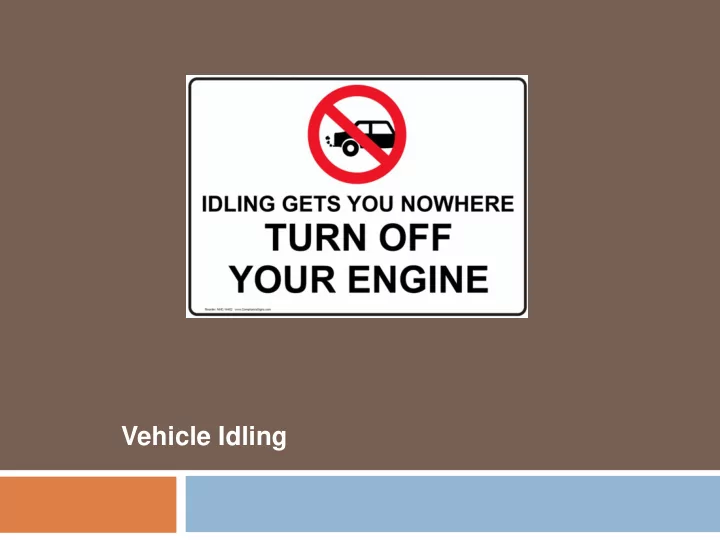
Vehicle Idling What is idling? Legal definition : Idling means the - - PowerPoint PPT Presentation
Vehicle Idling What is idling? Legal definition : Idling means the operation of the engine of a Boat, Motor Vehicle or Commercial Vehicle while the Boat, Motor Vehicle or Commercial Motor Vehicle is not in motion and not being used to
Vehicle Idling
Legal definition: Idling means the operation of
the engine of a Boat, Motor Vehicle or Commercial Vehicle while the Boat, Motor Vehicle or Commercial Motor Vehicle is not in motion and not being used to operate auxiliary equipment that is essential to the basic function
Vehicle.
Or: leaving your car engine running when
parked
Canadian motorists idle an average of 6 to 8
minutes a day.
40 % less in the summer.
Needless idling of vehicles...
Harms the Environment Contributes to Climate Change Impacts Human Health Wastes Money
An operating vehicle emits several different
criteria air contaminants (CACs) such as;
Volatile Organic Compounds (VOCs) Carbon Monoxide (CO) Nitrogen Oxides (NOx) Carbon Dioxide (CO2) Particulate Matter Plus more
Image courtesy of the Citizens Environmental Alliance
The Ontario Medical Association estimated
that in Essex County there were:
260 premature deaths 900 hospital admissions 2,750 emergency room visits
associated with poor air quality
Source: Region of Durham
Traffic related air pollution has been associated
with adverse cardio respiratory effects, including asthma.
Studies in the Netherlands and California
indicated that children exposed to higher levels
are at an increased risk of developing asthma.
Source: Portland , OR
5 10 15 20 25 30 35 8:59 9:05 9:11 14:00 14:06 14:12 14:18 14:24 14:30 14:36 14:42 14:48 14:54 15:00 15:06 15:12 15:18 15:24 15:30 15:36 15:42 15:48 15:54 NO (ppb)
Morning Student Dropoff Afternoon Student Pickup
Source: Vehicle Idling outside schools “ February 28th, presented at the Upwind/Downwind Conference Hamilton. Dr. Corr”
Air Pollution
Time Nitrogen Oxides Concentrations (ppb)
Ontario introduced the Air Quality Health Index
(AQHI) to help the public determine the health based risk associated with various levels of air pollution.
Source: City of Fort Collins, Colorado
Climate Change is the long-term
change in weather patterns
The evidence is clear. Rising
global temperatures have been accompanied by changes in weather and climate.
Over the past century, human
activities which burn fossil fuels like oil have released large amounts of carbon dioxide (CO2) and other greenhouse gases into the atmosphere.
Greenhouse gases act like a
blanket around Earth, trapping energy in the atmosphere and causing it to warm.
DID YOU KNOW that if every driver in Windsor
avoided idling for 3-minutes a day, the city would prevent 13,000 tonnes of CO2.
Every litre of gasoline burned, 2.3 kg of CO2 is
emitted (2.7 kg for diesel)
No technology exists for eliminating CO2
emissions.
Calculating CO2 emissions from a gasoline car
CO2 emitted = L gasoline x # vehicles x idling time x days x 2.3 kg CO2 min L CO2 emitted = 0.03 L x 172000 vehicles x 3 mins x 365 days x 2.3 kg CO2 min L CO2 emitted = ~ 13,000 tonnes
To capture that amount of
Carbon we would need to plant 336, 910 trees.
Or a forest 20 times the size
Complex.
US EPA Greenhouse Gas Equivalency Calculator
In 2014, approximately $372.5 million dollars was
spent on gasoline and diesel fuels within the City
If every vehicle reduced idling by 3 minutes a day,
we would save $5.65 million a year.
Natural Resources Canada identifies that
idling for over 10 seconds uses more fuel and produces more CO2 than restarting the engine.
To balance additional factors
such as wear and tear on car parts idling more than 60 seconds is not recommended.
and 1 multiple choice
Idling wastes fuel and money
Idling wastes fuel and money
With the advanced emissions
With the advanced emissions
Idling contributes to Climate
Idling contributes to Climate
In the winter, the best way to
In the winter, the best way to
Energy Myths -- Do You Have To Warm Up Your Car?
It is good practice to shut off
It is good practice to shut off
I should turn my engine off
I should turn my engine off
Making sure it’s safe to drive
Making sure it’s safe to drive
13 % of all Canadian kids have
13 % of all Canadian kids have
Which of the following are reported in a
cross-Canada survey for the most common reasons why Canadians idle?
a) Warming up a vehicle b) Sitting in drive-through lanes c) Stopping to talk to a friend d) Waiting for someone e) All the above
Which of the following are reported in a
cross-Canada survey for the most common reasons why Canadians idle?
a) Warming up a vehicle b) Sitting in drive-through lanes c) Stopping to talk to a friend d) Waiting for someone e) All the above
The City of Windsor was among one of the first
municipalities in Ontario to enact a by-law to prohibit the excessive idling of vehicles and
2001.
This by-law is in the process of being updated,
and is expected to prohibit the idling of vehicles beyond 3 minutes.
Signs are installed to
encourage drivers to turn off their vehicles in known areas of excessive idling.
School Education
resources have been created
Photo Source: Windsor Star
Educate students about the environmental,
health and financial costs of idling
Review the Idle Free Campaign Kit to find a
number of great ways to engage the school community about idling
If Idling is an issue at your school, contact the
City of Windsor about getting a free sign.
Don’t idle Spread the word about idling
Natural Resources Canada – Idle Free Zone
(http://www.nrcan.gc.ca/energy/efficiency/communiti es-infrastructure/transportation/idling/4397)
US Environmental Protection Agency – Idle Free
Schools – (https://www.epa.gov/region8/idle-free- schools)
US Environmental Protection Agency – A
Student’s Guide to Global Climate Change – (https://www3.epa.gov/climatechange/kids/basics/in dex.html)
City of Windsor – Environmental Master Plan
(www.windsorenvironmentalmasterplan.ca)
Canadian Environment and Climate Change
Air Quality Health Index (http://www.ec.gc.ca/cas- aqhi/default.asp?lang=En&n=CB0ADB16-1)
Citizens Environmental Alliance
(http://www.citizensenvironmentalliance.org/idlefr ee/resources.html#Anti-Idling Info)
NASA Climate Kids
(http://climatekids.nasa.gov/menu/weather-and- climate/)