SLIDE 1 Improving HCAHPS with a “Culture of Quiet”
- St. Francis Hospital (Puget Sound)
"Culture of Quiet” innovations:
- Added padding on doors
- Dimmed overhead hallway lights
and nursing station lights
- Changed wheels on rolling
equipment
- Placed signs on the entry doors
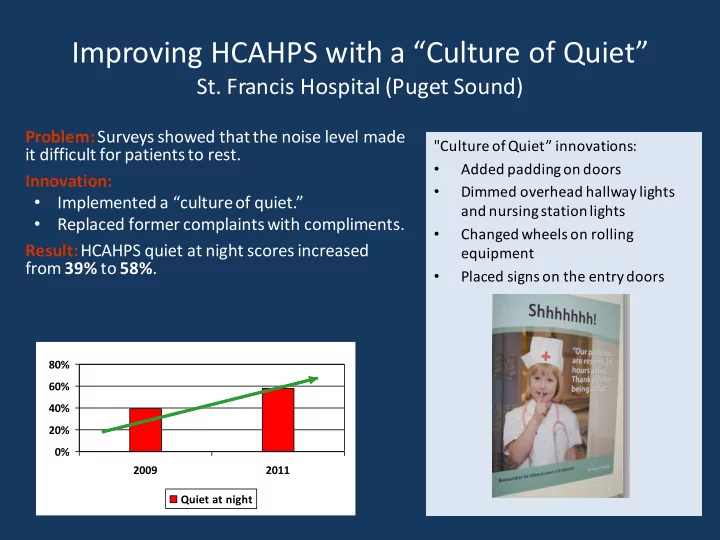
0% 20% 40% 60% 80% 2009 2011 Quiet at night
Problem: Surveys showed that the noise level made it difficult for patients to rest. Innovation:
- Implemented a “culture of quiet.”
- Replaced former complaints with compliments.
Result: HCAHPS quiet at night scores increased from 39% to 58%.
SLIDE 2 Reduced Infection Erie County Medical Center (Western New York)
Reduced potential for infection by increasing IV tube labeling from
65% to 100%.
0% 20% 40% 60% 80% 100% Before After
SLIDE 3 Patient and Family Council Increases HCAHPS Scores
Mercy Health Anderson Hospital (Cincinnati) “As part of the Patient Family Council, I can relate my experiences – both the positive and the less-than-completely satisfied – to hospital personnel and know that my input will help improve the care and service the hospital is providing.”
HCAHPS scores increased over 20% in:
- Communication with nurses
- Help from hospital staff
- Pain control
- Definitely recommend hospital
How we did it: Implemented a patient and Family Council, bringing together
- patients/families,
- volunteers,
- hospital leaders,
- nurses, and
- other department
representatives.
SLIDE 4 Reduction in Readmission Rates
Southern Maine Medical Center (Maine) Innovations:
– Standardize multidisciplinary rounds – Schedule appointments at time of discharge – Conduct discharge calls to patients within 24-36 hours
SLIDE 5
Round of Applause Congratulations to Erie County Medical Center (Western New York) for submitting an article on “Family Initiated Rapid Response” to American Nurse Today.
SLIDE 6 “For me as a leader, I consider TCAB a survival tool that is worth the investment.”
Jacquelyn Nefstead, RN, ONC Ministry Good Samaritan Health Center Wisconsin
SLIDE 7 Nurses Increase Patient Safety and Team Vitality
York Hospital (South Central Pennsylvania)
Problem: Nurses were concerned about patient assignments and the provision of safe care. Innovation: Developed a patient acuity tool to: – Predict nursing time needed for each patient – Make staffing assignments Results: – Team vitality scores increased to 94% – Assignments based on patient needs
What nurses say: “Now I feel like I know where the sick patients are-where the help is needed.”-RN “Now I understand why some areas were getting more ancillary help, and why some were fine with very little. Sometimes I would get frustrated before I could even ask, now everyone gets informed.”-NA “I just want to know that it’s fair… I want to give my patients the best care, and I never want them to fall, because I don’t have enough help.”- RN
SLIDE 8 Satisfaction with Call Button Response Time
Lovelace Westside Hospital (Albuquerque)
In purposeful hourly rounding, nurses:
hour
meet patient needs
- Resolve issues
- Ask patients what
they need
HCAHPS Question: Prompt response to call button
20 40 60 80 100 1st Qtr 3rd Qtr
SLIDE 9 Multidisciplinary Discharge Planning at the Bedside
- St. Mary’s Hospital (Maine)
Multidisciplinary rounding to increase patient and family involvement in discharge planning has had an overwhelmingly positive patient response. “…Patients appreciate the involvement in their plan of care. It gives them additional
- pportunities to understand the
diagnosis they are dealing with and collaborate with providers.”
SLIDE 10
Round of Applause Congratulations to Eastern Maine Medical Center (Maine) for having a poster on “TCAB Return on Investment” at the Nursing Economic$ Summit in June
SLIDE 11 Lowest Fall Rates in the City
Mercy Health Anderson Hospital (Cincinnati)
In February 2012, Mercy Health Anderson Hospital was recognized as having the lowest fall rate in the city!
They attribute their success to their participation in TCAB and spreading successful innovations for decreasing falls hospital-wide.
SLIDE 12
Improved Staff to Staff Communication
Wisconsin
SLIDE 13 Pneumococcal Vaccination Rates
Lovelace Medical Center (Albuquerque)
Problem: Process for screening and vaccinating patients was not reliable. Innovations:
- Developed standardized admission
form to screen patients
Results:
- Pneumococcal vaccination rates
increased from 48% to 98%
- Process spread hospital-wide
0% 10% 20% 30% 40% 50% 60% 70% 80% 90% 100% Before After Before After
SLIDE 14 Voluntary RN Turnover
Medina Memorial Hospital (Western New York)
Innovation:
satisfaction
nurses in the TCAB process
Reduced Voluntary RN Turnover
1 2 3 4 5 6 Dec-10 Jan-11 Feb-11 Mar-11 Apr-11 May-11 Jun-11 Jul-11 Aug-11 Sep-11 Oct-11 Nov-11 Dec-11
- Decreased nurse turnover rate from 7 FTEs per year to 1 FTE.
SLIDE 15
Round of Applause Congratulations to Medina Memorial Hospital (Western New York) for submitting an article on “Spreading TCAB to the Operating Room” to The American Journal of Nursing.
SLIDE 16
SLIDE 17 Pressure Ulcer Prevention
Sinai-Grace Hospital (Detroit)
Innovation: 2 staff members conduct a skin assessment upon admission. Results: A 94% decrease! Decrease from 34.7 per month to 2 per month.
Pressure Ulcers
5 10 15 20 25 30 35 40 Nov-09 Dec-09 Jan-10 Feb-10 Mar-10 Apr-10 May-10 Jun-10 Jul-10 Aug-10 Sep-10 Oct-10 Nov-10 Dec-10 Jan-11 Feb-11 Mar-11 Apr-11 May-11 Jun-11 Jul-11 Aug-11 Sep-11 Oct-11 Nov-11 Dec-11 Jan-12 Feb-12 Mar-12 Apr-12 May-12 Jun-12 Jul-12
Staff Comments:
people looking.”
care immediately.”
accurate and provides better care.”
SLIDE 18
Saving Time at Admission
Lovelace Westside Hospital (Albuquerque)
Saved 4.5 hours of nurse time per month with Patient Welcome Bags. Impact: More time to spend with patients.
SLIDE 19
Olmsted Medical Center (Minnesota) featured in the PostBulletin (Rochester, MN)
SLIDE 20
Round of Applause Congratulations to St. Francis Hospital (Puget Sound), for submitting an article on “Spreading the Principles of Effective Nurse-Led QI” to MEDSURG Nursing.
SLIDE 21
Increased Patient Satisfaction Scores
Medina Memorial Hospital (Western New York)
By regularly updating patient whiteboards, patient satisfaction scores in response to the question “Did nurse listen and communicate respectfully with you?” increased over 10%.
SLIDE 22 Decrease in Incidental Overtime
McLaren-Macomb (Detroit)
10 20 30 40 50 60 Hours of Overtime
Innovation: Standardized change of shift report. Result: Decreased incidental overtime from 53.75 hours per month to 36.5 hours per month.
SLIDE 23 Oregon
PATIENT & FAMILY-CENTERED TCAB INNOVATIONS
- Meal Coupons for New Dads: Provide meal coupons for hospital
cafeteria to new dads so they don’t need to leave their new family.
- Special Care Area: Created a special wing for patients who are confused,
noisy, or at high risk for falls. This allows staff to watch them more carefully while reducing disruption to other patients.
- NASCAR Admit: Developed a process called the NASCAR admit to
streamline the admission process for patients.
SLIDE 24
Lost Equipment
McLaren-Macomb (Detroit)
Problem: Misplaced and lost heart monitors Innovation: Labeled and assigned heart monitors to each patient room. Results: Money saved: $4500 Time saved: Priceless
SLIDE 25
Round of Applause Congratulations to Medina Memorial Hospital (Western New York) for having a poster on “The Business Case for TCAB” at the Nursing Economic$ Summit in June.
SLIDE 26 Reduced Waste
Ministry Good Samaritan Health Center (Wisconsin)
Zone marks an area in patient room where gowns or gloves are not required.
– Saves time – Saves money – Increases interaction with patients
# of gowns used prior # of gowns used post Time Saved Patient #1 18 6 42 min Patient #2 11 6 42 min Patient #3 114 44 308 min Patient #4 11 8 56 min Patient #5 5 3 21 min Patient #6 11 5 35 min Totals 170 72
8.4 hours
SLIDE 27
TCAB featured in Wisconsin Hospital Association Newsletter:
SLIDE 28 Medication Safety
Olmsted Medical Center (Minnesota) Innovation: Moved supplies out of the medication room to reduce interruptions to nurses. Results: Decreased medication variation from 72% to 23%.
0% 10% 20% 30% 40% 50% 60% 70% 80% 90% 100% Pre Relocation Post Relocation
SLIDE 29
Round of Applause Congratulations to MultiCare Tacoma General Hospital (Puget Sound) for submitting an article on “Bedside Shift Report” to American Nurse Today.
SLIDE 30 Increased Patient Safety
Spectrum Health System – Gerber Memorial Hospital (West Michigan)
A “no interruption zone” in front of the medication preparation area has decreased the number of interruptions and medication errors.
SLIDE 31 Decrease in End of Shift Overtime
- St. Francis Hospital (Puget Sound)
Bedside reporting decreased End of Shift overtime and saved $32,000.
SLIDE 32 Increased Time at the Bedside
Redington-Fairview General Hospital (Maine)
time spent looking for admission supplies
set-up checklist to include:
– Patient supplies – IV pole/pump – Correct bed
SLIDE 33 “I’ve been a nurse for 33 years, and I think this has been one of the best things I’ve seen as far as giving front-line staff a voice.”
Sheri Peters, Olmsted Medical Center, Minnesota
SLIDE 34
Round of Applause
Congratulations to York Hospital (South Central Pennsylvania) for having a poster on “Acuity-based Staffing: Using our Best to Accomplish the Most” at the National Orthopedic Nurses Congress in May.
SLIDE 35 Reduced Waste
Gettysburg Hospital (South Central Pennsylvania) Problem: Wasted time spent “hunting and gathering” for equipment and supplies. Innovation: Used LEAN process principles to organize space, supplies and equipment on the unit.
Before After
SLIDE 36 Reduced Infection by Increasing Handwashing McLaren-Macomb (Detroit) Innovation:
– Handwashing education poster – Handwash signs in every patient room
0% 20% 40% 60% 80% 100% 120% Before After Handwashing
SLIDE 37 Improved Communication
MultiCare Tacoma General Hospital (Puget Sound) Innovation: Bedside shift report:
– Introduce
– Update the white board – Include patient and family in report
What Patients Said: “[Nurses] made sure that they knew everything that was going on. They were very thorough.” “[Nurses] let me know things that I didn’t
- know. They were very informative.”
“I always knew what the plan was.” “I knew the name of my doctors and nurses.” “They knew me as a person, not just the lady with the hip surgery.” “I will never go to another hospital.”
SLIDE 38 Involving the Whole Care Team
Erie County Medical Center (Western New York)
A unit clerk discovered
cartridges. Total cost savings = $150,000