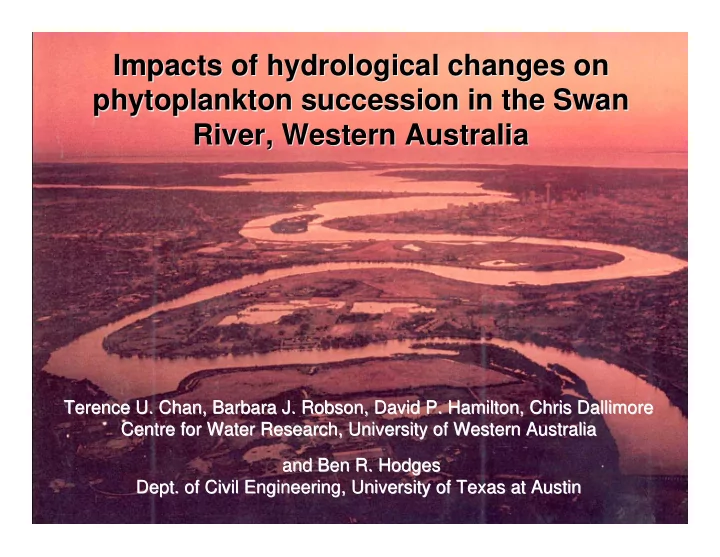
SLIDE 1 Impacts of hydrological changes on Impacts of hydrological changes on phytoplankton succession in the Swan phytoplankton succession in the Swan River, Western Australia River, Western Australia
Terence U. Chan, Barbara J. Robson, David P. Hamilton, Chris Dallimore Terence U. Chan, Barbara J. Robson, David P. Hamilton, Chris Dallimore Centre for Water Research, University of Western Australia Centre for Water Research, University of Western Australia and Ben R. Hodges and Ben R. Hodges
- Dept. of Civil Engineering, University of Texas at Austin
- Dept. of Civil Engineering, University of Texas at Austin
SLIDE 2
SLIDE 3
Upper Swan River estuary phytoplankton succession summer autumn winter spring summer Objective: determine to what extent this succession is the result of anthropogenic changes
SLIDE 4
SLIDE 5 121,000 km2
Perth
The Swan-Avon Catchment
SLIDE 6
- Extensive clearing for agriculture (~35% remains natural)
Extensive clearing for agriculture (~35% remains natural)
- Urbanization around estuary
Urbanization around estuary
- Construction of reservoirs
Construction of reservoirs
River “ “training training” ” to handle increased flows to handle increased flows
Removal of estuary sill
Hydrological Hydrological changes changes
SLIDE 7 Agricultural clearing Agricultural clearing with minimal retention with minimal retention
- f riparian zone
- f riparian zone
SLIDE 8
Perth Urban drains and groundwater intrusion dominate the summer inflows in the estuary
SLIDE 9 350 25 1.2 90% of the annual inflow
Present hydrology
SLIDE 10 Avon Avon “ “River River” ” during the during the summer summer
Catchment effects of Catchment effects of anthropogenic changes anthropogenic changes
Based on Based on LASCAM LASCAM model of model of Viney Viney and and Sivapalan Sivapalan
~ 5 fold ~ 5 fold ~ 16 fold ~ 16 fold ~ 40 fold ~ 40 fold Increased runoff due to clearing Increased runoff due to clearing Increased nutrient loads from agriculture Increased nutrient loads from agriculture Increased sediment yield Increased sediment yield
SLIDE 11 Salinity field data, Sept 26, 1995 to July 1, 1996
Salt-wedge estuary during summer in the upper reaches
Sill at 2m deepened to 14 m
SLIDE 12
“Snapshot” comparison of field data and 3D hydrodynamic model ELCOM
SLIDE 13
Computational Aquatic Ecosystem Dynamics Model CAEDYM
SLIDE 14 lines = CAEDYM/ELCOM model points = field data
SLIDE 15
field vs base case simulation
field data baseline model results
SLIDE 16
Model scenarios Model scenarios
Reduced catchment flows Reduced catchment flows Reduced nutrient loads Reduced nutrient loads Removal of reservoirs Removal of reservoirs Restoration of Fremantle sill Restoration of Fremantle sill
SLIDE 17
ELCOM model salinity results
baseline reduced catchment flows
SLIDE 18
CAEDYM- ELCOM model chlorophyte results
baseline reduced catchment flows and nutrients
SLIDE 19
baseline model results reservoirs removed model results
SLIDE 20
baseline model results reduced nutrient load model results
SLIDE 21
baseline model results reduced nutrient load and reduced flow model results
SLIDE 22
reduced nutrient load and reduced flow model results reduced nutrient load model results
SLIDE 23
Work in progress – effect of the sill on salinity
ELCOM model results baseline sill restored
SLIDE 24
Further Work Further Work
Apply longer run-up time to reduce Apply longer run-up time to reduce initialization artifacts initialization artifacts Model management targets for reduced Model management targets for reduced nutrient loads nutrient loads
SLIDE 25
Conclusions
Calibrated 3D model for water quality can capture phytoplankton succession in the Swan River estuary Anthropogenic nutrient loads have increased phytoplankton biomass Phytoplankton succession appears altered by changes in flow and loads
SLIDE 26 Acknowledgements
- Western Australian Estuarine Research
Foundation (WAERF)
- Water and Rivers Commission of Western
Australia (W&RC);
- WA Department of Transport;
- WA Department of Environmental Protection;
- Dr. David Horn
SLIDE 27
SLIDE 28
For further info contact: jackson@cwr.uwa.edu.au