Impact of Disclosures WHO 2017 and AJCC 8 th edition Shareholder - - PowerPoint PPT Presentation

impact of disclosures who 2017 and ajcc 8 th edition
SMART_READER_LITE
LIVE PREVIEW

Impact of Disclosures WHO 2017 and AJCC 8 th edition Shareholder - - PowerPoint PPT Presentation

5/26/2018 Impact of Disclosures WHO 2017 and AJCC 8 th edition Shareholder Five Prime Therapeutics and Adicet Bio on Gastropancreatic Neuroendocrine Neoplasms Consultant Celgene Grace E. Kim, MD These companies and its products will


slide-1
SLIDE 1

5/26/2018 1

Impact of WHO 2017 and AJCC 8th edition

  • n Gastropancreatic

Neuroendocrine Neoplasms

Grace E. Kim, MD

Disclosures

Shareholder

  • Five Prime Therapeutics and Adicet Bio

Consultant

  • Celgene

These companies and its products will not be discussed in this presentation

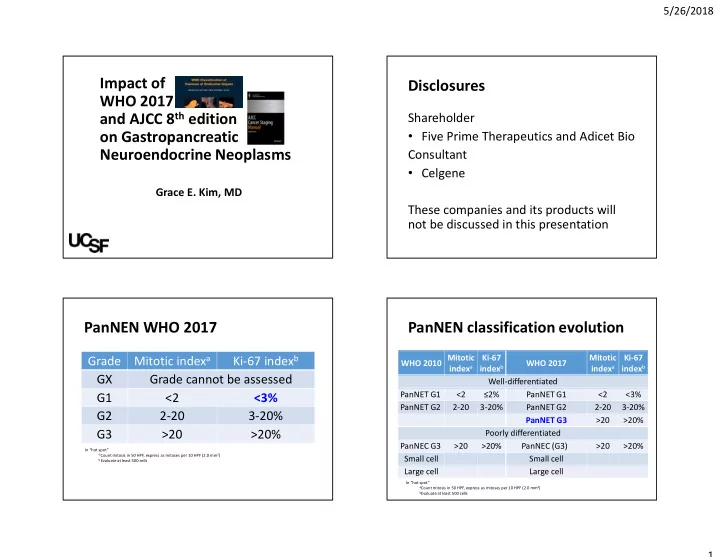
PanNEN WHO 2017

Grade Mitotic indexa Ki-67 indexb GX Grade cannot be assessed G1 <2 <3% G2 2-20 3-20% G3 >20 >20%

In “hot spot”

a Count mitosis in 50 HPF, express as mitoses per 10 HPF (2.0 mm2) b Evaluate at least 500 cells

PanNEN classification evolution

WHO 2010 Mitotic indexa Ki-67 indexb WHO 2017 Mitotic indexa Ki-67 indexb Well-differentiated PanNET G1 <2 ≤2% PanNET G1 <2 <3% PanNET G2 2-20 3-20% PanNET G2 2-20 3-20% PanNET G3 >20 >20% Poorly differentiated PanNEC G3 >20 >20% PanNEC (G3) >20 >20% Small cell Small cell Large cell Large cell

In “hot spot”

aCount mitosis in 50 HPF, express as mitoses per 10 HPF (2.0 mm2) bEvaluate at least 500 cells

slide-2
SLIDE 2

5/26/2018 2

Disease specific survival of high grade panNENs

Am J Surg Pathol. 2016; 40(9): 1192–1202.

Applicability

All gastrointestinal and pancreatobiliary tumors

  • Primary and metastasis
  • Cytology, biopsy, and surgical resection

AJCC 8th edition

Neuroendocrine chapters

  • Ampulla of Vater and Duodenum
  • Appendix
  • Colon and Rectum
  • Small intestine
  • Stomach
  • Pancreas

Neuroendocrine vs Carcinoma

Well differentiated neuroendocrine tumors (NET)

  • WHO grade G1, G2

and G3

Neuroendocrine carcinoma (NEC)

  • High grade/

poorly differentiated G3

slide-3
SLIDE 3

5/26/2018 3

Neuroendocrine Carcinoma

pT1 ≤2 cm Invades submucosa pT2 >2-4 cm Invades muscularis propria pT3 >4 cm or subserosal/ mesoappendix involvement Through muscularis propria into subserosal/mesoappendix pT4 Perforates peritoneum or directly invades adjacent

  • rgans/structures*

Invades visceral peritoneum/ serosa, directly invades adjacent

  • rgans/structures

AJCC appendix chapters

VS

*Excluding direct mural extension of adjacent bowel subserosa

AJCC colon chapters

Neuroendocrine Carcinoma

pT1 Invades lamina propria or submucosa and is ≤2 cm Invades submucosa pT2 Invades muscularis propria or >2cm Invades muscularis propria pT3 Invades muscularis propria into subserosa Through muscularis propria into pericolorectal tissue pT4 Invades visceral peritoneum (serosa) or other

  • rgans/structures

Invades visceral peritoneum or invades/adheres to adjacent

  • rgans/structures

VS

AJCC pancreas chapters

Neuroendocrine Exocrine

pT1 <2 cm* ≤2 cm pT2 2 cm - 4 cm* >2cm - ≤4 cm pT3 >4 cm* or invades duodenum/bile duct >4 cm pT4 Invades wall of large vessels

(celiac axis or SMA) or adjacent organ (stomach, spleen, colon, adrenal gland)

Involves celiac axis, SMA, and/or common hepatic artery, regardless of size

VS

*Limited to the pancreas; extension of tumor into peripancreatic adipose tissue is NOT a basis of staging

Outline

  • Ki-67 index
  • G3 pancreatic neuroendocrine

neoplasms

  • Is this a mixed neoplasm?
  • Staging appendiceal neuroendocrine

tumor

slide-4
SLIDE 4

5/26/2018 4

Outline

  • Ki-67 index
  • G3 pancreatic neuroendocrine

neoplasms

  • Is this a mixed neoplasm?
  • Staging appendiceal neuroendocrine

tumor

To count

  • Check stromal cells are negative
  • Find labeling “hot spot”
  • Evaluate at least 500 neoplastic cells
  • Report actual Ki67 index

Mod Pathol. 2016 Jan;29(1):93.

Issues with Ki67

  • Intensity can be variable
  • Due to antibody used and tissue section

thickness

  • Weak nuclear stain?
  • If near categorical cutoffs
  • Count multiple “hot spots” and obtain

average

Mod Pathol. 2015;28(5):686-94.

Figure from

WHO classification of tumours of endocrine organs. World Health Organization; 2017.

slide-5
SLIDE 5

5/26/2018 5

Surveyed colleagues WHO grade 2

Pathologist Circle + Slashes - % 28 383 6.8 Professor 1 28 383 6.8 Professor 2 32 415 7.7 Assistant Professor 3 39 499 7.8 Assistant Professor 4 30 419 7.2 Assistant Professor 5 36 425 8.4 GI Fellow 6 32 383 7.7

Which block?

Look for

  • Architectural alteration
  • Confluent growth pattern with reduced tumor stroma

and vasculature

  • Ischemic type tumor necrosis
  • Geographic, punctate, or single cell necrosis
  • Cytology changes
  • Increased nuclear size and atypia, nuclear membrane

abnormalities, chromatin clumping

  • Mitotic activity

Well-Differentiated Neuroendocrine Tumors with a Morphologically Apparent High-Grade Component: Clin Cancer Res. 2015 Feb 15;22(4):1011-7

slide-6
SLIDE 6

5/26/2018 6

Outline

  • Ki-67 index
  • G3 pancreatic neuroendocrine

neoplasms

  • Is this a mixed neoplasm?
  • Staging appendiceal neuroendocrine

tumor Pancreatic NeuroEndocrine Neoplasms (PanNEN)

Pancreatic NeuroEndocrine Carcinoma (PanNEC) G3 Pancreatic NeuroEndocrine Tumor (PanNET) G3 Both have mitotic >20/10 HPF and Ki67 >20%

Clinical parameters at ends of NEN spectrum

LG NET HG NEC Presentation Incidental finding Jaundice, weight loss, pain Imaging Octreotide scintigraphy positive 18F-FDG-PET avid Serum biomarkers ^ Neuroendocrine markers

(chromogranin-A, gastrin, etc)

^ Carcinoma markers

(CEA, CA19.9, CA125)

Clinical course Protracted

(up to 10 years before recurrence)

Rapid clinical deterioration

Treatment

NORDIC NEC study

  • Gastropancreatic NEN patients with Ki67 <55% are less

responsive to platinum agents

Emerging data

  • Both G3 panNENs respond to cytotoxic (platinum

and alkylating) agents

Predictive and prognostic factors for treatment and survival in 305 patients with advanced gastrointestinal neuroendocrine carcinoma (WHO G3): the NORDIC NEC study. Ann Oncol. 2013 Jan;24(1):152-60. Pancreas 2017 Mar;46(3):296-301.

slide-7
SLIDE 7

5/26/2018 7

Disease-specific survival (DSS) of stage-matched

Clin Cancer Res. 2016 Feb 15;22(4):1011-7

Does morphology distinguish?

WHO criteria of lung NEC

Large cell Small cell Size/shape Large, round to polygonal <3x size of small resting lymphocyte, round, oval, spindled Cytoplasm Moderate to abundant Scant, high nuclear/cytoplasmic ratio Cell border Ill-defined, prominent nuclear molding Nuclear chromatin Vesicular

Finely granular uniformly distributed “salt and pepper” or chromatin streaks

Nucleoli Prominent, presence facilitates separation from small cell NEC Absence to inconspicuous Architecture / Necrosis Organoid nesting, palisading, rosettes, trabecula in both, also small cell NEC often has sheet-like growth with large areas of necrosis; Necrosis as abundant apoptotic cells or large prominent areas

33 HG PanNEN cases

Histologically ambiguous by consensus in 20 cases (61%)

  • 1. All biopsies
  • 2. Morphology of large cell

NEC overlapped with WD NET

  • 3. One case had consensus

diagnosis of NEC was in fact WD NET

Am J Surg Pathol. 2016 Sep;40(9):1192-202.

slide-8
SLIDE 8

5/26/2018 8

Morphologic clues for G3

NET

  • Appears well differentiated, but G3 detected by Ki67
  • Co-existing or prior G1/G2 NET component
  • e.g. G1 panNET and G3 NET in liver
  • Geographic necrosis but retained organoid pattern
  • Nested, trabecular, loosely cohesive but organized vascular network

and hyalinized intratumoral fibrosis

NEC

  • Homogenous and lacks lower grade component
  • Co-existing conventional carcinoma
  • Expansile large irregular nests
  • Infiltrative, random large vessels, and desmoplastic type fibrosis

Problematic

  • No clinical history
  • Limited sample
  • Not classic small cell NEC
  • No overt low grade component (G1/G2)

Surveyed colleagues

slide-9
SLIDE 9

5/26/2018 9

Pathologist Diagnosis Ki67 Me NEN (crush) 35% Professor 1 67% Professor 2 Favor LCNEC -> NEN (crush) >50% Assistant Professor 3 WD NET G3 46% Assistant Professor 4 NEN (crush) 45% Assistant Professor 5 WD NET G3 >20% GI Fellow 6 WD NET G3 -> NEN (crush) 54%

Take home points 1.Try to count 2.Provide an actual % 3.Caveat if small or crushed sample

Cytology

Cancer Cytopathol. 2018 Feb 16. [Epub ahead of print] Cancer Cytopathol. 2018 Jan;126(1):44-53.

WD PanNET G1/G2 Plasmacytoid with round to ovoid nuclei, fine chromatin, smooth nuclear membranes PanNEC Large cell: abundant cytoplasm, large nuclei and vesicular nuclei or prominent nucleoli Small cell: nuclear molding, minimal cytoplasm, and hyperchromatic coarse, chromatin WD PanNET G3 Focally plasmacytoid can have NEC features (apoptosis/necrosis, abundant cytoplasm, large nuclei, prominent nucleoli, molding)

Denovo G3 NEN when nonplasmacytoid and has pleomorphic nuclei or abundant nucleoli requires mutational analysis

87 HG NEC tubular GI tract

  • 17/87 (20%) were neither small cell, large cell or mixed

NEC

  • “…the classic descriptions of small and large cell

neuroendocrine carcinoma in the pulmonary system does not perfectly translate to the gastrointestinal tract and the pancreatobiliary system.”

Am J Surg Pathol. 2008 May;32(5):719-31. Am J Surg Pathol. 2016 Sep;40(9):1192-202.

slide-10
SLIDE 10

5/26/2018 10

Case History

47 year old male with pancreatic NEN and bone and liver metastases status post neoadjuvant chemoradiation

Synaptophysin

slide-11
SLIDE 11

5/26/2018 11 Chromogranin Ki-67

Diagnosis?

  • Pancreatic neuroendocrine tumor
  • Well-differentiated G3 NET
  • Pancreatic neuroendocrine carcinoma
  • Large cell NEC

PanNEN genetic alterations

MEN1 DAXX/ATRX TP53 RB1 WD NET 44% 43% 4% PD NEC 56% 72%

  • Science. 2011 Mar 4;331(6021):1199-203.

Am J Surg Pathol. 2012 Feb;36(2):173-84.

slide-12
SLIDE 12

5/26/2018 12

Suggested panNEN G3 panel

DAXX / ATRX

  • Loss in 50% of G3 PanNETs

p53 / Rb

  • Abnormal expression in 92% PanNECs
  • Strong nuclear staining (>25%) or complete

absence of p53

Lack of altered protein expression not helpful Loss of ATRX Retained Rb p53

slide-13
SLIDE 13

5/26/2018 13

UCSF500 cancer gene panel

Pathogenic mutations in MEN1 and TP53

  • TP53 mutation are not exclusively found in

panNEC but rarely occur in G3 panNETs

  • Science. 2011 Mar 4;331(6021):1199-203.

Hum Pathol. 2018 Mar 26. [Epub ahead of print]

Pathology report

Pancreas, pancreaticoduodenectomy: Pancreatic neuroendocrine tumor, 7.5 cm, WHO G3 Comment: Although mitotic count of 33/10HPF and Ki-67 index

  • f 47% can be seen in G3 WD panNET and PD NEC,

the loss expression for ATRX supports the former.

  • Histopathology. 2018 Jan;72(1):168-177.

Outline

  • Ki-67 index
  • G3 pancreatic neuroendocrine

neoplasms

  • Is this a mixed neoplasm?
  • Staging appendiceal neuroendocrine

tumor

slide-14
SLIDE 14

5/26/2018 14

Case History A

57 year old man with an 8 cm pancreatic mass with focal synaptophysin and chromogranin staining. Consult question: Is this a pancreatic neuroendocrine tumor?

Left Right

slide-15
SLIDE 15

5/26/2018 15 Chromogranin Ki-67 index Trypsin

Diagnosis?

  • Neuroendocrine tumor/carcinoma
  • Acinar cell carcinoma
  • Mixed neuroendocrine-non-

neuroendocrine neoplasm (MiNEN)

slide-16
SLIDE 16

5/26/2018 16

Name change, criteria same

Mixed neuroendocrine-non-neuroendocrine neoplasm (MiNEN) previously mixed adenoneuroendocrine carcinoma (MANEC)

  • ≥30% of each components
  • Adeno-, squamous cell, or acinar cell carcinoma
  • Collision (side by side), composite

(intermingled), amphicrine (dual differentiation)

Endocr Pathol 2016:27:284-311

MiNEN

  • Morphologically recognizable as

neuroendocrine on H&E

  • Confirmed by stain(s)

Most reliable for NE differentiation

Endocr Pathol 2016:27:284-311

Synaptophysin Chromogranin Less specific More sensitive Usually diffusely positive in NET Absent/focally positive in NEC

Pathology report

Pancreas, biopsy: Carcinoma with neuroendocrine and acinar differentiation. Comment: Consistent with MiNEN; G3 neuroendocrine neoplasm and acinar cell carcinoma, but final assessment at time of resection since each component should comprise at least 30% of tumor for this designation.

Remember

  • 1. Primary PanNEN with >20% Ki-67

proliferation index -> consider trypsin stain to exclude acinar cell carcinoma

  • 2. If MiNEN -> provide all prognostic

information about the PanNEN component

  • % Ki67
  • small or large cell if NEC
slide-17
SLIDE 17

5/26/2018 17

~2% of cells immunoreactive for chromogranin

Primary colonic adenocarcinoma

Immunoreactivity for chromogranin A

  • >1 positive cells/mm2 -> 100/1170 (8.5%)
  • >2% immunoreactive cells -> 97/253

(38%)

  • >5 positive cells/mm2 -> 11/110 (10%)
  • 1-20% of tumor -> 12/54 (22%)
  • 10% of cells -> 22/56 (39%)

No uniform criterion

J Gastrointest Surg. 2014 May;18(5):968-76. Anticancer Res. 2002 Jan-Feb;22(1A):395-8.

Deduction

  • 1. 2% of colonic epithelial cells are

chromogranin positive

  • 2. MiNEN requires ≥30% NE component

Therefore 2% - 30% NE staining can be present in primary colonic adenocarcinoma with NE differentiation

J Gastrointest Surg. 2014 May;18(5):968-76. Anticancer Res. 2002 Jan-Feb;22(1A):395-8.

Is this a neuroendocrine neoplasm?

slide-18
SLIDE 18

5/26/2018 18

Synaptophysin

Case History B

79 year old women who underwent a right hemicolectomy for a right colonic mass

slide-19
SLIDE 19

5/26/2018 19 Synaptophysin

Chromogranin negative

Ki-67

Pathology report

Right colon and ileum, hemicolectomy: Mixed neuroendocrine and non-neuroendocrine neoplasm Comment: Mitosis: 23/10 HPF and Ki-67: 80% for WHO grade G3 large cell neuroendocrine carcinoma (NEC) No adenocarcinoma but NEC metastasis to lymph nodes pT4aN2b (according to colon carcinoma staging )

slide-20
SLIDE 20

5/26/2018 20

Case History C

34 year old woman with ulcerative colitis, liver lesions, ascending colon and ovarian masses

Synaptophysin

Chromogranin negative

Diagnosis?

  • Mixed neuroendocrine-non-

neuroendocrine neoplasm (MiNEN)

  • Neuroendocrine neoplasm
  • Adenocarcinoma
slide-21
SLIDE 21

5/26/2018 21

Neuroendocrine neoplasm?

Pros Cons Look Well-formed glands Not small or large cell NEC features, despite >75% Ki67 Stains Diffuse synaptophysin Chromogranin negative CK20 positive Colectomy specimen Synaptophysin

Pathology report

Colon, colectomy: Adenocarcinoma with diffuse synaptophysin (“amphicrine features”)

slide-22
SLIDE 22

5/26/2018 22

Liver metastasis Synaptophysin Ovarian metastasis Ovarian metastasis CK20

slide-23
SLIDE 23

5/26/2018 23

Chromogranin Synaptophysin

Pathology report

Colon, colectomy: Adenocarcinoma with diffuse synaptophysin (“amphicrine features”) Consultant diagnosis: Mixed adenoneuroendocrine carcinoma

Outline

  • Ki-67 index
  • G3 pancreatic neuroendocrine

neoplasms

  • Is this a mixed neoplasm?
  • Staging appendiceal neuroendocrine

tumor

Case History

17 year old with acute appendicitis who underwent appendectomy

Margin Base Tip

slide-24
SLIDE 24

5/26/2018 24

Pathology report

Appendix, appendectomy: 1. Well-differentiated neuroendocrine tumor, WHO grade G1 2. Acute appendicitis Size: 0.95 cm Location/involvement: Tip and into subserosa

slide-25
SLIDE 25

5/26/2018 25

Appendiceal neuroendocrine tumor

8th edition AJCC

pT1 ≤2 cm pT2 2-4 cm pT3 >4 cm or subserosal/mesoappendix involvement pT4 Invades adjacent organs/structures or perforates peritoneum

Evolution of pT category

7th edition AJCC 8th edition AJCC

pT1 ≤2 cm ≤2 cm pT2 2-4 cm or extension into the cecum 2-4 cm pT3 >4 cm or extension into ileum >4 cm or subserosal/ mesoappendix involvement pT4 Invades adjacent

  • rgans/structures

Invades adjacent

  • rgans/structures or

perforates peritoneum

Originated from

ENETS guidelines 8th edition AJCC

pT1 ≤1 cm, infiltrates submucosa and muscularis propria ≤2 cm pT2 ≤2 cm, infiltrates submucosa/ muscularis propria and/or minimal (≤3 mm) subserosa/ mesoappendix involvement 2-4 cm pT3 >2 cm and/or extensive (>3 mm) subserosa/mesoappendix involvement >4 cm or subserosal/ mesoappendix involvement pT4 Invades adjacent organs/structures or perforates peritoneum

Virchows Arch. 2007 Oct;451(4):757-62.

NANETS and ENETS treatment consensus guidelines

Size Mesoappendix WHO Grade Location LVI

<1 cm

Any present vs Depth >3 mm G2/G3 At base + Consider right hemicolectomy (RH)

1-2 cm

Any present G2/G3 At base + Consider RH Right hemicolectomy recommended

>2 cm

Right hemicolectomy indicated

  • Neuroendocrinology. 2018;106(3):242-251.

Right hemicolectomy recommended if indeterminable size or unclear margin status in 1-2 cm NET

“Consider” limited reports; “recommended, some consensus; “indicated,” uniform consensus in literature

slide-26
SLIDE 26

5/26/2018 26

Excellent prognosis even with mesoappendiceal invasion

No recurrence or metastasis

  • J Pediatr Surg 1990 Oct;25(10):1073-5.
  • 23 pediatric patients, 71% ≤1 cm, 30% had mesoappendiceal

invasion, 26 yrs follow-up

  • Am J Clin Pathol 2003 Nov;120(5):706-11.
  • 42 NETs <2 cm all had mesoappendiceal invasion, 53 mts

follow-up

ENETS 2012 consensus states “pose no further risk of recurrence if NETs ≤1 cm, ≤3 mm mesoappendiceal involvement, and negative margin”

Neuroendocrinology 2012;95:135-56.

  • Neuroendocrinology. 2018;106(3):242-251.

~25%

Limited data mesoappendiceal invasion alone portends adverse outcome

  • Neuroendocrinology. 2013;98(1):31-7.
  • 2 pts with 1-2 cm NET had LN met
  • one had 2.7 mm mesoappendiceal invasion
  • no data on other case

Many articles with incomplete data conclude mesoappendiceal invasion has an aggressive course

Prognostic factors to include in pathology report

  • 1. WHO grade/Ki67 index: G1/<3% (most), G2/3-

20%, G3/>20%

  • 2. Size: <1 cm, 1-2 cm (5-25%), and >2cm (<10%)
  • 3. Location: Tip (60-80%), body (5-20%), base

(<10%)

  • 4. Depth of mesoappendix invasion: ≤3 mm, >3

mm

  • 5. Angiolymphatic invasion: Absent, present
  • 6. Margin status: R0, R1
slide-27
SLIDE 27

5/26/2018 27

Take home points

  • Ki-67 index
  • Manual count static image and provide in all GI

NENs

  • G3 pancreatic neuroendocrine neoplasms
  • Immunohistochemical stains useful in distinguishing

G3 PanNET and PanNEC

  • Is this a mixed neoplasm?
  • ≥30% NE component by morphology and stains
  • Staging appendiceal neuroendocrine tumor
  • Provide depth of mesoappendiceal invasion if NET

≤2 cm

grace.kim@ucsf.edu

GI-Hepatobiliary Consultation Service UCSF Department of Pathology 505 Parnassus Avenue Room M-545, Box 0102 San Francisco, CA 94143 http://pathology.ucsf.edu/gi-hepatobiliary

Left Right

slide-28
SLIDE 28

5/26/2018 28

slide-29
SLIDE 29

5/26/2018 29

Clinical history

  • 62 year old man with GI bleeding, anemia, and

ascending colon mass who underwent hemicolectomy

  • Consult question: I see patchy synaptophysin and

CD56 along with high mitotic count and Ki67

  • proliferation. Is this a G3 neuroendocrine tumor or

neuroendocrine carcinoma?

Pathology report

Ascending colon, right colectomy: Invasive poorly differentiated adenocarcinoma Synaptophysin: Patchy staining (<50% of tumor) Chromogranin: Negative Ki-67 proliferation index: 74%

slide-30
SLIDE 30

5/26/2018 30