CSE 311 Foundations of 4.3 7 th Edition Computing I 3.5, 3.6 6 th - - PDF document

cse 311 foundations of
SMART_READER_LITE
LIVE PREVIEW

CSE 311 Foundations of 4.3 7 th Edition Computing I 3.5, 3.6 6 th - - PDF document

Announcements Reading assignments Today and Monday: CSE 311 Foundations of 4.3 7 th Edition Computing I 3.5, 3.6 6 th Edition 2.5, 2.6 up to p. 191 5 th Edition Lecture 11 Wednesday Modular Exponentiation and Primes


slide-1
SLIDE 1

CSE 311 Foundations of Computing I

Lecture 11 Modular Exponentiation and Primes Autumn 2011

Autumn 2011 CSE 311 1

Announcements

  • Reading assignments

– Today and Monday:

  • 4.3

7th Edition

  • 3.5, 3.6

6th Edition

  • 2.5, 2.6 up to p. 191 5th Edition

– Wednesday

  • Start on induction
  • Homework 4

– Available now (posted Wednesday night)

Autumn 2011 CSE 311 2

Highlights from last lecture

  • Introduction of modular arithmetic
  • Fumbling with the projector and whiteboard

(morning lecture)

Autumn 2011 CSE 311 3

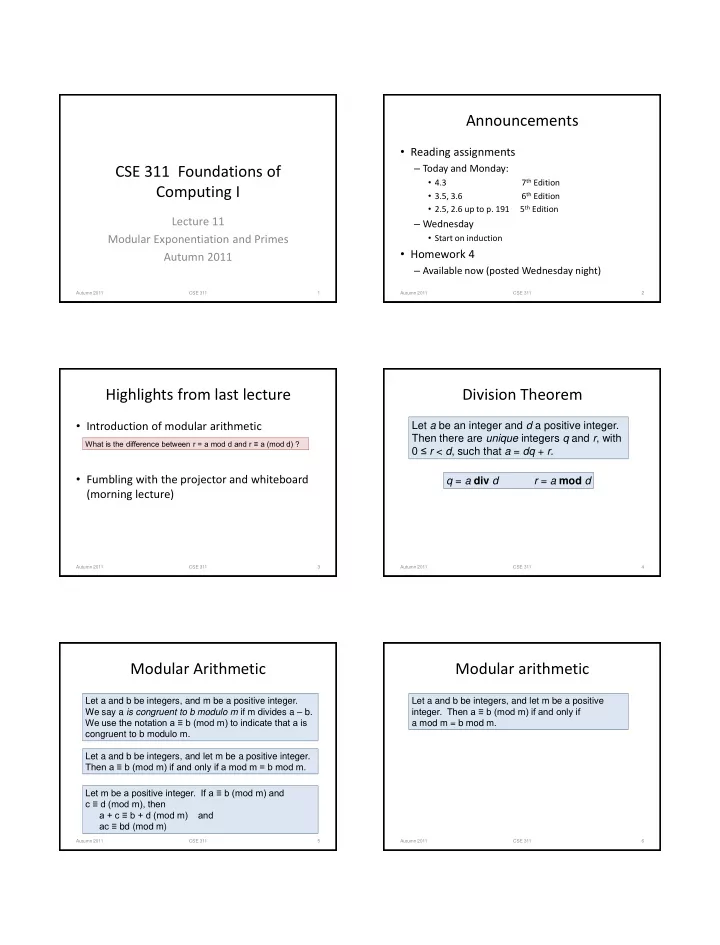
What is the difference between r = a mod d and r ≡ a (mod d) ?

Division Theorem

Autumn 2011 CSE 311 4

Let a be an integer and d a positive integer. Then there are unique integers q and r, with 0 ≤ r < d, such that a = dq + r. q = a div d r = a mod d

Modular Arithmetic

Autumn 2011 CSE 311 5

Let a and b be integers, and m be a positive integer. We say a is congruent to b modulo m if m divides a – b. We use the notation a ≡ b (mod m) to indicate that a is congruent to b modulo m. Let a and b be integers, and let m be a positive integer. Then a ≡ b (mod m) if and only if a mod m = b mod m. Let m be a positive integer. If a ≡ b (mod m) and c ≡ d (mod m), then a + c ≡ b + d (mod m) and ac ≡ bd (mod m)

Modular arithmetic

Autumn 2011 CSE 311 6

Let a and b be integers, and let m be a positive

  • integer. Then a ≡ b (mod m) if and only if

a mod m = b mod m.

slide-2
SLIDE 2

Example

Autumn 2011 CSE 311 7

Let n be an integer, prove that n2 ≡ 0 (mod 4) or n2 ≡ 1 (mod 4)

n-bit Unsigned Integer Representation

  • Represent integer x as sum of powers of 2:

If x = i=0 bi 2i where each bi ∈ {0,1} then representation is bn-1...b2 b1 b0 99 = 64 + 32 + 2 + 1

18 = 16 + 2

  • For n = 8:

99: 0110 0011 18: 0001 0010

Autumn 2011 CSE 311 8

n-1

Signed integer representation

Autumn 2011 CSE 311 9

n-bit signed integers Suppose -2n-1 < x < 2n-1 First bit as the sign, n-1 bits for the value 99 = 64 + 32 + 2 + 1 18 = 16 + 2 For n = 8: 99: 0110 0011

  • 18: 1001 0010

Any problems with this representation?

Two’s complement representation

Autumn 2011 CSE 311 10

n bit signed integers, first bit will still be the sign bit Suppose 0 ≤ x < 2n-1, x is represented by the binary representation of x Suppose 0 < x ≤ 2n-1, -x is represented by the binary representation of 2n-x 99 = 64 + 32 + 2 + 1 18 = 16 + 2 For n = 8: 99: 0110 0011

  • 18: 1110 1110

Key property: Two’s complement representation of any number y is equivalent to y mod 2n so arithmetic works mod 2n

Two’s complement representation

  • Suppose 0 < x ≤ 2n-1, -x is represented by the

binary representation of 2n-x

  • To compute this: Flip the bits of x then add 1:

– All 1’s string is 2n-1 so

  • Flip the bits of x  replace x by 2n-1-x

Autumn 2011 CSE 311 11

Basic applications of mod

  • Hashing
  • Pseudo random number generation
  • Simple cipher
slide-3
SLIDE 3

Hashing

  • Map values from a large domain, 0…M-1 in a

much smaller domain, 0…n-1

  • Index lookup
  • Test for equality
  • Hash(x) = x mod p
  • Often want the hash function to depend on all
  • f the bits of the data

– Collision management

Pseudo Random number generation

  • Linear Congruential method

xn+1 = (a xn + c) mod m

Simple cipher

  • Caesar cipher, A = 1, B = 2, . . .

– HELLO WORLD

  • Shift cipher

– f(p) = (p + k) mod 26 – f-1(p) = (p – k) mod 26

  • f(p) = (ap + b) mod 26

Modular Exponentiation

X 1 2 3 4 5 6 1 1 2 3 4 5 6 2 2 4 6 1 3 5 3 3 6 2 5 1 4 4 4 1 5 2 6 3 5 5 3 1 6 4 2 6 6 5 4 3 2 1 a a1 a2 a3 a4 a5 a6 1 2 3 4 5 6

Exponentiation

  • Compute 7836581453
  • Compute 7836581453 mod 104729

Fast exponentiation

int FastExp(int x, int n){ long v = (long) x; int m = 1; for (int i = 1; i <= n; i++){ v = (v * v) % modulus; m = m + m; Console.WriteLine("i : " + i + ", m : " + m + ", v : " + v ); } return (int)v; }

slide-4
SLIDE 4

Program Trace

i : 1, m : 2, v : 82915 i : 2, m : 4, v : 95592 i : 3, m : 8, v : 70252 i : 4, m : 16, v : 26992 i : 5, m : 32, v : 74970 i : 6, m : 64, v : 71358 i : 7, m : 128, v : 20594 i : 8, m : 256, v : 10143 i : 9, m : 512, v : 61355 i : 10, m : 1024, v : 68404 i : 11, m : 2048, v : 4207 i : 12, m : 4096, v : 75698 i : 13, m : 8192, v : 56154 i : 14, m : 16384, v : 83314 i : 15, m : 32768, v : 99519 i : 16, m : 65536, v : 29057

Fast exponentiation algorithm

  • What if the exponent is not a power of two?

81453 = 216 + 213 + 212 + 211 + 210 + 29 + 25 + 23 + 22 + 20

The fast exponentiation algorithm computes an mod p in time O(log n)

Primality

An integer p greater than 1 is called prime if the

  • nly positive factors of p are 1 and p.

A positive integer that is greater than 1 and is not prime is called composite.

Fundamental Theorem of Arithmetic

Autumn 2011 CSE 311 22

Every positive integer greater than 1 has a unique prime factorization

48 = 2 • 2 • 2 • 2 • 3 591 = 3 • 197 45,523 = 45,523 321,950 = 2 • 5 • 5 • 47 • 137 1,234,567,890 = 2 • 3 • 3 • 5 • 3,607 • 3,803

Factorization

  • If n is composite, it has a factor of size at most

sqrt(n)

Euclid’s theorem

  • There are an infinite number of primes.
  • Proof by contradiction:
  • Suppose there are a finite number of primes:

p1, p2, . . . pn

slide-5
SLIDE 5

Distribution of Primes

  • If you pick a random number n in the range

[x, 2x], what is the chance that n is prime?

2 3 5 7 11 13 17 19 23 29 31 37 41 43 47 53 59 61 67 71 73 79 83 89 97 101 103 107 109 113 127 131 137 139 149 151 157 163 167 173 179 181 191 193 197 199 211 223 227 229 233 239 241 251 257 263 269 271 277 281 283 293 307 311 313 317 331 337 347 349 353 359

Famous Algorithmic Problems

  • Primality Testing:

– Given an integer n, determine if n is prime

  • Factoring

– Given an integer n, determine the prime factorization of n

Primality Testing

  • Is the following 200 digit number prime:

409924084160960281797612325325875254029092850990862201334 039205254095520835286062154399159482608757188937978247351 186211381925694908400980611330666502556080656092539012888 01302035441884878187944219033