IMGD 1001: The Game Art Pipeline by Mark Claypool - - PDF document

imgd 1001 the game art pipeline
SMART_READER_LITE
LIVE PREVIEW

IMGD 1001: The Game Art Pipeline by Mark Claypool - - PDF document

IMGD 1001: The Game Art Pipeline by Mark Claypool (claypool@cs.wpi.edu) Robert W . Lindem an (gogo@wpi.edu) Artistic Courses AR 1 1 0 0 . ESSENTI ALS OF ART. This course provides an introduction to the basic principles of two and three-


slide-1
SLIDE 1

1

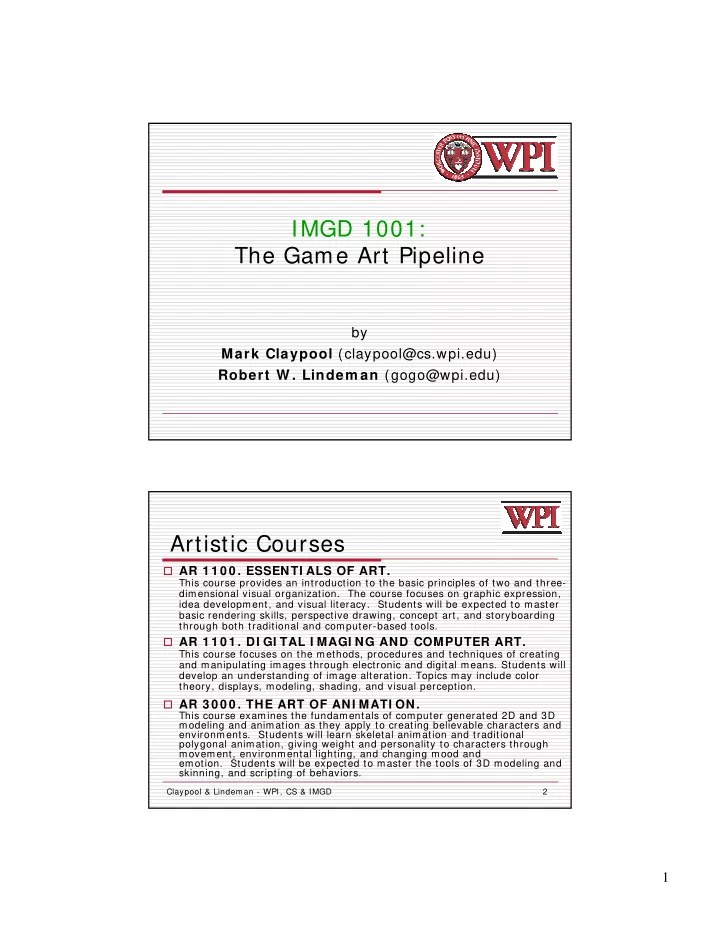
IMGD 1001: The Game Art Pipeline

by Mark Claypool (claypool@cs.wpi.edu) Robert W . Lindem an (gogo@wpi.edu)

Claypool & Lindeman - WPI, CS & IMGD 2

Artistic Courses

AR 1 1 0 0 . ESSENTI ALS OF ART.

This course provides an introduction to the basic principles of two and three- dimensional visual organization. The course focuses on graphic expression, idea development, and visual literacy. Students will be expected to master basic rendering skills, perspective drawing, concept art, and storyboarding through both traditional and computer-based tools.

AR 1 1 0 1 . DI GI TAL I MAGI NG AND COMPUTER ART.

This course focuses on the methods, procedures and techniques of creating and manipulating images through electronic and digital means. Students will develop an understanding of image alteration. Topics may include color theory, displays, modeling, shading, and visual perception.

AR 3 0 0 0 . THE ART OF ANI MATI ON.

This course examines the fundamentals of computer generated 2D and 3D modeling and animation as they apply to creating believable characters and

  • environments. Students will learn skeletal animation and traditional

polygonal animation, giving weight and personality to characters through movement, environmental lighting, and changing mood and

  • emotion. Students will be expected to master the tools of 3D modeling and

skinning, and scripting of behaviors.

slide-2
SLIDE 2

2

Claypool & Lindeman - WPI, CS & IMGD 3

Introduction

"The computer artist is modern-day

alchemist"

(Creating the Art of the Game, by Matthew Omernick)

Turn polygons and pixels into wondrous

worlds Sources of inspiration

Playing games!

How can make fun game if not having fun

yourself? The real world

The real world is always more interesting than

anything we can make up

Based on Foreword, Creating the Art of the Game, by Matthew Omernick

Claypool & Lindeman - WPI, CS & IMGD 4

Introduction: Remember the Constraints

Year 2098, Macrosoft will release

FunStation 3000, 14 million terabytes of RAM, quantum-holographic drive with near infinite storage, processors at the speed of light

Game developers complain not fast enough

Game artists must be creative inside

confines of technology

All disciplines: engineering, design, sound But often constraints biggest on artist

Based on Foreword, Creating the Art of the Game, by Matthew Omernick

slide-3
SLIDE 3

3

Claypool & Lindeman - WPI, CS & IMGD 5

Outline

The art pipeline Concept art 2D Art

Animation Tiles

3D Art

Modeling Texturing Lighting

Claypool & Lindeman - WPI, CS & IMGD 6

What's a Pipeline?

In the pipeline

  • Informal. in the process of being developed,

provided, or completed; in the works; under way. (Random House)

For our purposes

The sequence of operations required to move art

assets from concept to the finished product

The Art pipeline

2D: Concept, Creation, Conversion 3D: Concept, Creation (modeling, texturing, lighting),

Conversion

Asset management

slide-4
SLIDE 4

4

Claypool & Lindeman - WPI, CS & IMGD 7

Types of 2D Art

These are created with tools:

User Interface (UI) Sprites, tiles, and other pixel art Type and fonts

These need a pipeline:

Character art Scenery / worlds Characters Animation Video

Claypool & Lindeman - WPI, CS & IMGD 8

2D Asset Creation

slide-5
SLIDE 5

5

Claypool & Lindeman - WPI, CS & IMGD 9

2D Pipeline (1 of 3): Concept

Sketches

Napkin-style Detailed design treatments Prototypes

Claypool & Lindeman - WPI, CS & IMGD 10

"Napkin-style" Concept Art

slide-6
SLIDE 6

6

Claypool & Lindeman - WPI, CS & IMGD 11

2D UI Prototype

designersnotebook.com

Claypool & Lindeman - WPI, CS & IMGD 12

Paper UI Prototype

boxesandarrows.com

slide-7
SLIDE 7

7

Claypool & Lindeman - WPI, CS & IMGD 13

2D Pipeline (2 of 3): Creation

Commercial / third party tools:

Photoshop, The Gimp, sprite editors,

HTML/ browsers, Flash... Homegrown tools

Specialized animation systems Tools that simulate key game features (UI

layout tool, etc.)

The game engine

Claypool & Lindeman - WPI, CS & IMGD 14

Assets for 2D Animation (1 of 3)

eberlein.org/euphoria

slide-8
SLIDE 8

8

Claypool & Lindeman - WPI, CS & IMGD 15

Assets for 2D Animation (2 of 3)

cvrpg.com

Claypool & Lindeman - WPI, CS & IMGD 16

Assets for 2D Animation (3 of 3)

aniway.com

slide-9
SLIDE 9

9

Claypool & Lindeman - WPI, CS & IMGD 17

2D Pipeline (3 of 3): Conversion

Putting the assets into the final form

File type conversion

PSD to TGA / JPG, for example Compression Collection (zip files, pak files, etc.)

Testing in the game Debug / fix

Claypool & Lindeman - WPI, CS & IMGD 18

Group Exercise

Break into your project groups At the top of a piece of paper, each person writes the

description (text) of a visual concept for a character/ item/ object in your game (3-4 minutes)

About 1 small paragraph Rotate papers among group In the middle of the paper, draw a concept art sketch

based on the text (5 minutes)

Pass back to the original person Provide feedback (verbally), and briefly in text on bottom

(2-3 minutes)

(Hand in)

slide-10
SLIDE 10

10

Claypool & Lindeman - WPI, CS & IMGD 19

3D Asset Creation

Claypool & Lindeman - WPI, CS & IMGD 20

3D Pipeline (1 of 4): Concept

Sketches

Napkin-style Detailed design treatments Prototypes Maquettes Animation sketches / flipbooks Mockup models Texture mockups Architectural layout

slide-11
SLIDE 11

11

Claypool & Lindeman - WPI, CS & IMGD 21

3D UI Prototype

lostgarden.com

Claypool & Lindeman - WPI, CS & IMGD 22

3D Pipeline (2 of 4): Creation

Commercial / third party tools:

Photoshop, The Gimp, sprite editors,

HTML/ browsers, Flash...

3D tools: 3D Studio Max, Maya, Lightwave,

Blender Homegrown tools

Specialized animation systems Tools that simulate key game features (UI

layout tool, etc.)

The game engine Exporters / plugins

slide-12
SLIDE 12

12

Claypool & Lindeman - WPI, CS & IMGD 23

3D Studio Max

gamedev.net

Claypool & Lindeman - WPI, CS & IMGD 24

Stages of a Model

slide-13
SLIDE 13

13

Claypool & Lindeman - WPI, CS & IMGD 25

3D Pipeline (3 of 4): Texturing

Animation systems

Motion capture Third party tools Homebuilt tools

Texturing systems Shaders / surface tools Renderers / video systems

Claypool & Lindeman - WPI, CS & IMGD 26

Texturing and Accessories

garagegames.com

slide-14
SLIDE 14

14

Claypool & Lindeman - WPI, CS & IMGD 27

A Model, Textured

zbrush

Claypool & Lindeman - WPI, CS & IMGD 28

Character and a Skin (1 of 2)

secretlair.com

slide-15
SLIDE 15

15

Claypool & Lindeman - WPI, CS & IMGD 29

Character and a Skin (2 of 2)

cresswells.com

Claypool & Lindeman - WPI, CS & IMGD 30

3D Pipeline (4 of 4): Conversion

Export from modeling to custom formats Putting the assets into the final form

File type conversion

PSD to TGA / JPG, for example Compression Collection (zip files, pak files, etc.)

Testing in the game Debug / fix

slide-16
SLIDE 16

16

Claypool & Lindeman - WPI, CS & IMGD 31

Asset Management

How do you share the production process

across time, space, and content creators?

Source code has many tools -- "solved" Data/ Art is harder

Not easily merged Dependencies not obvious Relationships complex

Some commercial systems are trying Typically a combination of:

Homegrown tools Convention and process