1 Steps in Creating Animation Secondary Actions Sequences (1 of 3) - - PDF document

1
SMART_READER_LITE
LIVE PREVIEW

1 Steps in Creating Animation Secondary Actions Sequences (1 of 3) - - PDF document

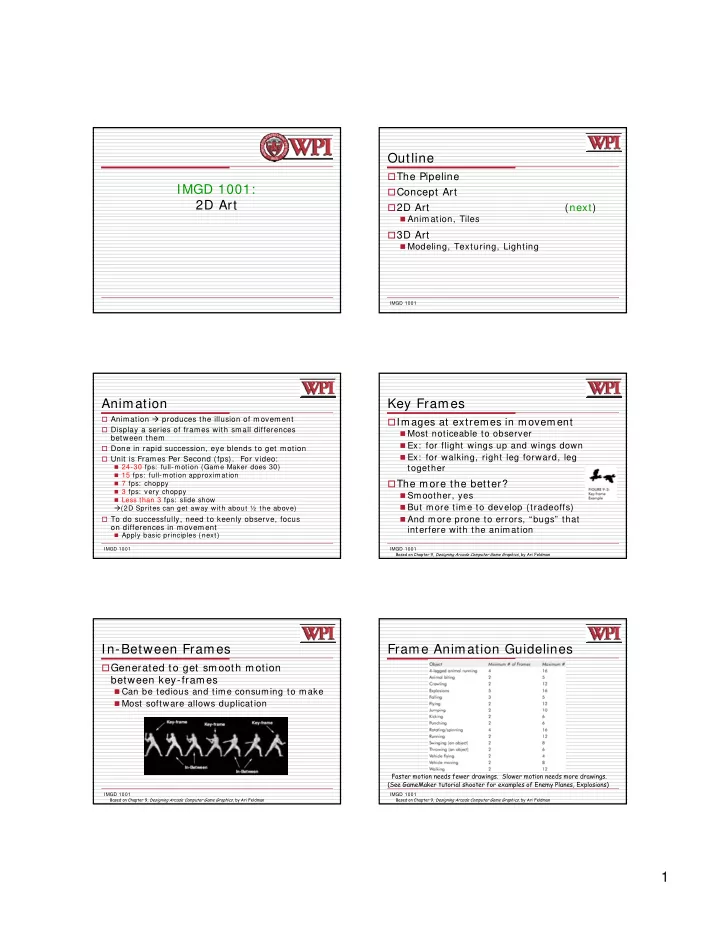
Outline The Pipeline IMGD 1001: Concept Art 2D Art 2D Art (next) Animation Tiles Animation, Tiles 3D Art Modeling, Texturing, Lighting IMGD 1001 Animation Key Frames Animation produces the illusion of


slide-1
SLIDE 1

1

IMGD 1001: 2D Art Outline

The Pipeline Concept Art 2D Art

(next)

 Animation Tiles

IMGD 1001

 Animation, Tiles

3D Art

 Modeling, Texturing, Lighting

Animation

 Animation  produces the illusion of movement  Display a series of frames with small differences

between them

 Done in rapid succession, eye blends to get motion  Unit is Frames Per Second (fps). For video:

 24 30 fps: full motion (Game Maker does 30)

IMGD 1001

 24-30 fps: full-motion (Game Maker does 30)  15 fps: full-motion approximation  7 fps: choppy  3 fps: very choppy  Less than 3 fps: slide show

(2D Sprites can get away with about ½ the above)  To do successfully, need to keenly observe, focus

  • n differences in movement

 Apply basic principles (next)

Key Frames

Images at extremes in movement

 Most noticeable to observer  Ex: for flight wings up and wings down  Ex: for walking, right leg forward, leg

t th

IMGD 1001

together The more the better?

 Smoother, yes  But more time to develop (tradeoffs)  And more prone to errors, “bugs” that

interfere with the animation

Based on Chapter 9, Designing Arcade Computer Game Graphics, by Ari Feldman

In-Between Frames

Generated to get smooth motion

between key-frames

 Can be tedious and time consuming to make  Most software allows duplication

IMGD 1001

Based on Chapter 9, Designing Arcade Computer Game Graphics, by Ari Feldman

Frame Animation Guidelines

IMGD 1001

Based on Chapter 9, Designing Arcade Computer Game Graphics, by Ari Feldman

(See GameMaker tutorial shooter for examples of Enemy Planes, Explosions) Faster motion needs fewer drawings. Slower motion needs more drawings.

slide-2
SLIDE 2

2

Secondary Actions

Animation part that does not lead

movement, but follows it

 Add extra dimension of reality  Ex: Hair moving in wind

IMGD 1001

 Ex: Cape billowing backward

Based on Chapter 9, Designing Arcade Computer Game Graphics, by Ari Feldman

Steps in Creating Animation Sequences (1 of 3)

 Conceptualize – have vision (in mind or on paper) of what

animation will look like

 Decide on object behavior

  • 1. Animated once (no looping)
  • 2. Animated continuously (using cycles)

 2nd choice means must make last key frame blend with first

IMGD 1001

 2nd choice means must make last key frame blend with first  Choose an image size – will contain and constrain object  Test and experiment briefly to have plenty of room  Design key-frames - drawing the motion extremes  Use simple shapes to represent main actions

 Ex: stick figures or basic shapes (circles, squares)

Based on Chapter 9, Designing Arcade Computer Game Graphics, by Ari Feldman

Steps in Creating Animation Sequences (2 of 3)

Estimate the in-betweens

 Think of how many you will need to complete

the sequence smoothly

 Be conservative. Easier to add additional

transition frames than to remove them

IMGD 1001

transition frames than to remove them Apply secondary enhancements

 Embellish to look convincing and enticing  Exaggeration

Based on Chapter 9, Designing Arcade Computer Game Graphics, by Ari Feldman

Steps in Creating Animation Sequences (3 of 3)

Test each movement

 Can be done with ‘copy’ and ‘undo’ in tool  Others have animation rendering (ex- Game

Maker)

 L

k f fl ( t di l d i l

IMGD 1001

 Look for flaws (movement, discolored pixels

… ) Repeat

 Repeat for all animations

Based on Chapter 9, Designing Arcade Computer Game Graphics, by Ari Feldman

Primitives

 Used in many games  If you know these, you can apply primitive

rules out of the box:

 Cylindrical primitive  Rotational primitive

IMGD 1001

 Disintegration primitive  Color flash primitive  Scissors primitive  Growing primitive  Shrinking primitive  Minor primitives (used less often)  (See Chapter 9 of Feldman)

Based on Chapter 9, Designing Arcade Computer Game Graphics, by Ari Feldman

Tiles

Needed for common backgrounds

 Too hard to make every pixel different!

Exploration games (especially outdoors)

make heavy use of these

IMGD 1001

y

 Grass, trees, water, sand

Start with a grass tile to warm up

So You Want to Be a Pixel Artist?, by Tsugumo

slide-3
SLIDE 3

3

Grass is Green

Use a basic green square But this looks unnatural

 Like flat, shiny metal

No illusion of movement

IMGD 1001

No illusion of movement

So You Want to Be a Pixel Artist?, by Tsugumo

 Simply a Green Box

(Ex: bkg_grass0)

Grass has Variation

Can do a lot with simple enhancement of

color shades

IMGD 1001

So You Want to Be a Pixel Artist?, by Tsugumo

(Ex: bkg_grass1)

Make Variation More Random

Can use the “spray” tool

IMGD 1001

So You Want to Be a Pixel Artist?, by Tsugumo

(Ex: bkg_grass2)

Make Look Random but with Control

Draw by hand for more control

 4 pixel line strokes

IMGD 1001

So You Want to Be a Pixel Artist?, by Tsugumo

(Ex: bkg_grass3)

The “Grid” (1 of 3)

Looks too much like tiles “Large” blank is problem, so remove

IMGD 1001

So You Want to Be a Pixel Artist?, by Tsugumo

The “Grid” (2 of 3)

 Still, some “lines” are visible when repeated  Break up with more color

IMGD 1001

So You Want to Be a Pixel Artist?, by Tsugumo

slide-4
SLIDE 4

4

The “Grid” (3 of 3)

Much better!

IMGD 1001

So You Want to Be a Pixel Artist?, by Tsugumo

(Ex: bkg_grass4)

Don’t Try This at Home

 Don’t use same texture for all, else not much

better than just colors

IMGD 1001

So You Want to Be a Pixel Artist?, by Tsugumo

When the Rubber hits the Road?

 Beware of the seams where different types of

tiles meet!

IMGD 1001

So You Want to Be a Pixel Artist?, by Tsugumo

Group Exercise

Break into groups Think of a (simple) animation (sprite)

needed for your game

Make key frames Make key frames Make in-betweens Try it out!

 Sketch on paper (grids for pixels)  Flip-book

Feedback from group

IMGD 1001