Reading Required: Angel, sections 9.1 9.6, 9.8 Optional: OpenGL - - PDF document

reading
SMART_READER_LITE
LIVE PREVIEW

Reading Required: Angel, sections 9.1 9.6, 9.8 Optional: OpenGL - - PDF document

Reading Required: Angel, sections 9.1 9.6, 9.8 Optional: OpenGL Programming Guide , the Red Book, chapter 3 Hierarchical Modeling cse457-07-hierarchical 1 cse457-07-hierarchical 2 Symbols and instances Most graphics APIs


slide-1
SLIDE 1

cse457-07-hierarchical 1

Hierarchical Modeling

cse457-07-hierarchical 2

Reading

Required: Angel, sections 9.1 – 9.6, 9.8 Optional: OpenGL Programming Guide, the Red Book, chapter 3

cse457-07-hierarchical 3

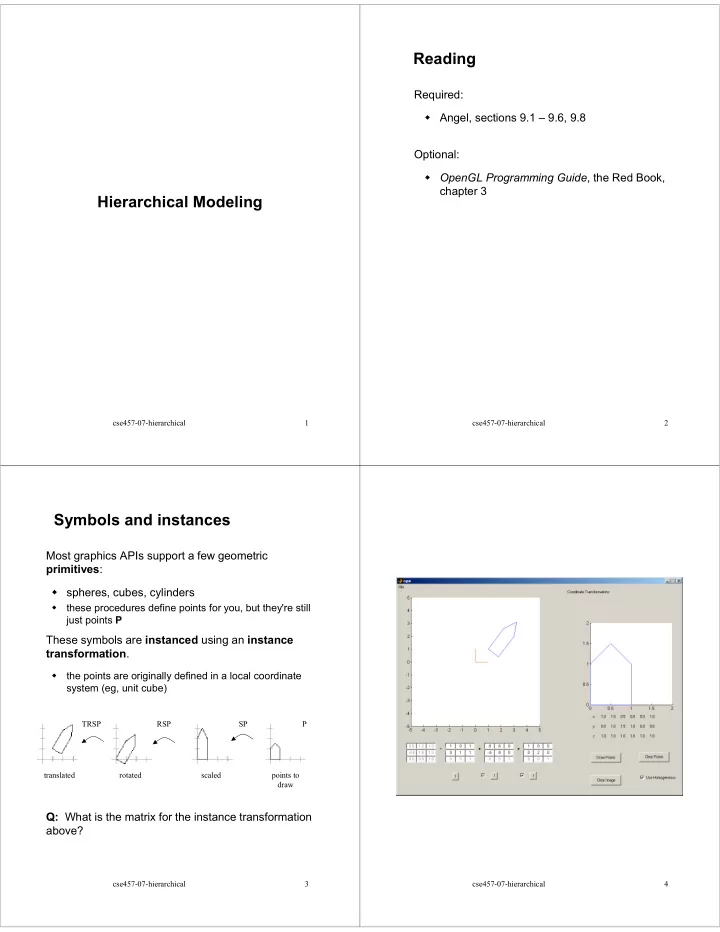
Most graphics APIs support a few geometric primitives: spheres, cubes, cylinders

  • these procedures define points for you, but they're still

just points P

These symbols are instanced using an instance transformation.

  • the points are originally defined in a local coordinate

system (eg, unit cube)

Q: What is the matrix for the instance transformation above?

Symbols and instances

points to draw scaled SP RSP rotated TRSP translated P cse457-07-hierarchical 4

slide-2
SLIDE 2

cse457-07-hierarchical 5

Connecting primitives

P P

cse457-07-hierarchical 6

3D Example: A robot arm

Consider this robot arm with 3 degrees of freedom: Base rotates about its vertical axis by θ Lower arm rotates in its xy-plane by φ Upper arm rotates in its xy-plane by ψ Q: What matrix do we use to transform the base? Q: What matrix for the upper arm? Q: What matrix for the lower arm?

h1 h2 h3 Base Upper arm Lower arm

cse457-07-hierarchical 7 cse457-07-hierarchical 8

Robot arm implementation

The robot arm can be displayed by keeping a global matrix and computing it at each step:

Matrix M_model; main() { . . . robot_arm(); . . . } robot_arm() { M_model = R_y(theta); base(); M_model = R_y(theta)*T(0,h1,0)*R_z(phi); lower_arm(); M_model = R_y(theta)*T(0,h1,0)*R_z(phi) *T(0,h2,0)*R_z(psi); upper_arm(); }

Do the matrix computations seem a tad wasteful?

slide-3
SLIDE 3

cse457-07-hierarchical 9

Instead of recalculating the global matrix each time, we can just update it in place by concatenating matrices on the right:

Matrix M_model; main() { . . . M_model = Identity(); robot_arm(); . . . } robot_arm() { M_model *= R_y(theta); base(); M_model *= T(0,h1,0)*R_z(phi); lower_arm(); M_model *= T(0,h2,0)*R_z(psi); upper_arm(); }

Robot arm implementation, better

cse457-07-hierarchical 10

OpenGL maintains a global state matrix called the model-view matrix, which is updated by concatenating matrices on the right.

main() { . . . glMatrixMode( GL_MODELVIEW ); glLoadIdentity(); robot_arm(); . . .

} robot_arm() { glRotatef( theta, 0.0, 1.0, 0.0 ); base(); glTranslatef( 0.0, h1, 0.0 ); glRotatef( phi, 0.0, 0.0, 1.0 ); lower_arm(); glTranslatef( 0.0, h2, 0.0 ); glRotatef( psi, 0.0, 0.0, 1.0 ); upper_arm(); }

Robot arm implementation, OpenGL

cse457-07-hierarchical 11

ObjectAxes.cpp

cse457-07-hierarchical 12

Hierarchical modeling

Hierarchical models can be composed of instances using trees or DAGs: How might we draw the tree for the robot arm?

  • edges contain geometric transformations
  • nodes contain geometry (and possibly drawing

attributes)

slide-4
SLIDE 4

cse457-07-hierarchical 13

A complex example: human figure

Q: What’s the most sensible way to traverse this tree?

torso left upper arm head right upper arm left upper leg right upper leg left lower arm right lower arm left lower leg right lower leg cse457-07-hierarchical 14

Human figure implementation, OpenGL

figure() { torso(); glPushMatrix(); glTranslate( ... ); glRotate( ... ); head(); glPopMatrix(); glPushMatrix(); glTranslate( ... ); glRotate( ... ); left_upper_arm(); glPushMatrix(); glTranslate( ... ); glRotate( ... ); left_lower_arm(); glPopMatrix(); glPopMatrix(); . . . } cse457-07-hierarchical 15

Order of transformations

Let’s revisit the very first simple example in this lecture. To draw the transformed house, we would write OpenGL code like: glMatrixMode( GL_MODELVIEW ); glLoadIdentity(); glTranslatef( ... ); glRotatef( ... ); glScalef( ... ); house(); Note that we are building the composite transformation matrix by starting from the left and postmultiplying each additional matrix

cse457-07-hierarchical 16

Global, fixed coordinate system

One way to think of transformations is as movement of points in a global, fixed coordinate system Build the transformation matrix sequentially from left to right: T, then R, then S Then apply the transformation matrix to the

  • bject points: multiply all the points in P by

the composite matrix TRS

  • this transformation takes the points from
  • riginal to final positions

points to draw scaled SP RSP rotated TRSP translated P

slide-5
SLIDE 5

cse457-07-hierarchical 17

Local, changing coordinate system

Another way to think of transformations is as affecting a local coordinate system that the primitive is eventually drawn in.

local frame translate scale rotate

Draw!

This is EXACTLY the same transformation as

  • n the previous page, it's

just how you look at it.

cse457-07-hierarchical 18

Animation

The above examples are called articulated models: rigid parts connected by joints They can be animated by specifying the joint angles (or other display parameters) as functions

  • f time.

cse457-07-hierarchical 19

Key-frame animation

The most common method for character animation in production is key-frame animation. Each joint specified at various key frames (not necessarily the same as other joints) System does interpolation or in-betweening Doing this well requires: A way of smoothly interpolating key frames: splines A good interactive system A lot of skill on the part of the animator

cse457-07-hierarchical 20

Scene graphs

The idea of hierarchical modeling can be extended to an entire scene, encompassing: many different objects lights camera position This is called a scene tree or scene graph. Scene Camera Light1 Light2 Object1 Object2 Object3

slide-6
SLIDE 6

cse457-07-hierarchical 21

Summary

Here’s what you should take home from this lecture: All the boldfaced terms. How primitives can be instanced and composed to create hierarchical models using geometric transforms. How the notion of a model tree or DAG can be extended to entire scenes. How OpenGL transformations can be used in hierarchical modeling. How keyframe animation works.