Sound Sound Audible vibration in an elastic Audible vibration in - - PDF document

sound sound
SMART_READER_LITE
LIVE PREVIEW

Sound Sound Audible vibration in an elastic Audible vibration in - - PDF document

9/28/2009 IMGD IMGD- -1001 1001 The Game Development Process The Game Development Process Todays topic: Todays topic: Class 15 Class 15 Game Audio Game Audio Thursday, 24 September 2009 Thursday , 24 September 2009 Sound Sound


slide-1
SLIDE 1

9/28/2009 1 IMGD IMGD-

  • 1001

1001 The Game Development Process The Game Development Process Class 15 Class 15 Thursday Thursday, 24 September 2009 , 24 September 2009 Today’s topic: Today’s topic: Game Audio Game Audio

Sound Sound

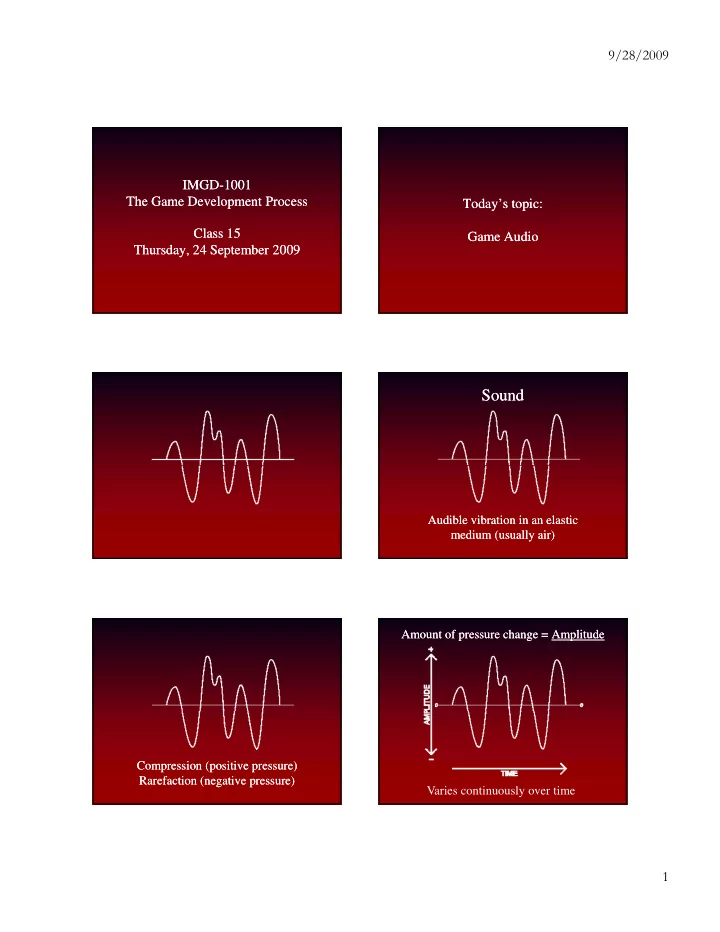
Audible vibration in an elastic Audible vibration in an elastic medium (usually air) medium (usually air) Compression (positive pressure) Compression (positive pressure) Rarefaction (negative pressure) Rarefaction (negative pressure) Amount of pressure change = Amount of pressure change = Amplitude Amplitude Varies continuously over time

slide-2
SLIDE 2

9/28/2009 2

Rate Rate of vibration/pressure

  • f vibration/pressure change =

change = Frequency Frequency Measured in cycles per second (Hertz or Hz)

Frequency range of human hearing: Frequency range of human hearing: Approximately 20 to 20,000 Hz Approximately 20 to 20,000 Hz Analog recording and playback Analog recording and playback

Transducers: Convert one type of energy to another All All transducers introduce distortion transducers introduce distortion

Digital audio Digital audio

 Experimental recordings: Late ‘60s

Experimental recordings: Late ‘60s

 Jazz/classical: Early 70s

Jazz/classical: Early 70s

 First symphonic recording: 1976

First symphonic recording: 1976

 First major label recording: 1979

First major label recording: 1979

 Ry Cooder’s

Ry Cooder’s Bop Till You Drop Bop Till You Drop

 Ry Cooder s

Ry Cooder s Bop Till You Drop Bop Till You Drop

 Compact Disc

Compact Disc

 Jointly created by Sony/Phillips

Jointly created by Sony/Phillips

 Introduced October 1, 1982

Introduced October 1, 1982

 Billy Joel’s

Billy Joel’s 52nd Street 52nd Street

 Biggest seller

Biggest seller

 Beatles

Beatles 1 (30M+ copies) (30M+ copies)

Digital audio Digital audio based on based on sampling sampling

Amplitude of signal is measured (and usually recorded) Amplitude of signal is measured (and usually recorded) at precise time intervals, converted to stream of numbers at precise time intervals, converted to stream of numbers

slide-3
SLIDE 3

9/28/2009 3

Digital recording and playback Digital recording and playback

Extremely accurate, low Extremely accurate, low noise and distortion noise and distortion Almost immeasurable wow or flutter Almost immeasurable wow or flutter Easily edited and manipulated Easily edited and manipulated Essentially perfect replication Essentially perfect replication

Digital sampling (“digitizing”) Digital sampling (“digitizing”)

 Sample rate

Sample rate

 Number of samples taken per second

Number of samples taken per second

 Also measured in Hertz

Also measured in Hertz

 Sample resolution

Sample resolution p

 Range of numbers used to describe

Range of numbers used to describe each sample each sample

 Measured in binary bits

Measured in binary bits

 8 bits = 256 values (

8 bits = 256 values (± ± 127) 127)

 16 bits = 65,536 values (

16 bits = 65,536 values (± ± 32K) 32K)

 24 bits = 16,777,216 values

24 bits = 16,777,216 values

How often to sample? How often to sample?

 Depends on desired frequency range

Depends on desired frequency range

  Nyquist frequency = Sample rate

Nyquist frequency = Sample rate i d f ll i l i d f ll i l required to fully express a signal required to fully express a signal

  2X maximum required frequency

2X maximum required frequency

  2X 20 kHz = 40 kHz minimum sample

2X 20 kHz = 40 kHz minimum sample rate to represent full human range rate to represent full human range

How much to sample? How much to sample?

 Depends on desired dynamic range

Depends on desired dynamic range

 Dynamic range = Difference

Dynamic range = Difference between softest and loudest sounds between softest and loudest sounds

 Measured in decibels (dB); 1 dB =

Measured in decibels (dB); 1 dB = faintest perceptible sound faintest perceptible sound

 Real

Real-

  • world range: 10

world range: 10-

  • 20 dB (anechoic

20 dB (anechoic chamber) to 140 dB (beside jet engine) chamber) to 140 dB (beside jet engine)

 Each bit of sampling resolution

Each bit of sampling resolution approximately doubles dynamic range approximately doubles dynamic range

Home audio formats Home audio formats

 Compact Disc

Compact Disc

  Sample rate: 44.1 kHz

Sample rate: 44.1 kHz

  Sample resolution: 16 bits

Sample resolution: 16 bits

  Dynamic range: >90 dB

Dynamic range: >90 dB

  Dynamic range: >90 dB

Dynamic range: >90 dB

  Two channels for stereo

Two channels for stereo

  “CD quality”

“CD quality”

 HD/BluRay DVD

HD/BluRay DVD

  Up to 8 channels 96

Up to 8 channels 96 kHz 24 kHz 24-

  • bit audio

bit audio

  Dynamic range: >120 dB

Dynamic range: >120 dB

slide-4
SLIDE 4

9/28/2009 4

“CD quality” data rate “CD quality” data rate

 44,100 samples per second

44,100 samples per second

 16 bits (2 bytes) per sample

16 bits (2 bytes) per sample

 2 channels

2 channels

 44,100 x 2 x 2 = 176,400 bytes/sec

44,100 x 2 x 2 = 176,400 bytes/sec

  • r 10.584 MB per minute
  • r 10.584 MB per minute

 Typical pop song 30

Typical pop song 30-

  • 40 MB if

40 MB if uncompressed uncompressed

Compressed digital audio Compressed digital audio

 Lossless compression

Lossless compression

  Preserves data perfectly

Preserves data perfectly

  Compression ratio

Compression ratio: 2:1 typical : 2:1 typical

  Compression ratio

Compression ratio: 2:1 typical : 2:1 typical

 Lossy compression

Lossy compression

  Discards some data to increase

Discards some data to increase compression ratio compression ratio

  The trick is: What to throw away?

The trick is: What to throw away?

The game changer: MP3 (1994) The game changer: MP3 (1994)

 Lossy compression algorithm based

Lossy compression algorithm based

  • n
  • n auditory masking

auditory masking

 Loud low

Loud low-

  • frequency sounds can make

frequency sounds can make f h h f h h f d d bl f d d bl softer high softer high-frequency sounds inaudible frequency sounds inaudible

 Perceptual coding: Throw away high

Perceptual coding: Throw away high frequencies frequencies that “can’t be heard that “can’t be heard anyway” anyway”

 Compression ratio

Compression ratio: 10:1 : 10:1 or better

  • r better

 Pop song becomes a 3 MB file

Pop song becomes a 3 MB file

The MP3 Phenomenon The MP3 Phenomenon

 First Web appearance: Late ‘94

First Web appearance: Late ‘94

 Winamp, mp3.com (Summer ’97)

Winamp, mp3.com (Summer ’97)

 First portable players (Spring ’98)

First portable players (Spring ’98)

  32 MB Eiger MPMan F10, Rio PMP300

32 MB Eiger MPMan F10, Rio PMP300

 Napster (June ‘99)

Napster (June ‘99)

  Created by Shawn Fanning (19),

Created by Shawn Fanning (19), Northeastern University Northeastern University

Game audio: Early days Game audio: Early days

 Apple II and PC: Click the speaker

Apple II and PC: Click the speaker

 Atari, C64, early consoles: FM synths

Atari, C64, early consoles: FM synths

 Macintosh (January 1984)

Macintosh (January 1984)

 AdLib PC sound card (1976)

AdLib PC sound card (1976)

 AdLib PC sound card (1976)

AdLib PC sound card (1976)

 Creative Labs Sound Blaster (1989)

Creative Labs Sound Blaster (1989)

 AdLib with digital audio + game port

AdLib with digital audio + game port

 CD

CD-

  • ROM (1985)

ROM (1985)

 CD

CD-

  • R (1990)

R (1990)

 MIDI/music synthesis

MIDI/music synthesis

Game audio: Today Game audio: Today

 All game audio is digital

All game audio is digital

  Music, SFX, VO delivered pre

Music, SFX, VO delivered pre-

  • rendered

rendered

 Typical assets

Typical assets

(bi d di ) (bi d di )

  .wav (bigger, no decoding)

.wav (bigger, no decoding)

  .mp3 (small, decoded, requires license)

.mp3 (small, decoded, requires license)

  .ogg (small, decoded, no license)

.ogg (small, decoded, no license)

  .flac (smaller, decoded)

.flac (smaller, decoded)

 Real

Real-

  • time mixing, effects,

time mixing, effects, spatialization spatialization

slide-5
SLIDE 5

9/28/2009 5 Tonight’s assignment: Tonight’s assignment: Continue reading Rollings/Morrs Continue reading Rollings/Morrs Continue reading Rollings/Morrs Continue reading Rollings/Morrs Continue Project 4 Continue Project 4 Questions? Questions? Friday: Friday: Game design Game design